
Edible
Red Mombin
Spondias purpurea
Also known as Jocote, Ciruela, Purple mombin, Spanish plum
How to grow red mombin, Spondias purpurea. The jocote sold on every Central American street corner, the living fences it is grown as, and how a branch stuck in the ground becomes a tree.
At a glance
- Difficulty
- Moderate
- Water
- Weekly in growth, nearly dry when leafless
- Light
- Full sun
- Temperature
- Minimum 8 deg C. Damaged by frost
- Humidity
- Low to moderate. It tolerates a marked dry season
- Hardiness
- USDA 10-11, RHS H1b, hardy to 5 C
- Type
- Tender deciduous tree
- Height
- 5-15 m in the open, 1.5 m in a pot
- Native to
- southern Mexico, Central America
- Best month
- May, June and September in the Northern Hemisphere, November, December and March in the Southern Hemisphere
Seasonally dry tropical America. It sheds its leaves in the dry season and flowers on bare wood, and it roots so readily from cut branches that whole living fences are built from it.
Hardiness zones describe winter cold alone. Summer heat, humidity, rainfall and the length of the growing season decide as much, so treat the range as the outer limit rather than as a recommendation.
Every month named in this guide is for the temperate Northern Hemisphere. If you garden in the Southern Hemisphere, shift each one by six months, so May becomes November. Closer to the equator the wet and dry seasons matter more than the calendar, and the shift stops being a useful guide.
Not known to be toxic
- Safe to eat
- The fruit green or ripe, and the young leaves
- Do not eat
- The large fibrous stone, which is not eaten
Red mombin is not toxic and nothing in it is listed as harmful to people or to cats and dogs. The fruit is eaten green and crunchy with salt and lime, or ripe and sweet, and the young leaves are eaten as a green in parts of Central America. The stone is large relative to the fruit, fibrous and inedible, and it is a choking hazard for a small child given a whole fruit. The species is in the Anacardiaceae with mango and cashew, so the sap can irritate anyone strongly sensitive to poison ivy, though reports are rare and the reaction is much milder than mango's.
Sources: ASPCA toxic and non-toxic plants, RHS potentially harmful garden plants
About
Jocote is street food across Central America. Small purple-red fruits sold from a bucket, eaten green with salt, lime and chilli, or ripe when they turn soft and sweet with a resinous edge.
The tree is grown as a fence as much as an orchard crop. A thick branch cut and pushed into the ground roots and grows, so field boundaries across Mexico and Guatemala are lines of living jocote trees that also happen to fruit.
For a temperate grower that same trait makes it approachable. A cutting is easy to root, the tree is deciduous so it wants a cool dry winter rather than heat, and it fruits within three or four years.
Appearance and character
A low-branching spreading deciduous tree with a thick trunk, 5 to 15 m in the open.
Bark is grey and rather smooth, and the trunk is often disproportionately stout for the height.
Branches are brittle and the wood is soft.
Leaves are pinnate, 10 to 25 cm, with 5 to 25 small leaflets, and they appear after the flowers.
The tree is leafless through the dry season and through a cool winter.
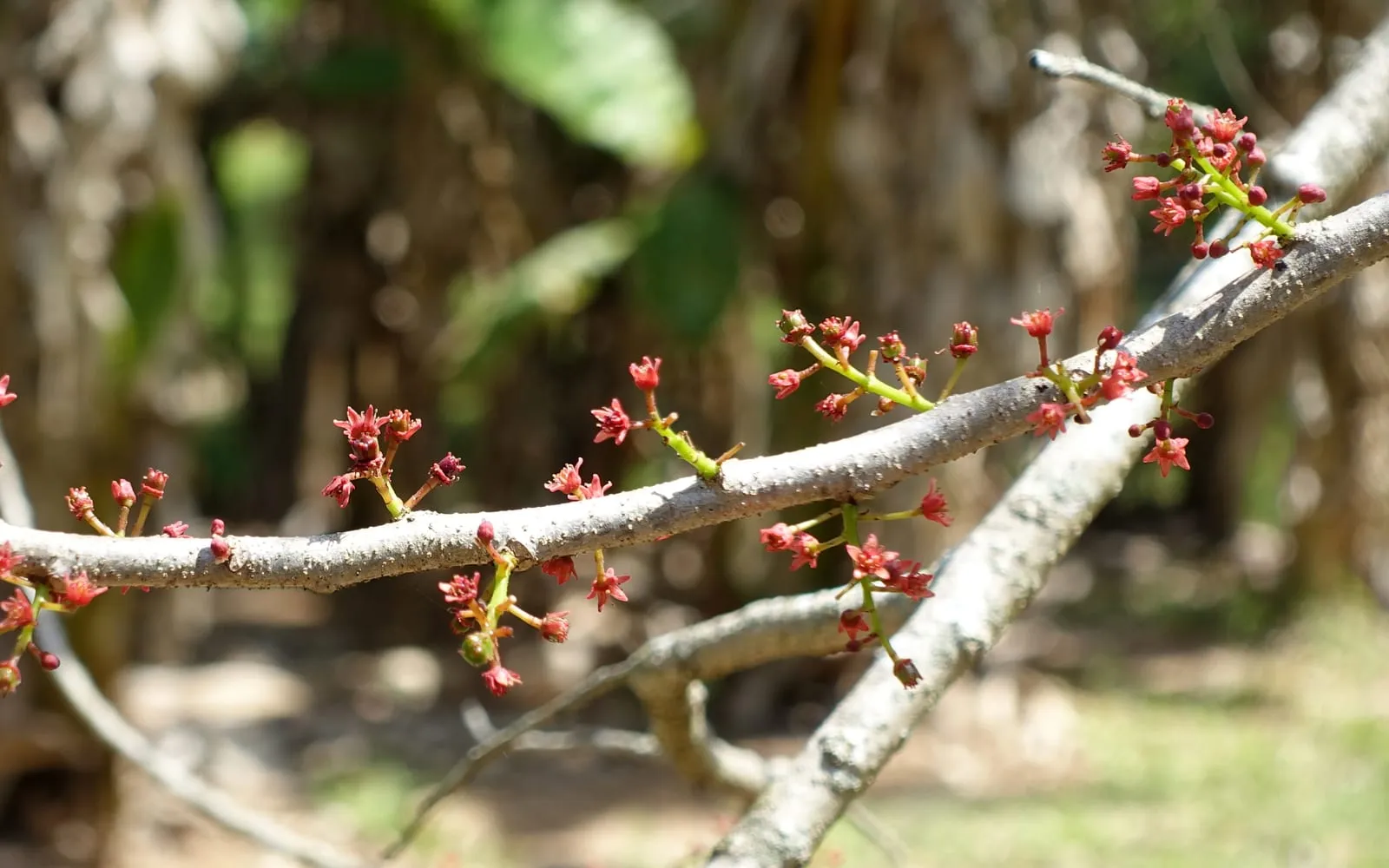
Flowers come before the leaves, in small clusters directly on the bare branches, tiny and red to purple, which makes a flowering tree unexpectedly striking.
Fruit is oval, 2 to 5 cm, ripening from green through yellow to deep red or purple, with a thin glossy skin.
Flesh is yellow, juicy and aromatic, sharp when green and sweet with a resinous note when ripe.
The stone is large relative to the fruit and fibrous.
Where it is from
Red mombin is native to southern Mexico and Central America, where it grows in seasonally dry forest.
Domestication is pre-Columbian and the fruit appears in Mesoamerican records. The Nahuatl name gave Spanish jocote.
It spread through the Caribbean and into South America, and the Spanish carried it to the Philippines, where it is grown in a small way.
Central America remains where it matters. El Salvador, Guatemala, Nicaragua and Mexico grow it commercially and it is sold on every street.
The living fence habit is widespread. Branches cut and set in the ground root readily, so boundaries are planted with it and cropped as well.
Temperate markets see it very rarely, in Latin American food shops, usually frozen.
How it grows
Take a large hardwood cutting. A branch 3 to 5 cm thick and a metre long, cut and set into free-draining compost, roots readily and is the standard method.
Sow seed if a cutting is not available. Germination is slow and uneven, taking four to twelve weeks at 22 to 28 deg C.
Grow in free-draining compost. This species tolerates poor, stony and limy ground.
Give full sun and a minimum of 8 deg C.
Water weekly in growth and keep the plant nearly dry when leafless.
Feed monthly from April to September at moderate strength.
Prune while dormant to control size, and handle the brittle branches carefully.
Expect fruit in two to four years from a cutting, which is among the quickest in this collection.
Allow a proper dry dormancy. Flowering follows the dry rest and comes on bare wood.
Through the seasons
Winter is dormancy. Hold above 8 deg C, keep the compost nearly dry, and feed nothing. The tree is bare.
Late winter is the pruning window.
Early spring brings flowers on the bare branches, before any leaves.
Spring brings the leaves after the flowers.
Early summer is fruit set and swell.
Late summer to autumn is harvest.
Late autumn is leaf fall and the return to dormancy.
Care difficulty
Moderate, and among the more practical fruits in this collection for a cool climate.
Dormancy is the reason. A cool dry winter suits it, which is far easier to provide than constant tropical heat.
Propagation from a large cutting is quick and reliable.
Fruit comes in two to four years from a cutting.
Soil is undemanding, including poor and limy ground.
Drought tolerance is good, and overwatering is the main fault.
Brittle branches need care in handling, and a wet dormancy rots the roots.
Watering
Water weekly in growth, giving a thorough soak and letting the compost dry well down.
Keep it nearly dry through winter dormancy. A wet leafless plant rots.
Water steadily during fruit swell.
Drain fully.
Tap water is fine, including hard water.
Keep humidity low to moderate.
Resume watering as the flowers and then the leaves appear.
Warning signs, diseases and pests
Bare branches through the winter are what the tree is meant to do. It is deciduous on a dry season rather than a cold one, so it drops everything and stands empty for months.
Clusters of small red flowers opening on that bare wood, weeks ahead of any leaf, is the species running to schedule.
A plant wilting in damp compost while it is leafless is rotting at the root, and that is how most of them die in a temperate collection. A dormant tree is drawing almost nothing, so the compost stays wet long enough to kill it.
Branches snapping under their own weight or in a gust is the wood, which is soft and brittle in this genus. Do not lean a ladder on it and do not let a laden branch go unsupported.
Brown limpets along the stems are scale.
White fluff where a leaf joins the stem is mealybug.
Fine webbing across the foliage is spider mite.
Blackened shoot tips the morning after a cold night are frost damage.
A tree that leafs out but never flowers has usually been kept too comfortable. Without a distinctly dry, cool rest it stays in growth and skips flowering altogether.
Growing environment
A frost-free glasshouse or conservatory, with the pot stood outside for the warm months.
A winter held between 8 and 14 deg C, kept dry, with the tree leafless throughout. That rest is what buys the following year’s flowers.
Summer warmth of 22 to 32 deg C.
Full sun, and plenty of it.
Low to moderate humidity, which is unusual for a tropical fruit and follows from the seasonally dry forest it comes from.
Open compost of no great richness. Lime does not trouble it, so anything from pH 6.0 to 8.0 will do.
A pot of 35 to 45 cm.
Shelter from wind, because the wood breaks easily and a snapped main limb takes years to replace.
Feeding
A balanced liquid feed once a month while the tree is in leaf, mixed weaker than the bottle suggests.
High potash once fruit is swelling.
Nothing after the end of August. The wood has to ripen before the leaves drop, and late feed keeps it soft into the winter when brittle green shoots snap at a touch.
Nothing at all while it is bare.
Repot or top-dress in late winter, which is the one time of year you can see the whole framework and work without damaging foliage.
A light hand throughout. This is a tree of seasonally dry country and it fruits better lean than well fed.
Magnesium where the older leaves yellow between green veins, which is the shortage that shows up first in a pot.
Troubleshooting
How do I propagate one? Take a hardwood cutting 3 to 5 cm thick and about a metre long and set it in free-draining compost. It roots readily, which is why Central American field boundaries are planted with living jocote fences.
How soon will it fruit? Two to four years from a cutting, which is among the quickest in this collection.
Green or ripe? Both. Green it is crunchy and sharp, eaten with salt, lime and chilli. Ripe it is soft, red-purple and sweet with a resinous note.
It flowered on bare branches with no leaves. Normal. Red mombin flowers before it leafs out, and a flowering tree in that state is striking.
It never flowered. It probably had a warm wet winter. The species needs a cool dry dormancy to flower properly.
A branch broke off. The wood is soft and brittle. Handle it carefully and shelter it from wind.
What is the difference from yellow mombin? Red mombin is smaller, purple-red and sweeter, from Central America. Yellow mombin is larger, yellow and sharper, from the Amazon and the Caribbean.
Can I grow it in chalky soil? Yes. It tolerates poor, stony and limy ground well.
Red Mombin problem guides
Not sure what is wrong? See the common vegetable pests guide.