
Edible
Yam Bean
Pachyrhizus erosus
Also known as Jicama, Mexican turnip, Sengkuang, Bangkuang
How to grow jicama, Pachyrhizus erosus. A crisp sweet root on a plant whose pods and seeds are an insecticide, and why the flowers have to come off.
At a glance
- Difficulty
- Moderate
- Water
- Twice a week through growth, less as the root swells
- Light
- Full sun
- Temperature
- 20-30 deg C, nothing below 12
- Humidity
- Moderate
- Hardiness
- USDA 10-12, RHS H1b, hardy to 8 C
- Type
- Tender perennial legume grown as an annual
- Height
- 4-6 m of vine in a season
- Native to
- Mexico, Central America
- Best month
- April in the Northern Hemisphere, October in the Southern Hemisphere
The root swells only on short days, so a long warm season of 5 to 9 months is needed and the crop finishes in autumn. Growers pinch the flowers off, since seed set stops the root filling. Everything above ground carries rotenone and is poisonous, which is a hazard rather than a footnote.
Hardiness zones describe winter cold alone. Summer heat, humidity, rainfall and the length of the growing season decide as much, so treat the range as the outer limit rather than as a recommendation.
Every month named in this guide is for the temperate Northern Hemisphere. If you garden in the Southern Hemisphere, shift each one by six months, so April becomes October. Closer to the equator the wet and dry seasons matter more than the calendar, and the shift stops being a useful guide.
Poisonous if eaten
- Safe to eat
- The swollen root only, raw or cooked
- Do not eat
- The pods, the seeds, the leaves and the stems, all of which contain rotenone
- Harm from
- Eating it
- Affects
- People, cats and dogs
One part of this plant is food and the rest of it is an insecticide. The swollen root is crisp, sweet and safe raw or cooked. Everything above ground contains rotenone and related rotenoids at concentrations high enough that the mature seeds have been used as a fish poison and a crop insecticide across Central America and South East Asia for centuries. Rotenone was withdrawn from amateur garden use across the EU and Britain in 2009 and is no longer approved as a pesticide here, which gives some sense of how it is regarded. Eating the seeds causes vomiting, and severe poisoning and deaths are recorded. Keep the pods away from children and pets, cut off and dispose of the flowers and any pods that form, and never compost seed where an animal can reach it. The root itself is not affected and is eaten in quantity across Mexico and South East Asia. Neither the RHS nor the ASPCA lists the species by name; the toxicity of rotenone to cats and dogs is well established regardless.
Sources: RHS potentially harmful garden plants, ASPCA toxic and non-toxic plants
About
Jicama is the crisp white root sold in Mexican and South East Asian shops, a flattened brown-skinned globe the size of a grapefruit or larger, peeled and eaten raw in sticks with lime and chilli. The texture is somewhere between an apple and a water chestnut and it stays crisp for hours after cutting, which no other root vegetable does.
The plant is a legume, a twining bean relative with trifoliate leaves and pea-like flowers, and it fixes its own nitrogen. What it does not do is behave like a bean in the kitchen, because the pods and seeds contain rotenone, an insecticide withdrawn from garden use across Europe in 2009, and they are poisonous.
Growing it means removing the flowers. Left to flower and pod, the plant puts its energy into seed and the root stays small, so commercial growers pinch the flowers off as they appear. The same job removes the poisonous part of the plant, which is a convenient overlap.
Appearance and character
A twining perennial legume grown as an annual, throwing 4 to 6 m of vine in a season from a root that swells below.
Leaves are trifoliate, each leaflet broadly triangular and coarsely toothed towards the tip, 5 to 15 cm long, on long stalks.
The vine twines rather than clinging, and it needs something narrow to wrap around.
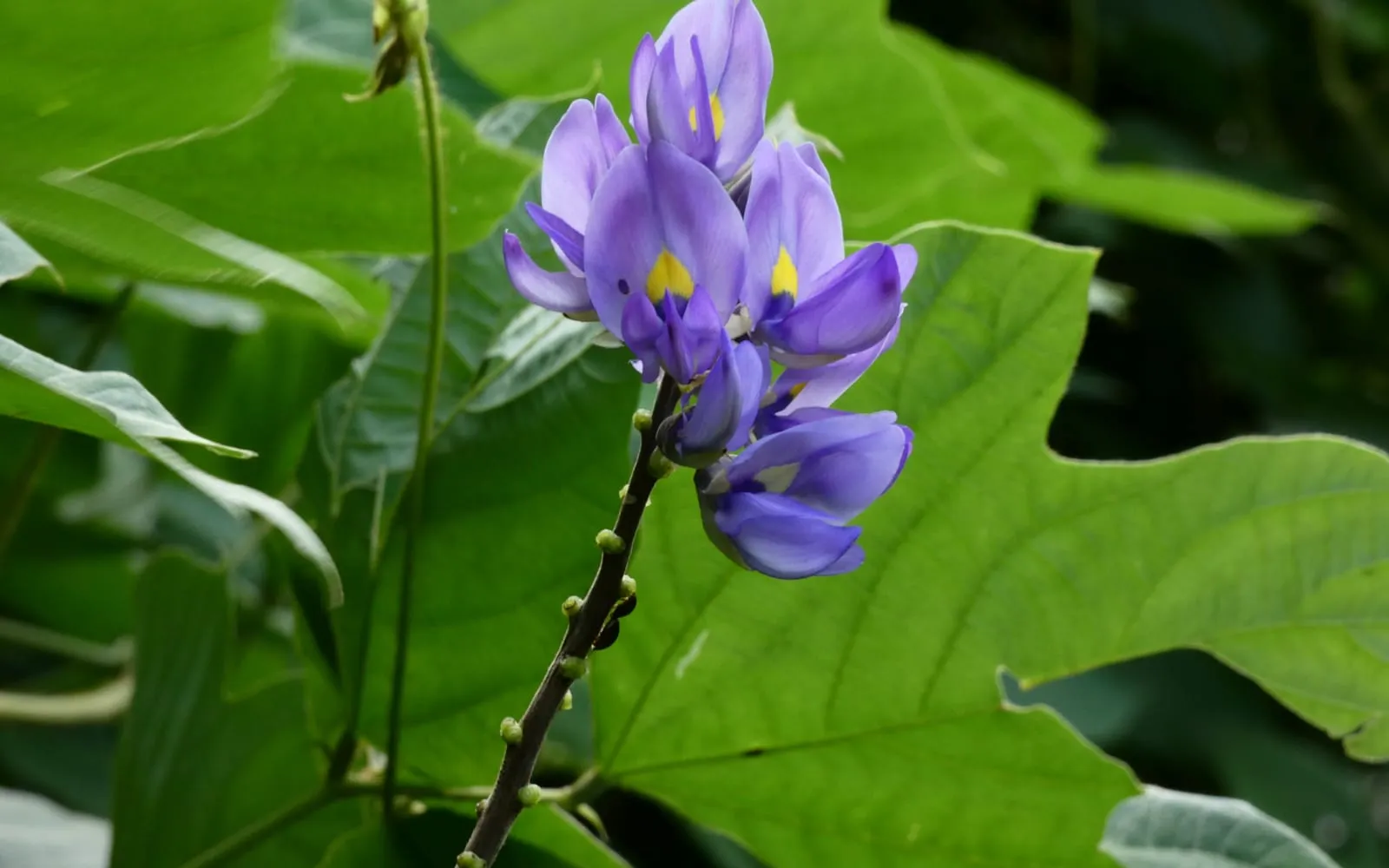
Flowers are typical pea flowers, 2 cm across, in loose blue, violet or white racemes. They are attractive, and on a crop plant they are removed on sight.
Pods are flat, green, hairy and 8 to 15 cm long, holding four to nine flat seeds. Everything about them is poisonous.
The root is the crop. A single swollen taproot, flattened and top-shaped, brown and papery skinned, from 500 g to several kilograms. Thin fibrous roots run off below it.
Peeled, the flesh is white, crisp, juicy and mildly sweet, with none of the starchiness of a potato and none of the heat of a radish.
Where it is from
Pachyrhizus erosus comes from Mexico and Central America, where it was domesticated well before European contact and grown from Mexico south into Costa Rica.
Aztec agriculture used it and the Nahuatl name xicamatl is the source of jicama.
Spanish ships took it across the Pacific to the Philippines in the sixteenth century on the Manila galleon route, and from there it spread through South East Asia. It is now a common market vegetable in Indonesia, Malaysia, Thailand, Vietnam and southern China, sold as bangkuang or sengkuang.
Chinese cooking adopted it as a substitute for water chestnut, which it resembles in texture and beats on availability.
Mexico remains the largest producer, and Mexican jicama supplies the United States market.
How it grows
Sow seed in April at 22 to 25 deg C, having soaked it for 24 hours. Handle the seed with care and keep it away from children.
Sow one seed to a 9 cm pot, 2 cm deep, and pot on before the taproot hits the bottom.
Plant out in late May or June into a deep container or greenhouse border with light sandy free-draining compost.
Depth and looseness decide the crop. A heavy or shallow soil gives a small misshapen root.
Give a support for the vine to twine up, 2 m or more.
Pinch off every flower as it appears. This is the single most important job, and a plant left to flower will give you pods and no root.
Water evenly through summer, easing off as the root swells in autumn.
Feed very little. It is a legume and it makes its own nitrogen.
Lift in October or November once the foliage yellows, before any frost.
Store the root somewhere cool, dry and dark. It keeps for a month or two and should not be refrigerated below 10 deg C.
Through the seasons
April is for sowing indoors in warmth after soaking the seed.
May is potting on and growing the young plant under cover.
June is planting out into a deep container or border under glass.
July is vine growth, and the month to get the support up.
August brings the first flower buds, which come off as they appear.
September and October are when the root swells, and the reason for all the flower removal.
November is harvest, once the leaves yellow and before frost.
Winter is storage somewhere cool, dry and above 10 deg C.
Care difficulty
Moderate under glass and unreliable outdoors in a cool climate.
It needs a long warm season of five or six months to swell a decent root.
Deep light free-draining soil is the difference between a grapefruit and a radish.
Flower removal has to be done every few days from August, and skipping it costs the crop.
The plant fixes its own nitrogen, so overfeeding is a commoner mistake than underfeeding.
The poisonous seed means it is not a plant to grow where small children forage unsupervised.
Watering
Water twice a week from planting out.
Keep the soil evenly damp through the vine growth phase.
Reduce as the root swells in autumn, since a waterlogged root splits and rots.
Water at the root rather than the foliage.
Never leave it standing wet, which the taproot will not tolerate.
Stop watering as the leaves yellow before harvest.
Warning signs, diseases and pests
Flower buds appearing are a job rather than a symptom, and they need pinching off every few days.
A large vine with a tiny root means the flowers were left on, or the soil was too rich in nitrogen.
Wilting in wet compost is root rot.
A split root means irregular watering, usually a drought followed by a soaking.
Fine speckling with webbing is red spider mite under dry glass.
Sticky leaves with black growth are aphids or whitefly.
A forked or misshapen root has hit a stone or the base of the pot.
Pods forming on the plant should be cut off and disposed of where no animal can reach them.
Growing environment
A greenhouse, polytunnel or conservatory where summers are cool.
Full sun.
Minimum 12 deg C, with 20 to 30 deg C for growth.
Deep light sandy free-draining soil, at least 40 cm.
A support of 2 m or more.
Low fertility, since it makes its own nitrogen.
Somewhere cool and dry above 10 deg C to store the root afterwards.
Feeding
Feed sparingly. This is a nitrogen-fixing legume and rich soil goes into leaf.
Skip the manure and the general fertiliser entirely.
Give a high-potash tomato feed monthly from midsummer, which supports the root rather than the vine.
Work grit or sharp sand into a heavy soil instead of compost, since the problem is usually structure rather than fertility.
Mulch lightly.
Stop feeding once the leaves begin to yellow.
Troubleshooting
Can I eat the pods like a runner bean? No. The pods, seeds, leaves and stems all contain rotenone, and the seeds have been used as a fish poison and as a crop insecticide, one withdrawn from European garden use in 2009. Only the swollen root is food.
Why should I remove the flowers? Because a flowering plant puts its energy into seed rather than root. Growers who leave the flowers on get a fine vine and a root the size of a radish.
What does it taste like? Crisp, juicy and mildly sweet, closer to a water chestnut or an unripe pear than to a potato. It stays crisp after cutting, which is why it is eaten raw.
How do I prepare it? Peel the papery brown skin and the fibrous layer under it with a knife rather than a peeler, then slice or cut into batons. Raw with lime and chilli is the Mexican way, and it also stir-fries well.
My root is tiny. Either the flowers were left on, the soil was too rich, the season was too short, or the compost was too shallow. It needs 40 cm of loose light soil and five warm months.
Can I grow it outdoors in a cool climate? Not with any reliability. It needs a long warm season and will make a vine and no root in an ordinary cool summer.
Is it related to the yam? No, despite the name yam bean. It is a legume, related to beans and peas. The yams are monocots in a different family.
How long does the root keep? A month or two somewhere cool and dry above 10 deg C. Refrigeration below that causes chilling injury and the flesh goes translucent.
Are the seeds useful for anything? They have been used as an insecticide and a fish poison, which is what the toxicity is. That is not a use to attempt at home, and rotenone is no longer approved as a pesticide across Europe.
Yam Bean problem guides
Not sure what is wrong? See the common vegetable pests guide.