
Edible
Jack Bean
Canavalia ensiformis
Also known as Horse bean, Sword bean, Wonder bean, Chickasaw lima
How to grow jack beans, Canavalia ensiformis. A cover crop with a sword-shaped pod, the bean that gave chemistry its first crystallised enzyme, and seed that needs hours of boiling.
At a glance
- Difficulty
- Moderate
- Water
- Very little once established. It is markedly drought tolerant
- Light
- Full sun
- Temperature
- 20-32 deg C, and frost kills it
- Hardiness
- USDA 10-11, RHS H1b, hardy to 5 C
- Type
- Perennial in the tropics, grown as a tender annual where frost comes
- Height
- 100-200 cm
- Native to
- central America, the West Indies
- Best month
- May and September in the Northern Hemisphere, November and March in the Southern Hemisphere
Heat, drought and poor acid soil are all taken without complaint, which is why it is grown as a cover crop and green manure far more than as food. It needs 100 to 180 frost-free days. The mature seed carries concanavalin A and canavanine and needs long boiling with changes of water.
Hardiness zones describe winter cold alone. Summer heat, humidity, rainfall and the length of the growing season decide as much, so treat the range as the outer limit rather than as a recommendation.
Every month named in this guide is for the temperate Northern Hemisphere. If you garden in the Southern Hemisphere, shift each one by six months, so May becomes November. Closer to the equator the wet and dry seasons matter more than the calendar, and the shift stops being a useful guide.
Toxic if eaten
- Safe to eat
- Very young pods cooked, and mature seed only after prolonged soaking and boiling
- Do not eat
- Raw and undercooked seed
- Harm from
- Eating it
- Affects
- People, dogs, cats and horses
Jack bean is eaten in parts of Africa, Asia and Latin America and it needs serious preparation first. The mature seed contains concanavalin A, a lectin that agglutinates red blood cells and damages the gut lining, and canavanine, an amino acid that the body can mistake for arginine and incorporate into proteins in place of it, producing malformed enzymes. Both cause illness when the seed is eaten raw or undercooked. Traditional preparation is to soak the seed for a day or more with changes of water, remove the seed coat, and boil it for several hours in water that is discarded. Levels vary between accessions, and this is not a bean to experiment with casually. It is widely grown as a green manure and cover crop, and in that role the seed is not eaten at all, which is the safest way for a temperate gardener to use it. Keep the seed away from children, dogs and grazing animals, since canavanine poisoning of livestock is recorded.
Sources: RHS on potentially harmful garden plants, British Horse Society on poisonous plants
About
Jack bean is grown around the world mainly to be ploughed back into the soil. It is one of the standard tropical green manures, producing a heavy crop of leaf, fixing nitrogen, smothering weeds, tolerating drought and acid soil, and suppressing nematodes in the ground it grows on.
As a food it is marginal and demanding. The mature seed contains concanavalin A and canavanine, and eating it requires soaking, dehulling and hours of boiling with the water discarded. Communities that eat it worked out how over generations, and it is not a bean to improvise with.
It has one claim on scientific history. James Sumner crystallised urease from jack bean meal in 1926, the first enzyme ever crystallised, and demonstrated that enzymes are proteins. He shared the Nobel Prize in Chemistry for it in 1946, and jack bean urease remains a standard laboratory reagent.
Appearance and character
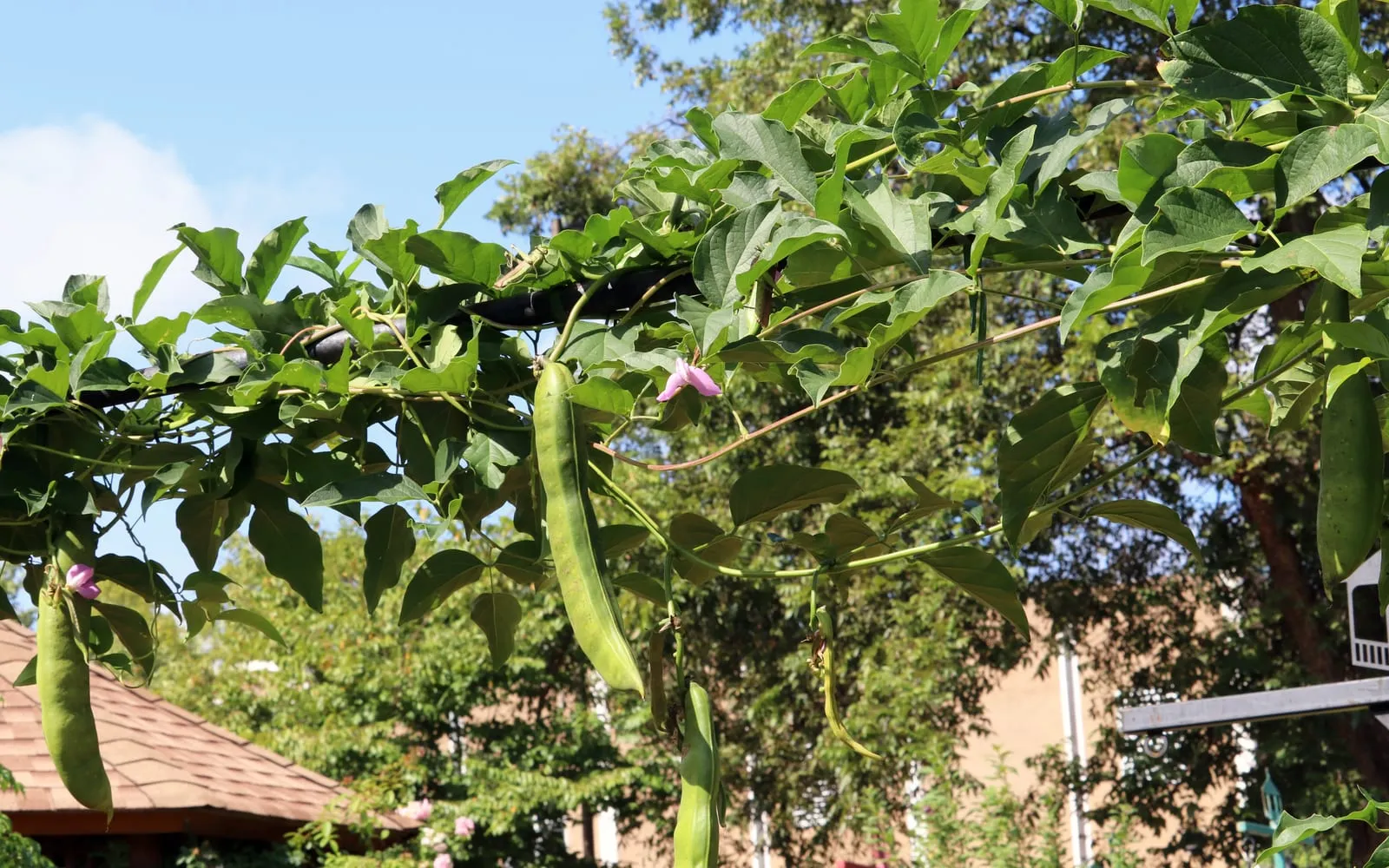
The plant is a stout bushy legume, sometimes twining weakly at the shoot tips but mostly self-supporting, with large trifoliate leaves whose leaflets are broad ovals up to 20 cm long.
The flowers are pink, purple or white pea flowers, 2 to 3 cm across, carried in loose clusters on stalks from the leaf joints. They are largely self-pollinating.
The pod is unmistakable and gives the plant one of its names. It is straight, flattened, sword-shaped, up to 35 cm long, with a distinct ridge running along each side near the upper edge. Inside are ten to fifteen large white seeds with a conspicuous brown hilum running much of the way along one edge.
Where it is from
Jack bean was domesticated in central America and the West Indies from wild Canavalia populations, and archaeological seeds from Mexican caves indicate use several thousand years ago, though whether that represents cultivation or gathering is uncertain.
It spread through the tropics after European contact, reaching Africa and Asia, and it was adopted widely as a forage, a cover crop and a famine food rather than as a mainstream pulse.
Brazil, India, Indonesia and parts of west Africa grow it today, almost always in those secondary roles. No country grows it as a major food crop, which reflects the preparation the seed requires more than any shortcoming in the plant.
How it grows
Jack bean germinates in warm soil and grows vigorously, producing a large bushy plant within two months. It has a deep taproot and is among the most drought tolerant legumes in cultivation.
It nodulates readily with a broad range of rhizobia, which is part of why it establishes on degraded ground that other legumes will not colonise.
Flowering starts in mid-summer and pods form over several weeks. The pods take a long time to mature, and in a short season the plant will usually produce green pods before the frost ends it rather than ripe seed.
Its allelopathic and nematode-suppressing effects come from compounds released by the roots and from the residue when the crop is dug in, which is why it is planted before crops that suffer from root-knot nematode.
Through the seasons
Sow indoors in April in deep pots at 20 deg C, and plant out at the end of May once frost has passed, 45 cm apart.
Growth is slow in June and vigorous through July and August, producing a large bushy plant with heavy foliage. Flowers appear from July.
As a green manure, cut the plant down in September and dig it in or leave it as a mulch. As a seed crop, expect green pods rather than dry ones in a cool climate, and harvest young pods at 10 cm or less if you intend to cook them.
Care difficulty
The plant grows easily and the seed is the problem. Jack bean establishes on poor ground, tolerates drought and acidity, and produces a great deal of leaf with no attention whatever.
Ripening seed in a short season is unlikely, and preparing that seed for eating is a serious undertaking involving a day of soaking, dehulling and several hours of boiling with the water thrown away.
The sensible use in a cool climate is as a green manure and a large curious plant. Grown that way it is easy, useful and interesting, and the safety question does not arise.
Watering
Water at planting and through the first month while the taproot establishes. After that the plant needs very little and is among the more drought tolerant legumes there is.
In a container it needs regular watering, since the taproot cannot go anywhere and a large leafy plant transpires heavily.
Waterlogging causes root rot. Free drainage is the one soil condition the plant insists on, and it will otherwise grow on ground most crops refuse.
Warning signs, diseases and pests
Jack bean has few problems, and its resistance to pests and diseases is part of why it is used as a cover crop. Outside the tropics the difficulties are climatic rather than biological.
Slugs take young plants, particularly the large soft seed leaves as they emerge. Aphids gather on the growing tips.
Red spider mite is a greenhouse problem in dry air, showing as fine pale speckling on the leaves and webbing at the tips.
Root rot follows waterlogging. Frost ends the plant in a single night, and the practical failure in a cool climate is that the season finishes before the pods do.
Growing environment
Full sun and warmth. Jack bean grows at 20 to 32 deg C, tolerates heat that stops most legumes, and is killed by frost.
Soil tolerance is exceptionally broad. The plant grows on poor, acid, degraded and compacted ground from pH 4.5 to 8, which is why it is used to rehabilitate soil rather than to be grown on good soil.
Free drainage is the requirement. Given that, it will produce a substantial plant on ground where nothing else establishes, and it will leave that ground better than it found it.
Feeding
Feed nothing. The plant fixes its own nitrogen and is used precisely because it produces bulk on soil with no fertility to speak of.
As a green manure the whole point is to capture nitrogen from the air and nutrients from the soil and to return them when the crop is dug in, so adding fertiliser works against the purpose.
Dig the foliage in while it is still green and soft. Left to become woody, jack bean residue breaks down slowly and ties up nitrogen while it does.
Troubleshooting
Can I eat jack beans? Only with serious preparation. The mature seed contains concanavalin A and canavanine, and it needs a day of soaking with water changes, dehulling, and several hours of boiling with the water discarded. This is not a bean to experiment with.
What is it usually grown for? As a green manure and cover crop. It fixes nitrogen, smothers weeds, tolerates drought and poor acid soil, and suppresses root-knot nematode in the ground it grows on.
Is it the same as sword bean? The names overlap. Canavalia gladiata is the sword bean proper, with a longer curved pod and red seeds. Canavalia ensiformis is jack bean, with a straight pod and white seeds. Both need the same preparation.
Will I get ripe seed in a cool climate? Probably not. The pods take a long time to mature and frost ends the plant, so the crop is green pods and foliage rather than dry seed.
Can I eat the young pods? Very young pods, under about 10 cm, are cooked and eaten in some places. Older pods become fibrous and carry more of the compounds that make the seed a problem.
What is the urease story? James Sumner crystallised urease from jack bean meal in 1926, the first enzyme anyone had crystallised, which proved that enzymes are proteins. He shared the 1946 Nobel Prize in Chemistry for the work.
Is it safe to have in a garden with children? The plant is not a contact hazard, and the seed is. Large white beans in a sword-shaped pod are exactly the kind of thing a child picks up, so grow it where that will not happen or cut the pods off before they mature.
Jack Bean problem guides
Not sure what is wrong? See the common vegetable pests guide.