
Edible
Sweet Granadilla
Passiflora ligularis
Also known as Granadilla, Grenadia, Sweet passion fruit
How to grow sweet granadilla, Passiflora ligularis. The Andean passion fruit with an orange shell and grey pulp, sweeter than the purple kind, and the tapping test that tells you it is ready.
At a glance
- Difficulty
- Moderate
- Water
- Twice a week in growth, less in winter
- Light
- Full sun to light shade
- Temperature
- Minimum 5 deg C. It wants cool nights and dislikes real heat
- Humidity
- Moderate to high
- Hardiness
- USDA 10-11, RHS H1c, hardy to 2 C
- Type
- Tender evergreen perennial climber
- Height
- 5-10 m of growth in a season
- Native to
- the Andes of Peru, Bolivia
- Best month
- May, June and September in the Northern Hemisphere, November, December and March in the Southern Hemisphere
Andean highlands at 1,000 to 2,500 m, so it wants warm days and cool nights and dislikes lowland tropical heat as much as it dislikes frost.
Hardiness zones describe winter cold alone. Summer heat, humidity, rainfall and the length of the growing season decide as much, so treat the range as the outer limit rather than as a recommendation.
Every month named in this guide is for the temperate Northern Hemisphere. If you garden in the Southern Hemisphere, shift each one by six months, so May becomes November. Closer to the equator the wet and dry seasons matter more than the calendar, and the shift stops being a useful guide.
Not known to be toxic
- Safe to eat
- The pulp and seeds inside the shell
- Do not eat
- The rind, and unripe fruit
Sweet granadilla is not toxic and the fruit is eaten across the Andes, including by small children, who are given it as one of the first fruits. The hard rind is inedible. Unripe Passiflora fruit of many species contains cyanogenic glycosides and is best avoided, which is a reason to wait for ripeness rather than a warning about the ripe fruit. The leaves and stems of some Passiflora contain the same compounds and should not be eaten, though the ASPCA does not list this species as toxic to cats or dogs. As with all passion fruit, the seeds are eaten with the pulp and are harmless.
Sources: ASPCA toxic and non-toxic plants, RHS potentially harmful garden plants
About
Sweet granadilla is the passion fruit that gets eaten by the spoonful. The shell is smooth, hard and bright orange, it cracks open with thumb pressure, and inside is a mass of greyish translucent pulp around black seeds, sweet and mild with none of the sharpness of the purple passion fruit.
Andean children are given it early because it is so mild, and it is one of the few fruits sold peeled and ready in Colombian and Peruvian markets.
The vine wants cool nights. It comes from Andean valleys at 1,500 to 2,500 m, which makes it one of the few plants in this collection that dislikes real tropical heat and suits a heated greenhouse rather better than the equator would.
Appearance and character
A vigorous evergreen climber, putting on 5 to 10 m of growth in a season and climbing by coiling tendrils.
Stems are round and green, becoming woody at the base.
Leaves are alternate, broadly heart-shaped, 8 to 20 cm, entire rather than lobed, dark green above and paler below, with a slightly puckered surface. The absence of lobes separates it from the purple passion fruit at a glance.
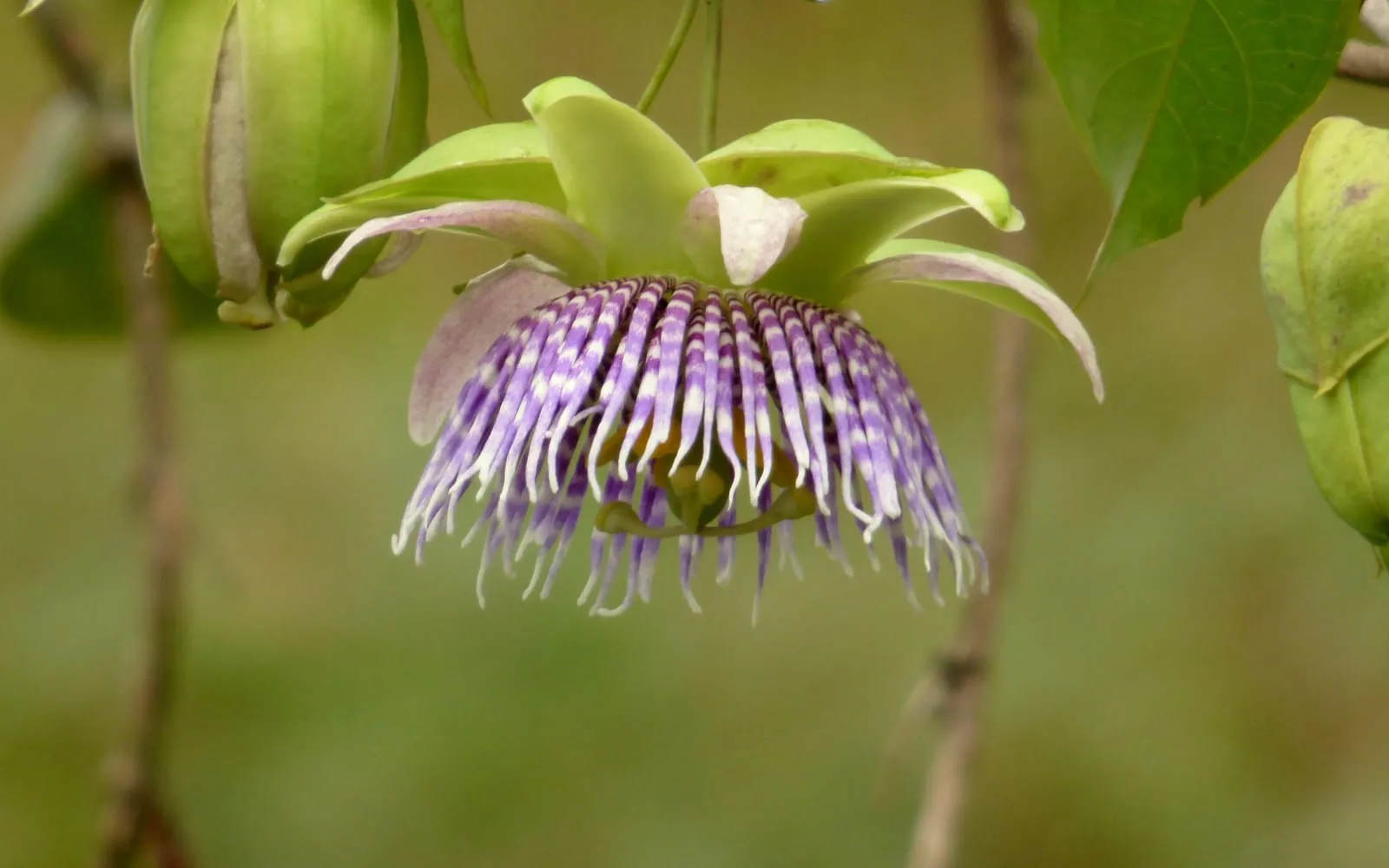
Flowers are large and complex, 6 to 10 cm, with greenish white sepals, white petals, and a corona of long wavy filaments banded in purple, blue and white.
Fruit is oval to round, 6 to 8 cm, with a hard smooth shell ripening from green to bright orange, often with fine pale flecks.
The shell is brittle rather than leathery and cracks cleanly under thumb pressure.
Inside is a mass of grey to translucent pulp in a membranous sac, sweet, mild and aromatic, around numerous flat black seeds that are eaten with it.
A ripe fruit sounds hollow when tapped, which is the standard test.
Where it is from
Sweet granadilla is native to the Andes of Peru and Bolivia, growing in valleys at 1,500 to 2,500 m, where days are warm and nights are cool.
Cultivation is pre-Columbian and the fruit was grown across the Andean world before European contact.
Colombia is now the largest producer and exporter, with Peru, Ecuador and Bolivia following, and Colombian granadilla reaches European supermarkets in small quantities.
The altitude requirement shapes where it can be grown. It does badly in hot lowland tropics, which is why it is a highland crop and why plantings in Florida and South East Asia have been disappointing.
New Zealand, Kenya and parts of India grow it at altitude.
Temperate markets see it occasionally in larger supermarkets and in Latin American food shops, sold as granadilla.
How it grows
Sow seed from a ripe fruit. Germination is uneven at 20 to 25 deg C, taking two to eight weeks, and soaking the seed for a day helps.
Take cuttings from a good plant, which root readily and come true.
Grow in rich free-draining compost, slightly acid.
Give full sun or light shade and a minimum of 5 deg C.
Provide strong support. This is a vigorous vine and it will fill a greenhouse roof in a season.
Water twice a week in growth and less in winter.
Feed fortnightly from April to September, moving to high potash as flowering starts.
Hand-pollinate under glass. Passiflora flowers are built for large bees and hummingbirds, and a closed greenhouse has neither, so brush pollen from the anthers onto the three stigmas in the morning.
Prune hard in late winter. The vine flowers on new growth and an unpruned plant becomes a tangle.
Expect fruit in the second year from seed, which is fast, taking two to three months from flower.
Through the seasons
Winter is a cool rest above 5 deg C, watered sparingly and unfed.
Late winter is the hard pruning window, cutting back to a framework.
Spring brings vigorous new growth and the first flowers.
Early summer is the main flowering and hand pollination period.
Midsummer is fruit swell, two to three months from flower.
Autumn is harvest, and a plant may still be flowering.
Late autumn is when to stop feeding and reduce watering.
Care difficulty
Moderate, and better suited to a heated greenhouse than most of these plants.
The cool-night preference is why. This is a highland plant that dislikes real tropical heat, so a heated greenhouse suits it and a hot one does not.
Minimum 5 deg C is the floor.
Vigour is the practical problem. The vine grows 5 to 10 m in a season and needs strong support and hard annual pruning.
Hand pollination is needed under glass for any real crop.
Fruit comes in the second year from seed, which is the fastest in this collection.
Spider mite and whitefly under glass are the routine pests and need watching.
Watering
Water twice a week in growth, keeping the compost consistently damp.
A vine in full growth uses a great deal of water in warm weather.
Reduce in winter, keeping the compost barely damp.
Water steadily during fruit swell, since irregular watering causes drop.
Drain fully.
Use rainwater where the supply is very hard.
Keep humidity moderate to high, which reduces spider mite.
Warning signs, diseases and pests
Flowers dropping without setting means no pollination. Hand-pollinate in the morning.
Fine stippling and webbing on the leaves is red spider mite, which passion flowers attract under glass.
Clouds of small white insects rising when disturbed are whitefly.
Yellow mottling and distorted leaves are virus. There is no cure. Destroy the plant and control aphids on the others.
Fruit dropping small is irregular watering or poor pollination.
Wilting in damp compost is root rot.
Rampant growth with no flowers means too much nitrogen. Switch to high potash.
Leaf drop after a cold spell is chill damage.
Growing environment
A cool to warm greenhouse or conservatory with strong overhead support.
Minimum 5 deg C, with 18 to 25 deg C days and cooler nights. It dislikes sustained heat above 30 deg C.
Full sun to light shade.
Moderate to high humidity.
Rich free-draining moisture-retentive compost, slightly acid.
pH from 5.5 to 6.5.
Wires, a trellis or a roof to climb, and room for 5 to 10 m of growth.
A large pot or a greenhouse border.
Feeding
Feed fortnightly from April to September with a balanced liquid feed.
Switch to a high-potash feed such as tomato food as flowering starts.
Stop feeding at the end of September.
Give nothing through winter.
Top-dress or repot in late winter after pruning.
Avoid heavy nitrogen, which gives metres of growth and no flowers.
Add magnesium if older leaves yellow between the veins.
Troubleshooting
How is it different from a purple passion fruit? Sweeter and much milder, with a hard smooth orange shell rather than a wrinkling purple one, grey pulp rather than orange, and unlobed heart-shaped leaves rather than three-lobed ones.
How do I know when one is ripe? Tap it. A ripe granadilla sounds hollow. The shell should also be fully orange and it cracks under thumb pressure.
The flowers fall off without setting. No pollination. Passiflora flowers are built for large bees and hummingbirds and a closed greenhouse has neither. Brush pollen from the anthers onto the three stigmas in the morning.
It grows metres and never flowers. Too much nitrogen. Switch to a high-potash feed and prune hard in late winter, since it flowers on new growth.
Does it want a hot greenhouse? No, and this is what sets it apart in this wave. It is an Andean highland plant that wants warm days and cool nights and does badly in sustained heat above 30 deg C.
How soon will it fruit? In the second year from seed, taking two to three months from flower, which is the fastest in this collection.
The leaves are mottled and distorted. Virus, which passion flowers are prone to. There is no cure. Destroy the plant and control aphids on the rest.
Can I eat the seeds? Yes. They are eaten with the pulp, as in any passion fruit.
Sweet Granadilla problem guides
Not sure what is wrong? See the common vegetable pests guide.