
Edible
Oca
Oxalis tuberosa
Also known as New Zealand yam, Uqa, Oka
How to grow oca, Oxalis tuberosa. The daylength trigger that decides the crop, why you must not lift before December, and protecting the haulm from the first frost.
At a glance
- Difficulty
- Moderate
- Water
- Weekly through summer
- Light
- Full sun to light shade
- Temperature
- 15-22 deg C. The top growth is killed by the first frost
- Hardiness
- USDA 8-11, RHS H2, hardy to 0 C
- Type
- Tender perennial grown as an annual
- Height
- 30-40 cm
- Native to
- The Andes of Peru and Bolivia
- Best month
- December in the Northern Hemisphere, June in the Southern Hemisphere
Like the other Andean tubers it is strictly short-day, starting to tuberise only when daylength falls below about 12 hours, so the plant grows all summer and does its real work in the last five or six weeks. Frost before that is the usual reason a crop fails. New Zealand grows it commercially as yam, and day-neutral breeding lines are beginning to change the picture.
Hardiness zones describe winter cold alone. Summer heat, humidity, rainfall and the length of the growing season decide as much, so treat the range as the outer limit rather than as a recommendation.
Every month named in this guide is for the temperate Northern Hemisphere. If you garden in the Southern Hemisphere, shift each one by six months, so December becomes June. Closer to the equator the wet and dry seasons matter more than the calendar, and the shift stops being a useful guide.
Edible, with limits
- Safe to eat
- The tubers, raw or cooked, and the young leaves in small amounts
- Harm from
- Eating it
- Affects
- People
Oca is a food crop grown across the Andes and eaten daily by millions, and the tubers are safe. The caution concerns oxalic acid, which the genus Oxalis is named for. All parts contain it, the leaves considerably more than the tubers, and the tubers of some Andean landraces more than the varieties sold in Britain. Oxalic acid in quantity binds calcium, irritates the gut and contributes to kidney stones in people prone to them, which is the same caution that applies to rhubarb leaves, sorrel and spinach. Ordinary portions of oca tuber are well within safe limits. Anybody with a history of kidney stones or on a low-oxalate diet should treat oca as they treat sorrel and rhubarb. Boiling reduces the oxalate content, and the traditional Andean practice of leaving tubers in the sun for a week before eating raises the sugar content and mellows the sharpness. Eat the leaves in small quantities only, as you would sorrel, and do not treat them as a spinach substitute. The ASPCA lists Oxalis species as toxic to cats, dogs and horses on the same oxalate grounds, so keep a dog from grazing the foliage.
Sources: RHS potentially harmful garden plants, ASPCA (Shamrock, Oxalis species)
About
Oca is the second most important tuber crop in the Andes after the potato, and it grows well in Britain, which almost nobody knows. The plants are handsome, the pests ignore them, and blight does not touch them.
Everything turns on one fact. Oca does not begin forming tubers until the day length drops below about twelve hours, which in Britain happens around the autumn equinox in late September. The plant then has until the first hard frost to make its crop.
That is why the harvest instruction is a date rather than a stage. Leave the plants alone until December, whatever the foliage looks like, and protect the haulm from the first frosts so it can keep feeding the tubers. A grower who lifts in October, seeing tired-looking foliage, finds nothing worth eating and concludes the crop does not work here.
Appearance and character
A low spreading clump 30 to 40 cm tall, with fleshy, brittle, often red-tinged stems that sprawl outwards and root where they touch the soil.
Leaves are clover-like with three heart-shaped leaflets, fresh green, and they fold down at night and in bright sun in the way all Oxalis leaves do.
Small yellow five-petalled flowers appear from late summer, and plants outside the Andes seldom set seed.
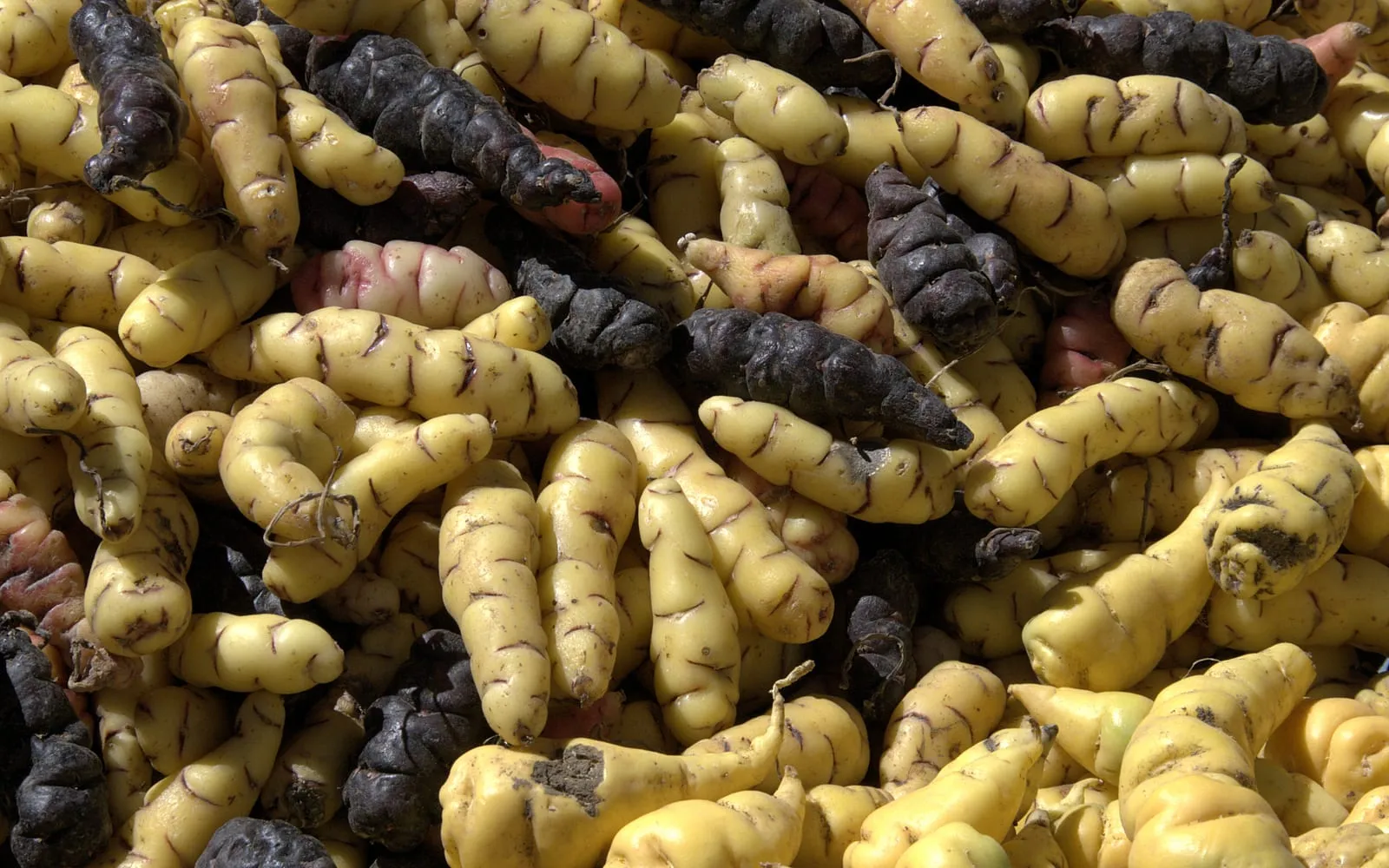
Tubers are small, 3 to 8 cm long, cylindrical and ridged with prominent eyes, looking something like a stubby wrinkled carrot. They come in white, yellow, orange, pink, red and near-black, and a mixed row is a striking thing to lift.
Flesh is waxy and yellow to white, tasting lemony and slightly sharp raw and sweeter after storage in the light.
Where it is from
Oca is native to the high Andes of Peru and Bolivia, where it has been cultivated for thousands of years at altitudes between 3,000 and 4,000 metres. Andean farmers maintain dozens of landraces, and the diversity of tuber colour in a Peruvian market is far beyond anything sold in Europe.
It reached Europe in the early nineteenth century and was trialled seriously during the potato blight years of the 1840s as a possible replacement, since it is immune to Phytophthora infestans.
The trials failed on daylength. Oca planted in Europe did not tuberise before the frosts, and nobody understood why until the photoperiod response was worked out much later.
New Zealand took it up successfully in the nineteenth century and grows it commercially as the New Zealand yam, which is where most British seed tubers originate.
How it grows
Plant tubers in April, or start them in pots under cover in March and plant out after the last frost. The tubers are frost-tender and so is the top growth.
Plant at 5 cm deep and 30 cm apart in rows 60 cm apart. The plants spread sideways and fill the space.
Earth up in July as you would potatoes, or mulch deeply. Tubers form on short stolons close to the surface and need covering.
Leave the plants alone through the autumn. The foliage looks increasingly tired from September, which is exactly when the tubers start forming underground.
Protect the haulm from the first light frosts with fleece. Every extra fortnight of green leaf after the equinox adds significantly to the crop.
Lift in December, two or three weeks after the frost has killed the top growth. Dig carefully, since the tubers sit close to the surface and scatter.
Save a dozen tubers for next year, stored somewhere frost-free and dark.
Through the seasons
Early spring starts the tubers into growth in pots under cover in March.
Late spring is for planting out, from late April to mid-May once the frosts have finished. Water in and mulch.
Summer grows the foliage and nothing else. No tubers are forming yet, whatever the plant looks like. Earth up in July and water weekly.
Autumn is when the crop is made. Tuberisation begins around the equinox in late September. Cover with fleece against the first frosts to keep the leaves working as long as possible.
Early winter is the harvest. Wait two or three weeks after the haulm has been killed by frost, then lift in December. Leave the tubers in the light for a week before eating to sweeten them.
Care difficulty
Moderate, and it is knowledge rather than skill that decides the outcome.
The harvest date is the whole thing. December, not October. A grower who lifts early gets marbles.
Frost protection in October and November is the other half of the same point. Fleece over the haulm through the first light frosts buys weeks of tuber formation.
Slugs are the main pest and they find the tubers near the surface.
Drainage matters over the wet autumn when the crop is forming. Heavy waterlogged ground rots the developing tubers.
Blight is not a concern, which makes oca a useful crop on a plot where potatoes have failed.
Watering
Water weekly through summer to keep the plants growing, around 12 litres per square metre in dry weather.
Keep watering into September and October. The plants are forming their crop then, and a dry autumn reduces it.
Avoid waterlogging. Oca rots in standing water and the risk is highest in November when the tubers are sitting in cold wet soil.
Mulch after earthing up, which holds moisture, covers the shallow tubers and keeps the soil warmer into the autumn.
Container growing works well, in a pot of 30 litres or more, and has the advantage that the pot can be moved under cover in November to extend the season.
Warning signs, diseases and pests
Slugs are the main pest, grazing young shoots in spring and the tubers near the surface in autumn. Earth up or mulch deeply to bury the tubers, and patrol on damp evenings.
Frost killing the haulm in early October is the biggest single loss. Fleece the plants through the first light frosts.
Aphids cluster on the growing tips in summer and are dealt with by predators.
Root and tuber rot follow waterlogging on heavy ground in late autumn. Grow on a raised bed or in containers where the soil is heavy.
Small tubers almost always mean an early lift or an early frost rather than a disease.
Blight does not affect oca, which is one of the reasons to grow it.
Rabbits and deer will graze the foliage where they have access.
Growing environment
Full sun to light shade.
Light, free-draining soil suits it. Heavy wet clay is the one soil where oca struggles, since the crop forms in the wettest months.
A slightly acid soil, pH 5.5 to 7, matches its Andean origins, and it tolerates a wider range.
Shelter matters in autumn. A warm sheltered corner delays the killing frost by a week or two, which is worth a noticeable amount of crop.
A raised bed helps on heavy ground and warms the soil.
Rotate on three years. Oca shares almost no diseases with other crops, which makes it easy to place.
Feeding
Oca needs little. Dig compost into the bed before planting and leave it at that on soil in reasonable heart.
Avoid nitrogen. It produces a large sprawling plant with no more tubers, and it delays the crop.
A dressing of sulphate of potash before planting helps on poor sandy ground.
Container plants benefit from a potash-rich liquid feed, such as a tomato feed, every fortnight from August.
Never use fresh manure.
Troubleshooting
I lifted in October and found nothing. Oca does not start forming tubers until the days shorten below about twelve hours, around late September. Lift in December.
The first frost killed the plants in early October. Fleece the haulm through early frosts. Every extra fortnight of green leaf after the equinox adds substantially to the crop.
Lots of foliage and few tubers. Too much nitrogen, or an early frost. Feed with potash rather than nitrogen and protect the top growth in autumn.
The tubers rotted in the ground. Waterlogging in November. Grow on a raised bed or in containers on heavy soil.
Slugs ate the tubers. They sit close to the surface. Earth up or mulch deeply in July, and patrol on damp evenings.
The tubers taste sharp. Normal when freshly lifted. Leave them in the light on a windowsill for a week, which is the traditional Andean practice and converts some of the acid to sugar.
Do I need to peel them? No. The skin is thin and the tubers are cooked or eaten raw whole.
Will potato blight affect them? No. Oca is immune to Phytophthora infestans, which is why it was trialled as a potato replacement in the 1840s.
Oca problem guides
Not sure what is wrong? See the common vegetable pests guide.