
Outdoor plant
Siberian Ginseng
Eleutherococcus senticosus
Also known as Eleuthero, Ci wu jia, Devil's shrub
How to grow Eleutherococcus senticosus, a hardy prickly shrub from the Russian Far East. Why it is not a ginseng, where the name came from, and how easy it is in a temperate garden.
At a glance
- Difficulty
- Easy
- Water
- In the first two summers, then rarely
- Light
- Partial shade or sun, and it takes woodland edge conditions well
- Temperature
- Fully hardy, to about minus 30 deg C
- Hardiness
- USDA 3-7, RHS H7, hardy to -35 C
- Type
- Hardy deciduous shrub
- Height
- 2-3 m, occasionally more
- Native to
- the Russian Far East, north-east China, Korea, Hokkaido
- Best month
- November in the Northern Hemisphere, May in the Southern Hemisphere
Not a Panax at all, and far easier than the true ginsengs, growing as an ordinary hardy shrub in sun or part shade. Cold does not trouble it. Seed shares the double dormancy of the family and takes two winters, so propagation from cuttings or suckers is the practical route.
Hardiness zones describe winter cold alone. Summer heat, humidity, rainfall and the length of the growing season decide as much, so treat the range as the outer limit rather than as a recommendation.
Every month named in this guide is for the temperate Northern Hemisphere. If you garden in the Southern Hemisphere, shift each one by six months, so November becomes May. Closer to the equator the wet and dry seasons matter more than the calendar, and the shift stops being a useful guide.
Harmful if eaten
- Do not eat
- The black berries, and the prickles on every stem
- Harm from
- Eating it and handling it
- Affects
- People
The root and root bark are the parts with a history of use, and the European Medicines Agency maintains a herbal monograph on eleutherococci radix covering exactly that material, which is the best short reference for how the plant is regulated in Europe. The plant does not appear on the RHS list of potentially harmful garden plants, and the ASPCA does not list it among plants toxic to dogs, cats or horses. The black berries have no history of being eaten and are best treated as ornamental rather than as food. The practical hazard in a garden is mechanical. Every young stem is armed with fine downward-pointing prickles that break off in skin, which is where the name devil's shrub comes from, so prune it in gauntlets. Anyone taking the root as a supplement alongside prescribed medicines should mention it to their GP, which the NHS advises for herbal products generally.
Sources: European Medicines Agency herbal monograph, eleutherococci radix, NHS on herbal medicines, RHS potentially harmful garden plants, ASPCA toxic and non-toxic plants
About
Siberian ginseng is not a ginseng. Eleutherococcus senticosus is a prickly deciduous shrub that shares a family with Panax and shares none of its chemistry, and the name is a piece of Cold War marketing that stuck. Soviet researchers in the 1960s looked for a cheap and abundant substitute for a root that took six years to grow, settled on this shrub, and called what they found in it eleutherosides.
The plant itself has been used in north-east China and the Russian Far East for a long time under its own names, ci wu jia in Chinese, and it was never confused there with ren shen. The confusion is a European and American one, and it is common enough that suppliers now label the product eleuthero to avoid it.
As a garden shrub it is a good plant and an undemanding one. Fully hardy well past anything a temperate winter produces, happy in the dappled shade at a woodland edge, growing to three metres of arching prickly stems with handsome five-fingered leaves. Plant it where nobody has to squeeze past it.
Appearance and character
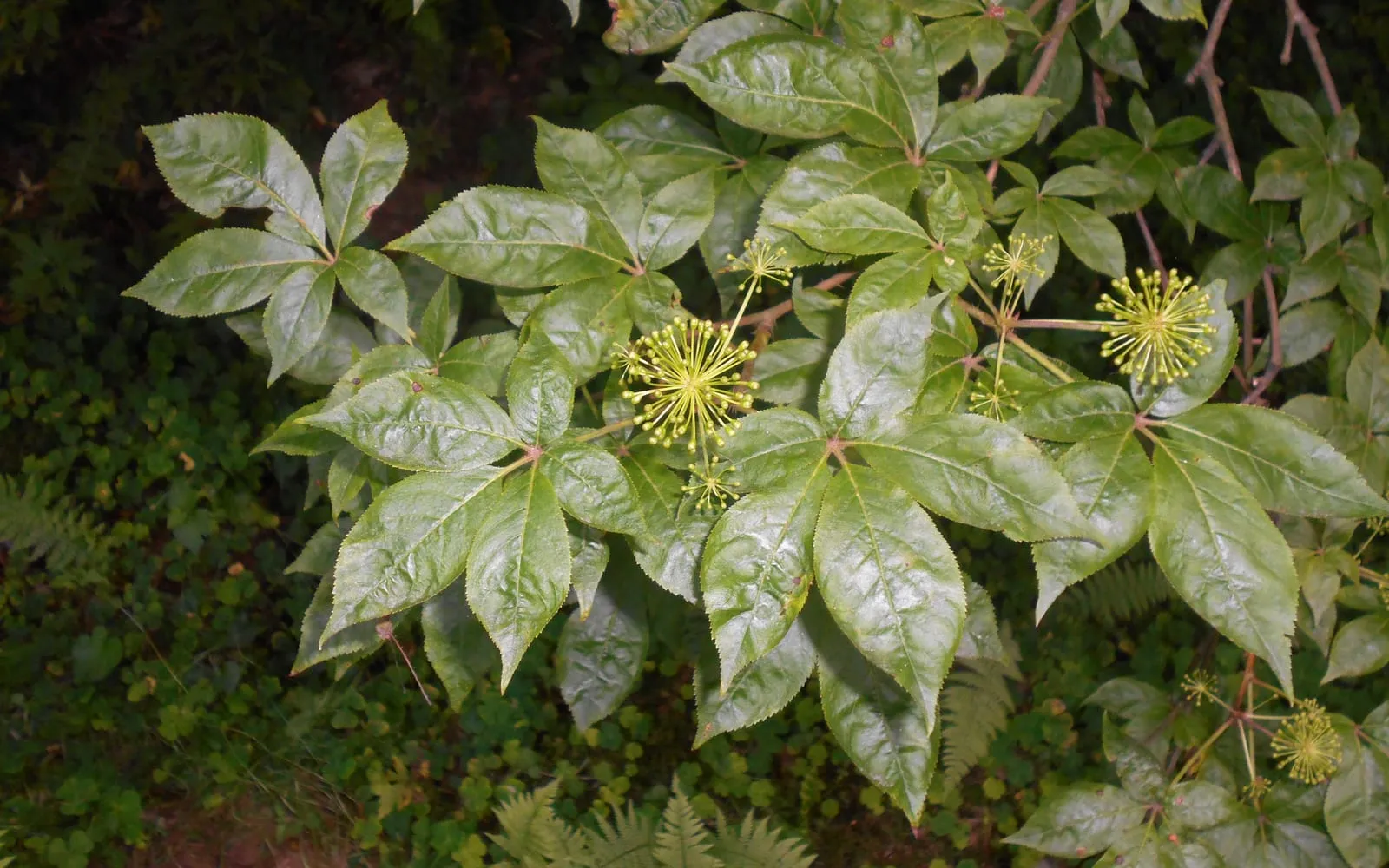
The leaves give the family away. Five leaflets radiate from the top of a long stalk like the fingers of a hand, each toothed and pointed, 6 to 12 cm long, turning a decent yellow before they fall. Anyone who knows a horse chestnut leaf will read the arrangement at once, though these are much smaller.
The stems carry the character. Young wood is pale brown and densely covered in slender downward-pointing prickles, thin enough to break off in a hand and numerous enough to make bare-armed pruning a mistake. Older wood loses most of them and becomes grey and ridged.
Flowers open in July in rounded umbels on long stalks, small and violet to yellowish, and easy to overlook. The fruit that follows is the ornamental moment, tight globular clusters of glossy black berries held above the foliage into autumn.
Where it is from
The plant grows through the mixed forests of the Russian Far East, north-east China, Korea and Hokkaido, in the same broad region as Panax ginseng and often in the same woods. It occupies the lighter ground, forming thickets at forest edges, in clearings and along stream sides.
Those forests have a continental climate with winters down to minus 30 deg C and warm humid summers, which is why the shrub is unfazed by anything a maritime climate offers. It is also why it does better in a cool northern garden than in a hot dry one.
Collection for the herb trade is largely from wild stands in Russia and China rather than from plantations, since the shrub grows abundantly and regenerates from suckers after cutting. Pressure on the wild population is real in places but the species is not threatened in the way ginseng and goldenseal are.
How it grows
It grows as a suckering thicket. A young plant puts up a few upright stems, then sends up more from the base each year, so a solitary shrub becomes a clump two metres across in a decade. That habit makes it useful as a boundary planting and a nuisance in a small border.
New growth extends fast in May and June, hardens through late summer and stops. The wood is tough and the shrub does not need support, though heavy fruiting can arch the outer stems outward.
Roots are shallow and spreading, with the thick fleshy root and root bark that the herb trade takes concentrated near the crown. A plant is old enough to lift roots from at four or five years, and cutting a shrub back hard encourages it to sucker rather than killing it.
Through the seasons
Plant a container-grown shrub in November, or any time between autumn and early spring while it is dormant. Space it two metres from anything it should not grow into, and water it through its first two summers.
Leaves come out in April, flowering follows in July, and black berries ripen from September. There is no deadheading and no pruning schedule. Cut out dead or crossing stems in late winter and take suckers off the edge of the clump if it is spreading further than you want.
Propagation is by suckers lifted in autumn, by hardwood cuttings taken in winter, or by seed, which needs a warm period then a cold one and takes eighteen months. Suckers are quicker and root reliably.
Care difficulty
This is the easiest plant in the wave. It is hardy, tolerant of most soils, needs no feeding beyond a mulch, and has few pests. Planted in the right place it looks after itself for decades.
The single planning decision is space. A suckering shrub that reaches three metres and carries prickles on every young stem is a poor choice beside a path, and moving it later means digging out a spreading root system.
The other consideration is what you want from it. As an ornamental it earns its place with foliage and black fruit. As a source of root it needs four or five years and a willingness to cut into the crown.
Watering
Water it well through the first two growing seasons while the root system establishes. After that a shrub in reasonable soil needs nothing in a temperate climate except in a severe drought.
The plant likes moisture and dislikes standing water. Woodland edge conditions, damp but draining, describe what it evolved with. Heavy clay that stays wet all winter is the one soil to avoid or improve.
A mulch of leaf mould or compost in spring conserves more moisture than watering supplies and improves the soil at the same time.
Warning signs, diseases and pests
Aphids cluster on soft new shoots in spring and are dealt with by the birds and hoverflies that a garden with mixed planting supports. Scale insects appear on older stems as small brown limpets and rarely need action.
Rabbits will bark young stems over winter, which can ring and kill a new plant. A spiral guard for the first two winters is worth the trouble in a rural garden.
Honey fungus is the disease that kills an established shrub, and Eleutherococcus has no particular resistance. The signs are a shrub that fails to leaf out properly, white fungal sheets under the bark at the base and black bootlace rhizomorphs in the soil. There is no cure, and replanting the same spot with another susceptible shrub repeats the outcome.
Growing environment
Partial shade suits it best, which in practice means a woodland edge, the north side of a hedge, or dappled light under high tree canopy. It grows in full sun in a cool climate and scorches in a hot dry one.
Soil should be humus-rich, moist and free-draining, from slightly acid to neutral. It is not fussy about texture and grows on sand or loam alike as long as the drainage works.
Hardiness is no constraint. The shrub survives minus 30 deg C in its native range, which puts almost every temperate garden inside its comfort. Exposure to cold drying wind in spring can burn young growth, so a sheltered position gives better foliage.
Feeding
A mulch of leaf mould or garden compost in spring is enough. The shrub grows in poor forest soils in the wild and does not want feeding.
Where growth is weak on a thin sandy soil, a general-purpose granular fertiliser in March will lift it, applied once and watered in. Repeated feeding produces soft growth that aphids find first.
Mulching does more than feeding. It keeps the shallow root system cool and moist, which is what the plant responds to.
Troubleshooting
Is it related to real ginseng? Only at family level. Both are in the Araliaceae, and Eleutherococcus is a woody shrub with a different chemistry from the Panax species. The name came from Soviet research in the 1960s looking for a cheaper substitute.
How prickly is it? Prickly enough to matter. Young stems carry dense fine downward-pointing prickles that snap off in skin. Prune with gauntlets and site it away from paths.
Will it take over? It suckers steadily and forms a clump a couple of metres across over ten years. That is spread rather than invasion, and removing suckers each autumn keeps it in bounds.
Can I eat the berries? There is no tradition of eating them and no good information saying they are safe, so treat them as ornamental. The root and root bark are the parts with a history of use.
When can I harvest root? From four or five years, in autumn. Dig on one side of the clump, take a portion of the root, and backfill. The shrub regenerates from what is left.
Does it need a pollinator? No. Plants carry functional flowers and set fruit on their own, though a group fruits more heavily than a solitary shrub.
My shrub has failed to leaf out this spring. Check the base for white fungal sheets under the bark and black bootlaces in the surrounding soil. Honey fungus is the likeliest cause of a sudden failure in an established plant and there is no treatment.