
Outdoor plant
Hardy Rubber Tree
Eucommia ulmoides
Also known as Du zhong, Gutta-percha tree, Eucommia
How to grow Eucommia ulmoides, the only species in its family. Tearing a leaf to see the rubber strands, why it is extinct in the wild, and how tough it is in a garden.
At a glance
- Difficulty
- Easy
- Water
- Through the first two summers only
- Light
- Full sun
- Temperature
- Fully hardy, to about minus 25 deg C
- Hardiness
- USDA 4-7, RHS H7, hardy to -25 C
- Type
- Deciduous tree
- Height
- 12-20 m
- Native to
- central China
- Best month
- November in the Northern Hemisphere, May in the Southern Hemisphere
Hardy to -25 deg C and the only surviving member of its family, which makes it a curiosity as much as a crop. Tear a leaf slowly and fine strands of latex hold the halves together. Bark harvest kills a tree, so cultivated stands rather than wild ones now supply the trade.
Hardiness zones describe winter cold alone. Summer heat, humidity, rainfall and the length of the growing season decide as much, so treat the range as the outer limit rather than as a recommendation.
Every month named in this guide is for the temperate Northern Hemisphere. If you garden in the Southern Hemisphere, shift each one by six months, so November becomes May. Closer to the equator the wet and dry seasons matter more than the calendar, and the shift stops being a useful guide.
Not known to be toxic
Eucommia ulmoides has no record of toxicity. NC State Extension lists the species without a poisonous-plant classification, the tree does not appear on the RHS list of potentially harmful garden plants, and the ASPCA does not list it among plants toxic to dogs, cats or horses. The bark is used in Chinese practice under the name du zhong and is available as a supplement, and the latex the leaves contain is a hard gutta-percha type rather than the elastic latex of the rubber tree, which is why it was investigated as a rubber source and never became one. Anyone taking the bark as a supplement alongside prescribed medication should mention it to their GP, which the NHS advises for herbal products generally. As a garden tree it presents no hazard to children, pets or livestock.
Sources: NC State Extension, Eucommia ulmoides, RHS potentially harmful garden plants, ASPCA toxic and non-toxic plants, NHS on herbal medicines
About
Tear a leaf of Eucommia slowly in half and the two halves stay connected by fine white threads that stretch across the gap like cobweb. Those threads are gutta-percha, a hard latex, and no other hardy tree does this. It is the most satisfying identification test in this collection and it works on any leaf at any time of year the tree is in leaf.
The tree is the only living species in its family, the Eucommiaceae, with no close relatives anywhere. Fossil records show the family was once widespread across the northern hemisphere, and a single species in central China is what remains. Like the houpo magnolia it is regarded as extinct in the wild, surviving because the bark is valuable enough to be worth planting.
As a garden tree it is under-used and thoroughly good. Hardy to minus 25 deg C, untroubled by chalk, drought, pollution or poor soil, free of almost every pest and disease, with clean glossy elm-like foliage. It has no autumn colour to speak of, which is the only thing to be said against it.
Appearance and character
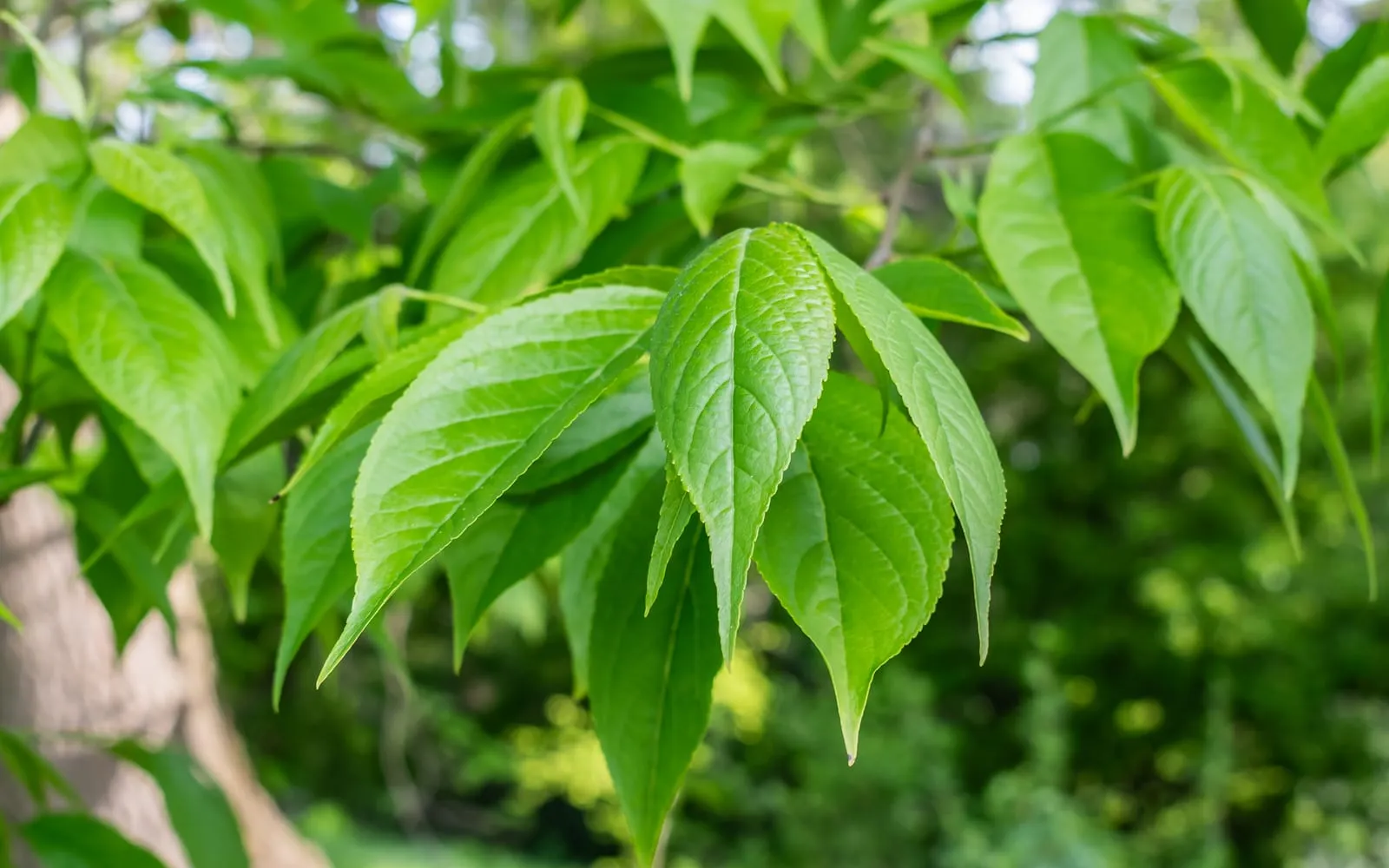
Leaves are alternate, elliptical, 8 to 16 cm long, pointed, with finely toothed margins and a slightly quilted surface between the veins, glossy dark green above. The resemblance to an elm leaf gives the species its name, ulmoides, and the leaf base is symmetrical where an elm’s is lopsided.
The rubber threads are in the leaves, the bark and the fruit. Tearing a leaf slowly across reveals them at once, and they hold the halves together for several centimetres. Children find this reliably impressive.
Flowers are inconspicuous, without petals, appearing with the leaves in spring on separate male and female trees. Female trees carry flat winged fruits like small elm samaras, 3 cm long, which persist into winter. Bark is grey, becoming ridged with age.
Where it is from
The species is native to central China, in Sichuan, Hubei, Shaanxi, Guizhou and Yunnan, in mountain forest between 300 and 2500 m. No wild population has been confirmed for a long time, and every known stand is planted or derived from planting.
The bark is one of the standard items in Chinese herbal practice, used under the name du zhong for two thousand years, and the plantations that supply it are the reason the species survives. Harvest strips bark from mature trees, and it is done in a way that allows the tree to recover rather than killing it.
It was introduced to Western cultivation around 1896 and has proved much hardier than its origin suggested. It grows well across Britain and northern Europe and is used as a street tree in parts of the United States.
How it grows
Growth is moderate, around 30 to 50 cm a year in reasonable conditions, and a tree reaches ten metres in about twenty-five years. The crown is upright when young and rounds out with age into a broad dome.
The tree is dioecious, with male and female flowers on separate plants. Neither sex offers much ornamentally and the fruit on a female tree is unobtrusive. Seedlings are uncommon outside its native range.
Roots are deep and fibrous rather than shallow and fleshy, which is part of why the tree tolerates drought, compaction and root disturbance far better than a magnolia does.
Through the seasons
Plant in November while dormant, in an open sunny position, staking for the first two years. Water through the first two summers.
Leaves come out in April and hold through until they drop in late autumn, usually without colouring. The flowers in spring pass unnoticed.
There is no seasonal maintenance to speak of. Prune in late winter only to remove crossing or damaged branches. The tree needs no feeding, no spraying and no attention once established.
Care difficulty
As easy as any tree in cultivation. It tolerates chalk, clay, sand, drought, cold, wind and urban pollution, and it has no significant pests.
The only genuine failure mode is waterlogging. Ground that stays saturated through the winter rots the roots, and that is the one condition to avoid.
Availability is the practical obstacle. It is uncommon in the nursery trade and usually has to be sought from a specialist, which is a shame for a tree this useful.
Watering
Water through the first two summers after planting to establish the root system. After that the tree is drought tolerant and needs nothing in a temperate climate.
Deep infrequent watering is better than frequent light watering during establishment, since it draws the roots down.
The tree tolerates dry conditions well and waterlogging badly, so if the soil is heavy, plant on a slight mound rather than in a hollow.
Warning signs, diseases and pests
Almost nothing attacks it. Scale insects appear on young stems occasionally and squirrels bark young trees in some gardens, and neither amounts to much.
Honey fungus is the disease that kills established trees, as with most garden trees, and Eucommia has no particular resistance. Thinning crown, white fungal sheets under the bark at the base and black bootlaces in the soil are the signs.
A tree that is failing without those signs is almost always in ground that holds winter water. Check the drainage before looking for anything more complicated.
Growing environment
Full sun and an open position. The tree grows in light shade and makes a poorer shape for it.
Soil can be almost anything that drains. It grows on chalk, clay, sand and poor urban soil with equal indifference, across a wide pH range.
Hardiness is not a consideration. The tree survives minus 25 deg C and tolerates wind and coastal exposure better than most large deciduous trees.
Feeding
None. The tree grows on poor ground without complaint and feeding produces no benefit.
A mulch of compost around a newly planted tree, kept clear of the trunk, helps through the establishment years.
Where a young tree is growing slowly, the cause is usually grass competition at the base or a stake left too tight. Both are easier to fix than anything nutritional.
Troubleshooting
How do I do the rubber trick? Tear a leaf slowly across the middle rather than snapping it. Fine white threads of gutta-percha stretch between the two halves and hold them together for several centimetres.
Is it related to the rubber plant? No. Ficus elastica, the rubber plant, is a fig, and Hevea brasiliensis, the commercial rubber tree, is a spurge. Eucommia is the only species in its own family and its latex is a hard gutta-percha rather than elastic rubber.
Why was it never used commercially for rubber? The yield is low and the latex is hard rather than elastic, so it behaves like gutta-percha, which is useful for insulation and golf balls rather than tyres. Extraction has never been economic.
Is it hardy? Yes, to about minus 25 deg C, and it tolerates wind, drought, chalk and pollution. It is one of the toughest ornamental trees available.
How big does it get? Twelve to twenty metres over many decades, with a broad rounded crown. Allow it space.
Does it have autumn colour? Little worth the name. The leaves fall green or dull yellow, which is the one criticism of an otherwise excellent tree.
Where do I buy one? From a specialist tree nursery. It is uncommon in general garden centres despite being easier to grow than much of what they stock.