
Outdoor plant
Baikal Skullcap
Scutellaria baicalensis
Also known as Chinese skullcap, Huang qin, Golden root
How to grow Scutellaria baicalensis, the huang qin of Chinese medicine. A hardy dry-slope perennial with blue hooded flowers, and the yellow root behind the name baicalin.
At a glance
- Difficulty
- Easy
- Water
- Occasionally in the first summer, rarely after
- Light
- Full sun
- Temperature
- Fully hardy, to about minus 25 deg C
- Hardiness
- USDA 4-8, RHS H6, hardy to -25 C
- Type
- Hardy herbaceous perennial from a thick yellow root
- Height
- 30-50 cm
- Native to
- north-east China, Mongolia, Siberia around Lake Baikal, Korea
- Best month
- May in the Northern Hemisphere, November in the Southern Hemisphere
Sharp drainage and full sun suit it, and winter wet at the crown kills it faster than any frost. The thick yellow root takes three to four years to reach a usable size. Its natural ground is dry stony grassland, so treat it as a Mediterranean herb rather than a woodland one.
Hardiness zones describe winter cold alone. Summer heat, humidity, rainfall and the length of the growing season decide as much, so treat the range as the outer limit rather than as a recommendation.
Every month named in this guide is for the temperate Northern Hemisphere. If you garden in the Southern Hemisphere, shift each one by six months, so May becomes November. Closer to the equator the wet and dry seasons matter more than the calendar, and the shift stops being a useful guide.
Harmful if eaten
- Do not eat
- None identified. The root is the part used
- Harm from
- Eating it
- Affects
- People
Scutellaria baicalensis root has been used in China for centuries and is sold in the West as a food supplement. The plant does not appear on the RHS list of potentially harmful garden plants, and the ASPCA does not list it among plants toxic to dogs, cats or horses. The documented problem is not with the plant in a garden but with what is sold under its name. Skullcap products have been associated with cases of liver injury, and investigations have repeatedly found the cause to be adulteration or substitution with Teucrium species, which contain hepatotoxic diterpenoids and look similar as dried material. That is an argument for knowing what a plant in your own garden is, which is the one thing a grower has over a buyer. Anyone taking the root alongside prescribed medication should mention it to their GP, as the NHS advises for herbal products generally.
Sources: LiverTox, Skullcap, RHS potentially harmful garden plants, ASPCA toxic and non-toxic plants, NHS on herbal medicines
About
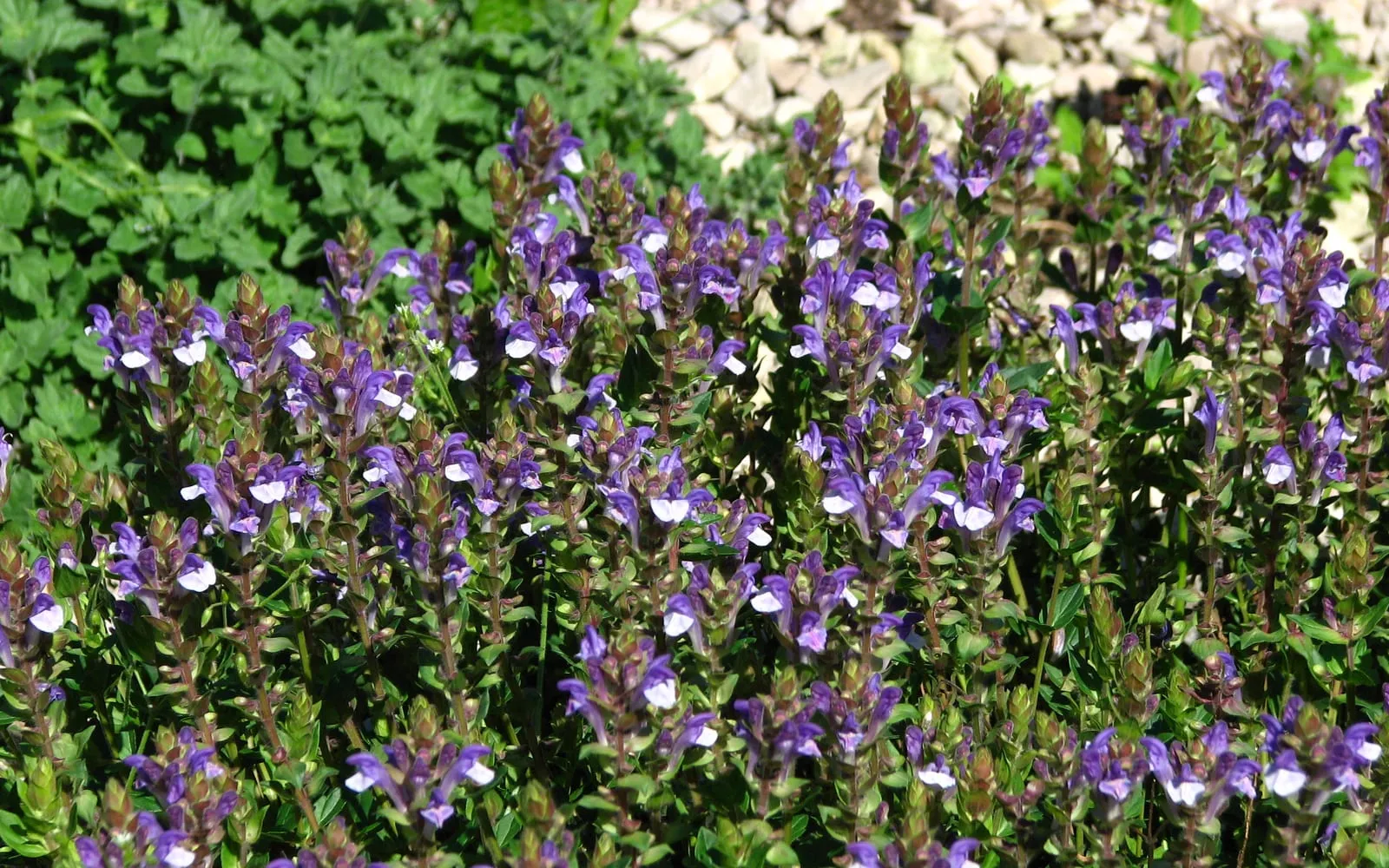
Baikal skullcap is a good garden plant that almost nobody grows. It makes a knee-high clump of narrow dark leaves, covered from June to September in one-sided spikes of hooded flowers in a strong blue-purple, and it thrives on the kind of dry sunny bank where most perennials struggle.
The root is the reason for its fame elsewhere. Huang is the Chinese word for yellow, and the thick root is a deep yellow inside from the flavonoids baicalin and wogonin. It is one of the fundamental items in Chinese herbal practice and appears in a large proportion of classical formulas.
The name skullcap comes from the seed capsule rather than the flower. After the petals fall, the upper lip of the calyx forms a small helmet-shaped cap over the seed, and the same feature names every Scutellaria. Most gardeners know the genus through Scutellaria alpina in a rock garden.
Appearance and character
The plant makes a clump of many stems, each square in cross section as a mint relative should be, rising 30 to 50 cm and leaning outward as they lengthen. The leaves are narrow lances 1.5 to 4 cm long, dark green, opposite, unstalked and smooth-edged, set close along the stem.
Flowers come in one-sided racemes at the stem tips. Each is 2 to 3 cm long, tubular, with a hooded upper lip and a spreading lower one, in a violet-blue that is stronger than most garden blues. Flowering runs from June into September and bees work it heavily.
The root is thick, fleshy, and yellow throughout, running 20 to 30 cm down and branching. Old roots hollow out at the centre, which Chinese graders treat as a different grade from the solid young root.
Where it is from
The species grows on dry sunny grassland and stony slopes across north-east China, Mongolia, Korea, and the Siberian steppe around Lake Baikal, which is what its name records. It occupies thin poor soils that dry hard in summer and freeze in winter.
Those conditions are the useful information for a gardener. The plant is adapted to drought and to cold, and it has no adaptation whatever to a wet winter, which is what kills it.
Wild collection has thinned populations in parts of northern China, and the root in trade now comes largely from cultivated fields in Hebei, Shanxi and Inner Mongolia, grown on a three-year cycle before lifting.
How it grows
Seed germinates readily at 18 to 20 deg C without any pretreatment, which sets it apart from most of the roots in this collection. Sow in spring and plants flower in their second year, sometimes late in their first.
The root thickens through the second and third seasons and is lifted in autumn of the third or fourth year. Plants left longer keep growing and the root goes hollow, which does not harm the plant and changes what the root is worth in trade.
The top dies to the ground in autumn and reappears in April. A plant is long-lived in a well-drained spot and short-lived in a heavy one, and dividing an established clump in spring is straightforward.
Through the seasons
Sow in March or April under cover, or direct into a prepared bed in May once the soil warms. Plant out at 30 cm spacing on a sunny bank, a raised bed or a gravel garden.
Flowering runs June to September. Deadhead the first flush and the plant produces a second, or leave the spikes to set seed, which it does freely enough to give volunteers around the parent.
Cut the dead stems down in late autumn or leave them for winter structure and tidy in March. Lift the root in the autumn of the third year, wash it, split thick pieces and dry until brittle.
Care difficulty
Easy, on the right soil. Baikal skullcap wants what a Mediterranean herb wants and for the same reason. Give it sharp drainage and full sun, feed it nothing, and keep mulch away from the crown.
On heavy clay it is short-lived and often does not see a second spring, and the cause is winter wet rather than cold. Grit worked into the planting hole, a raised bed or a gravel garden all fix it.
Beyond that there is nothing to do. No staking, no feeding, no pest control worth mentioning, and a plant that flowers for four months.
Watering
Water new plants through their first summer to establish them. After that the root goes deep enough to find its own water and the plant is drought tolerant.
Watering an established clump in an ordinary cool summer does more harm than good, since the plant is adapted to drying out and its roots rot in soil that stays damp.
Container plants need more care. Use a gritty compost, water when the top few centimetres are dry, and keep the pot on the dry side over winter, ideally with the pot lying on its side or under cover.
Warning signs, diseases and pests
Slugs graze the emerging shoots in April and can flatten a young plant. Grit around the crown and a patrol in damp weather cover it.
Powdery mildew appears as a white coating in a hot dry summer, particularly on plants in a rain shadow at the foot of a wall. It disfigures rather than kills. Aphids gather on the flowering stems and are dealt with by predators in a mixed border.
Root rot is what kills the plant, and the symptom is a clump that comes through winter smaller each year and then fails to appear at all. The cause is almost always drainage, and the fix is a different site rather than a treatment.
Growing environment
Full sun, all day. This is a steppe plant and it flops and flowers poorly in shade.
Soil should be sandy, gritty or stony, sharply drained, and neutral to alkaline at pH 6.5 to 8.0. Poor soil is fine and rich soil produces lax growth. A gravel garden, a sunny bank or a raised bed all suit it.
Cold is not an issue. The plant comes through Siberian winters and a maritime one never approaches that. Wet is the constraint, and any position that stays waterlogged in January will kill it whatever the temperature does.
Feeding
None. On reasonable garden soil the plant needs no fertiliser at any point, and feeding produces soft leaning growth with fewer flowers.
Where the soil is exhausted, a thin scattering of general fertiliser in spring is enough for a season. Avoid manure and avoid rich mulches, which hold moisture against the crown.
If anything is worth adding to the soil it is grit. Drainage is the input this plant responds to.
Troubleshooting
Is this the same as American skullcap? No. Scutellaria lateriflora is a different species from North America with a separate tradition of use, and the two are not interchangeable. Both are sold as skullcap, which is one reason the supply chain for this plant has a substitution problem.
Why did my plant die over winter? Wet soil rather than cold. The species survives minus 25 deg C in dry ground and rots in a cold wet clay bed at zero. Grit, a raised bed or a slope solves it.
When do I lift the root? In the autumn of the third or fourth year, once the top has died down. Wash, split thick pieces lengthways, and dry until they snap.
Does it self-seed? Yes, moderately, in open gritty ground. Seedlings are easy to spot and easy to move while small.
Will it grow in a pot? Well, in a deep pot with a gritty compost. Keep it dry over winter and repot every second spring.
Are the flowers good for bees? Very. The tubular hooded flowers suit long-tongued bumblebees and the plant is in flower from June to September, which is a long season for a hardy perennial.
My plant has grown tall and floppy. Too rich a soil, too much shade or too much water. The plant is built for a poor dry sunny bank and grows compactly only when it gets one.