
Outdoor plant
Peacock Flower
Dietes bicolor
Also known as African Iris, Butterfly Iris
Practical guidance for growing peacock flower, Dietes bicolor, including its rhizome rather than true bulb, iris-like fans, one-day flowers, drought tolerance, and mild toxicity.
At a glance
- Difficulty
- Easy
- Water
- Regularly while establishing, then drought-tolerant once settled
- Light
- Full sun to light shade; flowers most freely in full sun
- Temperature
- Tolerates a light frost once established; hard frost damages or kills the top growth
- Hardiness
- USDA 8-11, RHS H3, hardy to -6 C
- Type
- Evergreen rhizomatous perennial, growing from a spreading rootstock rather than a true bulb
- Height
- 45-75 cm in flower
- Native to
- South Africa
The zone range describes the leaves rather than the plant as a whole. A hard frost blackens the foliage of peacock flower outright, but the thick rootstock below ground often survives conditions colder than the leaves ever could, resprouting in spring even after a winter that looked like it had killed the plant. Where the ground itself freezes solid, the rootstock is lost along with everything above it, which is the real limit on where this species can be grown outdoors year round.
Hardiness zones describe winter cold alone. Summer heat, humidity, rainfall and the length of the growing season decide as much, so treat the range as the outer limit rather than as a recommendation.
Harmful to cats and dogs if eaten
- Do not eat
- The rhizome most of all; the sap can also irritate skin
- Harm from
- Eating it and handling it
- Affects
- Cats and dogs
Dietes bicolor is not individually listed by the RHS or the ASPCA, but it belongs to the iris family, Iridaceae, and both organisations document the closely related genus Iris as producing gastrointestinal upset if the rhizome is eaten, along with skin irritation from contact with the sap in some people. Reasoning by that family relationship rather than by a direct listing is necessary here, since no dedicated toxicology study of this particular species appears to exist. In practice the risk is modest: the rhizome sits below ground and out of easy reach, the leaves are tough and not especially palatable, and there is no established record of serious poisoning in cats or dogs from this species specifically.
Sources: RHS potentially harmful garden plants, ASPCA toxic and non-toxic plants
About
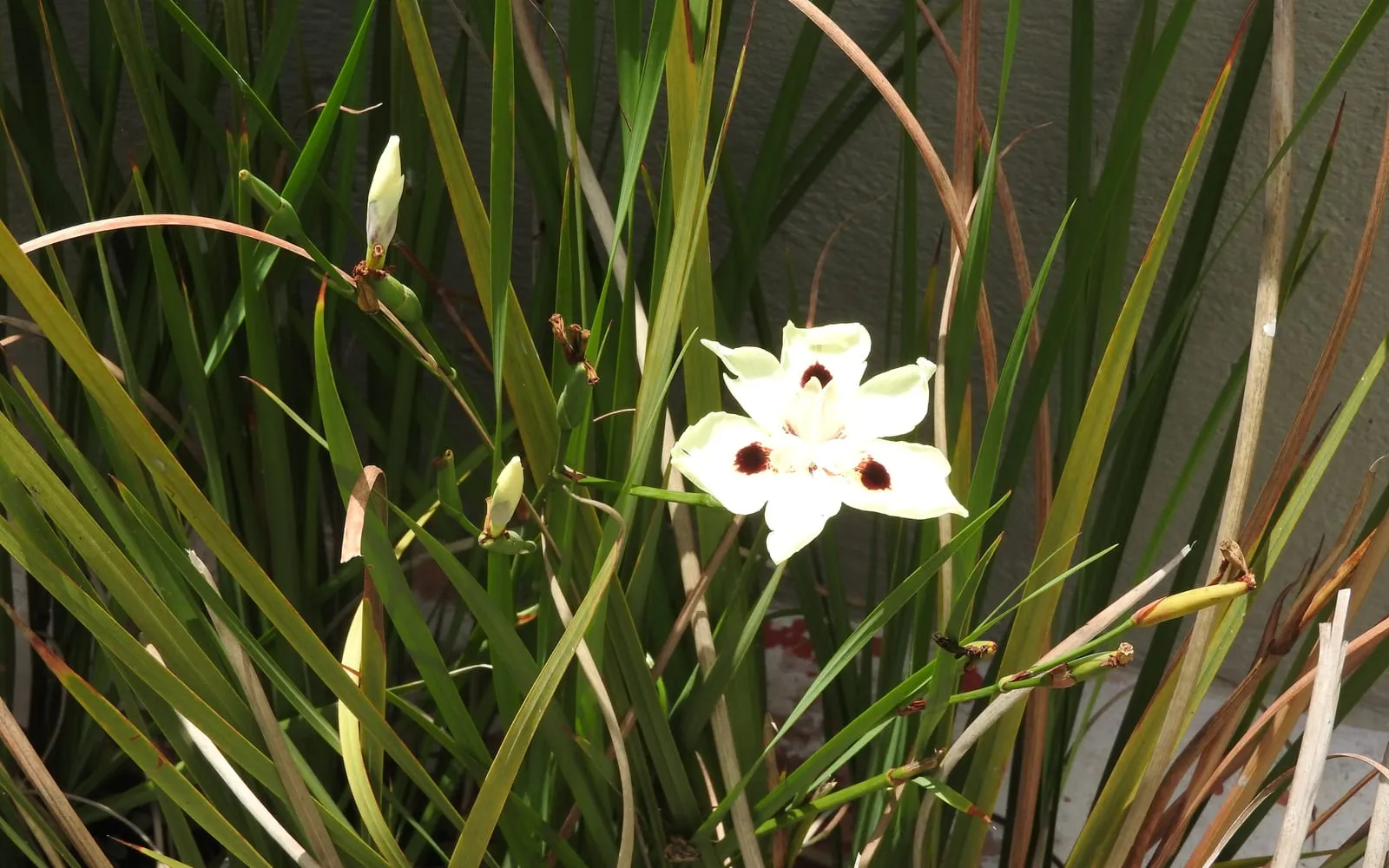
Peacock flower grows from a thick, spreading rhizome rather than a true bulb, forming clumps of stiff, upright, iris-like leaves that stay evergreen through most climates it is grown in. It flowers over a long season rather than in one flush, opening pale yellow blooms marked with a distinctive dark blotch that gives the plant its common name.
Each individual flower lasts only a single day, opening in the morning and closing by evening, but a healthy clump produces a steady succession of buds through spring and summer, so the plant as a whole is rarely without some flowers open for weeks at a stretch. It is an easy, low-maintenance choice for a sunny border in a climate mild enough to keep it going year round.
Appearance and character
The leaves grow in flat, fan-shaped clusters, narrow, tough and dark green, rising directly from the rhizome without any visible stem, and the overall look is close to a smaller, more compact relative of true iris.
Flowers are carried on wiry stems that branch and rebranch, holding buds at different stages so that a single stem can show a spent flower, an open one and a tight bud all at once. Each bloom has three larger outer tepals, pale yellow with a bold maroon-brown blotch near the base of each one, and three smaller inner tepals, plus a slender, curling style branch at the centre that gives the flower its slightly spidery, intricate look up close.
Spent flowers curl and shrivel quickly rather than hanging on untidily, and a clump in full production can look almost self-cleaning, needing little deadheading to stay tidy through the flowering season.
Where it is from
Dietes bicolor is native to South Africa, found mainly in the Eastern Cape, growing along streambanks and in rocky, well-drained ground with a warm, fairly dry climate for much of the year interrupted by a wetter season. That background explains its combination of drought tolerance once established and a strong preference for soil that never stays waterlogged for long.
It has been widely planted outside its native range in mild-winter regions worldwide, valued for its long flowering season, its tolerance of poor soil and coastal exposure, and how little routine care it demands once settled into a border.
How it grows
Plant divisions or nursery-grown clumps in spring or autumn, in full sun or light shade, in free-draining soil. It tolerates poor, sandy or gravelly ground far better than heavy clay, which holds water around the rhizome for longer than it can comfortably take.
Space plants generously, since an established clump spreads steadily outward from its rhizome and can become congested within a few years, flowering less freely once the centre of the clump is overcrowded.
Divide congested clumps every three to five years, lifting the rhizome mass and separating it into sections with several healthy fans of leaves each, replanting promptly rather than letting the divisions dry out.
Cut out individual flower stems once they have finished producing buds, close to the base, rather than shearing the whole clump over, since new flowering stems arise continuously from actively growing fans through the season.
Through the seasons
Spring brings the start of the main flowering season, as new growth resumes and the first flower stems extend from the clump.
Summer continues the flowering display at its peak in most climates, with a steady succession of one-day blooms opening through the warmest months.
Autumn slows flowering gradually as temperatures drop, though a mild autumn can keep some blooms coming later than expected.
Winter is quiet in a mild climate, with the evergreen foliage persisting throughout; where frost is a real risk, this is the season that tests whether the rhizome survives to resprout the following spring.
Care difficulty
Easy, and a plant that rewards being left alone rather than fussed over. Once established, it needs no regular watering beyond an occasional deep soak in a prolonged dry spell, no routine feeding beyond a light annual application, and no protection through a mild winter. The plant’s real limits are climate rather than care: it needs a winter mild enough that hard, penetrating frost does not reach the rhizome, and gardeners near the cold edge of its range should expect the foliage to be cut back some years even if the rootstock survives.
Watering
Water regularly through the first growing season while the rhizome establishes a proper root system, then reduce to occasional deep watering during extended dry spells once the clump is settled.
Avoid keeping the soil constantly moist, since this is a plant that tolerates genuine drought far more readily than it tolerates waterlogged ground, where the rhizome is prone to rotting.
Warning signs, diseases and pests
Thrips cause fine pale streaking or silvering on leaves and flowers, sometimes distorting new buds before they open fully. Blue or yellow sticky traps help monitor numbers, and a strong plant generally tolerates a light infestation without treatment.
Spider mite thrives in hot, dry conditions, showing as fine speckling on the leaves with faint webbing in a bad case. Watering the soil rather than misting the foliage does little to prevent it, since this is an outdoor plant, but keeping the clump well watered during a hot dry spell reduces stress that makes an infestation worse.
Slugs and snails graze young, emerging fans in wet weather, though established clumps with tough, mature leaves are far less bothered.
Root rot follows consistently wet soil, particularly heavy clay or a low spot where water collects after rain. Improve drainage before replanting rather than replanting into the same wet ground.
Growing environment
Full sun brings the heaviest flowering; in light shade the plant still grows and flowers, but less prolifically, and in deeper shade flowering drops off considerably.
Free-draining soil matters more than fertility. It tolerates poor, sandy or stony ground with little complaint and generally performs worse, not better, in a rich, constantly damp border.
It copes well with coastal exposure and wind once established, and its tough, upright leaves rarely need any staking or support even in an open, exposed position.
Feeding
A balanced, general-purpose fertiliser applied once or twice a year, in spring and again in midsummer, is enough to keep a clump flowering well. Heavy or frequent feeding is unnecessary and can push soft leafy growth at the expense of flowers.
No feeding is needed through a mild winter, when growth is minimal even in a climate where the plant stays fully evergreen.
Troubleshooting
The flowers only last a day. Is something wrong? No, that is normal. Each individual bloom opens for a single day, but a healthy, established clump produces new buds continuously through the flowering season, so the display as a whole lasts for weeks even though no single flower does.
Frost blackened all the leaves over winter. The rhizome often survives a frost that kills the top growth outright, so cut back the damaged leaves once the cold has passed and watch for new fans emerging from the base in spring before writing the plant off.
My clump has stopped flowering as well as it used to. Overcrowding is the likely cause once a clump has spread for several years without being divided. Lift and separate it in spring or autumn, replanting sections with room to grow.
Can I grow it in a container? Yes, in a large pot with excellent drainage, though it will need dividing and repotting somewhat more often than a plant given open ground, since its spreading rhizome fills a container faster than a border.
Is it really a bulb? Not technically. It grows from a thick, spreading rhizome rather than a true bulb, closer in structure to a bearded iris than to a tulip or daffodil, though it is generally sold and shelved alongside true bulbs in the trade.