
Outdoor plant
Chinaberry
Melia azedarach
Also known as Persian lilac, Bead tree, Pride of India, White cedar
How to recognise Melia azedarach, and why its berries are the problem. A lilac-flowered tree with yellow fruit that has killed children and livestock, and where it is invasive.
At a glance
- Difficulty
- Easy
- Water
- In the first two summers only
- Light
- Full sun
- Temperature
- Hardy to about minus 10 deg C, and it needs a warm summer
- Hardiness
- USDA 7-11, RHS H4, hardy to -10 C
- Type
- Deciduous tree
- Height
- 7-12 m, occasionally 15
- Native to
- India, southern China, south-east Asia, Australia
Fast, drought-tolerant and free-seeding, which is the exact combination that has made it a serious invasive across the southern United States, Australia and South Africa. Check the local status before planting. The fruits are toxic to people, pigs and some other mammals, and birds eat them and spread the seed.
Hardiness zones describe winter cold alone. Summer heat, humidity, rainfall and the length of the growing season decide as much, so treat the range as the outer limit rather than as a recommendation.
Poisonous if eaten
- Do not eat
- The berries above all, and the bark, leaves and flowers
- Harm from
- Eating it
- Affects
- People, cats, dogs and horses
Chinaberry fruit is poisonous and has killed. The ASPCA lists the chinaberry tree as toxic to dogs, cats and horses, naming the fruit as the most poisonous part and describing vomiting, diarrhoea, drooling, weakness, seizures and shock. NC State Extension lists Melia azedarach with the highest severity rating it uses, records that the berries are the danger and that as few as six to eight have been reported as a fatal dose for a child, and notes that pigs are particularly susceptible. The toxins are meliatoxins, tetranortriterpenes concentrated in the fruit, and no antidote exists, so treatment is supportive. Symptoms can begin within a few hours and include vomiting, bloody diarrhoea, incoordination and seizures. Any suspected ingestion by a child or an animal is a medical emergency. Get medical help or a vet immediately, take a piece of the plant with you, and do not wait for symptoms. The fruit hangs on the bare tree through the winter, which is what makes it a hazard for months rather than weeks. Birds eat the berries and are sometimes intoxicated by them, which is one of the ways the tree spreads.
Sources: ASPCA, Chinaberry tree, NC State Extension, Melia azedarach, RHS potentially harmful garden plants
About
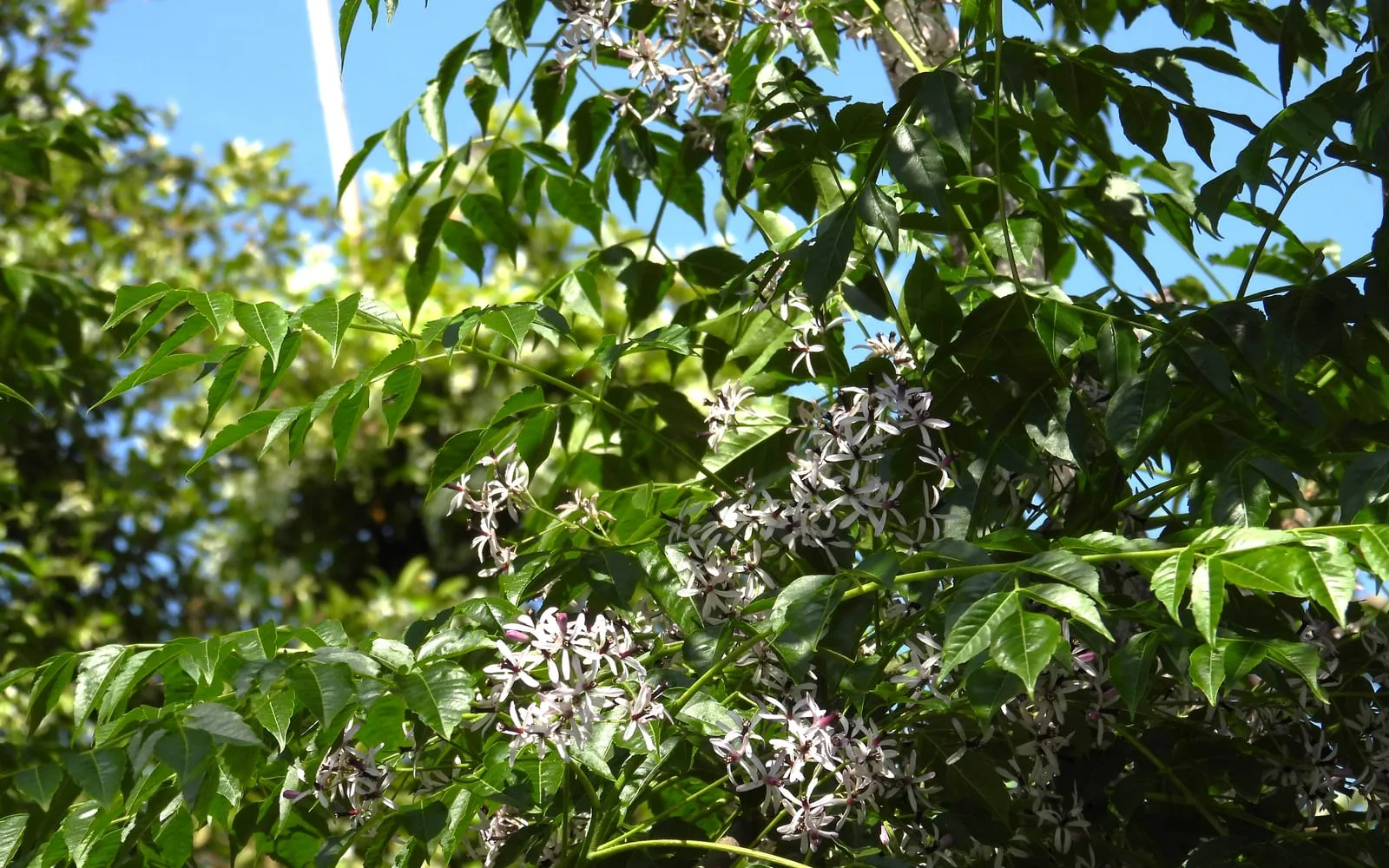
Chinaberry is a pretty tree with a serious problem. In May it carries sprays of lilac-coloured flowers with a scent like honey, over fine bipinnate foliage, and in autumn the leaves fall to leave clusters of pale yellow berries hanging on bare branches all winter. Those berries have killed children, dogs, pigs and sheep.
It is in the same family as neem, the Meliaceae, and it shares the family chemistry in a less useful form. Where neem’s compounds became an insecticide, chinaberry’s meliatoxins concentrate in the fruit and cause vomiting, seizures and death in enough recorded cases to give NC State Extension’s toxicity rating its highest level.
The tree is uncommon in cool climates and grows there only in the warmest gardens, where it needs a sheltered sunny spot and does not reliably ripen fruit. It is enormously common across the southern United States, Australia and southern Africa, where it has naturalised and is treated as an invasive weed. This guide is written for identification.
Appearance and character
The leaves are the easiest character. They are bipinnate or tripinnate, 20 to 50 cm long, divided and divided again into many small pointed leaflets with toothed margins, giving a fine lacy texture. They are alternate on the stem and turn yellow before falling.
Flowers open in May and June in loose branched sprays 10 to 20 cm long. Each is about 2 cm across with five narrow lilac petals around a dark purple staminal tube, and the scent carries. A tree in flower is attractive, which is why it was planted so widely.
The fruit is the identification feature and the hazard. Round drupes about 1.5 cm across, green ripening to pale yellow, wrinkling as they age, hanging in clusters and persisting on the bare tree through the whole winter. Each holds a hard ridged stone that has been used as a bead, which gives the tree another of its names.
Where it is from
The species is native to India, southern China, south-east Asia and northern Australia, in monsoon forest and open woodland. It is fast-growing, drought tolerant and undemanding, which is why it was planted across the warm parts of the world as a shade and street tree.
That planting has consequences. Chinaberry has naturalised widely in the southern United States, in South Africa and in parts of Australia outside its native range, and it is listed as an invasive or noxious weed in a number of those places. It seeds prolifically, suckers from the roots and outcompetes native vegetation along watercourses.
In a cool climate it is a rarity. It is hardy to about minus 10 deg C, needs a hot summer to ripen its wood, and is grown in a handful of mild gardens. It has not become a problem there.
How it grows
Growth is fast. A seedling reaches several metres in a few years in a warm climate, and the tree flowers young. The wood is brittle and the crown is prone to losing branches in storms, which is why it fell out of favour as a street tree.
It spreads by seed and by root suckers. Birds eat the berries and carry the seed, and a felled tree throws up suckers from its root system for years afterwards, both of which are the reasons it is hard to eradicate where it has naturalised.
In a cool garden it grows slowly, may be cut back by a hard winter and regrows from the base, and rarely reaches more than a few metres. Fruit set depends on a hot summer.
Through the seasons
The tree leafs out late, in May, and flowers almost at once, with the scent noticeable from several metres in still weather.
Foliage holds through the summer and turns yellow in autumn. Once the leaves fall the berries stand out clearly against the bare branches and remain there through the winter, shrivelling but not dropping.
That winter persistence is the practical point for anyone with a tree. The fruit is present and accessible for months, at the season when a garden is bare and a yellow berry is the most interesting thing in it.
Care difficulty
The tree is easy to grow and the decision about growing it is the difficult part. In a garden with children, dogs or grazing animals the winter-long presence of highly poisonous fruit is a strong argument against planting one.
If a tree is already in place, the practical management is to remove the fruit. Cutting off flowering shoots in June prevents fruit set on a small tree, and sweeping up fallen berries in autumn removes what is within reach.
Where a tree has to be removed, expect suckers from the root system for several seasons afterwards and plan to keep cutting them.
Watering
Water a newly planted tree through its first two summers. After that it is drought tolerant and needs nothing in a temperate climate.
The tree grows on poor dry ground and tolerates drought better than most deciduous trees of its size, which is part of what makes it invasive where the climate suits it.
Waterlogged ground is the one condition it will not take, and a tree planted in a wet hollow declines rather than thriving.
Warning signs, diseases and pests
Very little attacks the tree. Scale insects settle on young stems and the foliage is largely left alone, which is unsurprising given the chemistry.
The warning signs worth watching are structural and reproductive. Brittle wood sheds branches in high wind, particularly on a tree that has been topped. And seedlings appearing around a mature tree mean it is setting viable fruit, which in a warm garden is worth acting on.
The safety warning is the standing one. Berries on the tree or on the ground from October to March are the hazard, and anyone with a chinaberry and a young family should be clearing them.
Growing environment
Full sun in a sheltered position. It needs the warmest spot available in a cool climate, and a wall or a courtyard improves its chances considerably.
Soil is not a constraint. The tree grows on poor, dry, sandy or alkaline ground and asks nothing of it, provided it drains.
Hardiness is the limit. Around minus 10 deg C damages it and a colder winter cuts it to the ground, from which it usually regrows. Fruit ripens only after a hot summer.
Feeding
None. The tree grows fast on poor ground and feeding produces soft growth on a species whose wood is already brittle.
A mulch of compost around a newly planted tree helps it establish. Nothing beyond that is needed at any stage.
Where growth is poor, the cause is cold or waterlogging rather than nutrition, and neither is corrected by fertiliser.
Troubleshooting
How poisonous are the berries? Enough to kill. NC State Extension gives the species its highest toxicity rating and records reports of six to eight berries being a fatal dose for a child. The ASPCA lists the tree as toxic to dogs, cats and horses, with the fruit as the most poisonous part.
What do I do if a child or a pet has eaten one? Treat it as an emergency. Get medical help or a vet immediately, take a piece of the plant with you, and do not wait to see whether symptoms develop. There is no antidote and treatment is supportive.
Should I remove a tree in my garden? That depends on who uses the garden. With young children or a dog that picks things up, removing the fruit each year is the minimum, and removing the tree is a reasonable decision. Expect root suckers for several years after felling.
Can I stop it fruiting? On a small tree, yes, by cutting off the flowering shoots in June before fruit sets. On a large one this becomes impractical.
Is it related to neem? Yes, both are in the Meliaceae, and the family chemistry runs through both. Neem’s compounds became an insecticide and chinaberry’s concentrate in the fruit as meliatoxins.
Will it grow in a cool climate? In the warmest gardens, in a sheltered sunny spot. It is hardy to about minus 10 deg C, is often cut back by a hard winter and rarely ripens fruit here.
Why is it a problem in America and Australia? It seeds prolifically, birds spread the seed, and it suckers from the root, so it forms thickets along watercourses and outcompetes native plants. Several states and territories list it as invasive or noxious.