
Outdoor plant
Five Flavour Berry
Schisandra chinensis
Also known as Magnolia vine, Wu wei zi, Schizandra
How to grow Schisandra chinensis, the five flavour berry. Getting fruit from a plant that needs a male and a female, the shade it wants at the root, and the scent in May.
At a glance
- Difficulty
- Moderate
- Water
- Regularly through the first two summers, then in dry spells
- Light
- Shade or dappled light at the root, sun on the top growth
- Temperature
- Fully hardy, to about minus 25 deg C
- Hardiness
- USDA 4-8, RHS H6, hardy to -25 C
- Type
- Hardy deciduous twining climber
- Height
- 6-9 m
- Native to
- north-east China, the Russian Far East, Korea, Japan
- Best month
- March in the Northern Hemisphere, September in the Southern Hemisphere
Most plants carry flowers of one sex only, so a crop needs a male and a female or a self-fertile named cultivar, and a lone seedling vine will flower for years without fruiting. Cold does not trouble it. It wants moist soil and part shade, with the roots cool and the top in light.
Hardiness zones describe winter cold alone. Summer heat, humidity, rainfall and the length of the growing season decide as much, so treat the range as the outer limit rather than as a recommendation.
Every month named in this guide is for the temperate Northern Hemisphere. If you garden in the Southern Hemisphere, shift each one by six months, so March becomes September. Closer to the equator the wet and dry seasons matter more than the calendar, and the shift stops being a useful guide.
Edible, with limits
- Safe to eat
- The ripe berries, which are eaten and dried
- Harm from
- Eating it
- Affects
- People
The berry is a food in north-east Asia, dried and brewed as a tea and used as a flavouring, and the name five flavour berry describes what eating one is like: sour skin, sweet flesh, bitter and pungent seed, and a salty aftertaste. It does not appear on the RHS list of potentially harmful garden plants and the ASPCA does not list it among plants toxic to dogs, cats or horses. Two practical notes rather than warnings. The berries are strongly acidic and eating a large quantity fresh causes heartburn in some people, which is one reason they are usually dried or cooked. And schisandra is documented as affecting the liver enzymes that clear many prescribed drugs, so anyone taking the berry regularly as a supplement alongside medication should mention it to their GP. The NHS page on herbal medicines explains why interactions of that kind are the main risk with herbal products.
Sources: NHS on herbal medicines, RHS potentially harmful garden plants, ASPCA toxic and non-toxic plants, MHRA register of traditional herbal registrations
About
Schisandra chinensis carries the best name of any plant in this collection. Wu wei zi means five flavour berry, and the five are on the label because they are in the fruit. The skin is sour and the flesh is sweet, the seed is bitter and pungent when chewed, and a salty aftertaste is what is left. Chinese medicine has taken that as evidence the berry works on the whole body, and a Western gardener can take it as a reason to try one off the vine.
The plant is a hardy twining climber from the forests of north-east Asia, growing up trees to nine metres in the wild and to about six on a pergola. It carries cream flowers with a strong sweet scent in May and hanging strings of scarlet berries in September, and it is a good ornamental quite apart from the fruit.
The catch is sex. Most plants are functionally single-sexed, so a lone specimen flowers beautifully and sets nothing. Buy a named self-fertile clone, or plant a male and a female together, and check which you are getting before you pay.
Appearance and character
Stems twine anticlockwise around anything upright, growing 1 to 2 m a year once established, and the older wood becomes brown and flaky. The plant does not cling to walls, so it needs wires, a trellis or a tree to climb.
The leaves are alternate, elliptical, 5 to 10 cm long, with a slightly fleshy feel and a fresh green colour, turning yellow in autumn. Crushed, they smell faintly of lemon.
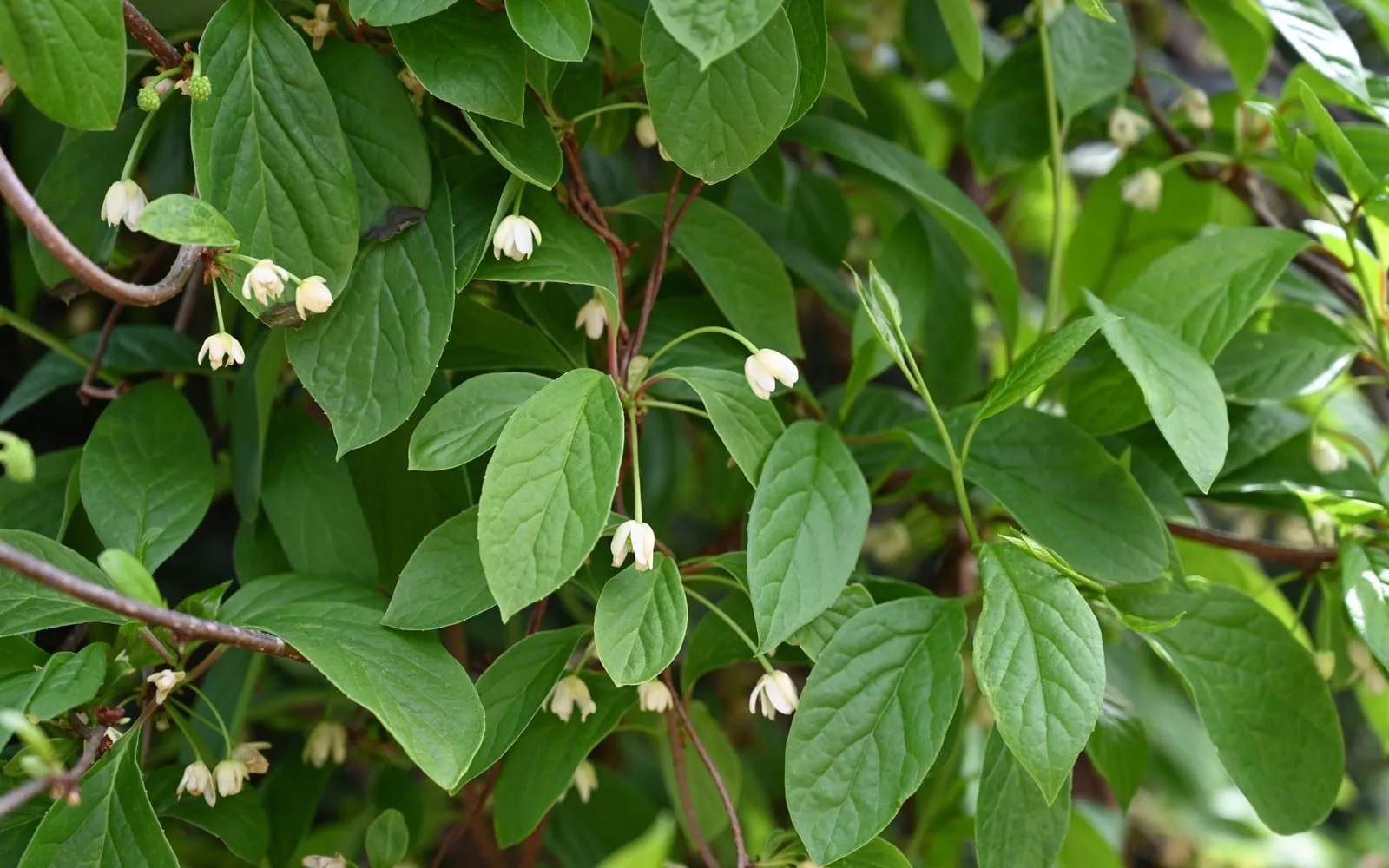
Flowers appear in May, hanging singly from the leaf axils on slender stalks. Each is about 1.5 cm across, cream to pale pink, waxy, and carries a scent strong enough to notice from several metres in still evening air. The fruit follows as a hanging spike of ten to forty bright red berries, each about 6 mm across, ripening in September and holding on the plant for weeks.
Where it is from
The natural range covers north-east China, the Russian Far East, Korea and northern Japan, in mixed forests where the plant climbs birch, poplar and Korean pine. It grows in valley bottoms and along streams, in moist soil under a canopy, with its top growth reaching the light where the trees open up.
That habitat sets the growing conditions. Shade and moisture at the root, light at the top, and a cold winter that the plant needs rather than merely tolerates. It is hardy well below minus 20 deg C.
Commercial production is centred on Jilin and Liaoning in China, where the fruit is dried in the sun and traded as wu wei zi. Russia has its own tradition of use, recorded among hunters in the Amur region, and the plant was investigated by Soviet researchers in the same programme that produced the eleuthero story.
How it grows
A young plant spends its first two seasons making roots and does little above ground, which catches out people who expect a climber to climb straight away. From the third year it extends fast, 1 to 2 m of new growth a season, and it begins flowering at three to five years from planting.
The plant suckers from the base, sending up new shoots around the parent, so an established specimen becomes a clump rather than a single stem. Those suckers are the easiest way to propagate it.
Fruiting depends on both pollination and frost. Flowers open in May and a late frost takes them, which is the commonest reason for a barren year on a plant that is otherwise doing everything right. A sheltered site earns its keep.
Through the seasons
Plant in March into ground improved with leaf mould, at the base of a support, with the root zone shaded by a low shrub or a stone slab. Water it well through the first two summers.
Flowering comes in May, with the scent as the main event. Berries colour from late August and are usually ripe through September, when netting is the only thing that stops blackbirds taking the crop. Pick the whole hanging spike.
Prune in late winter while the plant is dormant, thinning congested growth and shortening side shoots. It flowers on short spurs off older wood, so a hard all-over cut removes the next season’s fruit.
Care difficulty
The plant is hardy and healthy, and two things stop people getting fruit. The first is buying one plant and expecting berries. The second is planting it in a hot dry spot, where it survives and never thrives.
Site it as you would a clematis, with the roots in cool shade and the stems running up into the light. A north or east wall with a support suits it, and so does a pergola leg with a shrub at its foot.
Patience is the third requirement. Three to five years to the first flowers is normal, and a plant that spent its first two summers looking like a stick is behaving as it should.
Watering
Water regularly through the first two growing seasons. Schisandra roots are shallow and it is intolerant of drying out, and a plant that dries in July drops leaves and sulks for the rest of the year.
An established plant in soil with leaf mould worked in copes with most summers, and wants a deep soak in a genuine drought rather than frequent light watering. Mulch does most of this work.
Standing water is the other failure. The plant wants moist and draining, and it rots in a spot that puddles through winter.
Warning signs, diseases and pests
Aphids find the soft spring growth and are the commonest pest, sticky rather than serious. Slugs graze the suckers and low shoots and can check a young plant.
Vine weevil is a problem in containers, where the grubs eat the roots and the first symptom is a plant that wilts and lifts out of the compost. In open ground it is rarely serious.
The two things that cost fruit are not diseases. A late May frost takes the flowers, and a lone plant of the wrong sex never had a chance. Birds account for what survives both, stripping ripe berries within days, so net the plant in early September if you want the crop.
Growing environment
Cool shade at the root and light at the top. That combination is the whole trick with this plant, and it comes straight from a forest climber that starts on a shaded floor and finishes in the canopy.
Soil should be humus-rich, moisture-retentive and free-draining, slightly acid at pH 5.5 to 6.5. Work in leaf mould or composted bark before planting, and mulch each spring.
Give it a sheltered spot out of cold spring winds and out of frost pockets. The plant is hardy but the flowers are not, and shelter is the difference between a crop and a display.
Feeding
A leaf mould or compost mulch in spring is the standard treatment and enough on most soils. It feeds the plant slowly and keeps the shallow roots cool.
On thin sandy ground a balanced granular fertiliser in March supports the season’s growth. Avoid high-nitrogen feeds, which produce long soft shoots and fewer flower spurs.
Where a plant flowers well and fruits poorly, feeding is not the answer. Pollination or frost will be the reason, and no fertiliser addresses either.
Troubleshooting
Why does my plant flower but never fruit? Almost certainly sex. Most schisandra plants are functionally male or female, so a single specimen has nobody to pollinate it. Add a plant of the other sex, or grow a self-fertile named clone such as Eastern Prince.
What do the berries taste like? Sour skin, sweet flesh, and a bitter, pungent, faintly salty seed. Eaten fresh they are startling. Dried or cooked with sugar they are much easier, which is how they are usually used.
How long until it fruits? Three to five years from planting, and longer if the plant went in small. The first two seasons go into roots.
Does it damage walls? No. It twines and needs wires or a trellis, and it has no aerial roots or adhesive pads, so it cannot climb a bare wall at all.
Why did it flower and then produce nothing after a cold May? A late frost during flowering. The plant is hardy well below minus 20 deg C in winter and the open flowers are not, which is why a sheltered site matters.
Can I grow it in a container? For a few years in a large pot with a support, though it fruits better in the ground. Keep the compost moist, shade the pot, and watch for vine weevil.
When do I prune? Late winter, while dormant. Thin congested stems and shorten side shoots. It fruits on short spurs on older wood, so avoid cutting everything back hard.