
Outdoor plant
Amur Cork Tree
Phellodendron amurense
Also known as Huang bai, Chinese cork tree
How to grow Phellodendron amurense, a hardy tree with corky bark and aromatic leaves. Male trees, huang bai bark and invasive risks.
At a glance
- Difficulty
- Easy
- Water
- Through the first two summers only
- Light
- Full sun
- Temperature
- Fully hardy, to about minus 35 deg C
- Hardiness
- USDA 3-7, RHS H7, hardy to -35 C
- Type
- Deciduous tree
- Height
- 10-15 m
- Native to
- north-east China, the Russian Far East, Korea, Japan
- Best month
- November in the Northern Hemisphere, May in the Southern Hemisphere
Hardy to -35 deg C and adaptable to almost any soil, which is what made it a problem. It is an invasive species across the north-eastern United States, where birds spread the seed into hardwood forest. Trees are male or female, so planting a male-only cultivar removes the risk.
Hardiness zones describe winter cold alone. Summer heat, humidity, rainfall and the length of the growing season decide as much, so treat the range as the outer limit rather than as a recommendation.
Every month named in this guide is for the temperate Northern Hemisphere. If you garden in the Southern Hemisphere, shift each one by six months, so November becomes May. Closer to the equator the wet and dry seasons matter more than the calendar, and the shift stops being a useful guide.
Harmful if eaten
- Do not eat
- The black berries, and the bark, which is a strong bitter
- Harm from
- Eating it
- Affects
- People
The inner bark is bright yellow with berberine, the same alkaloid that colours goldenseal and barberry, and it is used in Chinese practice under the name huang bai. NC State Extension lists Phellodendron amurense without a poisonous-plant classification, the tree does not appear on the RHS list of potentially harmful garden plants, and the ASPCA does not list it among plants toxic to dogs, cats or horses. The berries are aromatic and bitter, are eaten by birds and are not a human food, and eating a quantity would be expected to cause stomach upset. Berberine itself is documented as unsuitable in pregnancy and in newborns, where it can displace bilirubin, and LiverTox carries a monograph on the compound. None of this makes the tree a hazard in a garden. It is a large hardy shade tree and the bark is the part with a medicinal history.
Sources: NC State Extension, Phellodendron amurense, LiverTox, Berberine, RHS potentially harmful garden plants, ASPCA toxic and non-toxic plants
About
The amur cork tree earns its name by touch. Mature bark is thick, deeply ridged and corky, soft enough to press with a thumb, in a pale grey-brown that looks ancient on a tree of forty years. Underneath it is bright chrome yellow, which is the berberine and the reason the bark is one of the fundamental items in Chinese herbal practice under the name huang bai.
Above that the tree is a good large ornamental. Pinnate leaves that smell strongly of citrus when crushed, since it is in the same family as rue and orange, a broad spreading crown that casts light shade, and clear yellow autumn colour. It is hardy to minus 35 deg C and untroubled by pollution or poor soil.
The one thing to get right is sex. The tree is dioecious, and female trees carry heavy crops of black berries that birds spread. In the north-eastern United States that has made it an invasive tree and female trees are banned in Massachusetts. In Europe the risk is much smaller, and planting a male avoids the question.
Appearance and character
The bark is the character. Young trees have smooth grey bark, and from about fifteen years it thickens into deep corky ridges that give under pressure. Cut or scrape it and the inner layer is a startling yellow.
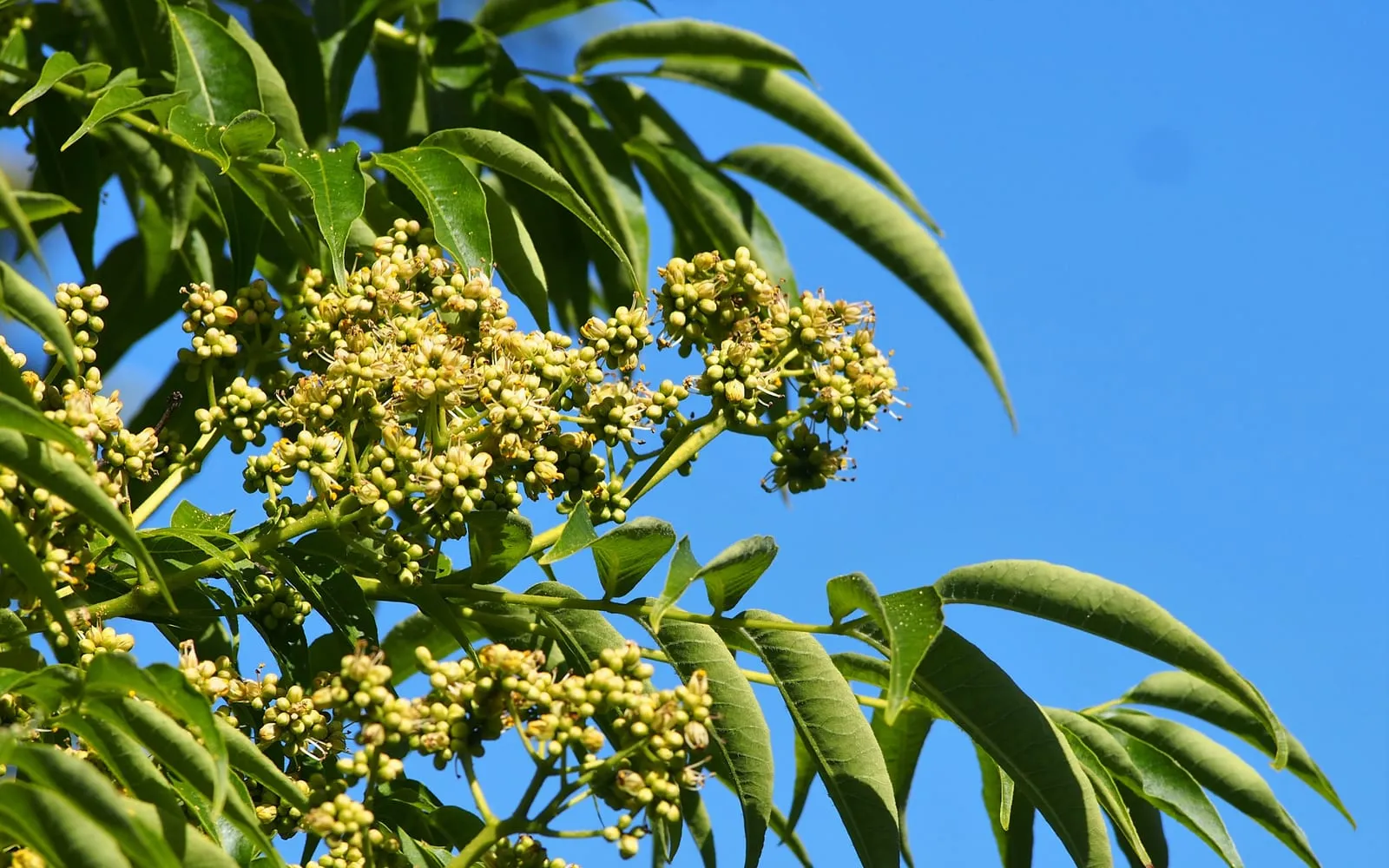
Leaves are pinnate, 25 to 40 cm long, with five to thirteen leaflets, each oval and pointed, dark glossy green above and paler below. Crushed, they release a sharp citrus and turpentine smell that identifies the tree at once. Autumn colour is a clear bright yellow, and the leaves fall early.
Flowers are small, greenish-yellow and in loose clusters in June, with male and female on separate trees. Female trees carry clusters of black berries about 1 cm across from September, which persist into winter and are strongly aromatic when crushed.
Where it is from
The species grows in the mixed forests of north-east China, the Russian Far East, Korea and Japan, in river valleys and on lower mountain slopes, in the same region as Manchurian walnut and Korean pine.
That range is bitterly cold in winter, which is why the tree is hardy to minus 35 deg C, and it is why it is planted as a street tree in continental cities where milder species fail.
It was introduced to Europe and North America in the nineteenth century as an ornamental and a street tree. In the eastern United States it has escaped into woodland and is listed as invasive in several states, spreading by bird-sown seed from female trees.
How it grows
Growth is moderately fast when young, slowing as the tree matures, and a specimen reaches ten metres in about twenty-five years in a cool climate. The crown spreads as wide as the tree is tall, on a trunk that often divides low.
The tree is dioecious. Male trees flower and set nothing, female trees fruit heavily from about fifteen years, and there is no way to tell them apart before they flower, which is the argument for buying a named male clone.
Roots are shallow and spreading, which makes the tree drought tolerant once established and makes it awkward to underplant. It tolerates compacted soil and urban conditions better than most large trees.
Through the seasons
Plant a bare-root or container tree in November while dormant, in a position with room for a crown as wide as the tree is tall. Stake it for the first two years and water through the first two summers.
Leaves come out in May, later than most trees, and the small greenish flowers follow in June. Autumn colour is a clear yellow in October and the leaves drop early, often all within a few days.
Prune in late winter if shaping is needed, removing crossing or damaged branches. The tree needs no regular pruning. On a female tree, sweeping up fallen berries prevents seedlings appearing in beds nearby.
Care difficulty
Easy, and among the most tolerant large trees available. It handles cold, drought, poor soil, compaction and urban pollution, and it has few pests.
The decision to make is which tree to buy. A named male clone avoids the fruit, the seedlings and the question of invasiveness altogether, and it is what a responsible nursery will offer.
Space is the other consideration. This is a wide tree, ten to fifteen metres in both directions eventually, so it wants an open position rather than a boundary.
Watering
Water through the first two summers after planting, generously and infrequently rather than little and often, to encourage the roots to go down.
An established tree needs no watering in a temperate climate. It is markedly drought tolerant, which is one of the reasons it is used as a street tree.
Waterlogged ground is the exception. The tree wants free drainage and declines in soil that stays saturated through the winter.
Warning signs, diseases and pests
Very little troubles it. Scale insects appear on young stems occasionally and squirrels strip bark from young trees, which is a nuisance rather than a threat.
Honey fungus is the disease that kills established trees, as it does with so many. The signs are a crown that thins and fails to leaf out fully, white fungal sheets under the bark at the base and black bootlace strands in the soil. There is no cure.
The other thing to watch is reproductive. Seedlings appearing in beds under a mature tree mean it is female and setting viable seed, which is the moment to start clearing fallen fruit.
Growing environment
Full sun and an open position. The tree grows in light shade and develops a lopsided crown reaching for the light.
Soil should be deep and free-draining. Beyond that the tree is unfussy and grows on poor, sandy, chalky or compacted ground, which is why it is used in difficult urban sites.
Hardiness is not a concern anywhere in its range. It survives minus 35 deg C and leafs out late, which keeps it clear of spring frosts.
Feeding
None once established. The tree grows on poor ground by preference and feeding achieves nothing useful.
A mulch of compost around a newly planted tree, kept clear of the trunk, helps it establish through the first two seasons.
Where a young tree is growing poorly, look at drainage, competition from grass and staking before considering nutrition.
Troubleshooting
Should I plant a male or a female tree? A male. Female trees fruit heavily and birds spread the seed, which has made the species invasive in the eastern United States. Named male clones are sold and avoid the question.
How do I tell which I have? Only by waiting for it to flower and fruit, from about fifteen years. There is no reliable way before that, which is why buying a named clone matters.
Is the bark really corky? Yes, on a mature tree. It thickens into deep soft ridges you can press with a thumb, and the inner layer is bright yellow.
Why do the leaves smell of citrus? Because the tree is in the Rutaceae, alongside rue, citrus and the hardy orange. The aromatic oils are a family character.
How big will it get? Ten to fifteen metres tall and as wide, over several decades. It is a wide tree and needs an open position.
Is it invasive outside North America? There is no evidence of it in Europe, where the climate is less favourable than in the north-eastern United States, and it has escaped into woodland there. Planting a male tree removes the question.
My tree has failed to leaf out properly. Check the base for white fungal sheets under the bark and black bootlaces in the soil. Honey fungus is the likeliest cause of sudden decline in an established tree.