
Edible
Sea Kale
Crambe maritima
Also known as Seakale, Crambe
How to grow sea kale, Crambe maritima. Forcing the shoots under a pot in February, growing it from thongs, and the shingle beach habitat that explains its needs.
At a glance
- Difficulty
- Moderate
- Water
- Weekly in the first year, rarely once established
- Light
- Full sun
- Temperature
- Fully hardy to about -20 deg C, dying back each winter
- Hardiness
- USDA 4-8, RHS H7, hardy to -20 C
- Type
- Hardy herbaceous perennial, long-lived
- Height
- 60-75 cm
- Native to
- The coasts of Europe, including Britain
- Best month
- February in the Northern Hemisphere, August in the Southern Hemisphere
A shingle-beach plant, so it takes salt spray, wind and sharp drainage that would kill most vegetables, and it wants full winter dormancy. Forcing depends on that dormancy, since the blanched shoots come from a crown that has been properly cold. In a mild climate it never rests and the forcing does not work.
Hardiness zones describe winter cold alone. Summer heat, humidity, rainfall and the length of the growing season decide as much, so treat the range as the outer limit rather than as a recommendation.
Every month named in this guide is for the temperate Northern Hemisphere. If you garden in the Southern Hemisphere, shift each one by six months, so February becomes August. Closer to the equator the wet and dry seasons matter more than the calendar, and the shift stops being a useful guide.
Not known to be toxic
- Safe to eat
- The forced shoots in spring, and the young leaves cooked
Sea kale is a food crop and carries no toxicity concern. The RHS does not list Crambe maritima as a potentially harmful garden plant and the ASPCA does not list it as toxic to cats and dogs, though a dog eating a quantity of any raw brassica is likely to get wind and a loose stomach from the glucosinolates. The forced shoots are the traditional crop and are eaten like asparagus. Unforced green leaves are edible cooked and are strong and slightly bitter, closer to a coarse kale. One point concerns conservation rather than health. Sea kale is a scarce native of British shingle beaches and is protected under the Wildlife and Countryside Act 1981, which makes it an offence to uproot any wild plant without the landowner's permission. Buy seed or thongs from a nursery and do not dig plants from a beach.
Sources: RHS potentially harmful garden plants, ASPCA toxic and non-toxic plants
About
Sea kale grows wild on the shingle beaches of southern and eastern England, and that habitat explains everything the plant wants in a garden. Sharp drainage, full sun, no competition, and a deep root that goes looking for water rather than waiting to be given it.
The crop is not the leaves. Cover a dormant crown with a pot in February and it sends up blanched shoots in the dark, white and pink-tinged, which are cut at 20 cm and cooked like asparagus. They taste of hazelnut and mild cabbage and they arrive in March, which is an empty month in the kitchen garden.
Eighteenth-century beachcombers in Sussex found the wild plants already blanched where shingle had drifted over them, which is where the technique came from. William Curtis wrote it up in 1799 and it became a standard Victorian kitchen-garden crop before falling out of use entirely.
Appearance and character
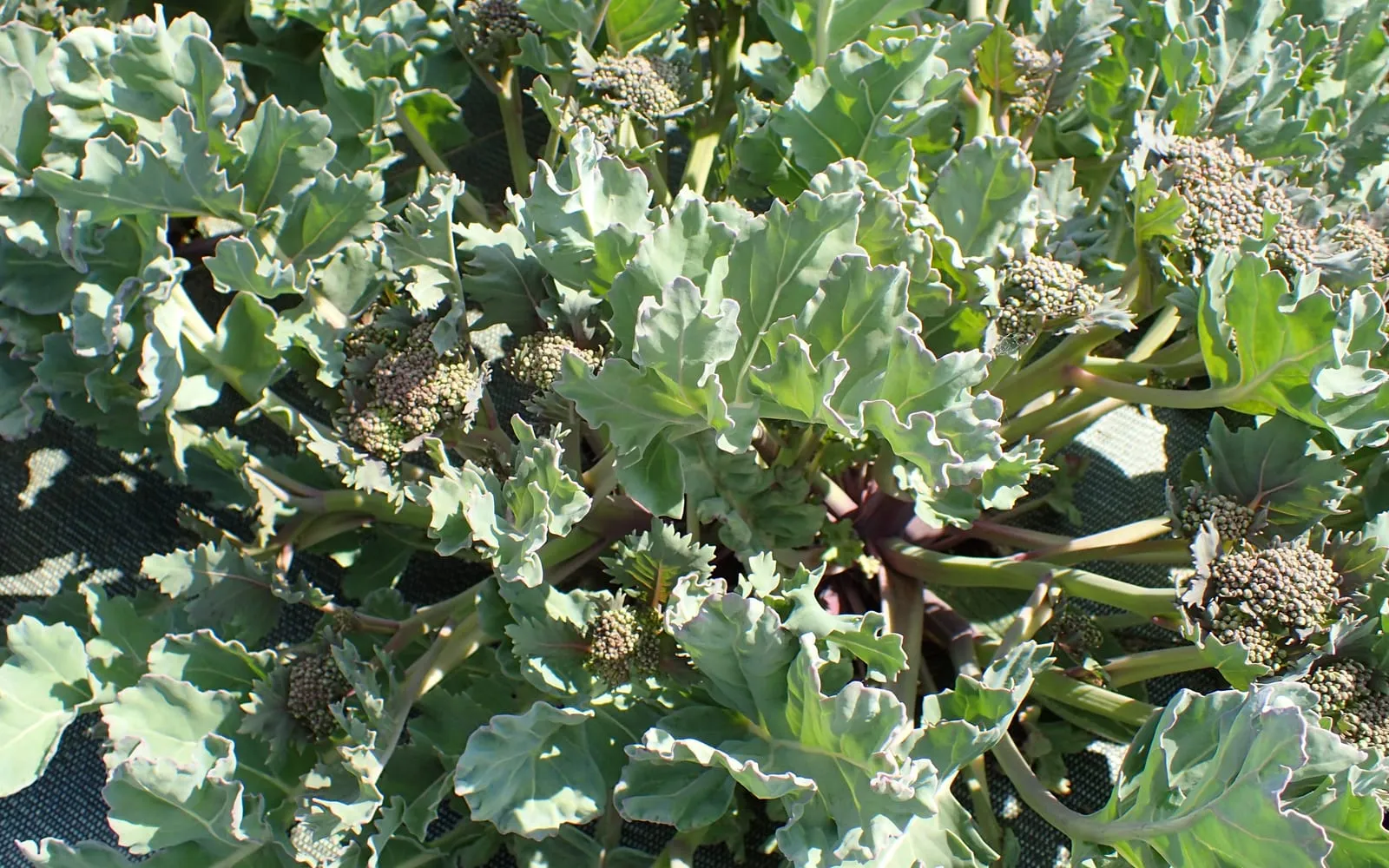
A broad mound of very large leaves, each up to 30 cm across, oval to rounded with deeply wavy and lobed margins, in a distinctive waxy blue-grey.
The leaves are thick and fleshy with a bloom that water beads on, an adaptation to salt spray and drying wind.
The root is a deep, thick, fleshy taproot with side roots, and those side roots are what provide the thongs used for propagation.
Forced shoots are white to cream, sometimes flushed pink or purple at the tip, 20 to 25 cm long, and crisp.
In June the plant produces broad domed heads of small white four-petalled flowers with a strong honey scent, followed by round papery seed pods that float, which is how the plant spreads along a beach. It is handsome enough to earn a place in an ornamental border.
Where it is from
Sea kale is native to the Atlantic, North Sea and Baltic coasts of Europe, including Britain, where it grows on shingle and sand just above the strand line. It is scarce in Britain, where it is legally protected against uprooting.
The wild plant tolerates salt spray, drought and shifting shingle, and lives for decades on ground that supports almost nothing else.
Beach gatherers ate the naturally blanched shoots long before anybody grew it. A plant buried by drifting shingle produces the same pale shoots a forcing pot does.
Curtis’s 1799 pamphlet moved it into kitchen gardens, and by the mid-nineteenth century it was standard in walled gardens across Britain, forced under terracotta sea kale pots made for the purpose. Those pots are now collectable garden antiques.
Commercial growing collapsed in the twentieth century and it survives mostly in restaurant kitchen gardens and among gardeners who like a spring vegetable nobody else has.
How it grows
Grow from thongs rather than seed where you can. A thong is a pencil-thick side root 10 to 15 cm long, cut flat at the top and slanted at the base, planted vertically in March with the top just below the surface.
Seed works and takes longer. Sow in March in modules, remove the corky seed coat by rubbing to improve germination, and plant out in autumn. Expect to wait three years before forcing.
Plant 45 to 60 cm apart in deep, free-draining, sandy ground in full sun.
Leave the plant alone for two full years. Let it build a crown and a root, cut off the flowering stems, and force nothing.
From the third year, force in February. Cover the dormant crown with a traditional sea kale pot, an upturned bucket, or a large pot with the drainage hole blocked, and pack straw or leaves around it for warmth.
Cut the shoots at 20 cm in March, taking them at the base with a knife. Take one cutting per crown and then remove the pot and let the plant grow away in the light for the rest of the year.
Through the seasons
Midwinter is when the crowns go dormant. Clear the dead foliage in January and mulch around the plants.
February is forcing. Cover the crowns and exclude all light. Check under the pot for slugs weekly, since they find blanched shoots before you do.
March brings the harvest. Cut the shoots at 20 cm, then uncover the crown and let it green up.
Summer is recovery. Feed after forcing, water in the first year, and remove the flowering stems on plants you intend to force again, unless you want the seed or the display.
Autumn is for taking thongs from lifted plants and for cutting back the dying foliage. Do not force a crown that was forced the previous spring, or it will exhaust itself.
Care difficulty
Moderate, and the difficulty is patience rather than technique.
The plant needs two full years before it can be forced, and forcing it too soon kills it or sets it back years. This is the commonest way people lose a sea kale bed.
Drainage is the second requirement and it is absolute. Sea kale rots over winter on heavy wet ground. Raised beds, sand and grit worked in, or a gravel bed all solve it.
Slugs under a forcing pot are the practical nuisance. A dark, damp, warm space containing tender white shoots is the best slug habitat anyone could design. Check weekly.
Alternate the crowns you force, resting each for a year, or the plants exhaust themselves.
Once established, the plant lives for decades with very little attention.
Watering
Water weekly through the first summer while the plant establishes.
An established plant rarely needs watering. The taproot goes deep and the species is adapted to shingle, which holds very little water.
Water after forcing, once the pot comes off, to help the plant recover.
Avoid watering into the crown in winter. Wet soil around a dormant crown on heavy ground is what rots it.
Container growing is possible in a deep pot of at least 45 cm with very free drainage, though a plant in the ground makes a better crown.
Warning signs, diseases and pests
Slugs are the main pest and they concentrate under the forcing pot, where they find the blanched shoots first. Lift the pot weekly through February and March and clear them.
Cabbage white caterpillars strip the summer leaves. The crown survives, and netting is worthwhile on young plants still building a root.
Flea beetle shot-holes young foliage without lasting harm.
Clubroot affects sea kale as it does all brassicas, distorting the root and weakening the plant. Do not plant into ground with a clubroot history.
Root rot follows waterlogging over winter on heavy ground and is the commonest way an established plant dies. Improve drainage before planting.
An exhausted crown produces few thin shoots. Rest it for a year and feed it.
Violet root rot occasionally attacks the root on wet ground, showing as a purple felty growth.
Growing environment
Full sun, and the more the better.
Deep, free-draining, sandy or gravelly soil is the requirement, and it is worth building if the garden does not have it. Work sharp sand and grit into a raised bed to at least 40 cm.
Sea kale tolerates and even appreciates a poorer soil than most vegetables, and it will not tolerate winter wet.
Lime to pH 6.5 to 7.5. It grows naturally on shell shingle and takes an alkaline soil happily.
Give it a permanent position. This is a perennial that will occupy the same ground for twenty years or more, so do not put it in a rotation bed.
Shelter is unnecessary. The plant is adapted to coastal gales and salt spray, and it is a good choice for a seaside garden.
Feeding
Feed once a year, after forcing has finished, with well-rotted compost or seaweed meal spread around the crown.
Seaweed meal suits it particularly, which is unsurprising in a shingle-beach plant.
Avoid heavy nitrogen, which produces soft leaves and a weaker crown.
Mulch in autumn with compost or leaf mould, kept clear of the crown itself.
A plant that has been forced hard benefits from a spring feed and a season off.
Troubleshooting
Thin, weak forced shoots. The crown is too young or was forced last year too. Wait until the plant is three years old, and rest each crown every other year.
Slugs ate the shoots under the pot. Lift the pot weekly through the forcing period and clear them out. It is the best slug habitat in the garden.
The plant rotted over winter. Waterlogging. Sea kale needs sharp drainage. Rebuild the bed with sand and grit, or plant on a raised mound.
Green shoots rather than white ones. Light is getting under the pot. Block the drainage hole, weight the pot down, and pack straw around the base.
Swollen distorted roots. Clubroot. Do not plant sea kale on ground with a clubroot history.
The leaves were stripped in summer. Cabbage white caterpillars. Net young plants that are still building a crown.
Can I eat the green leaves? Yes, cooked. They are strong and slightly bitter, more like a coarse kale than the forced shoots. Take a few and leave the plant enough to build its root.
Can I collect plants from a beach? No. Sea kale is scarce and protected under the Wildlife and Countryside Act 1981, and uprooting a wild plant without the landowner’s permission is an offence. Buy seed or thongs from a nursery.
Sea Kale problem guides
Not sure what is wrong? See the common vegetable pests guide.