
Edible
Black Cherry
Prunus serotina
Also known as Wild Black Cherry, Rum Cherry
How to grow black cherry, Prunus serotina. Why wilted or frost-damaged leaves carry more cyanide risk than fresh ones, telling ripe fruit from the bitter unripe kind, and why a swallowed stone is safer than a crushed one.
At a glance
- Difficulty
- Easy
- Water
- Water while young; established trees need none beyond rainfall
- Light
- Full sun to light shade
- Temperature
- Fully hardy
- Hardiness
- USDA 3-9, RHS H7, hardy to -30 C
- Type
- Fast-growing deciduous tree
- Height
- 20-30 m
- Native to
- eastern North America
Extremely cold hardy across almost its entire native range, from eastern Canada down to the Gulf states, and winter is rarely what limits where it can be planted. It is a pioneer species that colonises open and disturbed ground readily, which is useful to know before planting one deliberately: given full sun and average soil, it seeds around and establishes with very little encouragement.
Hardiness zones describe winter cold alone. Summer heat, humidity, rainfall and the length of the growing season decide as much, so treat the range as the outer limit rather than as a recommendation.
Poisonous if eaten
- Safe to eat
- Ripe fruit flesh, used for jelly, syrup and wine once the stones are removed
- Do not eat
- Leaves, twigs, bark and seed kernels, especially wilted or frost-damaged leaves
- Harm from
- Eating it
- Affects
- People, cats, dogs and horses
The fully ripe, dark purple-black fruit flesh is edible and has long been cooked into jelly, syrup and wine once the bitter stones are strained out. Everything else on the tree carries cyanogenic glycosides that break down into hydrogen cyanide when the tissue is damaged, and the danger is worst in wilted or frost-damaged leaves, where the wilting itself speeds up the chemical reaction that releases the cyanide. That combination has made black cherry a well-documented cause of fatal poisoning in cattle and horses, most often after a storm brings branches down into a pasture and animals graze on the wilting leaves before they dry out completely. An intact swallowed pit usually passes through harmlessly, but a crushed or chewed seed kernel releases the same toxin as the leaves, and a child or pet that eats a quantity of leaves, bark or crushed pits needs the same urgency as any other cyanide exposure. Ripe fruit flesh eaten on its own, with the stones spat out rather than chewed, carries none of this risk.
Sources: ASPCA toxic and non-toxic plants, RHS potentially harmful garden plants
About
Black cherry is a fast-growing native tree valued both for a fine, reddish timber prized by furniture makers and for dark, bittersweet fruit that ripens to good eating once fully coloured. It is one of the most widespread trees in eastern North America, colonising open and disturbed ground readily and reaching useful size faster than most other native hardwoods.
That same vigour comes with a hazard useful to understand clearly. The ripe fruit flesh is food, and has been for as long as people have picked it, but the leaves, bark and seed kernels contain compounds that release cyanide when damaged, a genuine and sometimes fatal risk to grazing animals in particular.
Appearance and character
Leaves are glossy dark green, oblong and finely toothed, with a pair of small glands where the blade meets the leaf stalk, a detail typical of the genus Prunus. Crushed or scratched, both leaves and twigs give off a distinctive bitter almond scent, the smell of the same cyanogenic compounds that make the foliage hazardous.
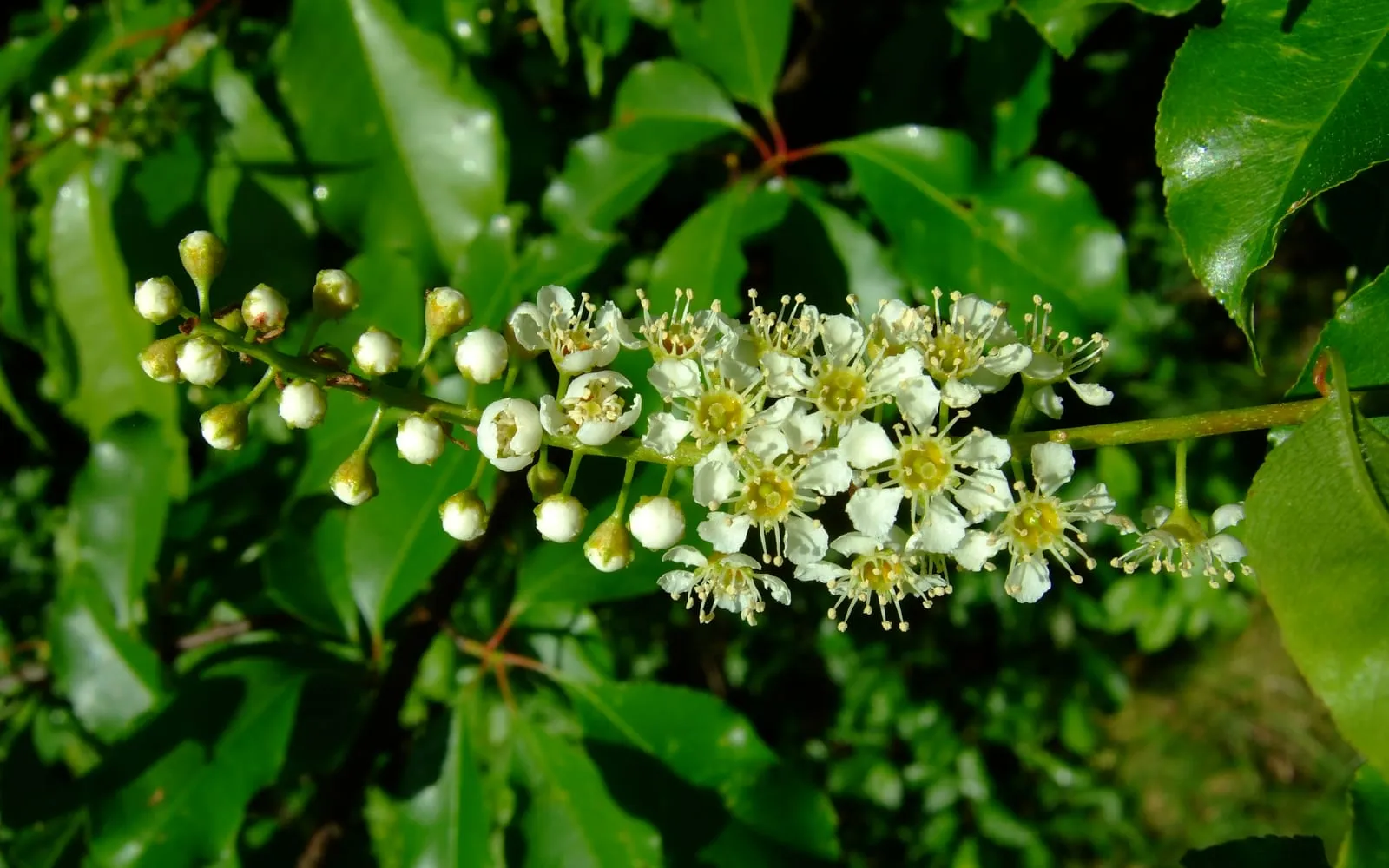
Young bark is smooth and reddish-brown, marked with horizontal streaks, and matures on an older trunk into dark, rough, small scaly plates often compared to burnt flakes. White flowers open in drooping, elongated clusters after the leaves have emerged in spring, a later and looser arrangement than many ornamental cherries that flower on bare wood.
The fruit ripens through late summer from red to a deep, almost black purple, hanging in small drooping clusters. Unripe or partly ripe fruit is sharply bitter and astringent; only fully dark, soft fruit is worth picking, and even then the flavour is more suited to cooking with sugar than to eating fresh off the tree.
Where it is from
Prunus serotina is native across most of eastern North America, from southeastern Canada down through the eastern United States into Texas and Florida, with separate populations in the mountains of Mexico and Central America. It grows naturally as a pioneer of forest edges, clearings and disturbed ground, often among the first trees to establish after logging, fire or farmland abandonment.
That pioneering habit explains both its fast growth and its tendency to seed itself widely wherever birds carry the fruit, since birds are the main dispersers of the seed and show none of the sensitivity to the cyanogenic compounds that grazing mammals do.
How it grows
Plant in full sun to light shade in almost any reasonably drained soil; black cherry is not fussy about soil type and grows fastest in open ground with good light. It establishes quickly from a young tree and needs comparatively little aftercare once past its first couple of seasons.
Site it away from grazing land or paddocks where livestock could reach fallen or storm-broken branches, since wilting leaves on damaged wood are the single most common source of serious cyanide poisoning in animals associated with this species.
Prune, where needed, in summer rather than winter, since pruning wounds made during the dormant season are more vulnerable to silver leaf infection, a fungal disease that enters through fresh cuts in cool, damp conditions.
Allow it the eventual space of a large tree from the outset. It grows fast when young and can reach a substantial size within a couple of decades, so a position too close to a building or boundary becomes a problem sooner than with many slower trees.
Through the seasons
Spring brings leaf emergence followed by the white flower clusters, opening later than many ornamental cherries since the leaves come first.
Summer is the main growing season, with fruit developing through the early part and ripening from red to black by late summer.
Autumn brings good yellow to red leaf colour before leaf fall, and is a reasonable time to plant a new tree in a mild climate.
Winter is complete dormancy. The tree is fully hardy through severe cold and needs no protection once established.
Care difficulty
Easy. Black cherry grows readily in ordinary soil with minimal intervention, needing no routine feeding and only occasional pruning to remove damaged or crossing wood. The genuine care consideration is siting, keeping grazing animals away from fallen branches and choosing a spot with room for a large, fast-growing tree, rather than any ongoing horticultural attention the tree itself demands.
Watering
Water a newly planted tree regularly through its first one to two growing seasons while the root system establishes, particularly during any dry spell.
Once established, it needs no supplemental watering in most climates and tolerates both average garden soil and drier conditions well, a legacy of its pioneering habit on disturbed, often unimproved ground.
Warning signs, diseases and pests
Eastern tent caterpillars are a classic pest of this species, building conspicuous silk tents in branch forks in spring and feeding on the surrounding foliage. Removing tents while small, ideally in the evening when caterpillars are inside, limits defoliation on a manageable tree.
Silver leaf disease dulls the foliage to a silvery sheen on affected branches and causes progressive dieback, entering through pruning wounds made in cool, wet weather. Pruning only in summer, when infection risk is lowest, is the main preventative measure; there is no cure once a branch is infected, and removing it is the usual response.
Bacterial canker causes sunken, gummy lesions on the bark and small, round holes in the leaves where infected tissue has dropped out. Cutting out affected branches during dry weather and avoiding wounding the tree unnecessarily both help limit its spread.
Aphids cluster on young growth, curling and distorting the leaves. Light infestations are usually kept in check by natural predators without intervention.
Growing environment
Full sun produces the strongest, most vigorous growth and the best fruit crop, though the tree tolerates a good deal of shade, particularly when young, as it would growing up among other trees at a forest edge.
Almost any well-drained soil suits it, from poor sandy ground to average garden loam, reflecting its role as a coloniser of disturbed sites rather than a specialist of rich, cultivated soil.
Keep the eventual mature size in mind when choosing a position, since a tree planted too close to structures or boundaries becomes difficult to manage once it reaches its full height.
Feeding
Feeding is rarely necessary. Black cherry grows well without supplemental fertiliser in most soils, another consequence of its adaptation to disturbed, often nutrient-poor ground where it is frequently one of the first trees to establish.
Where soil is very poor, a single light application of a balanced fertiliser in spring during the tree’s early years can support faster establishment, though this is rarely essential.
Troubleshooting
Storm damage has left broken branches lying in a field where animals graze. Remove the branches promptly rather than leaving them to wilt in place, since wilting foliage on damaged wood is when cyanide release is at its worst and grazing animals are most at risk. Fencing animals away from the area until debris is cleared is the safest approach.
The fruit tastes bitter and unpleasant. It was picked before full ripeness. Only fully dark, soft, almost black fruit has lost enough of its astringency to be worth using, and even then it is better suited to cooking with sugar than to eating raw off the tree.
Foliage on part of the tree has turned a dull, silvery colour. This is the classic sign of silver leaf disease, usually following a pruning wound made in damp, cool weather. There is no treatment for an infected branch beyond removing it, and pruning only in summer in future reduces the risk of it happening again.
Seedlings keep appearing all over the garden. Birds that eat the fruit disperse the seed widely, and black cherry germinates readily in open ground. Pulling unwanted seedlings while they are small is far easier than dealing with an established one later.
Is the fruit safe for children to eat? The ripe, dark flesh is fine in modest quantity, with the stones spat out rather than chewed, since a crushed or chewed seed kernel carries the same cyanide risk as the leaves. Supervising young children while they eat wild fruit and discouraging pit-chewing is a sensible precaution with any Prunus species, more than this one.