
Edible
Red Amaranth
Amaranthus cruentus
Also known as Purple amaranth, Blood amaranth, Huauhtli, Callaloo
How to grow amaranth, Amaranthus cruentus. A grain the Spanish tried to ban, seeds that pop like tiny popcorn, and leaves that cook like spinach.
At a glance
- Difficulty
- Easy
- Water
- Water through establishment, then sparingly
- Light
- Full sun
- Temperature
- 20-30 deg C, and growth stops below 15
- Hardiness
- USDA 2-11, RHS H2, hardy to 2 C
- Type
- Tender annual
- Height
- 100-200 cm
- Native to
- central America, southern Mexico and Guatemala
- Best month
- May, June and September in the Northern Hemisphere, November, December and March in the Southern Hemisphere
A C4 plant that takes heat, drought and poor soil, and most grain amaranths are short-day, so a Mexican or Central American variety at high latitude runs to leaf and flowers too late to fill. Soil needs about 15 C to germinate and frost ends it. The leaves are eaten as a vegetable across Africa, Asia and the Caribbean, which is a larger use than the grain in much of the world.
Hardiness zones describe winter cold alone. Summer heat, humidity, rainfall and the length of the growing season decide as much, so treat the range as the outer limit rather than as a recommendation.
Every month named in this guide is for the temperate Northern Hemisphere. If you garden in the Southern Hemisphere, shift each one by six months, so May becomes November. Closer to the equator the wet and dry seasons matter more than the calendar, and the shift stops being a useful guide.
Edible, with limits
- Safe to eat
- The seed, and the young leaves cooked
- Do not eat
- Large quantities of raw leaf, and any leaf from a heavily fertilised plant
- Harm from
- Eating it
- Affects
- People, horses, cats and dogs
Amaranth grain contains no gluten and is safe. The leaves need two qualifications. They contain oxalates in the same way spinach, chard and beetroot leaves do, so anyone advised to limit oxalate for kidney stones should treat amaranth the same way, and cooking with the water discarded reduces the level. More significantly, Amaranthus species accumulate nitrate, particularly when grown on heavily manured or fertilised ground, and nitrate poisoning of cattle, pigs and sheep grazing pigweed species is documented in veterinary literature. Horses are also affected. Do not feed quantities of amaranth foliage to livestock or to rabbits and guinea pigs, and do not grow the leaf crop on ground that has just had a heavy nitrogen dressing. Ordinary human consumption of cooked young leaves is not a concern.
Sources: RHS on potentially harmful garden plants, British Horse Society on poisonous plants
About
Amaranth is a pseudocereal, like quinoa and buckwheat, grown for a tiny seed used as a grain and for leaves eaten as a vegetable. Amaranthus cruentus is one of three grain species, and it belongs to the same genus as the pigweeds that come up in disturbed ground worldwide.
Mesoamerica built a food system on it. The Aztecs grew huauhtli on a scale comparable to maize and beans, and it appears in tribute lists as one of the principal staples. It also had a ritual use. Priests ground the seed into a dough called tzoalli, shaped it into figures of deities, and the figures were eaten. Spanish administration discouraged the crop for that reason, and although the frequently repeated claim that it was banned outright is hard to source, cultivation collapsed after the conquest and survived in remote areas.
The plant is easy in a temperate garden. It grows fast in warmth, tolerates drought, produces a spectacular flower head, and gives both a leaf crop and a seed crop from the same sowing.
Appearance and character
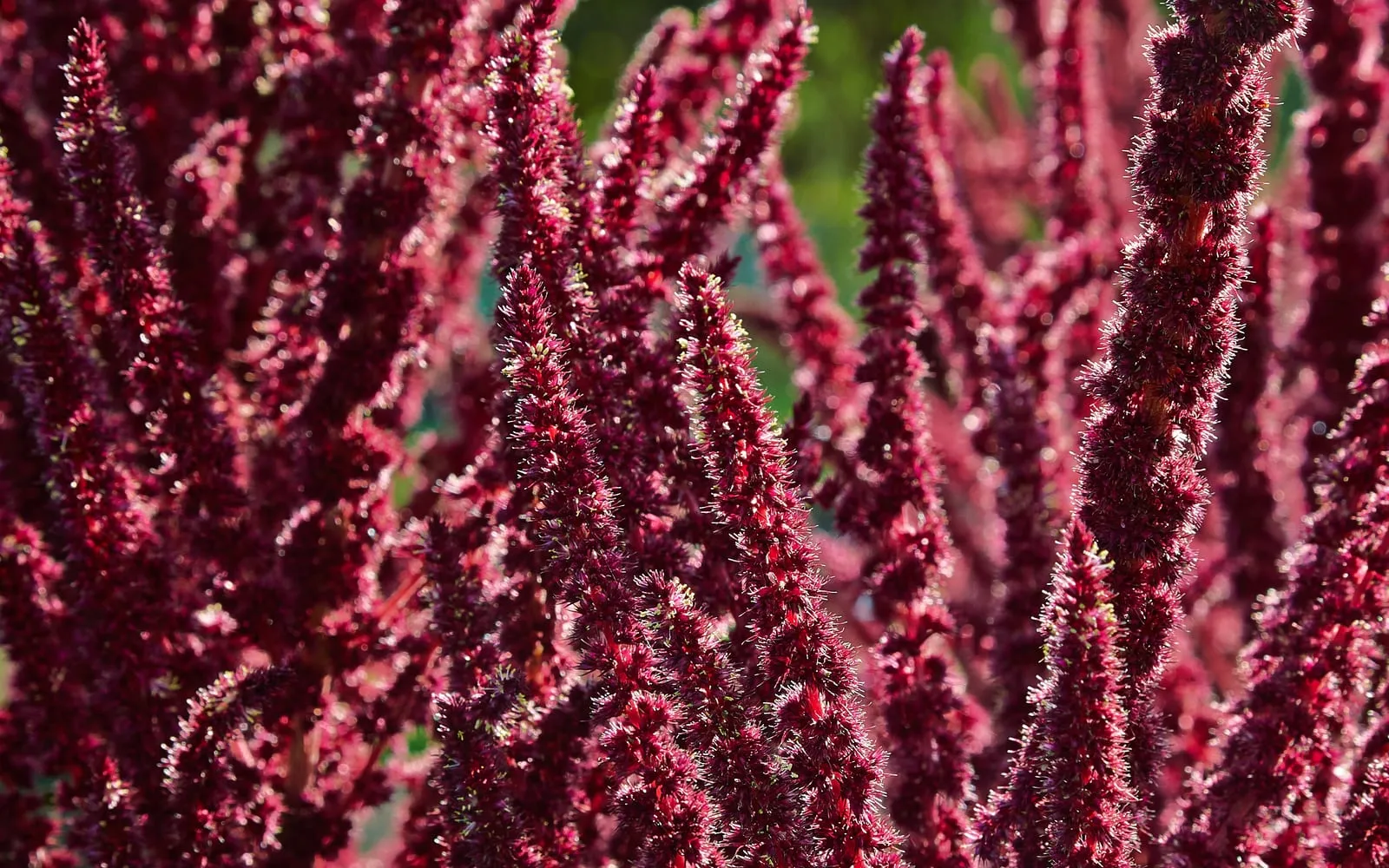
The plant is upright and branching, with a thick often reddish grooved stem and broad oval leaves that can be green, bronze, purple or striped depending on the variety. Red amaranth varieties carry crimson pigment through the whole plant.
The flower head is a dense plume at the top of the stem, standing upright and branching into a heavy candelabra shape, and it can be crimson, purple, gold or green. It is made of thousands of minute flowers with papery bracts, and it holds its colour for months.
The seed is tiny, about 1 mm across, round, shiny and pale gold to black depending on the variety. A single plant produces tens of thousands of them, and they thresh free of any hull, which is a real advantage over the millets.
Where it is from
Amaranthus cruentus was domesticated in southern Mexico and Guatemala from the wild species Amaranthus hybridus, with archaeological seed from Tehuacan in Mexico dating cultivation to around 4000 BC.
It became one of the staple crops of Mesoamerica, grown alongside maize, beans and squash, and it travelled as a food and a ritual plant across the region. Two sister species were domesticated separately, Amaranthus hypochondriacus further north in Mexico and Amaranthus caudatus in the Andes.
After the Spanish conquest the crop retreated to remote highland areas and to kitchen gardens. Its revival began in the 1970s, and it is now grown commercially in Mexico, Peru, India, China and Nepal, and increasingly for the leaf across Africa and the Caribbean.
How it grows
Amaranth seed is minute and germinates on the surface, so sowing depth is the one thing to get right. It needs warmth, around 18 deg C, and light, and the seedlings are small and slow for their first three weeks.
After that the plant accelerates. It uses C4 photosynthesis, the efficient pathway that maize and sorghum use, and it will put on a metre in six weeks in a warm July while shrugging off drought that stops a bean.
Flowering starts in late summer and the head fills over about six weeks. The plant is wind-pollinated and outcrosses freely, so saved seed from a mixed planting will not come true. Ripe seed shatters readily, and the reliable harvest method is to bend the head into a bag or a bucket and shake it.
Through the seasons
Sow indoors in April in modules, or outdoors from late May once the soil is above 15 deg C. Barely cover the seed. Thin or plant out to 30 to 45 cm apart.
Growth is slow through June and rapid through July. Pick leaves from the point the plant is 30 cm tall, taking the growing tips to encourage branching, and keep picking through the summer.
The flower head appears in August and colours through September. Harvest seed in late September or early October when the head has started to dry and seed falls when you rub it. Shake or strip the heads into a bucket, dry the seed thoroughly, and winnow. The first frost ends the plant.
Care difficulty
Amaranth is easy once it is up and vulnerable before that. The seed is minute, the seedlings take three weeks to look like anything, and slugs will clear a row in a night, so raising it in modules and planting out at 10 cm is worth the trouble.
After establishment it needs nothing. It tolerates drought, poor soil and heat, and disease rarely troubles it outside its home range.
The one recurring nuisance is self-seeding. A plant left to shed produces thousands of volunteers that look exactly like pigweed, and they will keep coming for two or three years. Cut the heads before they drop if you do not want them.
Watering
Water at planting and through establishment while the root system develops. After that amaranth is markedly drought tolerant and does better on the dry side.
A soak during a long dry spell in July supports the leaf crop, and picking leaves from a drought-stressed plant gives you tough bitter ones.
Waterlogging is poorly tolerated and shows as yellowing and stunting. Free drainage is more important than fertility, and a raised bed suits it.
Warning signs, diseases and pests
Slugs are the pest that costs a sowing. Amaranth seedlings are tiny and slow for three weeks, and a wet spell in that window hands the bed over. Plant out from modules at 10 cm tall instead of direct sowing.
Aphids gather on the growing tips and inside the developing flower heads, where they are hard to reach and where they leave honeydew that turns the head sticky.
Leaf miner tunnels pale winding trails in the lower leaves. It looks alarming and does little damage on a plant this vigorous, so pick off the worst leaves and carry on.
Birds take ripening seed, which is worth netting against if the seed crop matters. Frost ends the plant, and the first cold night in October turns the whole thing black.
Growing environment
Full sun and warmth. Amaranth is a C4 plant from Mesoamerica and it grows properly above 20 deg C, doing very little below 15.
Soil should drain freely and be moderately fertile. The plant tolerates poor ground and produces a smaller crop there, and it copes with pH from 5.5 to 7.5. Heavy nitrogen produces lush leaf that accumulates nitrate, which is a reason to be moderate rather than generous.
Shelter helps the tall varieties, which become top heavy once the flower heads are full and will lean or snap in an exposed spot. Staking a two-metre plant is reasonable in a windy garden.
Feeding
Feed moderately, and think about which crop you want. A leaf crop responds to nitrogen with more and better leaves, and a seed crop responds with height, lodging and delayed ripening.
One dressing of a balanced granular feed at around six weeks suits both purposes on ordinary soil.
Do not overdo the nitrogen on a leaf crop. Amaranthus species accumulate nitrate, and heavily fed plants carry more of it, which is a real veterinary problem in grazing animals and a reason for moderation in a vegetable bed.
Troubleshooting
Can I eat both the leaves and the seed? Yes, and that dual use is the point of the plant. Pick young leaves through the summer and cook them like spinach, then let the head mature and take the seed in autumn.
How do I harvest such small seed? Bend the dry head into a bucket or a bag and shake or rub it. What falls out is a mixture of seed and chaff, which separates by winnowing in a light breeze or by sieving.
Can I pop amaranth? Yes. A tablespoon of dry seed in a hot dry pan, covered and shaken, pops in seconds into something the size of a pinhead. It is a traditional Mexican preparation and it is what alegria bars are made from.
Is it gluten-free? Yes. Amaranth is a pseudocereal with no relationship to the grasses and no gluten.
Was amaranth banned by the Spanish? Cultivation collapsed after the conquest and Spanish authorities discouraged it because of its ritual role, in which ground seed was formed into figures of deities and eaten. The claim of an outright ban is repeated widely and is hard to substantiate.
Is it the same as pigweed? Same genus. Pigweeds are wild Amaranthus species, and Amaranthus cruentus was domesticated from one of them. Volunteer seedlings from a crop look exactly like weeds.
Are the leaves safe? Cooked, in ordinary quantities, yes. They contain oxalates like spinach and chard. Do not feed quantities of the foliage to livestock or to rabbits and guinea pigs, since Amaranthus species accumulate nitrate and grazing poisoning is documented.
Why did my plant fall over? Top-heavy flower heads in an exposed site. Stake the tall varieties once the head starts to fill, or grow a shorter variety.
Red Amaranth problem guides
Not sure what is wrong? See the common vegetable pests guide.