
Edible
Garden Cress
Lepidium sativum
Also known as Cress, Mustard and cress, Peppergrass, Halim
How to grow garden cress, Lepidium sativum. Ready in a fortnight on a windowsill, growing it in the ground for a bigger crop, and the mustard-and-cress timing trick.
At a glance
- Difficulty
- Easy
- Water
- Daily on a windowsill, every few days in the ground
- Light
- Full sun to light shade
- Temperature
- 10-20 deg C. Bolts fast in heat
- Hardiness
- USDA 2-11, RHS H4, hardy to -5 C
- Type
- Annual
- Height
- 15 cm as a crop, 60 cm in flower
- Native to
- Western Asia and north-east Africa
- Best month
- March in the Northern Hemisphere, September in the Southern Hemisphere
Fast enough to crop in three weeks from sowing, which means it fits any climate with a short cool window rather than needing a season. Heat above about 25 deg C sends it straight to flower. Successional sowing every fortnight is how it is grown everywhere it is grown.
Hardiness zones describe winter cold alone. Summer heat, humidity, rainfall and the length of the growing season decide as much, so treat the range as the outer limit rather than as a recommendation.
Every month named in this guide is for the temperate Northern Hemisphere. If you garden in the Southern Hemisphere, shift each one by six months, so March becomes September. Closer to the equator the wet and dry seasons matter more than the calendar, and the shift stops being a useful guide.
Not known to be toxic
- Safe to eat
- The seedlings, leaves and seed pods, raw
Garden cress is a food crop and carries no toxicity concern. The RHS does not list Lepidium sativum as a potentially harmful garden plant and the ASPCA does not list it as toxic to cats and dogs, though a dog eating a quantity of it is likely to get an upset stomach from the mustard oils. Those mustard oils are glucosinolates and their breakdown products, the same class that gives radish and watercress their heat, and they are harmless in the quantities anybody eats. The seeds are used medicinally in South Asia under the name halim and are eaten in quantity there without issue. One point applies to seedling crops generally rather than to this plant: sprouted and seedling greens grown warm and damp can carry food-poisoning bacteria if the seed was contaminated, so use seed sold for growing, keep trays clean, and rinse the crop before eating. That is a hygiene point about the method rather than a property of cress.
Sources: RHS potentially harmful garden plants, ASPCA toxic and non-toxic plants
About
Garden cress is the fastest crop anybody grows. Seed on damp kitchen paper on Monday gives something worth cutting by the following weekend, which is why it has been the standard first plant handed to children for a century.
Grown properly in soil rather than on a saucer, it is a considerably better vegetable than that suggests. Plants reach 15 cm in three weeks with a hot peppery flavour close to watercress, and a row sown every fortnight from March gives a supply that costs almost nothing.
The mustard-and-cress pairing has a timing trick behind it. Cress germinates in two days and mustard in one, so sowing the cress three days before the mustard brings both to cutting height together. Sown on the same day, the mustard swamps the cress.
Appearance and character
An upright plant, 15 cm as a leaf crop and up to 60 cm when it runs to flower.
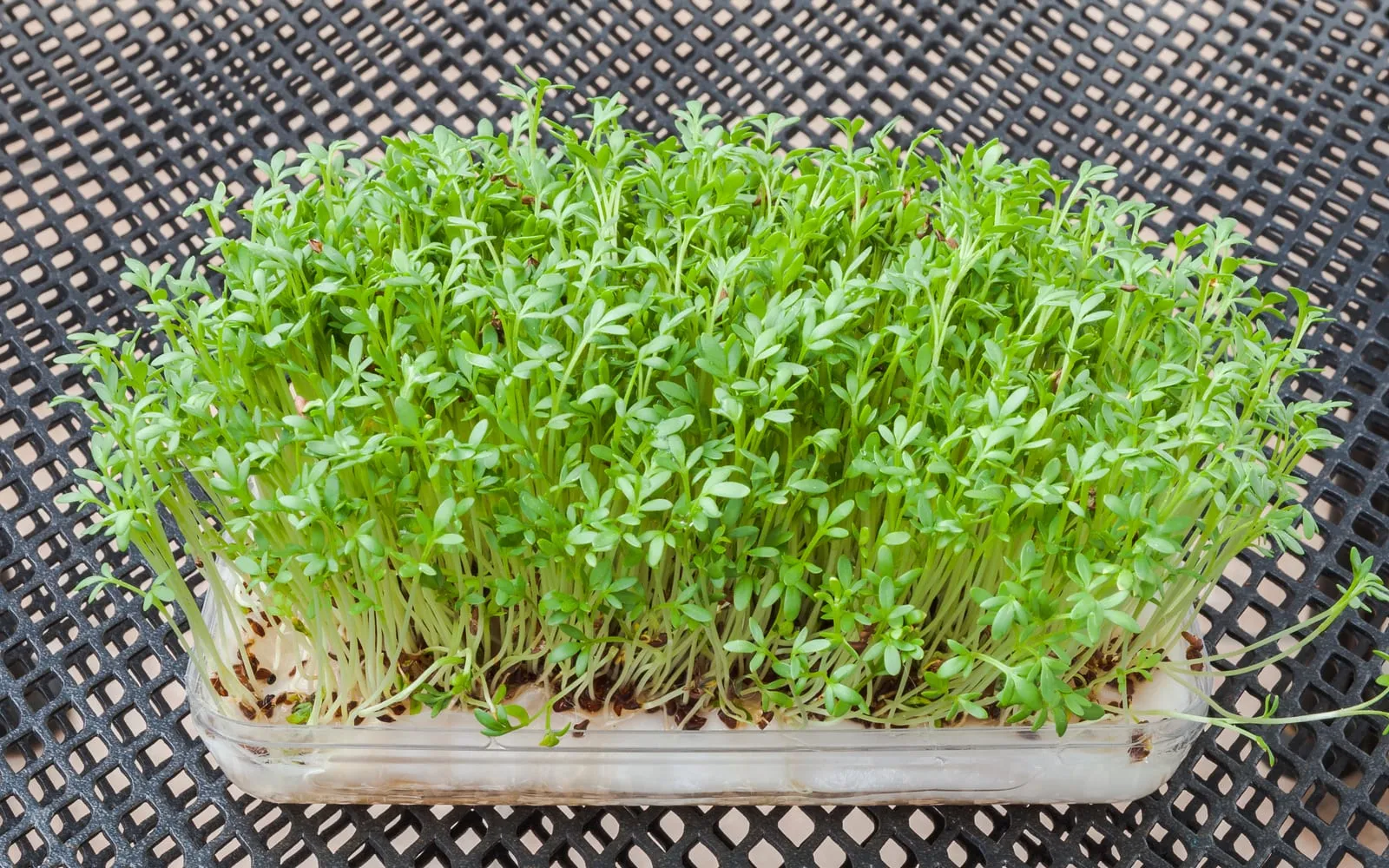
Seedling leaves are the familiar pair of rounded cotyledons on a white stem, which is the whole plant in a punnet of mustard and cress.
True leaves are finely divided and feathery, in a fresh bright green. The curled forms sold as ‘Extra Curled’ are frillier and more decorative, and the broad-leaved forms are milder.
Flowers are tiny and white, on branching spikes, followed by flat rounded seed pods with a notch at the top.
Flavour is hot and peppery, stronger than rocket and closer to watercress, intensifying as the plant ages and in dry weather.
Where it is from
Garden cress is native to western Asia and north-east Africa, probably around Egypt, Iran and Ethiopia.
Cultivation is very old. It appears in Egyptian records, and Greek and Roman authors treat it as an everyday plant. Persian gardens grew it and the Persian word for it entered several European languages.
India grows it as halim or aliv, using the seed rather than the leaf, in sweets and in traditional medicine.
Britain has grown it since at least the Middle Ages, and it became a Victorian staple as the cress half of mustard and cress, sold in punnets and grown on flannel by the tray in market gardens.
It is a Lepidium, in the same genus as the pepperweeds and dittander, and a brassica like radish and mustard.
How it grows
For seedling crops, sow thickly on damp kitchen paper, capillary matting or fine compost in a shallow tray. Keep in the light and cut with scissors at 5 cm, which takes seven to ten days. There is no second cut.
For proper leaf crops, sow direct in the ground from March to September at 1 cm deep in rows 15 cm apart, thinned to 10 cm.
Germination takes two to four days, which is faster than anything else in this collection.
Cut leaf crops at 10 to 15 cm, around three weeks from sowing. A hard cut leaves a stub that regrows once, and the second cut is smaller and hotter.
Sow every fortnight. The crop is over in a month either way, so succession is the whole technique.
For mustard and cress together, sow the cress three days before the mustard.
Through the seasons
Late winter is windowsill season. A tray of cress in February is the first green thing of the year and takes ten days.
Spring starts outdoor sowings from March. Cool damp spring weather gives the best leaf crops, mild and generous.
Summer is difficult outdoors. Heat brings bolting within a fortnight and a fierce flavour. Sow in light shade, keep it damp, and cut very young.
Autumn brings good outdoor crops again from September as the weather cools.
Winter is indoor growing. A tray on a cool bright sill produces all winter, and cress is one of very few crops that works this way.
Care difficulty
The easiest crop in the collection, and the one most likely to succeed for somebody who has never grown anything.
Speed is what makes it easy. Nothing has time to go wrong in ten days.
Damping off is the one indoor problem, caused by sowing too thickly in a closed container with no airflow. Sow thinly, ventilate, and do not cover the tray once the seed has germinated.
Bolting is a summer problem outdoors and is solved by sowing in spring and autumn.
Keeping the surface damp is the only daily job, and a tray dries out in hours on a warm sill.
Watering
Water daily for tray crops. A shallow tray of seedlings dries out within a day and a dried-out cress crop does not recover.
Water from below where possible, standing the tray in shallow water for a few minutes, which avoids flattening the seedlings.
Outdoor rows need watering every few days in dry weather. A dry plant is hot, tough and bolts sooner.
Keep the surface damp during germination, which takes only two to four days.
Never let a tray stand in water permanently, which brings damping off.
Warning signs, diseases and pests
Damping off collapses seedlings at soil level in a crowded warm tray. Sow more thinly, ventilate, and remove any cover once germination starts.
Flea beetle shot-holes outdoor sowings from April to July. Fine mesh from the day of sowing, and the crop is usually cut before the damage matters.
Slugs graze outdoor seedlings. Water in the morning.
Bolting sends up a flower spike within weeks in warm weather and turns the leaves fierce. Sow in spring and autumn and cut young.
A mouldy tray means the seed was sown too thickly or the tray was covered too long.
Yellowing seedlings in a tray mean too little light. Move to a bright sill.
Growing environment
Full sun to light shade outdoors, and a bright cool windowsill indoors. Direct midday sun on a warm sill cooks a tray.
Fertile, moisture-retentive soil for outdoor crops.
Neutral to slightly acid soil, pH 6 to 7.
For tray crops, almost any substrate works. Kitchen paper, capillary matting and cotton wool all carry a crop, and fine seed compost gives a better one than any of them because the seedlings can feed.
Ventilation indoors prevents damping off.
Rotate outdoor rows with the brassicas where clubroot is present, though a three-week crop rarely picks anything up.
Feeding
Garden cress needs no feeding. The crop is finished before feeding could have any effect.
Tray crops grown on paper live entirely on the seed’s own reserves, which is why they cannot be cut twice.
Outdoor rows on soil in reasonable heart need nothing.
Never use fresh manure or high nitrogen. Both give soft growth and a duller flavour, and neither is warranted for a crop this brief.
Troubleshooting
The seedlings collapsed at the base. Damping off. Sow more thinly, ventilate, and take any cover off once the seed has germinated.
The tray dried out and the crop died. Cress needs the surface damp at all times. Water daily, or stand the tray in shallow water for a few minutes.
It flowered within three weeks. Bolting, which happens fast in warm weather. Sow in spring and autumn outdoors, and cut at 10 to 15 cm.
The mustard swamped the cress. Mustard germinates a day faster and grows quicker. Sow the cress three days before the mustard.
The leaves are too hot. Grown dry or picked too old. Water more and cut younger.
It did not regrow after cutting. A tray crop grown on paper cannot regrow, since there are no reserves. A soil-grown row regrows once, smaller.
Pale yellow seedlings. Too little light. Move to a brighter but cooler position.
Can I grow it all winter? Yes, indoors on a bright cool sill. It is one of very few crops that produces through a cold winter without a greenhouse.
Garden Cress problem guides
Not sure what is wrong? See the common vegetable pests guide.