
Edible
Quinoa
Chenopodium quinoa
Also known as Quinua, Kinwa, Andean rice
How to grow quinoa, Chenopodium quinoa. A fat hen relative from the Andes, the soap coating you have to wash off, and a crop that grows better in a cool summer than a hot one.
At a glance
- Difficulty
- Moderate
- Water
- Water through establishment, then very little
- Light
- Full sun
- Temperature
- Cool suits it. It tolerates light frost and dislikes heat above 32 deg C
- Hardiness
- USDA 4-9, RHS H4, hardy to -5 C
- Type
- Hardy annual
- Height
- 100-200 cm
- Native to
- the Andean altiplano, the Lake Titicaca basin
- Best month
- April, May and September in the Northern Hemisphere, October, November and March in the Southern Hemisphere
It is an Andean crop and it wants cool conditions, performing best between 15 and 20 C, so it suits a cool summer better than most crops with an exotic reputation. Heat above about 35 C makes the pollen sterile, which rules out hot lowland summers. The real difficulty is rain before harvest, which starts the seed germinating in the standing panicle. Saponins coat the seed and have to be washed off or the crop bought pre-rinsed.
Hardiness zones describe winter cold alone. Summer heat, humidity, rainfall and the length of the growing season decide as much, so treat the range as the outer limit rather than as a recommendation.
Every month named in this guide is for the temperate Northern Hemisphere. If you garden in the Southern Hemisphere, shift each one by six months, so April becomes October. Closer to the equator the wet and dry seasons matter more than the calendar, and the shift stops being a useful guide.
Edible, with limits
- Safe to eat
- The seed, once the saponin coating has been washed off, and the young leaves cooked
- Do not eat
- Unwashed seed, whose saponin coating is bitter and irritant
- Harm from
- Eating it
- Affects
- People, dogs and cats
Quinoa contains no gluten and is a staple of gluten-free cooking. The seed is coated in saponins, soap-like compounds the plant uses to deter birds and insects, and they are bitter, irritate the gut and destroy red blood cells in quantity. Commercially sold quinoa has been washed or abraded to remove them, and a further rinse at home takes off what is left. Home-grown seed has not been treated at all, so wash it in several changes of water, rubbing it between your hands, until the water no longer foams. Saponins are more of a problem for pets than for people, since dogs and cats are more sensitive to them, and unwashed quinoa can cause vomiting and diarrhoea in both. Quinoa leaves, like those of spinach and its other Amaranthaceae relatives, contain oxalates, so anyone with a history of kidney stones should treat them the way they treat spinach.
Sources: RHS on potentially harmful garden plants, Blue Cross on foods poisonous to pets
About
Quinoa is a Chenopodium, which puts it in the same genus as fat hen, the weed that comes up in disturbed ground worldwide. It sits in the Amaranthaceae alongside beetroot, spinach and chard. Like buckwheat and amaranth it is a pseudocereal, a broadleaved plant grown for a seed used as a grain.
The Andes domesticated it around the Lake Titicaca basin some five to seven thousand years ago, and it became one of the staples of highland South America alongside potato and maize. The Inca called it the mother grain. Spanish colonial administration suppressed its cultivation in favour of European cereals, and it survived in subsistence farming at altitude.
Its rise since the 1990s has been rapid enough to cause its own problems. World demand pushed Bolivian and Peruvian prices up sharply, which raised grower incomes and made the staple expensive for the urban poor in the same countries. The 2013 International Year of Quinoa marked the peak of that attention, and production has since spread to dozens of countries, Britain included.
Appearance and character
A young quinoa plant looks exactly like fat hen, with the same dull grey-green diamond-shaped leaves carrying a mealy coating that rubs off on a finger. Anyone weeding a quinoa bed for the first time pulls up half the crop.
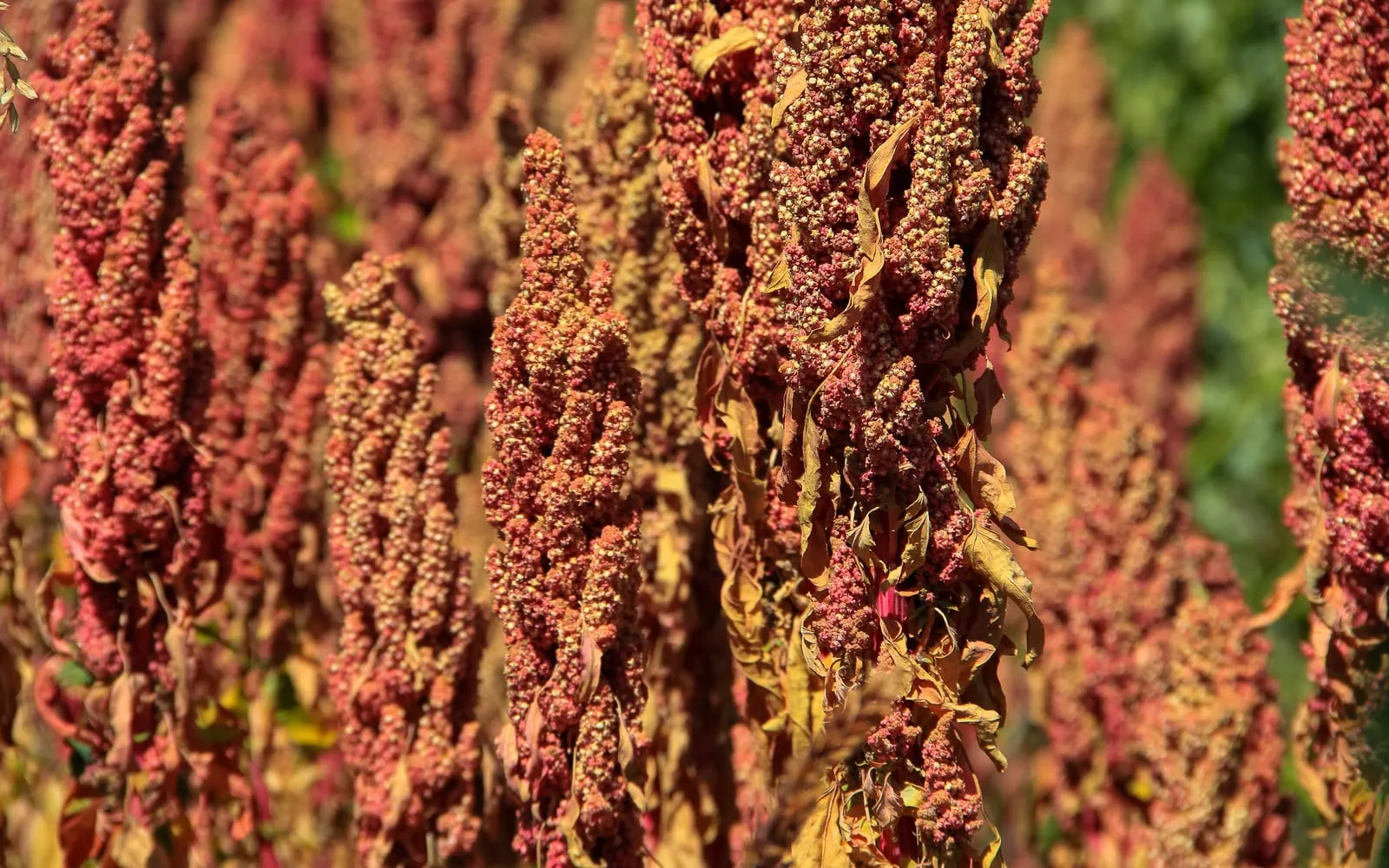
By midsummer the difference is obvious. Quinoa grows to head height or more with a thick, often reddish, grooved stem and branches carrying dense clusters of tiny flowers. As the seed sets, the heads colour, and depending on the variety they turn cream, gold, orange, pink, red or almost black. A ripening quinoa field is one of the more striking things in agriculture.
The seed is a small flattened disc about 2 mm across with a pale ring around the edge, which is the embryo coiled around the outside of the starch. Cooked, that embryo separates and curls, which is the little white tail everyone notices.
Where it is from
Quinoa was domesticated on the altiplano around Lake Titicaca, on the modern border of Peru and Bolivia, from a wild Chenopodium ancestor. Archaeological seed from the region dates cultivation to at least 3000 BC and probably earlier.
The crop adapted into distinct ecotypes across the Andean range. One group came off the Bolivian salt flats, another from the valleys, a third from the high altiplano and a fourth from sea level in southern Chile. That last group matters for northern European growing, since Chilean coastal quinoa is adapted to long days and mild temperatures rather than to tropical highland conditions.
Britain grows it commercially in a small way, mostly in Essex, Shropshire and Hampshire, using varieties bred from that Chilean material. The British climate suits it better than most people expect.
How it grows
Quinoa germinates fast in cool soil, sometimes within two days, and the seedlings are small and vulnerable for the first fortnight. Once past that it grows steadily, forming a taproot that goes deep and gives it real drought tolerance.
Flowering starts around ten weeks after sowing. The flowers are tiny and mostly self-pollinating, with a proportion of wind-borne outcrossing, so saved seed drifts a little in a mixed planting.
Seed fill takes about six weeks, and the plant colours as it goes. The crop is ready when the seed is hard enough to resist a thumbnail and the leaves have mostly dropped. Quinoa has very little seed dormancy, so rain on a ripe head starts germination within a day or two, which is the single biggest risk to a crop grown where autumn is wet.
Through the seasons
Sow in late April or early May, directly into a firm seedbed at about 1 cm deep, in rows 40 to 50 cm apart. The soil needs to be warm enough to move it quickly past the seedling stage, since slugs take the small plants readily.
Thin to about 20 cm apart in the row once the plants are recognisable. Growth is slow for a month and then rapid, and the crop should be at head height by late July with the heads colouring in August.
Harvest in September when the seed is hard and the leaves have dropped. Cut the heads, dry them thoroughly under cover, then rub the seed out and winnow. Wash the seed to remove the saponin before you cook it, and dry it again before storing.
Care difficulty
Quinoa suits a temperate garden better than most exotic-sounding crops. It tolerates cold, likes a cool summer, roots deeply, and needs neither a greenhouse nor much attention.
Three things trip people up. Slug damage at the seedling stage can wipe out a sowing in a night. The seedlings are indistinguishable from fat hen, so sow in straight rows and weed by row rather than by eye. And rain on a ripe head starts the seed germinating in place, which is a timing problem a wet autumn makes real.
The washing is the last obligation and it is easy to underestimate. Home-grown quinoa has its full saponin coating, and it takes several changes of water and some rubbing before the foam stops.
Watering
Water at sowing and through establishment, and then hold back. Quinoa’s taproot goes deep and the plant is drought tolerant once it is up, having been selected on ground that receives very little rain.
A soak in a dry June helps the plant build the frame that carries the head. After flowering, water sparingly, and once the head has coloured, stop.
Waterlogging is poorly tolerated and shows as yellowing and stunting. Free drainage matters more than richness, and the crop does well on light and even saline ground where other things struggle.
Warning signs, diseases and pests
Downy mildew is the main disease and it can be serious in a wet summer. It shows as pale yellow blotches on the upper leaf surface with a grey-violet felt underneath, starting low and moving up. Space the rows widely to keep air moving, and remove the lower leaves once the plant is established.
Slugs are the pest that costs whole sowings. Quinoa seedlings are tiny for their first two weeks and a wet spell hands the bed to them. Sow into warm soil, and protect the rows until the plants are 10 cm tall.
Birds work a ripening head enthusiastically, despite the saponin coating that is supposed to deter them. Net a small patch from the point the heads begin to colour.
Sprouting in the head is the failure that ruins a crop. Quinoa seed has almost no dormancy, so a wet fortnight in September starts it germinating on the plant, and the seed is then useless. Cut as soon as it is hard and finish drying it under cover.
Growing environment
Full sun and an open site. Quinoa is wind-firm at moderate heights and will lean in an exposed spot once the heads are heavy, so a little shelter helps the tallest varieties.
Soil should drain freely and can be poor. The crop tolerates sand, alkalinity to pH 8.5 and salinity that would kill most vegetables, which is what the Bolivian salt flat ecotypes were selected on. Rich ground produces a tall leafy plant that lodges.
Temperature preference favours a cool summer. Quinoa performs best between 15 and 20 deg C and suffers above 32, when pollen becomes sterile. Established plants tolerate light frost, and young plants have survived minus 4 deg C without damage.
Feeding
Feed moderately and early. A dressing of a balanced granular feed at four to six weeks, when the plant starts moving, supports the frame that carries the seed head.
Stop after flowering. Late nitrogen produces soft growth, delays ripening and increases lodging, and the crop needs to ripen before the autumn rains arrive rather than after them.
The plant is efficient on poor ground and needs less than the size of it suggests. On a bed that grew a manured crop last year, apply nothing.
Troubleshooting
Do I have to wash home-grown quinoa? Yes. The seed carries a saponin coating that is bitter and irritant, and shop quinoa has already been washed or abraded. Rinse yours in several changes of water, rubbing it between your hands, until the water stops foaming.
How do I tell quinoa seedlings from fat hen? At the two-leaf stage you cannot, since they are close relatives and look identical. Sow in straight rows and weed between the rows rather than trying to judge each plant.
Will quinoa grow in a cool summer? Well, and better than most people expect, since it prefers 15 to 20 deg C and suffers above 32. It tolerates light frost and is grown commercially in Britain as well as the Andes. The risk is a wet autumn rather than a cool summer.
Why is my seed sprouting on the plant? Quinoa has almost no seed dormancy, so rain on a ripe head starts germination within a day or two. Cut as soon as the seed resists a thumbnail and dry the heads under cover.
Can I eat the leaves? Yes, cooked like spinach, and they are good. They contain oxalates in the same way spinach and chard do, so anyone who has been told to limit oxalate should treat them the same way.
What are the colours in the heads? Varietal. Quinoa heads ripen cream, gold, orange, pink, red or near-black depending on the variety, and the colour is in the bracts rather than in the seed.
Is quinoa a complete protein? It contains all the essential amino acids in useful proportions, including lysine, which most cereals are short of. That is a real nutritional point and it is often overstated, since a mixed diet supplies the same thing.
Is it safe for my dog? Washed and cooked, in small amounts, yes. Unwashed seed is not, because dogs and cats are more sensitive to saponins than people are and they cause vomiting and diarrhoea.
Quinoa problem guides
Not sure what is wrong? See the common vegetable pests guide.