
Edible
Caraway
Carum carvi
Also known as Meridian fennel, Persian cumin
How to grow caraway, Carum carvi. The biennial that seeds in its second summer, cutting it before the seed shatters, and the root eaten as a vegetable.
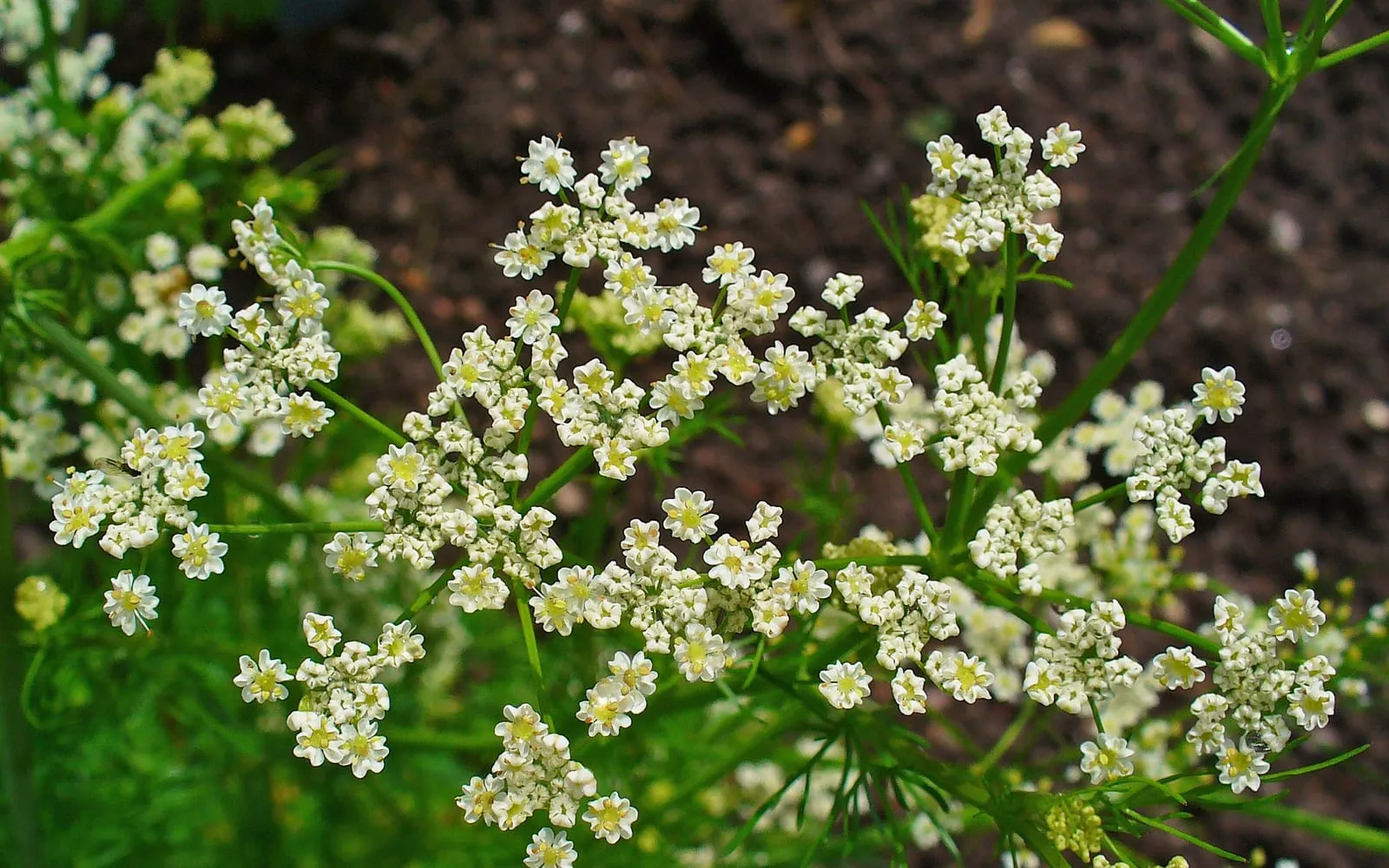
At a glance
- Difficulty
- Moderate
- Water
- In dry spells only
- Light
- Full sun
- Temperature
- Fully hardy. The rosette overwinters outdoors
- Hardiness
- USDA 4-8, RHS H6, hardy to -25 C
- Type
- Hardy biennial, occasionally annual in a warm year
- Height
- 30-60 cm, occasionally 80 cm
- Native to
- Europe, western Asia
- Best month
- April and July in the Northern Hemisphere, October and January in the Southern Hemisphere
A biennial that seeds in its second summer, so the ground is occupied for two seasons and a first-year sowing looks like a failure. Cold suits it and the rosette overwinters without protection. Seed ripens unevenly and shatters, so the crop is cut whole when the first umbels brown and finished under cover.
Hardiness zones describe winter cold alone. Summer heat, humidity, rainfall and the length of the growing season decide as much, so treat the range as the outer limit rather than as a recommendation.
Every month named in this guide is for the temperate Northern Hemisphere. If you garden in the Southern Hemisphere, shift each one by six months, so April becomes October. Closer to the equator the wet and dry seasons matter more than the calendar, and the shift stops being a useful guide.
Not known to be toxic
- Safe to eat
- Seeds, leaves and roots
Non-toxic. Caraway is a culinary spice with a very long record of safe use and it appears on neither the RHS list of potentially harmful garden plants nor the ASPCA list. Seeds, leaves and roots are all eaten, and the root has been used as a vegetable in central Europe for centuries. Caraway oil is a concentrated product and carries the usual caution that applies to any essential oil. The point requiring care is identification. Caraway is an Apiaceae and the family holds hemlock and hemlock water-dropwort, both of which can kill and both of which have ferny leaves and white umbels. Read the hemlock and hemlock water-dropwort guides before picking any wild umbellifer.
Sources: RHS potentially harmful garden plants, ASPCA toxic and non-toxic plants
About
Caraway is the seed in rye bread, in sauerkraut, in seed cake and in caraway schnapps. The flavour is warm and slightly sharp, closer to fennel than to cumin despite the two being confused constantly in shops and recipes.
It is a biennial. Sown in spring it makes a low ferny rosette in its first summer, overwinters outdoors, then throws up a flowering stem and sets seed the following July. Sowing it and expecting seed the same year is the commonest disappointment.
A cool climate suits it. Caraway is a northern European plant, it is fully hardy, and unlike anise or cumin it ripens its seed without trouble. It is the one seed spice in this wave a temperate garden supplies reliably.
Appearance and character
In year one, a low rosette of finely divided ferny leaves, 20 to 30 cm across, similar to a carrot top but finer.
In year two, a slender branching flowering stem 30 to 60 cm, hollow and ridged.
Flowers are small and white or faintly pink, in flat umbels 2 to 4 cm across, opening in June and July.
Seeds are the recognisable part. Curved, ribbed, brown and pointed at both ends, about 5 mm long, and strongly aromatic.
The root is a pale taproot, thick and parsnip-like on a good plant, and edible.
The whole plant is aromatic when crushed, though the scent is much weaker in the leaf than in the seed.
Where it is from
Caraway is native to Europe and western Asia and grows wild across much of the continent in meadows and on roadsides. In Britain it occurs as an escape rather than a native.
It is one of the oldest spices in European use. Caraway seeds have been found at Mesolithic sites and in Neolithic lake dwellings in Switzerland, which puts it among the earliest identifiable food plants in the archaeological record here.
Its use has always been northern. Germany, the Netherlands, Scandinavia, Poland and Russia all use it heavily in bread, cheese, cabbage dishes and spirits, and akvavit is flavoured with it.
England grew it and used it in seed cake, which was a standard baking item into the twentieth century and has largely disappeared. Shakespeare has a character offer a pippin and a dish of caraways.
The Netherlands, Finland, Poland and Egypt are the main producers now, and the crop is grown as a rotation break as well as for the spice.
How it grows
Sow direct where it is to grow. The taproot resents disturbance and transplanted plants seldom do well.
Sow in April or in early autumn, thinly in shallow drills, covering with 1 cm of soil, and thin to 20 cm.
An autumn sowing produces a stronger rosette and an earlier, heavier seed crop the following summer.
Choose an open sunny position on free-draining ground.
In year one, keep the row weeded and watered in dry weather. There is nothing to harvest beyond a few leaves.
The rosette overwinters outdoors without protection.
In year two, the flowering stem rises in May and the flowers open in June.
Cut the whole plant in July as soon as the seeds turn brown, and before they shatter, which they do within a few days of ripening. Cut in the morning while the dew is still on the heads, which reduces losses.
Hang the stems head-down in paper bags somewhere dry and airy and let the seed fall out.
Lift roots in autumn of the first year if you want them as a vegetable, which sacrifices the seed crop.
Through the seasons
Winter is a flat green rosette sitting through the cold. It is entirely hardy and needs nothing.
Spring brings the flowering stem in a second-year plant, and the first sowing for a new one.
Early summer is flowering, in June, and the umbels bring in hoverflies and small parasitic wasps.
Midsummer is the harvest and the timing is tight. Watch the seed from late June and cut as soon as it browns.
Late summer ends the second-year plants, which die after seeding. Clear them.
Autumn is the better sowing time for next year, and the time to lift first-year roots if you want them.
Care difficulty
Moderate, and the difficulty is timing rather than culture.
The plant is easy to grow. It is hardy, undemanding, ripens its seed in a cool summer without help and needs no feeding.
Harvest timing is what catches people. Caraway seed shatters within a few days of ripening, and a row left over a weekend can lose most of the crop. Watch it daily from late June and cut on the first morning the seeds go brown.
The biennial habit is the other surprise. A spring sowing gives you nothing but a rosette in its first year, and gardeners who expected seed pull the plants out in September.
Carrot fly attacks the root, which matters if you want the root as a vegetable and rarely otherwise.
Beyond that there is very little to do.
Watering
Water the seedbed before sowing and keep it damp until germination.
Water first-year plants in dry weather to build a good rosette and a strong taproot.
Water second-year plants while the stem is extending and the flowers are opening.
Stop once the seed starts to fill. Wet weather at ripening is the enemy and there is no reason to add to it.
Water at the base in the morning.
A container works if it is deep enough for the taproot, and needs weekly watering in summer.
Warning signs, diseases and pests
Seed lost to shattering is the commonest failure. Check the heads daily from late June and cut on the first sign of browning.
Carrot fly maggots tunnel the root, which spoils it as a vegetable and weakens the plant. Use fine mesh over the row if the root is the crop.
Slugs graze the young rosette. Protect a new sowing.
Aphids gather on flowering stems in June, and the hoverflies working the umbels usually deal with them.
Plants that never flower in year two were probably sown too late in year one to build an adequate rosette.
A first-year plant that bolts and flowers is responding to a check, usually drought or transplanting. Let it seed anyway.
Mouldy heads mean the plants were cut in wet weather or dried in a damp place.
Growing environment
Full sun. Caraway in shade makes a weak rosette and a poor seed crop.
Free-draining soil of moderate fertility. It grows on ordinary garden ground without any special preparation.
Neutral to alkaline, around pH 6.5 to 7.5.
An open position suits it, and it is a good plant for the edge of a vegetable bed where it can stand for two seasons.
It is fully hardy anywhere in its range, which distinguishes it from every other seed spice in this wave.
The flowers are excellent for beneficial insects, particularly hoverflies and the parasitic wasps that control aphids, so a stand near the vegetables earns its place twice.
Feeding
Nothing is needed in ordinary soil.
Avoid nitrogen. It produces a soft rosette that overwinters badly and a leafy second-year plant with less seed.
Compost worked in the previous autumn is adequate preparation for a two-year occupation of the ground.
A container plant takes a weak balanced feed monthly through its first summer.
A rich bed grows a bigger plant and no more seed, which is the usual outcome of feeding a spice crop.
Troubleshooting
It made a rosette and no seed. That is the first year. Caraway is a biennial and seeds in its second summer. Leave it in.
Most of the seed fell on the ground. It shatters within days of ripening. Check daily from late June and cut on the first morning the seeds brown, then dry the stems head-down in paper bags.
Is caraway the same as cumin? No. Cumin is Cuminum cyminum, a tender annual from western Asia with a warm earthy flavour. Caraway is hardy, biennial and sharper. Several languages use similar names for both, which is where the confusion starts.
The root was full of maggots. Carrot fly, which attacks caraway as it does carrots. Cover the row with fine mesh if you want the root.
Can I eat the root? Yes. Lift it in autumn of the first year, when it is parsnip-like, and cook it as a root vegetable. That ends the seed crop from that plant.
Can I sow it in pots and plant it out? Not with much success. The taproot resents disturbance. Sow direct.
When is the best time to sow? Early autumn, for a stronger rosette and an earlier seed crop. April works too.
Caraway problem guides
Not sure what is wrong? See the common vegetable pests guide.