
Outdoor plant
Switchgrass
Panicum virgatum
Also known as Panic grass, Wand panic grass
How to grow switchgrass, Panicum virgatum, a tall North American prairie native with deep drought-tolerant roots, airy flower panicles, and biofuel uses.
At a glance
- Difficulty
- Easy
- Water
- Regular watering while establishing, then rarely needed
- Light
- Full sun
- Temperature
- Fully hardy in winter; grows most strongly in a hot summer
- Hardiness
- USDA 4-9, RHS H7, hardy to -25 C
- Type
- Warm-season deciduous perennial grass
- Height
- 1-2.5 m
- Native to
- Central and eastern North America
Winter cold has never limited where switchgrass grows across its huge native range, which reaches well into Canada. It is a warm-season grass, meaning real growth waits until the soil warms well into the growing season and runs fastest in summer heat, so a fully hardy plant in a cool, short-summer climate stays shorter and less floriferous, not because the cold troubled it but because the growing season never got warm enough to drive full development.
Hardiness zones describe winter cold alone. Summer heat, humidity, rainfall and the length of the growing season decide as much, so treat the range as the outer limit rather than as a recommendation.
Harmful to horses if eaten
- Harm from
- Eating it
- Affects
- Horses
Switchgrass carries steroidal saponins that can cause hepatogenous photosensitization, sunburn-like skin damage linked to liver stress, in grazing animals that eat large quantities over a period of time. Sheep and goats are the animals most often reported affected in agricultural and veterinary literature, and horses have also been documented developing the condition after prolonged grazing or switchgrass hay. This is a pasture and forage-management issue rather than a garden hazard: it takes sustained, large-scale grazing to cause harm, and an ornamental clump in a border presents negligible risk to a horse, dog or cat that might occasionally nibble it. There is no ASPCA listing of switchgrass as toxic to cats or dogs.
Sources: HorseDVM poisonous plants database, USDA NRCS Plant Guide, switchgrass
About
Switchgrass was one of the dominant grasses of the North American tallgrass prairie, a landscape that has almost entirely disappeared under farmland, and it remains one of the most widely used native grasses in restoration plantings today. In a garden it brings the same scale and toughness: a tall, upright clump with a cloud of fine, airy flowers that catch light and colour beautifully through late summer and autumn.
Beyond ornamental use, switchgrass has a working life most garden grasses do not. Its deep roots, rapid biomass production and tolerance of poor land have made it one of the most studied candidate crops for cellulosic biofuel in North America, grown at agricultural scale specifically to be harvested and converted into ethanol, a use with no parallel among the other grasses covered in this guide.
The US Department of Energy selected switchgrass in 1991 as a model herbaceous energy crop for research, and cultivars bred specifically for biomass, including ‘Alamo’, ‘Kanlow’ and ‘Cave-in-Rock’, have since been trialled at field scale across the Midwest and southern United States, producing yields reported as high as several tonnes of dry matter per hectare in a single season. None of that breeding work was aimed at garden performance, and a gardener buying an ornamental cultivar such as ‘Heavy Metal’ or ‘Northwind’ is choosing a plant selected for colour and habit rather than for the biomass traits that matter to a biofuel grower, even though both trace back to the same wild species.
Appearance and character
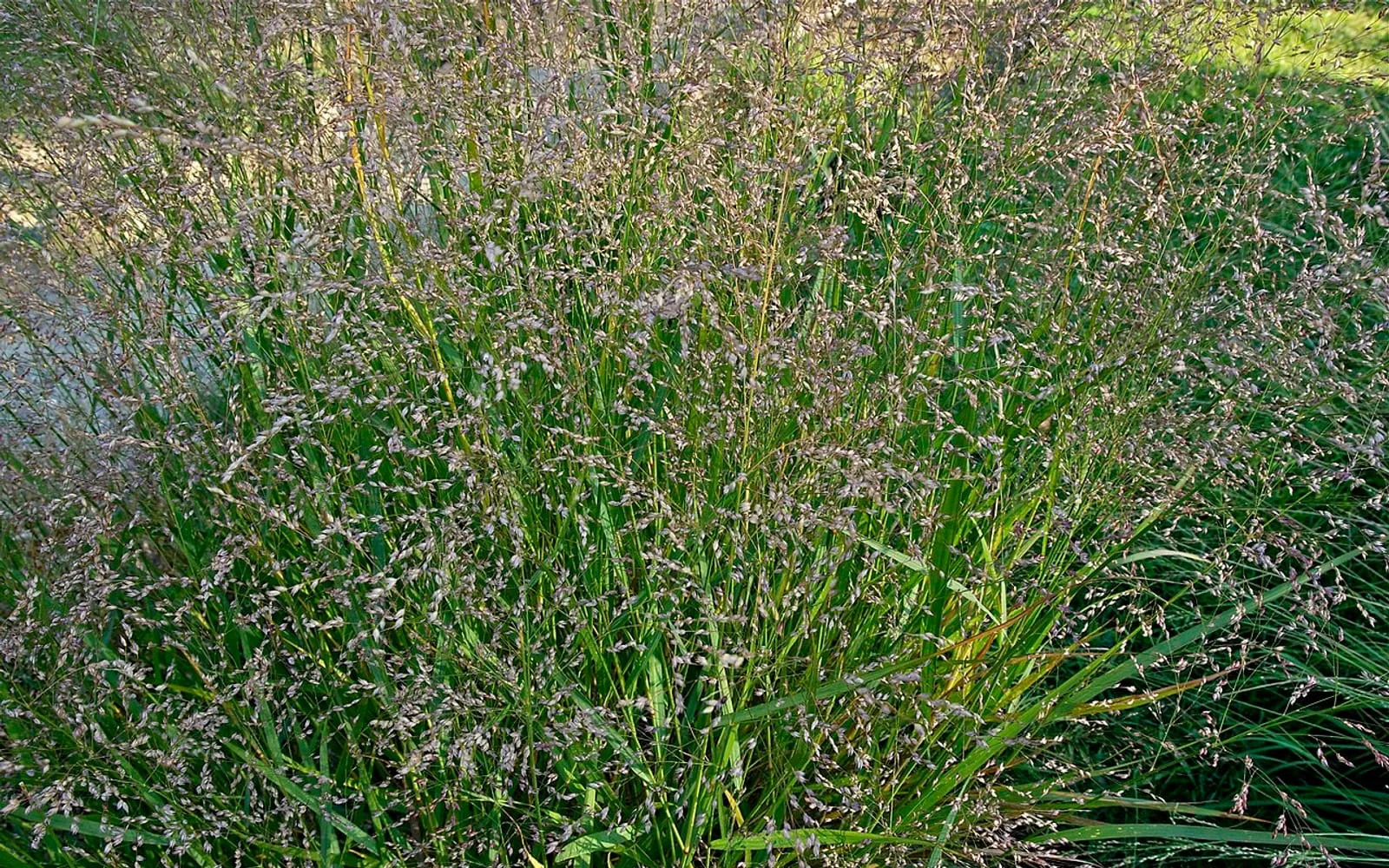
Upright, blue-green to grey-green foliage rises in a dense clump through spring and summer, narrow and slightly arching, before turning shades of gold, orange or deep burgundy in autumn depending on the cultivar. Some selections carry a strong reddish tint from midsummer onward, adding colour to the display well before the seasonal turn.
Flower panicles open from midsummer into a fine, airy haze well above the foliage, tiny flowers on wiry, branching stems that give the whole top of the plant a diffuse, cloud-like texture rather than a solid spike. Many cultivars carry a distinct pink or purple flush through this stage, which fades to a soft golden brown as the seed matures and holds through much of winter if left uncut.
Where it is from
Panicum virgatum is native across a huge range of central and eastern North America, from southern Canada down into Mexico, growing on prairie, open woodland and river floodplain in conditions that swing from waterlogged spring soil to genuine summer drought. That range gave rise to considerable variation within the species: prairie populations tend to be shorter and more drought-tolerant, while populations from wetter floodplain sites grow taller and tolerate heavier, damper soil.
Its deep root system, extending three metres or more into prairie soil in the wild, is the plant’s central adaptation, letting it draw on moisture and nutrients far below the reach of shallower-rooted neighbours and survive drought that would kill most garden perennials outright.
How it grows
Plant divisions or container-grown plants in spring, once the soil has warmed, in full sun. Growth is modest in the first year while the root system develops below ground, then accelerates noticeably from the second season onward as that deep root system matures.
Choose a lean to moderately fertile spot rather than the richest soil available. Excess fertility produces tall, weak growth prone to flopping or lodging under wind and rain, in clear contrast to the upright, self-supporting habit the species shows on leaner ground closer to its native prairie conditions.
Leave the foliage and flower panicles standing through winter for structure and colour, then cut the whole clump back hard to a few centimetres above ground in late winter, before new growth resumes. Divide an established clump every four or five years once the centre starts to die out and flowering thins, lifting and splitting it in spring as new growth begins.
Through the seasons
Spring starts slowly, since this is a warm-season grass that waits for real soil warmth before putting on visible growth, often well behind cool-season perennials nearby; this is also the window for the annual cutback and for dividing an overgrown clump.
Summer brings the most vigorous growth and the opening of the airy flower panicles, especially in hot weather.
Autumn brings strong foliage colour in many cultivars, running from gold through to deep burgundy, alongside the maturing, golden-brown seed heads.
Winter leaves the faded stems and panicles standing if left uncut, offering structure and food for seed-eating birds through the coldest months before the late-winter cutback.
Care difficulty
Easy, and tolerant of considerable neglect once established. It needs no staking despite its height, minimal watering beyond an occasional deep soak in its first year or two, and little to no feeding. The main requirement is patience during establishment, since a newly planted specimen puts most of its early energy into its deep root system rather than visible top growth.
Watering
Water regularly through the first growing season while the deep root system that gives this grass its drought tolerance is still developing. Established plants rarely need supplemental watering beyond ordinary rainfall, even through a fairly dry summer, and this species tolerates both drought and periodic waterlogging far better than most border perennials, reflecting its origin on both dry prairie and wet floodplain ground.
Warning signs, diseases and pests
Rust turns up as small orange pustules across the leaf blades, most often after a spell of humid summer weather, and usually does no more than mark the foliage without threatening the plant’s survival.
Older leaves can develop leaf spot, small discoloured patches that spread slowly across the blade in warm, damp conditions. It stays largely a cosmetic issue on an established garden clump, and stripping off badly marked foliage is enough to keep a planting looking presentable.
Smut shows up occasionally as dark, sooty spore masses in place of the normal flower structures, a disease taken more seriously in large-scale biofuel and forage plantings, where it can reduce seed yield, than in an ordinary garden border, where a single affected clump is easily cut back and left to regrow cleanly the following season.
Growing environment
Full sun is essential for strong, upright growth and the best autumn colour; in shade, plants grow thin, floppy and pale, and flower poorly. This species is unusually adaptable in soil terms, tolerating both poor, dry ground and heavier, damp clay, provided the soil is not permanently stagnant, and it copes with wind, heat and drought with ease once established.
Feeding
Feeding is rarely necessary and often counterproductive. In reasonably fertile soil, this grass grows strongly without additional fertiliser, and in rich soil it can grow too strongly, producing tall, weak stems that lodge rather than stand upright through autumn and winter. A single light application of balanced feed in spring is enough on poor soil.
Troubleshooting
The stems have flopped over rather than standing upright. Soil that is too rich or too consistently moist is the usual cause, pushing soft growth beyond what the stems can support. Avoid feeding in future seasons and consider dividing and replanting in leaner ground if the problem continues.
My plant is shorter than expected after a couple of years. Check how hot your summers run. This is a warm-season grass that grows tallest where summer heat is reliable, and a cooler climate can keep it noticeably shorter and slower to establish even well within its hardiness range.
When should I cut it back? Leave the old growth and panicles standing through winter for structure and interest, then cut the whole clump back to a few centimetres above ground in late winter, just before new shoots emerge.
Is it safe to keep horses or other grazing animals near a planted clump? An ornamental border planting presents negligible risk. The photosensitization linked to this species requires sustained, large-scale grazing or hay consumption over time, the kind of exposure a pasture or forage crop provides rather than a single decorative clump.
Can I grow it as more than an ornamental, say for biomass or fuel use? Yes, at a small scale, though switchgrass is grown for that purpose commercially at field scale with cultivars selected specifically for yield, so a garden planting is unlikely to produce useful quantities of biomass on its own.
Can I use it in a consistently damp part of the garden? Yes, more readily than many prairie grasses. Populations from wetter floodplain sites in its native range tolerate periodic waterlogging well, though permanently stagnant, airless soil is still worth avoiding.