
Pest
Horse chestnut leaf miner
Cameraria ohridella
Also called Horse chestnut leaf-mining moth, Conker tree moth, Cameraria
Horse chestnut leaf miner browns leaves and makes trees drop them weeks before autumn. The damage looks severe but rarely kills mature trees; bleeding canker on the bark is the more serious problem.
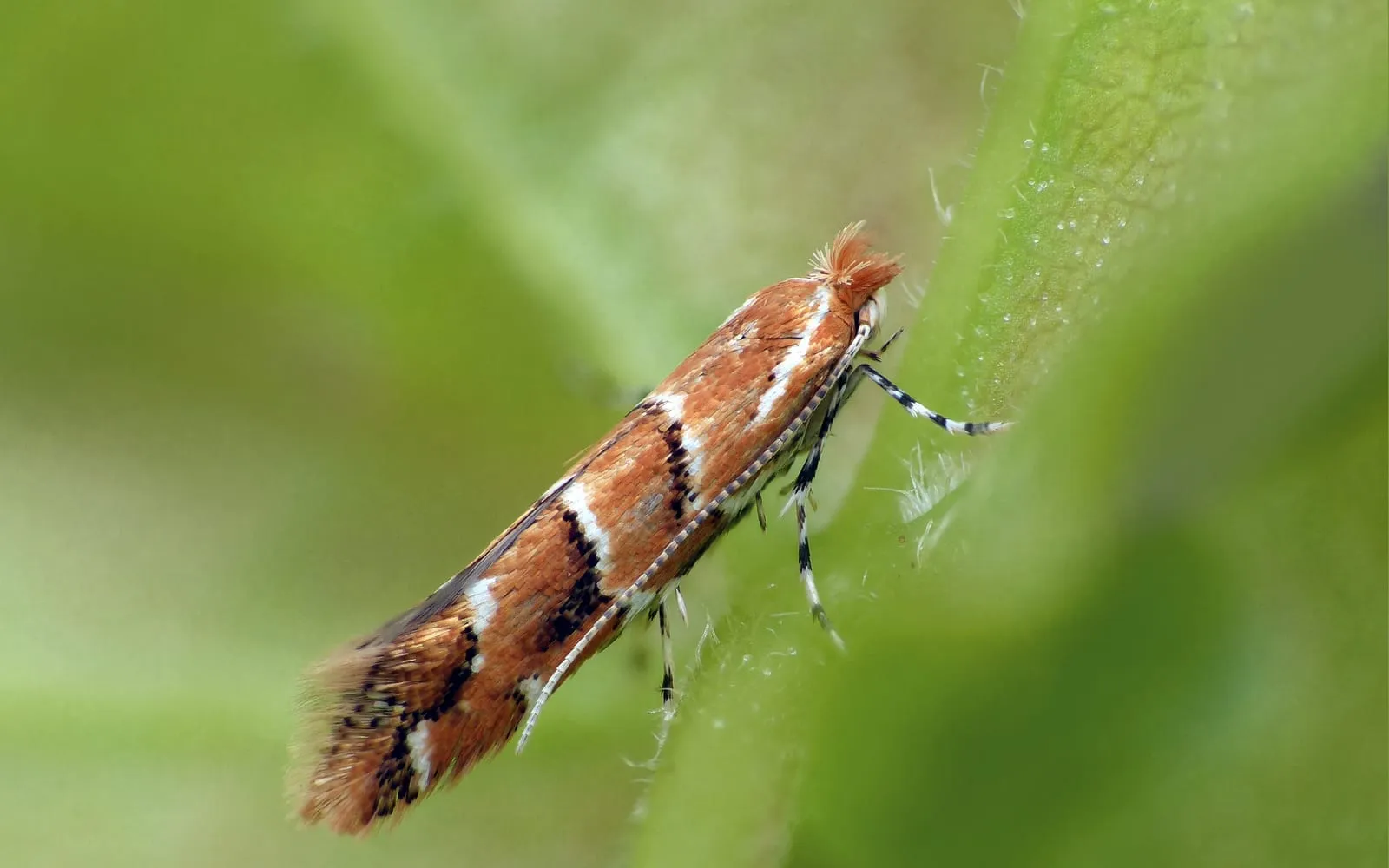
At a glance
- Type
- Pest
- Cause
- Insect
- Severity
- Cosmetic
- Affects
- Garden plants
- Active
- May to September
- Established in
- Europe and Asia
What you are seeing
- Small pale blotches on the leaves from late spring, each with a dark centre
- Blotches spreading and running together until the leaf is brown and papery
- Whole trees browning from June onwards and looking autumnal in high summer
- Leaves shrivelling and falling weeks or months before true leaf fall
- Damage worst on the lower branches early on and spreading up the tree
- A tiny caterpillar visible inside the blotch when a leaf is held up to the light
- Fallen leaves in autumn full of pupae, which is where the next year comes from
- The tree leafing out normally the following spring
Before you treat anything
The moth is harmless to people and animals. Horse chestnut conkers are poisonous if eaten, which has nothing to do with this insect. Do not be tempted into treating a large tree with anything sprayed, since the reach needed makes drift certain and the damage does not warrant it.
What you are looking at
Horse chestnuts turning brown in July. Not the odd branch, but whole trees, and often whole avenues of them, going the colour of late October while everything around them is still in full summer green. The leaves shrivel, curl and fall weeks or months early.
Look closely at a leaf early in the season and the damage starts as small pale blotches, each with a darker centre, scattered between the veins. They enlarge, run together, and the leaf goes papery brown.
Hold an affected leaf up to the light and you can see a tiny caterpillar, or its pupal chamber, inside the blotch. That is the difference between this and everything else that browns a horse chestnut leaf.
Damage usually starts on the lower branches and works up the tree through the summer.
The tree is fine
A brown horse chestnut in July looks like a dying tree, and that impression is wrong.
The mines destroy leaf tissue late in the growing season, after the tree has already laid down most of the year’s growth. Trees defoliated every summer for a decade or more have been followed in several European countries, and they go on growing, flowering and leafing out normally each spring.
What does suffer is the conker crop, which comes out smaller. The other cost is aesthetic, and for an amenity tree in a park or a street that is not nothing.
Nothing available to a garden owner changes the outcome on a mature tree, and there is no reason to want to. Anyone offering to inject or spray a large horse chestnut for this is selling a treatment for a problem the tree is already handling.
Why this matters on this particular species
Horse chestnut carries two well-known problems and people conflate them constantly, usually to the tree’s cost.
Bleeding canker marks the bark. It weeps dark rust-coloured liquid down the trunk, the tissue under the bark dies, and in some trees the crown thins and dies back. It can kill.
The leaf miner marks the leaves and nothing else. It does not affect the bark, the wood, the roots or the tree’s survival.
A tree with brown leaves in August and clean bark has the miner and needs nothing. A tree with liquid running down the trunk has a different problem: use the bleeding canker page. A great many horse chestnuts have both at once, and the brown leaves are not evidence about the canker in either direction.
Where it came from and how it moves
The moth was first described in Macedonia in 1985 and has spread across almost all of Europe since, at rates of up to 100 km a year.
That is far quicker than a small weak-flying moth manages under its own power. The spread has followed motorway networks, because the pupae travel in fallen leaves picked up by vehicles, and infestations appear at service stations and along trunk roads before reaching the countryside between them.
Its origin was a long-standing puzzle. Horse chestnut is native to a small area of the Balkans, and the moth is now thought to have been living there quietly on wild trees before finding a continent’s worth of planted ones.
What to do about it
Do nothing on a mature tree.
Check the bark before worrying, since the canker is the problem on this species that matters.
Collect fallen leaves from a garden tree in autumn and compost them under soil or in a sealed bag so the pupae cannot emerge.
Expect leaf collection to help on an isolated tree and to achieve little in a street of infested ones.
Leave the parasitic wasps and the blue tits to it.
Plant Aesculus indica or Aesculus flava if you are choosing a new tree.
Refuse anything sprayed or injected into a large tree for this.
What it gets mistaken for
Bleeding canker marks the bark and weeps rust-coloured liquid, and it can kill.
Drought and wind scorch brown the leaf margins and tips evenly, leaving the middle green.
Guignardia leaf blotch browns patches with a yellow halo and no insect inside.
A droughted tree browns from the top and outside of the crown inwards rather than from the lower branches up.
What to do, in order
Start here
Prevention, and the changes that stop the problem returning. Most of these pages should end at this tier.
- Do nothing, which is the correct answer for nearly everyone
- Repeated infestation reduces the size of the conkers and does very little else. Growth rate, health and survival are barely affected even after years of heavy attack, and no measure available to a garden owner changes the outcome for a mature tree. Knowing that is worth more than any treatment on this page.
- Understand what it costs the tree, so you can leave it alone
- The mines destroy leaf tissue late in the season, after the tree has done most of its growing for the year. Trees defoliated every summer for a decade have been monitored and continue to grow, flower and leaf out normally. What suffers is the conker crop and the look of the tree from July.
- Plant a different species if you are choosing now
- Aesculus indica, the Indian horse chestnut, and Aesculus flava are far less affected, and the red-flowered Aesculus carnea is somewhat less affected than the common white one. That is a decision for a new planting rather than a reason to remove an existing tree.
Then reach for a barrier
Netting, hand removal and water. Nothing here harms anything except the target.
- Collect and compost the fallen leaves properly
- The moth overwinters as pupae in the fallen leaves, so removing them reduces next year's first generation. Compost them under a layer of soil or grass clippings, or in a sealed bag until they have rotted, so the adults cannot emerge. This is worth doing for a garden tree and is impractical along a street.
- Accept that leaf collection only works if the neighbours do it too
- The adults fly in from anywhere within reach, so clearing your own leaves while an avenue of infested trees stands down the road buys little. On an isolated tree it works well and on a suburban street it does not.
Then bring in the predators
Encourage what already lives in the garden, and buy predators in where the problem is under glass and nothing will arrive on its own.
- Leave the parasitic wasps to build up
- A range of native parasitic wasps have moved onto this moth since it arrived and parasitism rates have climbed slowly. They are the reason the damage in the longest-infested parts of Europe is no worse than it was, and spraying an ornamental tree would set them back for no gain.
- Let the birds work the leaves
- Blue tits take mining larvae out of horse chestnut leaves in significant numbers, and this was measured through a public science project in Britain. It costs nothing to encourage them.
Biological controls are live organisms and their sale and release are regulated country by country. An agent sold freely in one place may be unapproved in another, so buy from a licensed supplier where you live and never import or move one yourself.
Plants affected
Guides that name it among the problems to watch for. The list is the plants it is characteristic of rather than everything it will feed on.