
Edible
Asparagus
Asparagus officinalis
Also known as Garden asparagus, Sparrow grass
How to grow asparagus, Asparagus officinalis. Waiting three years before the first cut, stopping cutting on midsummer's day, and dealing with asparagus beetle.
At a glance
- Difficulty
- Moderate
- Water
- In dry spells, and particularly in the first two years
- Light
- Full sun, sheltered from strong wind
- Temperature
- Fully hardy, to about -30 deg C
- Hardiness
- USDA 3-8, RHS H7, hardy to -30 C
- Type
- Perennial, cropping for twenty years or more from one planting
- Height
- 1.5 m as fern
- Native to
- Europe, north Africa and western Asia, and native to British coasts
- Best month
- May in the Northern Hemisphere, November in the Southern Hemisphere
Winter dormancy is a requirement rather than a season to be endured, and a crown that never rests spears thinly and gives up early. Where there is no winter, growers force dormancy by withholding water for two or three months, which is how Peru crops twice a year and supplies the out-of-season trade. A bed takes three years to come into production and then runs for twenty.
Hardiness zones describe winter cold alone. Summer heat, humidity, rainfall and the length of the growing season decide as much, so treat the range as the outer limit rather than as a recommendation.
Every month named in this guide is for the temperate Northern Hemisphere. If you garden in the Southern Hemisphere, shift each one by six months, so May becomes November. Closer to the equator the wet and dry seasons matter more than the calendar, and the shift stops being a useful guide.
Skin irritant
- Safe to eat
- The young spears
- Do not eat
- The red berries on female plants
- Harm from
- Handling it and eating it
- Affects
- People, cats and dogs
The spears are the food and they are entirely safe. The red berries produced on female plants in autumn are a different matter and contain saponins, causing vomiting and abdominal pain if eaten, and the ASPCA lists Asparagus officinalis as toxic to cats and dogs on that basis. The berries are bright red and appear at a height a child can reach, so they matter in a garden, and growing an all-male F1 cultivar removes the question entirely since male plants set no fruit. Handling the fern causes contact dermatitis in some people, with an itchy rash on the forearms, so wear long sleeves when cutting it down. Eating asparagus produces a distinctive smell in the urine within half an hour, caused by sulphur compounds, and the ability to detect it varies genetically, which accounts for people disagreeing about whether it happens at all. The RHS lists Asparagus as a skin irritant and harmful if eaten, referring to the berries rather than the spears.
Sources: RHS potentially harmful garden plants, ASPCA toxic and non-toxic plants
About
Asparagus asks for three years of patience and then feeds you for twenty.
You plant one-year-old crowns in spring, you cut nothing at all in the first year, you take a very light cut in the second, and you get a proper crop from the third. That is a long time to give up a bed to something producing nothing, and it is why asparagus is an allotment and large-garden crop rather than a small-plot one.
What you get in return is a permanent bed that crops every May and June for two decades or more, producing something that tastes almost nothing like the imported spears in a supermarket.
Two rules govern the cropping. Stop cutting on or around midsummer’s day, and let everything after that grow into fern. The fern is what feeds the crown for next year, and cutting into July for a few extra meals costs you the following season.
The other requirement is drainage. Asparagus is a coastal plant in the wild, its crowns rot in wet ground, and a bed on heavy clay needs raising or the crop will not last.
Choose an all-male F1 cultivar. They yield substantially more than the old mixed types, they produce no berries, and no seedlings come up in the bed.
Appearance and character
A perennial reaching 1.5 m as fern, growing from a crown of fleshy roots that sits 15 to 20 cm below the surface.
Spears push up from the crown in April and May, 15 to 25 cm before cutting, green in most European cultivars and purple in some.
Purple cultivars such as ‘Pacific Purple’ are sweeter and less fibrous raw, and they turn green when cooked.
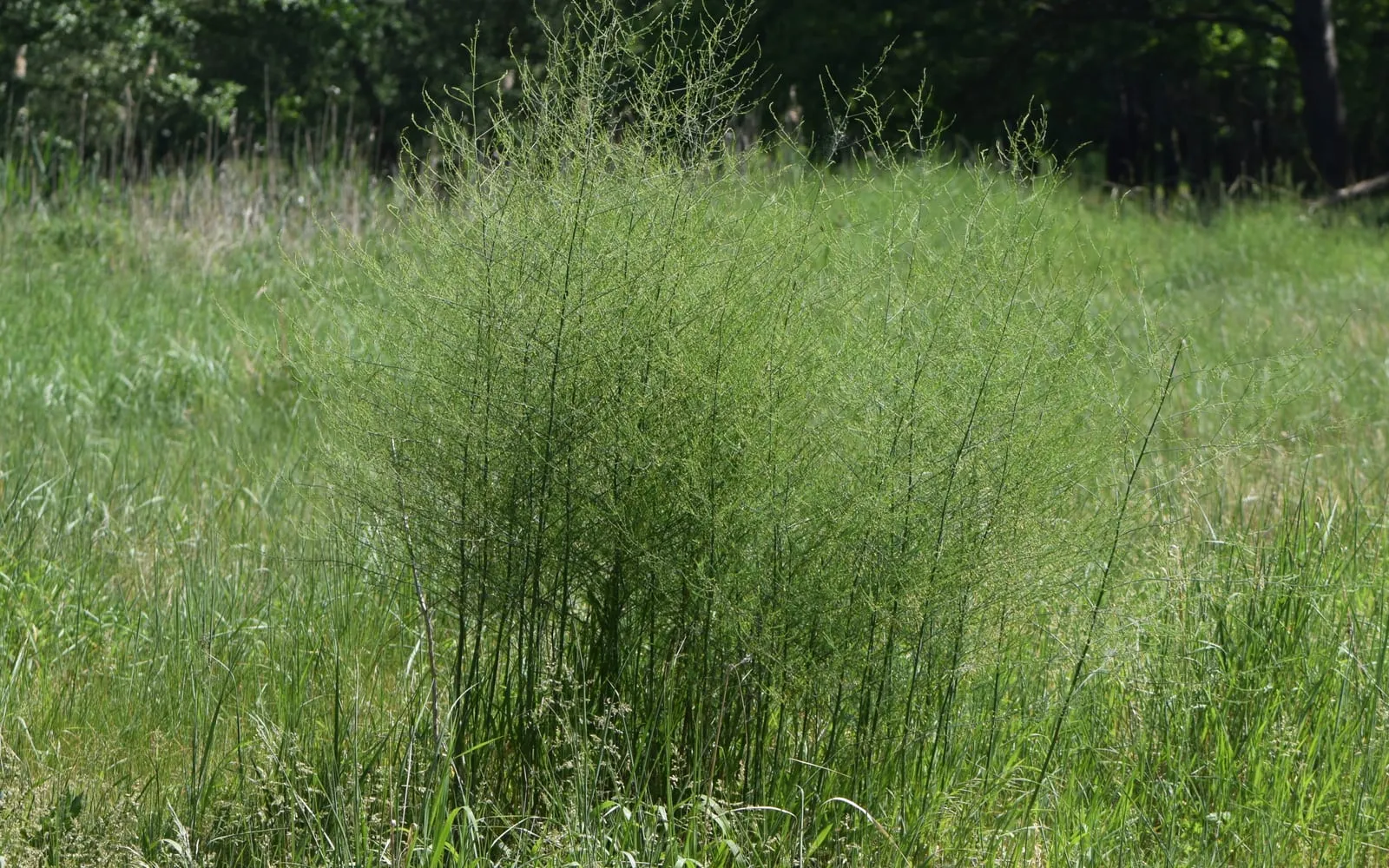
Left uncut, each spear opens into a tall much-branched fern of fine needle-like foliage, which is what the plant uses to rebuild the crown.
Flowers are small, greenish-white and inconspicuous, in June.
Berries appear on female plants in autumn, round, 6 to 8 mm, glossy red, and they are poisonous and produce seedlings.
Male plants produce no berries and put the energy into spears instead, which is why all-male cultivars yield around a third more.
The crown expands slowly outwards each year and remains productive for twenty years or more in a well-drained bed.
Blanched white asparagus is the same plant grown under a mound of soil so the spears never see light, which is the standard method in Germany and France.
Where it is from
Europe, north Africa and western Asia, and native to Britain on sandy coasts and cliffs, where wild asparagus, Asparagus prostratus, is now a rare protected plant.
The coastal origin explains the drainage requirement and the salt tolerance, and it is the reason old gardening books recommend dressing an asparagus bed with salt to suppress weeds.
The Egyptians, Greeks and Romans all cultivated it, and a Roman recipe for cooking it appears in Apicius.
Cato wrote instructions for growing it in the second century BC, and the method he describes is close to the modern one.
Britain has grown it since at least the sixteenth century, and the Vale of Evesham and the Formby coast are traditional producing areas.
Sparrow grass is an eighteenth-century English corruption of asparagus and was the usual spoken form for a long period.
All-male F1 cultivars were developed from the 1970s onwards and transformed yields, since male plants do not spend resources on seed.
The distinctive smell in urine after eating asparagus comes from sulphur compounds metabolised from asparagusic acid, and both the production and the ability to detect it vary between people.
How it grows
Prepare the bed thoroughly and clear every perennial weed before planting. This is the one chance you get, because an asparagus bed cannot be dug over afterwards and couch grass or bindweed in it is permanent.
Choose full sun, sheltered from strong wind, on free-draining light soil.
Raise the bed on heavy clay. Asparagus crowns rot in waterlogged ground and a raised bed 30 cm deep filled with a free-draining mix is the answer.
Dig in plenty of well-rotted manure the autumn before, and add grit on heavy soil.
Aim for pH 6.5 to 7.5, liming if necessary.
Plant one-year-old crowns in March or April. Older crowns transplant badly and are not worth the extra cost.
Dig a trench 30 cm wide and 20 cm deep, make a ridge of soil along the bottom, set each crown on the ridge with the roots spread down both sides, and space them 30 to 45 cm apart in rows 45 cm apart.
Cover with 5 to 8 cm of soil and fill the trench gradually as the spears grow through the season.
Water in and keep the bed watered through the first two summers.
Cut nothing in the first year. Let every spear grow into fern.
Cut lightly for two or three weeks in the second year, taking only the thickest spears.
Crop properly from the third year, for about six weeks from mid-April.
Stop cutting on or around midsummer’s day, 21 June, without exception. Everything after that grows into fern and rebuilds the crown for next year.
Cut spears when they are 15 to 20 cm tall, with a sharp knife 2 to 3 cm below the soil surface, taking care not to damage adjacent spears coming through.
Cut every two or three days in warm weather, since spears grow fast and become woody.
Support the fern with canes and string on an exposed site, since it grows to 1.5 m and blows over.
Cut the fern down in late autumn once it has yellowed, to 5 cm above the ground, and clear it away.
Weed by hand only. Hoeing damages the crowns, which sit close to the surface.
Mulch every spring with well-rotted manure or compost, which feeds the bed and suppresses weeds.
Remove any berries and seedlings if you have female plants, since seedlings crowd the bed.
Through the seasons
Winter the bed is bare, and this is the time to mulch and to plan.
Spring brings the spears from mid-April, and the cutting season runs to midsummer.
Summer cutting stops on 21 June and everything grows into fern, which needs supporting.
Autumn the fern yellows and is cut down, and the bed is mulched.
Care difficulty
Moderate. The growing is undemanding and the discipline is where people go wrong.
Two rules have to be kept. Do not cut in the first year and do not cut past midsummer. Both feel wasteful at the time and both determine whether the bed lasts twenty years or five.
Site preparation is the other half. Perennial weeds in the bed cannot be removed once the crowns are in, and drainage cannot be improved afterwards either.
Given a well-prepared free-draining bed and the cutting discipline, asparagus is one of the lowest-maintenance crops there is, needing a mulch, a hand weed and an autumn cut-down.
Watering
Water in generously at planting and keep the bed watered through the first two summers while the crowns establish.
Established beds need water in dry spells, particularly during the cutting season and while the fern is building.
Give a thorough soak rather than a sprinkle.
Drainage matters more than watering. Asparagus crowns sitting in wet winter soil rot, and this is the commonest reason a bed fails after a few years.
Mulch every spring to conserve moisture and suppress weeds.
Warning signs, diseases and pests
Small black and cream beetles with reddish markings on the fern in summer, with their grey larvae, is asparagus beetle. They strip the fern and weaken the crown for next year. Pick them off by hand, check the fern regularly from May, and clear all fern debris in autumn where they overwinter.
Thin weak spears in a mature bed is exhaustion, from cutting for too long, cutting in the first year, or a bed that needs feeding. Stop cutting at midsummer and mulch generously.
Crowns rotting and plants failing over a few years is waterlogging. Raise the bed and improve drainage.
Orange-brown pustules on the fern in late summer, turning black, is asparagus rust. Cut down and burn affected fern in autumn, improve air movement, and grow a resistant cultivar.
Spears emerging bent or with damaged tips is frost damage in April. Cover with fleece when frost is forecast during the cutting season.
Yellowing fern in midsummer is usually crown stress from over-cutting or waterlogging.
Seedlings coming up through the bed is female plants setting berries. Remove them and grow an all-male cultivar next time.
Slugs damaging emerging spears is common in a wet spring.
Japanese beetle strips the fern to a lace of veins in midsummer, feeding in visible groups, and is well established across most of the United States. It reached northern Italy in 2014 and southern Switzerland since, and the rest of Europe treats a sighting as notifiable.
Growing environment
Full sun, sheltered from strong wind, since the fern is tall and blows over.
Free-draining light soil, generously manured, at pH 6.5 to 7.5. Raise the bed on heavy clay. Fully hardy, to about -30 deg C. Space crowns 30 to 45 cm apart in rows 45 cm apart, and allow around ten plants per person for a worthwhile crop.
It suits an allotment, a large vegetable garden or a dedicated raised bed. It is a poor container crop, since the crowns need depth and permanence.
Site the bed where it can stay for twenty years and where it will not be dug, walked on or rotated.
Clear every perennial weed before planting, since this is the only opportunity.
Grow an all-male F1 cultivar such as ‘Gijnlim’, ‘Backlim’ or ‘Pacific 2000’ for a substantially higher yield and no berries or seedlings.
Grow a purple cultivar alongside for something sweeter and better raw.
Feeding
Manure the bed generously the autumn before planting.
Feed in early spring with a general balanced fertiliser as the spears start.
Feed again immediately after cutting stops at midsummer, which is when the crown is rebuilding for next year and when the feeding does most good.
Mulch every spring with well-rotted manure or compost, which feeds the bed and suppresses the weeds you cannot hoe.
Avoid heavy nitrogen late in the season.
The old practice of dressing the bed with salt reflects the plant’s coastal origin and it is of limited use on modern soils, and it is not necessary.
Troubleshooting
How long before I can pick any? Nothing in the first year, a light cut for two or three weeks in the second, and a full six-week crop from the third year onwards.
When do I stop cutting? On or around midsummer’s day, 21 June, without exception. Everything after that grows into fern that rebuilds the crown for next year, and cutting into July costs you the following season.
Should I buy older crowns to save time? No. One-year-old crowns establish far better than two or three-year-old ones, which transplant badly. The extra cost buys nothing.
Which cultivar should I grow? An all-male F1 such as ‘Gijnlim’ or ‘Backlim’. They yield around a third more than mixed types, produce no poisonous berries and leave no seedlings in the bed.
Can I grow it on clay? Only in a raised bed. Asparagus crowns rot in waterlogged soil, which is the commonest reason a bed dies after a few years.
There are black and cream beetles on the fern. Asparagus beetle. Pick them and their grey larvae off by hand from May, and clear all fern debris in autumn where they overwinter.
My spears are getting thinner every year. The crown is exhausted, usually from cutting too long into the summer. Stop at midsummer, feed the bed after cutting, and mulch generously.
Can I weed with a hoe? No. The crowns sit close to the surface and a hoe damages them. Hand weed only, which is why clearing perennial weeds before planting matters so much.
What are the red berries? Fruit on female plants. They are poisonous, they cause vomiting if eaten, and they produce seedlings that crowd the bed. Grow an all-male cultivar and the question does not arise.
Asparagus problem guides
Not sure what is wrong? See the common vegetable pests guide.