
Disease
Aster yellows
Candidatus Phytoplasma asteris
Also called Aster yellows phytoplasma, Green petal, Phyllody, Carrot yellows
Flowers that come out green, deformed and sterile, or turn into tufts of small leaves. A bacterium with no cell wall is rewriting the plant's development, and a leafhopper brought it.
At a glance
- Type
- Disease
- Cause
- Bacterium
- Severity
- Can kill the plant
- Affects
- Garden plants, Herbs and edibles
- Active
- June to September
- Established in
- Europe, North America, Central and South America, Africa, Asia, Australia and New Zealand
What you are seeing
- Flowers coming out green instead of coloured, with the petals leaf-like and stiff
- Flower heads replaced by a tuft of small deformed leaves
- Flowers that never set seed, on a plant that looks otherwise alive
- Dense witches' brooms of thin upright shoots from a point that would have flowered
- New leaves narrow, yellow and strap-like while older leaves stay green
- Carrots with hairy masses of fine roots and a bitter taste, tops reddened and twisted
- The whole plant stunted, upright and stiff in habit compared with its neighbours
- Scattered single plants affected in a row rather than a spreading patch
Before you treat anything
Carrots from an infected plant taste bitter and are unpleasant rather than harmful. Nothing about the phytoplasma affects people or animals.
What you are looking at
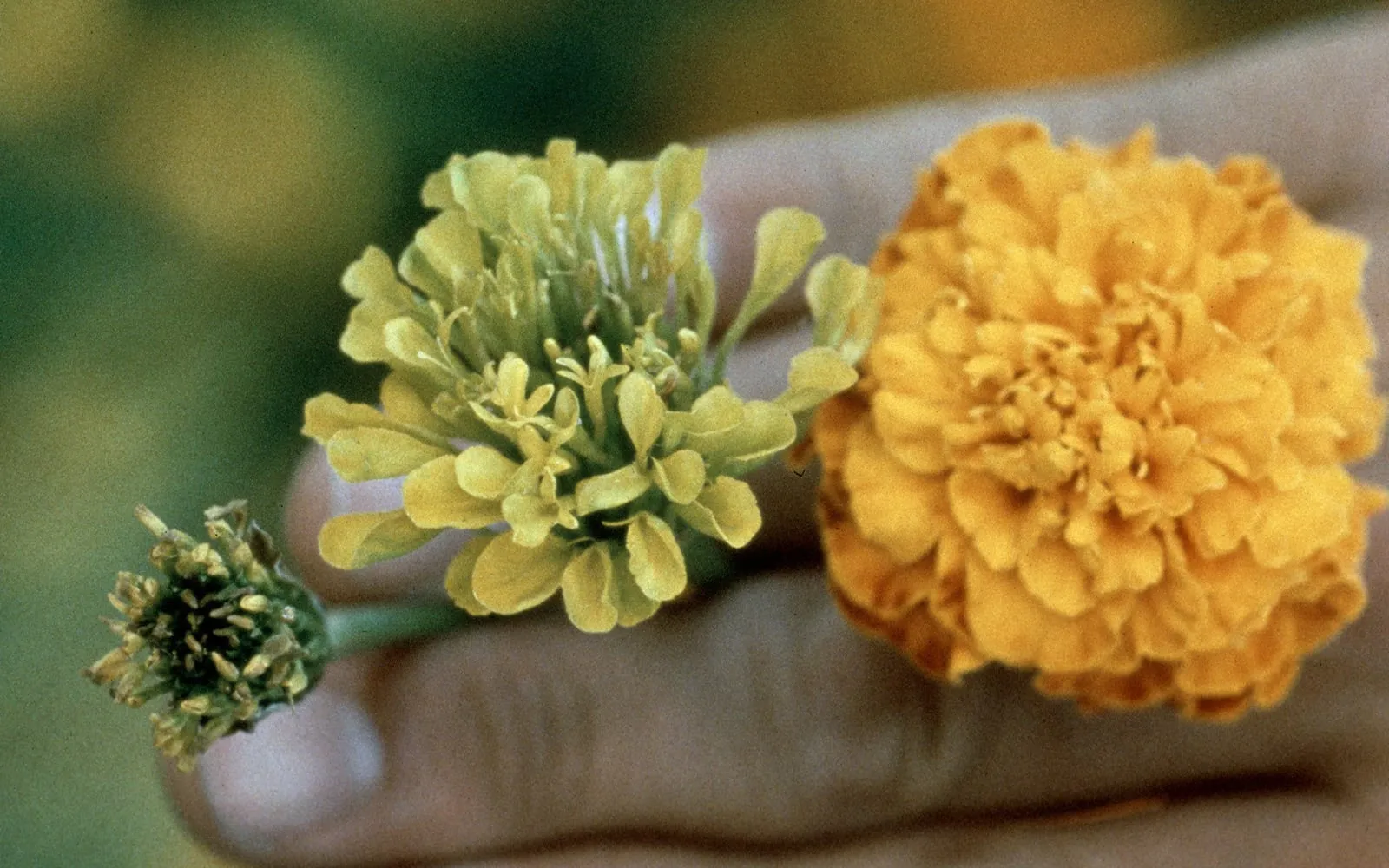
A flower that has come out green. The petals are there in outline but they are leaf-like, stiff and the colour of foliage, and the flower will not set seed. On a coneflower the centre often erupts into a tuft of small green shoots, which is the version most people photograph.
The plant around it is stiff and upright, with new leaves narrow and yellow while the older ones stay green. Sometimes a point that should have carried one flower carries a dense broom of thin shoots instead.
In carrots the signs are underground as well. The root grows a beard of fine hairy rootlets, tastes bitter, and the tops go red and twisted.
What separates it from most things is the pattern in the bed. Single plants are affected here and there while the ones beside them are untouched, because each infected plant was visited by a leafhopper rather than infected by its neighbour.
Something between a bacterium and nothing at all
A phytoplasma is a bacterium that has lost its cell wall and most of its genome. It cannot live outside a host, it cannot be grown in a laboratory dish the way ordinary bacteria can, and it lives in the phloem, the tissue that carries sugars around the plant.
From there it interferes with the plant’s own developmental signalling. The green flowers have a name, phyllody, and they are the plant building leaves where the genetic instructions for petals should have run. Virescence is the related symptom where the petals form but come out green. Neither is damage in the ordinary sense. The plant is being redirected.
The effect on the plant is sterility, and the effect on the phytoplasma is that a sterile plant keeps growing leafy tissue full of phloem for longer, which is where it lives and what the leafhoppers feed on.
Leafhoppers spread it
Leafhoppers acquire the phytoplasma by feeding on an infected plant, carry it for a period of one to three weeks while it multiplies inside them, and then transmit it for the rest of their lives.
An insect that feeds on your diseased coneflower today cannot infect anything for a fortnight, and that fortnight is the window in which pulling the plant out does some good.
The phytoplasma does not live in soil, is not carried on tools, and is not spread by seed. It survives the winter in the leafhoppers themselves and in perennial weeds that carry it without dying, and dandelion, plantain, thistle, wild carrot and chicory are all on that list. Clearing the rough margin around a plot is therefore a real control and digging over the bed is not.
In North America the picture has one more layer. The aster leafhopper does not overwinter in the north and migrates up from Texas and Mexico each spring, so how bad a season will be depends on conditions far to the south, and extension services issue forecasts rather than reports.
What to do about it
Pull out an infected plant as soon as you recognise it, bag it and take it off the plot.
Look at the flowers rather than the leaves when you walk the bed, since green petals are the sign that arrives first.
Clear dandelion, thistle, plantain and wild carrot from the margins.
Mesh carrots, celery and lettuce from sowing, and keep the mesh on.
Discard divisions, offsets and stored roots from an infected perennial, and keep the seed if you want it.
Spread the susceptible daisies through a mixed border instead of massing them.
Replant the same spot without hesitation, since nothing is left in the soil.
What it gets mistaken for
Reversion sends one strong green shoot from a variegated plant, and the shoot is otherwise normal.
Gall mites swell buds and distort leaves and leave the flower structure alone.
Hormone weedkiller twists everything downwind of it in a gradient rather than picking out single plants.
Mosaic viruses mottle the leaves and leave the flowers normal.
A plant that never makes buds is short of light, cold or feeding.
Nutrient shortages yellow whole leaves evenly across a bed and correct when you feed.
What to do, in order
Nothing available to a gardener will cure this once a plant has it. The steps below are about limiting the spread and deciding what to plant in its place.
Start here
Prevention, and the changes that stop the problem returning. Most of these pages should end at this tier.
- Pull out infected plants and take them away
- There is no cure and an infected plant stays infectious for the rest of its life, so every leafhopper that feeds on it can carry the phytoplasma to the next plant. Lift it, bag it and take it off the plot as soon as you recognise it. This is the whole of the control on a garden scale.
- Clear the perennial weeds around the plot
- Dandelion, plantain, thistle, wild carrot, chicory and many other perennials carry the phytoplasma through the winter without dying, and leafhoppers breed in them. The disease overwinters in the weeds and in the leafhoppers rather than in the soil, so a clean margin is the measure that reduces next year.
- Do not save seed or roots from an affected plant
- The phytoplasma is not carried in seed, so seed from an infected plant is safe. Anything propagated vegetatively is not, so discard the divisions, the offsets and the stored roots of infected perennials rather than replanting them.
- Accept that echinacea and the daisy family are the worst affected
- Coneflowers, asters, marigolds, coreopsis and chrysanthemums are among the most susceptible plants there are, and a bed of them near rough grass will lose some most years. Spacing the susceptible plants through a mixed border rather than massing them slows how fast it moves.
- Do not blame the soil and do not replace it
- Nothing about the ground caused this and the phytoplasma does not survive in soil. Replanting the same spot with a clean plant is fine, and digging out the bed achieves nothing.
Then reach for a barrier
Netting, hand removal and water. Nothing here harms anything except the target.
- Cover susceptible crops with insect mesh
- Fine mesh over carrots, celery and lettuce from sowing keeps leafhoppers off, and it is the only physical measure that works. It has to go on before the crop emerges and stay on, since a week of exposure at the wrong time is enough.
- Learn to recognise it in the first week
- The value of removal falls away as the season goes on, so knowing what green petals and a leafy flower head mean is worth more than any treatment. Walk the bed and look at the flowers rather than the leaves.
Plants affected
Guides that name it among the problems to watch for. The list is the plants it is characteristic of rather than everything it will feed on.