
Outdoor plant
Spanish Broom
Spartium junceum
Also known as Rush Broom, Weaver's Broom
How to grow Spanish broom, Spartium junceum. Why its rush-like green stems, not its leaves, do most of the plant's photosynthesis, why overwatering an established plant is riskier than drought, and why the seed pods carry the highest concentration of its alkaloids.
At a glance
- Difficulty
- Easy
- Water
- Regularly for the first year, then almost never
- Light
- Full sun
- Temperature
- Hardy in a mild winter climate; young growth is cut back by a hard frost
- Hardiness
- USDA 7-10, RHS H4, hardy to -12 C
- Type
- Deciduous-in-effect shrub, though it flowers and photosynthesises mainly through its stems
- Height
- 2-4 m
- Native to
- the Mediterranean
The zone range describes winter cold reasonably well and says nothing about the summer this plant needs. Spartium junceum needs a long, hot, dry summer to ripen its wood and flower at its best, the way its native Mediterranean coast provides, and a cool, cloudy or humid growing season leaves it leggy and reluctant to bloom even somewhere its winter minimum is never tested. A frost cuts the top growth back, but an established plant usually resprouts from the base the following spring if the roots were not also frozen.
Hardiness zones describe winter cold alone. Summer heat, humidity, rainfall and the length of the growing season decide as much, so treat the range as the outer limit rather than as a recommendation.
Toxic if eaten
- Do not eat
- All parts, and the seeds most of all
- Harm from
- Eating it and handling it
- Affects
- People, cats, dogs and horses
Every part of Spartium junceum contains cytisine and sparteine, two nicotinic alkaloids related to the compounds found in other brooms and, more distantly, in tobacco. Eating any quantity of the plant causes nausea, vomiting, abdominal pain and diarrhoea, and a large dose can produce loss of coordination, seizures and, in a severe case, respiratory failure. The RHS lists it as harmful if eaten and recommends gloves when handling a large amount of it. The seed pods carry the highest concentration of alkaloid and, dangling at a child's height on a mature plant, are the part most likely to be eaten by mistake. Dogs, cats and horses are all susceptible to the same alkaloids, and grazing animals with access to a hedge or bank of Spanish broom are at genuine risk if better forage runs short. Skin contact with the sap can also irritate sensitive skin during pruning or seed collection.
Sources: RHS potentially harmful garden plants, ASPCA toxic and non-toxic plants
About
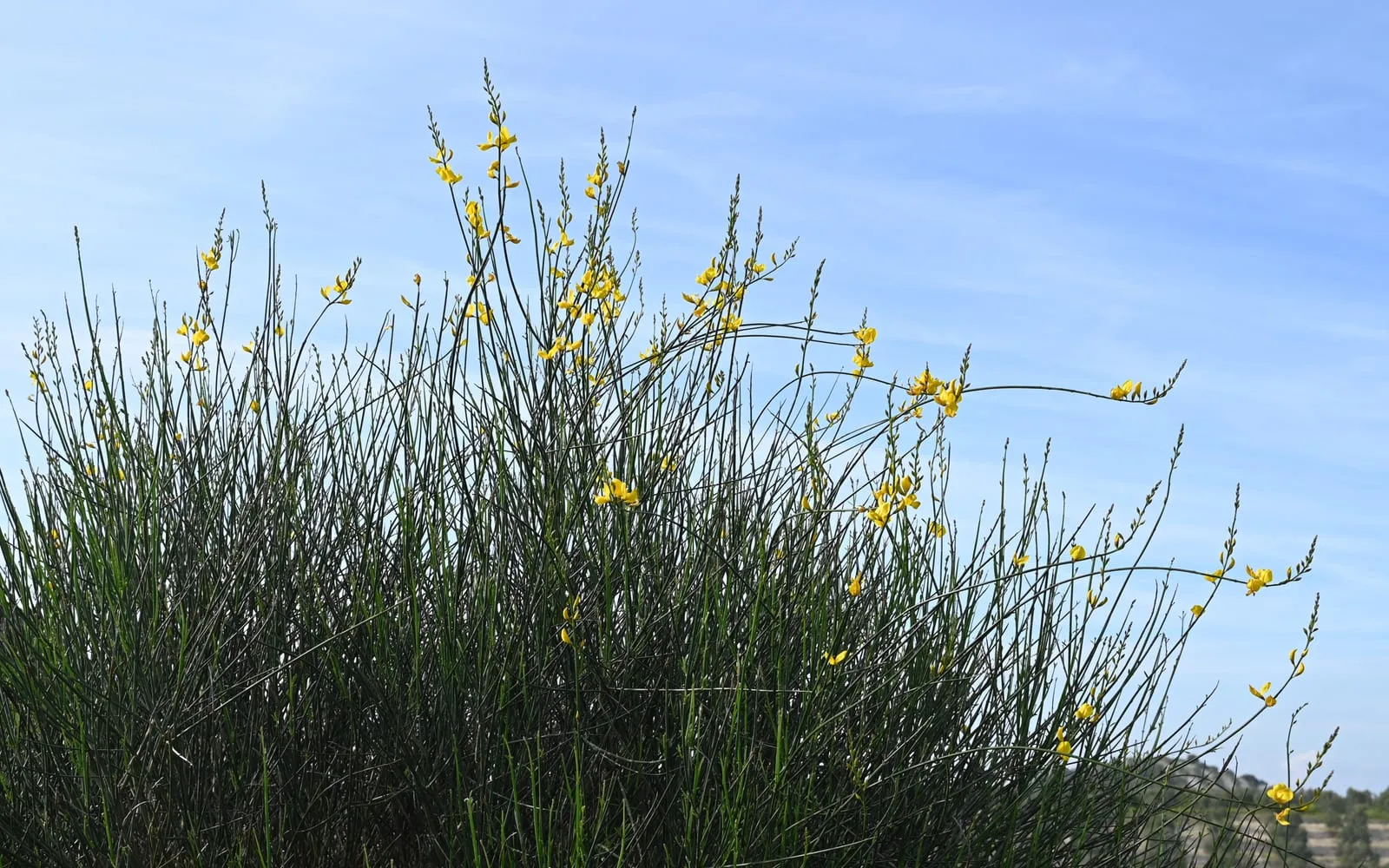
Spanish broom barely bothers with leaves. Its small, narrow leaves drop early in the season and the plant carries on regardless, photosynthesis handled instead by the tough, cylindrical, rush-like green stems that give the species its name, junceum, meaning rush-like. It is a drought-survival strategy shared with several other plants of hot, dry coastlines, and it helps Spanish broom tolerate a Mediterranean summer that would finish off a broad-leaved shrub.
What it delivers in return is a long, generous run of bright yellow, sweetly fragrant, pea-shaped flowers through late spring and summer, on a plant that needs almost nothing once it is established. It needs no feeding, as little water as it can be given, and only the poorest soil.
That same undemanding constitution has let it escape gardens in more than one part of the world with a similarly dry, mild climate, including California, South Africa and parts of Australia, where it is now managed as a weed. Check local guidance before planting it in a Mediterranean or dry-summer climate outside its native range.
Appearance and character
Stems are green, ridged and rush-like, arching upward from the base in a loose, fountain-like mass, doing most of the plant’s photosynthetic work once the sparse, narrow, short-lived leaves have dropped.
Flowers open from late spring through summer in loose clusters toward the stem tips, bright golden yellow, pea-shaped and strongly, sweetly scented, carrying a fragrance often compared to jasmine or sweet pea and noticeable from some distance on a warm evening. Bees work them hard through the whole flowering season.
Seed pods follow the flowers, flattened, hairy and pea-like, ripening from green to brown and splitting audibly to fling seed some distance from the parent plant, which is one of the ways it spreads so readily on suitable ground.
Roots, in common with the rest of the pea family, carry nodules that fix nitrogen from the air, letting Spanish broom colonise soil too poor and dry to support most other flowering shrubs.
Where it is from
Spartium junceum is native across the Mediterranean basin, growing on dry, rocky hillsides, roadside banks and scrubland from Iberia and North Africa through southern Europe to the eastern Mediterranean, typically on poor, well-drained, often calcareous soil in full sun.
It has been grown and used well beyond that native range for centuries. The tough fibres from its stems were historically processed into cordage and coarse cloth, which is where the common name Weaver’s Broom comes from, and it has long been planted along Mediterranean roadsides and embankments for its drought tolerance and its ability to bind loose, dry soil.
That same combination of toughness and prolific seeding has carried it into other dry-summer climates as an ornamental or erosion-control planting, and in several of them it has since become an established weed of disturbed and burned ground, contributing to wildfire risk through its oil-rich, resinous stems.
How it grows
Plant in full sun, in poor, free-draining soil, ideally somewhere that would otherwise be difficult to plant, such as a dry bank, thin chalky ground or a gravel garden. Rich, fertile soil produces soft, leggy growth and fewer flowers than poor, stony ground does.
Water regularly through the first year while the root system establishes, then step back almost entirely. An established Spanish broom is far more likely to suffer from overwatering, which encourages root rot in heavy soil, than from drought.
Prune lightly after flowering to keep the plant compact, cutting only into the current year’s soft green growth rather than into old bare wood, which this species regenerates from poorly if at all. An old, leggy plant that has been allowed to go unpruned for years is usually best replaced rather than renovated.
It establishes from a young pot-grown plant far more reliably than from a transplanted older one, since the taproot resents disturbance once it is down.
Through the seasons
Spring brings renewed stem growth and the first flowers opening toward the end of the season in a warm climate.
Summer is the main flowering period, a long run of fragrant yellow blooms through the hottest, driest months, exactly the conditions this plant is built for.
Autumn sees the seed pods ripening and splitting, scattering seed around the base of the plant and, on light soil, sometimes considerably further.
Winter is dormant and undemanding in a mild climate; in a colder one, frost can cut the soft green stems back hard, with regrowth from the base the following spring if the roots survive.
Care difficulty
Easy, on the right site, and difficult to please on the wrong one. Spanish broom needs poor soil, full sun, minimal water and a hot summer, and giving it rich soil, shade or regular watering produces a weak, floppy, short-lived plant rather than the tough, self-sufficient shrub it is capable of being.
Once matched to a suitable dry, sunny position, it needs almost no ongoing care beyond an annual light prune after flowering, and it copes with poor soil, salt air and drought better than almost anything else grown for summer colour.
Watering
Water a newly planted specimen regularly through its first summer while the root system establishes.
After that, water only in the most severe or prolonged drought, and treat any request for more than that as a warning sign of a badly sited plant rather than a routine need. Overwatering an established Spanish broom is a far more common cause of failure than underwatering it ever is.
Warning signs, diseases and pests
Aphids, particularly blackfly, cluster thickly along the green stems in spring and early summer, sometimes in dense enough numbers to coat a whole shoot. A strong jet of water dislodges a light infestation, and natural predators usually keep numbers down on an otherwise healthy plant.
Gall mites cause swollen, distorted, bud-like galls to form along the stems, disfiguring rather than seriously harmful. Pruning out and disposing of affected growth reduces the population.
Root rot follows planting in heavy or poorly drained soil, or from overwatering an established plant, showing as yellowing stems and a general decline despite consistently damp ground. Improve drainage rather than watering more, and consider the site unsuitable if standing water is a regular problem.
Broom rust appears as small orange pustules on the stems in a wet season, usually a minor cosmetic issue on a plant otherwise growing in conditions it likes. Improving airflow and avoiding overhead watering both help.
Growing environment
Full sun is close to essential. Spanish broom flowers poorly and grows leggy in shade, and it needs strong summer light to ripen its stems before winter.
Poor, dry, free-draining soil suits it far better than anything rich or regularly irrigated, and it is a sound choice for a difficult bank, a gravel garden or thin soil over chalk where little else thrives.
It tolerates coastal salt spray and wind well, and its drought tolerance once established makes it a sound choice for low-water planting in a hot, dry summer climate.
Give it room from the start, since it resents being moved once established and grows quickly to its full spread in good conditions.
Feeding
None needed on an established plant. As a nitrogen-fixing legume, Spanish broom draws much of its own fertility from the air rather than from the soil, which is part of why it thrives on ground too poor to support most flowering shrubs.
A young plant in barren, freshly disturbed soil can be given a very light feed in its first season to help it establish, but this is the exception rather than the rule.
Avoid feeding an established plant altogether. Extra fertility produces soft, floppy growth and fewer flowers, the opposite of what this species is grown for.
Troubleshooting
Why has my plant grown tall and floppy with few flowers? Almost always too much shade, too rich a soil, or too much water. Move it to the poorest, sunniest spot available and stop feeding and watering it, and the next season’s growth should be tighter and more floral.
Did a hard frost kill my plant? Possibly not. A frost cuts the soft green stems back, but an established plant with roots that survived usually resprouts from the base the following spring. Wait until late spring before deciding it is dead.
Are the seed pods dangerous? Yes, especially if children play near the plant. The seeds carry the highest concentration of the alkaloids that make every part of this plant harmful if eaten.
Is Spanish broom invasive where I live? Possibly, particularly in a dry-summer, mild-winter climate similar to the Mediterranean. It has become established as a weed in parts of California, South Africa and Australia, so it check local guidance before planting it.
Can I cut an old, leggy plant back hard to renovate it? Not reliably. Spanish broom regenerates poorly from old bare wood, so a badly overgrown or neglected plant is usually better replaced with a young one than cut back and hoped for.