
Outdoor plant
Japanese holly
Ilex crenata
Also known as Box-leaved holly, Kuro-gane holly
How to grow Japanese holly, Ilex crenata. The box substitute that resists box blight and box tree moth, how to clip it, and why it needs acid soil.
At a glance
- Difficulty
- Moderate
- Water
- Regular in dry spells, and never let a container dry out
- Light
- Full sun to partial shade
- Temperature
- Fully hardy, and cold drying wind browns the foliage
- Hardiness
- USDA 5-8, RHS H6, hardy to -25 C
- Type
- Evergreen shrub, long lived and slow growing
- Height
- 1-3 m depending on cultivar
- Native to
- Japan, Korea, eastern China, Taiwan and Sakhalin
- Best month
- April in the Northern Hemisphere, October in the Southern Hemisphere
It looks like box, clips like box and is immune to both box blight and box tree moth, which is the entire reason to plant it. It needs acid to neutral soil and yellows on chalk. Black root rot is its own weakness and it shows first as stunted yellow growth on wet ground, so plant it high and never in a spot that stays soggy.
Hardiness zones describe winter cold alone. Summer heat, humidity, rainfall and the length of the growing season decide as much, so treat the range as the outer limit rather than as a recommendation.
Every month named in this guide is for the temperate Northern Hemisphere. If you garden in the Southern Hemisphere, shift each one by six months, so April becomes October. Closer to the equator the wet and dry seasons matter more than the calendar, and the shift stops being a useful guide.
Harmful if eaten
- Do not eat
- The berries
- Harm from
- Eating it
- Affects
- People, cats and dogs
Japanese holly carries the ordinary cautions of the genus. Ilex berries contain saponins and related compounds, and eating them causes vomiting, abdominal pain and diarrhoea. The ASPCA lists Ilex species as toxic to cats and dogs on that basis, and the RHS lists holly as harmful if eaten. The berries on Ilex crenata are small and black rather than the conspicuous red of common holly, so they attract less attention from children, and a clipped hedge or topiary piece produces almost none because flowering wood is removed every year. The plant is separately male and female, so a lone specimen may never fruit at all. Reported outcomes from eating a few berries are vomiting and stomach upset rather than anything more serious, and a child who has eaten a handful is worth a call to a doctor. The leaves are small and soft-tipped rather than spined, so this species carries none of the scratching hazard of common holly.
Sources: RHS potentially harmful garden plants, ASPCA toxic and non-toxic plants
About
Japanese holly is what temperate gardeners started planting when box became impossible.
Box blight arrived in the 1990s and the box tree moth followed in 2007, and between them they have made Buxus sempervirens a difficult plant to keep alive across Europe and, since the moth reached Ontario in 2018, across much of eastern North America. Established parterres, knot gardens and clipped balls have been lost wherever the two arrived.
Ilex crenata is the closest substitute. The leaves are small, dark, glossy and closely set, the growth is dense and twiggy, it clips to a crisp face and holds it, and at two paces a clipped ball of Japanese holly reads as box. Neither box blight nor box tree moth touches it.
Two differences matter in practice. It is slower than box, so a hedge takes longer to fill and topiary takes longer to build, and it wants acid to neutral soil where box is happy on chalk. On alkaline ground it yellows, and that is the commonest reason a replacement planting fails.
Alternatives include Euonymus japonicus ‘Green Spire’ and the small cultivars of Ilex crenata such as ‘Dark Green’ and ‘Convexa’ are the usual choices, and yew remains the best plant for any hedge over about 60 cm.
Appearance and character
An evergreen shrub reaching 1 to 3 m depending on cultivar, dense and twiggy, and easily kept at any size by clipping.
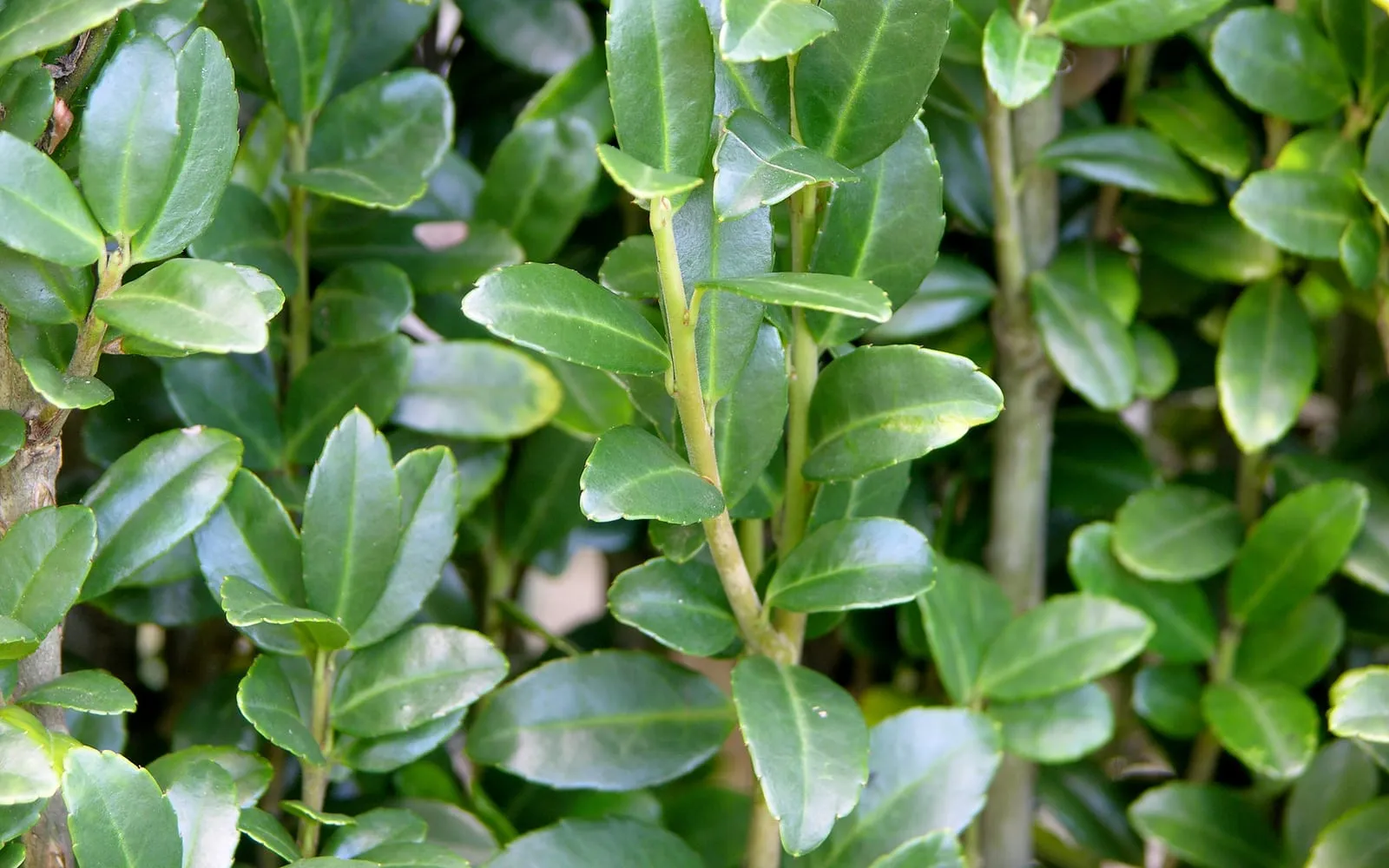
Leaves are the point of the plant. They are small, 1 to 2.5 cm long, oval, glossy dark green, leathery and finely toothed, with a soft rounded tip and no spines at all. They are held alternately along the stem, where box holds its leaves in opposite pairs, and that is the reliable way to tell a clipped ball of one from the other.
Flowers open in spring, small, white and inconspicuous, and the plant is separately male and female.
Berries follow on pollinated female plants, 6 mm across, glossy black rather than red, and largely hidden in the foliage.
Stems are fine and densely branched, which is what gives the clipped surface its quality.
Cultivars vary widely. ‘Convexa’ has slightly domed leaves and makes good topiary, ‘Dark Green’ is the standard hedging form, ‘Golden Gem’ is low and yellow-leaved, and ‘Sky Pencil’ is a narrow column.
Where it is from
Japan, Korea, eastern China, Taiwan and Sakhalin, growing in woodland, scrub and on mountain slopes.
It has been used for clipped work in Japanese gardens for centuries and is a standard subject for niwaki, the cloud-pruned forms of Japanese garden tradition.
It reached Britain in the middle of the nineteenth century and stayed a minor plant until the box problems of the last thirty years pushed it into the mainstream.
Box blight is caused by two fungi, Calonectria pseudonaviculata and Calonectria henricotiae, and it defoliates box from the base upwards leaving black streaks on the stems.
The box tree moth, Cydalima perspectalis, arrived from east Asia and its caterpillars strip box completely, often before anybody notices the webbing.
Japanese holly is unaffected by both, which is the whole basis of its current popularity.
How it grows
Check the soil pH before planting. Ilex crenata wants pH 5 to 6.5 and yellows above about 7.
On chalk or alkaline soil, grow it in containers of ericaceous compost rather than in the ground. It is a good container plant.
Plant in autumn or spring in sun or partial shade, into moist free-draining soil with leaf mould or composted bark worked in.
For a hedge, plant at 25 to 30 cm spacing, and expect it to take a season or two longer than box would to knit together.
For topiary, buy a plant already trained if you want a shape soon, since building one from scratch is a matter of years rather than seasons.
Clip twice a year, in late May or early June and again in late August. Two light cuts give a better surface than one hard one.
Use hand shears or secateurs on small work. Powered trimmers cut through the leaves and leave a fringe of browned edges that shows for weeks.
Clip on a dull day rather than in hot sun, which scorches the cut surfaces.
Mulch every spring with composted bark or leaf mould.
Water in dry spells for the first three years, and keep containers damp all year.
Renovate an overgrown plant by cutting back hard in late spring. It regrows from old wood, more slowly than box does.
Feed clipped plants, since regular cutting takes a great deal out of them.
Propagate from semi-ripe cuttings in late summer with bottom heat.
Through the seasons
Winter carries the evergreen structure, and cold drying wind may bronze the foliage, which recovers in spring.
Spring breaks into fresh growth in April and flowers inconspicuously, and this is feeding and mulching time.
Summer is clipping season, with the first cut in late May or early June and the second in late August.
Autumn ripens the small black berries on female plants and is a good planting time.
Care difficulty
Moderate. The clipping regime is straightforward and the soil requirement catches people out.
On acid to neutral, moist, free-draining ground it is easy, long-lived and needs two cuts a year.
On chalk it goes yellow and stays yellow. Use containers rather than soil treatment.
The other adjustment is expectation. Japanese holly is noticeably slower than box, so a hedge or a topiary piece costs more in time or in money at the point of purchase.
Watering
Water regularly through dry spells for the first three years while it roots in.
Established plants in reasonable soil manage on rainfall in a temperate climate and want water in a long drought.
Container plants need watering all year and must never dry out. Clipped topiary in a pot is particularly vulnerable in summer.
Use rainwater in a hard-water area, since tap water raises the pH of container compost over a couple of seasons and produces exactly the yellowing this plant is prone to.
Never let it stand in water. Phytophthora root rot follows waterlogging.
Warning signs, diseases and pests
Yellowing across the plant with green veins is lime-induced chlorosis on alkaline soil or from hard tap water. Move it to ericaceous compost, switch to rainwater, and use sequestered iron as a holding measure.
Bronze or purple foliage after a cold winter is wind burn rather than disease, and it greens up again in spring. Shelter from cold drying east wind reduces it.
Browned leaf edges over the whole clipped surface is trimmer damage. Use hand shears on anything you care about.
Sudden wilting, blackening at the base and death is Phytophthora root rot, which follows waterlogging. Improve drainage and do not replant in the same spot.
Brown limpet-like bumps on the stems with sticky leaves and sooty mould is scale insect. Treat in midsummer when the crawlers are active.
Pale winding trails inside the leaves is holly leaf miner, which is disfiguring and harmless.
Slow growth is normal for the species rather than a symptom. It is slower than box.
Black streaks on the stems with leaves dropping from the base upwards is box blight, and if you see it on Ilex crenata you have box rather than Japanese holly. Check whether the leaves are alternate or opposite.
Growing environment
Full sun to partial shade. Both suit it and the growth is denser in sun.
Moist, free-draining, acid to neutral soil rich in organic matter. Avoid chalk and avoid heavy wet clay.
Fully hardy to about -25 deg C, and cold drying wind bronzes the foliage, so shelter from the east improves its winter appearance.
Allow the size of the clipped shape you want, and for a hedge allow 40 to 60 cm of width.
It suits a low hedge, a parterre, topiary, a knot garden, a formal edge, a container or a Japanese-style garden.
Grow it where box would have gone, with the same companions, and accept the slower build.
Consider yew for anything above about 60 cm, since yew is faster, cheaper by the metre at scale, tolerates chalk and makes the better large hedge.
Its wildlife value is modest. The flowers feed bees briefly and the black berries feed birds on unclipped plants.
Feeding
Feed once in spring with an ericaceous or balanced slow-release fertiliser.
Feed clipped hedges and topiary twice, in spring and again after the first cut, since regular clipping removes a great deal of growth.
Mulch every spring with composted bark or leaf mould.
Feed container plants with a liquid ericaceous feed every two weeks from April to August, and top-dress with fresh compost each spring.
Avoid mushroom compost and anything containing lime.
Yellowing is a pH problem before it is a nutrient one.
Troubleshooting
Is it a good box substitute? Yes for small-leaved clipped work, and it is slower than box and needs acid to neutral soil. Neither box blight nor box tree moth affects it.
How do I tell it from box? Look at how the leaves are arranged. Japanese holly holds them alternately along the stem, box holds them in opposite pairs. Box also has a distinctive smell when clipped.
The leaves have gone yellow. Lime-induced chlorosis from alkaline soil or hard tap water. Move it to ericaceous compost, use rainwater, and apply sequestered iron as a stopgap.
Can I grow it on chalk? Not well in the ground. Use containers of ericaceous compost, or plant yew instead.
When do I clip it? Twice, in late May or early June and again in late August. Two light cuts beat one hard one.
The foliage went bronze over winter. Cold drying wind. It greens up again in spring. Shelter from the east reduces it.
All the cut leaves have brown edges. Powered trimmer damage. Use hand shears or secateurs on small-leaved evergreens.
How fast does it grow? Slowly, around 10 to 15 cm a year, which is less than box. Buy larger plants if you want a finished look sooner.
Is it poisonous? The berries are, in the ordinary way of hollies, causing vomiting and stomach upset. They are small and black and a clipped plant produces almost none.