
Outdoor plant
Pickerelweed
Pontederia cordata
Also known as Pickerel rush
How to grow pickerelweed, Pontederia cordata, at a pond margin. Planting depth, the long summer flower spikes, and why it feeds pollinators all season.
At a glance
- Difficulty
- Easy
- Water
- Permanently wet soil or shallow water
- Light
- Full sun
- Hardiness
- USDA 3-11, RHS H6, hardy to -20 C
- Type
- Hardy aquatic perennial
- Height
- 60-90 cm
- Native to
- Eastern North America, Caribbean
Fully hardy in shallow water or wet mud that does not freeze to the bottom, since the rhizome sits below the frost line for most of the winter. It flowers over a long season wherever summer water temperatures reach the high teens Celsius, and stops setting new flower spikes once autumn cools the water, rather than on a fixed calendar date.
Hardiness zones describe winter cold alone. Summer heat, humidity, rainfall and the length of the growing season decide as much, so treat the range as the outer limit rather than as a recommendation.
Not known to be toxic
Pickerelweed has no entry on the RHS poisonous plants list or the ASPCA toxic and non-toxic plant database, and neither humans nor the common pond visitors, ducks, fish and amphibians, treat it as anything other than food and cover. It is one of the more reliably safe choices for a wildlife pond with pets or children nearby.
Source: RHS
About
Pickerelweed is a North American marginal plant grown for one of the longest flowering seasons of any hardy pond plant, sending up spikes of small violet blue flowers continuously from early summer into autumn. It takes its common name from the pickerel, a freshwater fish that shelters among its stems.
It is a favourite of pond keepers who want colour without the fuss of a water-lily. Give it shallow water and sun, and it flowers for months rather than for a few days per bloom.
Appearance and character
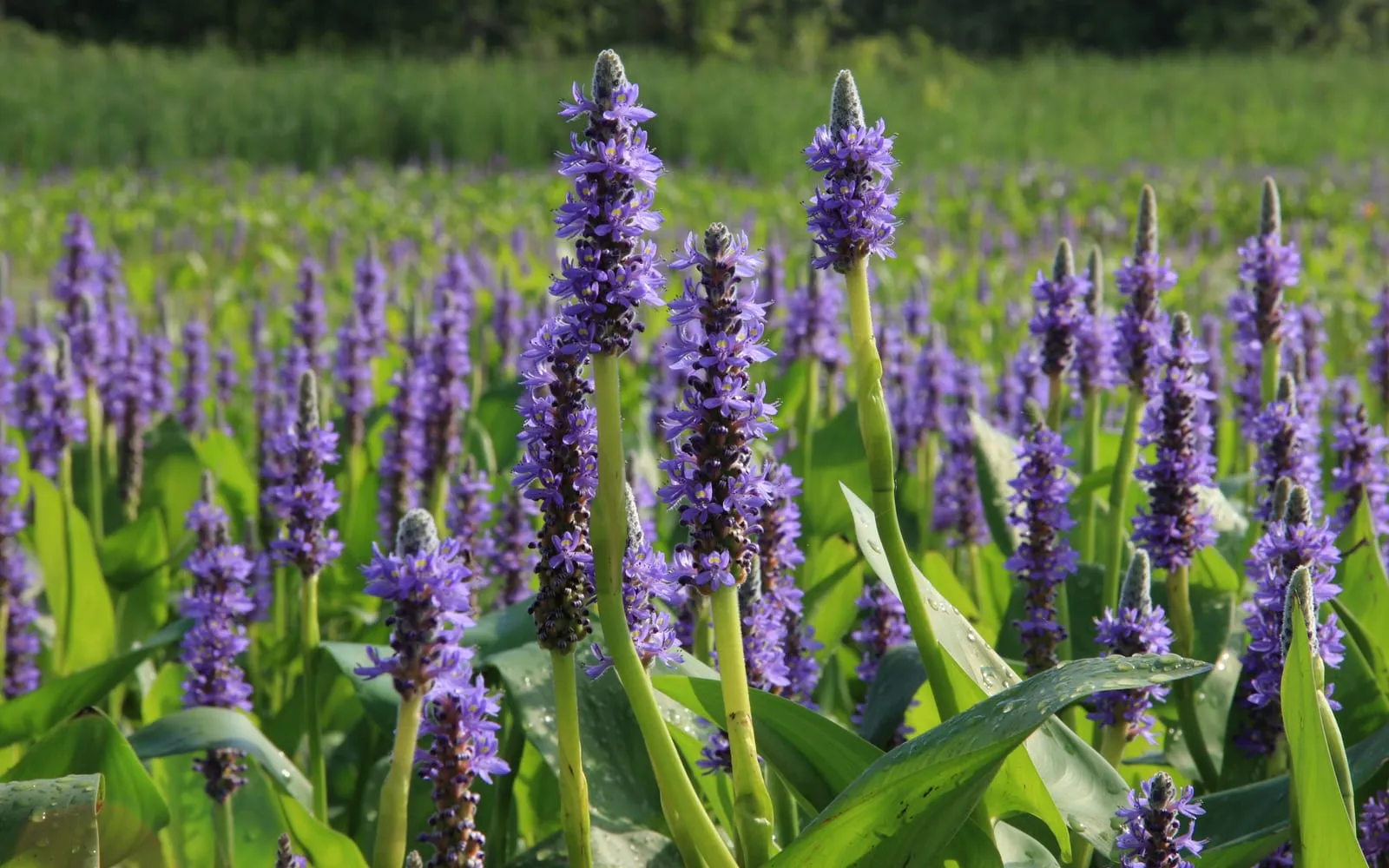
Broad, glossy, heart-shaped leaves stand upright on long stalks above the water, a shape that gives the plant its species name cordata, meaning heart-shaped. Flower spikes rise slightly above the foliage, each one densely packed with small tubular violet-blue flowers that open a few at a time from the base upward.
A single spike stays in flower for one to two weeks, and a healthy clump produces a continuous run of new spikes through the whole growing season, which is what gives the plant its long display compared with most other marginals. That long succession also makes it one of the better pond plants for bees and hoverflies, which work the spikes for nectar from early summer until the first cold nights.
Where it is from
Shallow fresh water across eastern North America and the Caribbean. It grows at pond edges, in marshes and along the slow-moving margins of lakes and rivers, almost always in full sun.
It expects warm summer water and a long growing season, both readily met in a garden pond through most temperate summers, and dies back completely once autumn cools the water, regrowing reliably from the rhizome the following spring.
How it grows
A hardy perennial spreading by a thick rhizome that creeps gradually outward, sending up new leaf and flower stems each year. Growth is steady rather than explosive, and a clump takes two or three seasons to fill a planting basket without becoming a nuisance the way some marginal plants do.
Because it flowers on new growth continuously through the season rather than in one flush, deadheading spent spikes has little practical effect on the total display. The plant keeps producing new spikes regardless of whether old ones are removed.
A clump reaches its full flowering potential in its second or third season, once the rhizome has filled enough of the basket to support several spikes opening at once rather than one at a time. Left in the same basket for many years without division, it eventually plateaus at whatever the container’s volume of aquatic loam can support, which is usually a wide, low mound of leaves with spikes rising steadily from spring right through to the first cold snap of autumn.
Through the seasons
Spring: Fresh leaves emerge from the rhizome as the water warms. Feed once new growth is underway.
Summer is the main flowering period, running from June into September, with a steady succession of new spikes. A second feed in midsummer keeps a heavily flowering clump going strong.
Autumn flowering tapers as the water cools, and foliage begins to yellow.
Winter the plant dies back to the rhizome, which needs nothing further so long as it sits below the depth that freezes solid.
Care difficulty
Easy. It tolerates a wide range of planting depths and needs little beyond full sun and a reliably wet root run, and it does not spread aggressively enough to need the yearly containment that yellow flag or some rushes demand.
Watering
Permanently wet is the requirement, whether that is shallow standing water at a pond margin or consistently sodden mud in a bog garden. Planting depth ranges from just a few centimetres of water over the crown up to about 30 cm for an established clump, and it tolerates being moved deeper or shallower within that range without much complaint.
Plant in a mesh aquatic basket with heavy aquatic loam rather than multipurpose compost, which breaks down and clouds pond water.
Warning signs, diseases and pests
Few problems trouble this plant in a garden pond. Aphids occasionally cluster on new growth above the waterline and are easily dislodged with a jet of water. Water snails sometimes graze young leaves, leaving small ragged patches, but rarely in numbers worth controlling.
Poor flowering usually traces back to insufficient sun rather than pests or disease; pickerelweed flowers weakly in anything less than several hours of direct light a day.
A clump that has stopped producing new spikes after several strong years has likely exhausted the nutrients in its basket rather than developed a problem, and responds well to a fresh feed or repotting into new aquatic loam.
Growing environment
Full sun is essential for good flowering; even light shade for part of the day noticeably reduces the number of spikes produced. Still or slow-moving water suits it far better than a strongly moving stream, which can disturb young plantings before the rhizome anchors.
It tolerates a wide range of water depths, which makes it a forgiving choice for a pond shelf whose exact water level varies through the season.
Feeding
An aquatic plant tablet pushed into the basket in spring covers most of the season’s needs, and a second application in midsummer supports the long flowering run through to autumn. As with other marginal plants, feed the basket directly rather than the open water, which mostly benefits algae instead.
Troubleshooting
Few or no flower spikes despite healthy leaves. Almost always insufficient sun. Move the basket to the sunniest available spot at the pond margin.
Leaves developing ragged patches. Check for grazing water snails; numbers are rarely high enough to need more than occasional hand removal.
Flowering has tailed off after several good seasons. The basket has likely run out of nutrients. Feed again, or lift and repot into fresh aquatic loam.
New growth looks sparse in spring. The rhizome may be sitting too deep for the water temperature this early in the season. Raise the basket slightly on bricks until growth is well underway, then lower it back to its usual depth.