
Outdoor plant
Sweet Violet
Viola odorata
Also known as English violet, Garden violet, Devon violet
How to grow sweet violets, Viola odorata. Shade, spreading by runners, the hidden flowers that set the seed, and why the scent seems to vanish.
At a glance
- Difficulty
- Moderate
- Water
- Rain is usually enough in shade
- Light
- Partial to full shade. Morning sun at most
- Temperature
- Fully hardy, to about -20 deg C
- Hardiness
- USDA 4-9, RHS H6, hardy to -20 C
- Type
- Evergreen perennial
- Height
- 5-15 cm
- Native to
- Europe, Western Asia, North Africa
- Best month
- February in the Northern Hemisphere, August in the Southern Hemisphere
It flowers in late winter and again produces a second, self-pollinating set of flowers in summer that never open and set most of the seed. Cool moist shade suits it and hot dry sun does not. It runs by stolons and seeds freely, and it has naturalised widely across North America and Australia, so it is best given a place it can spread into.
Hardiness zones describe winter cold alone. Summer heat, humidity, rainfall and the length of the growing season decide as much, so treat the range as the outer limit rather than as a recommendation.
Every month named in this guide is for the temperate Northern Hemisphere. If you garden in the Southern Hemisphere, shift each one by six months, so February becomes August. Closer to the equator the wet and dry seasons matter more than the calendar, and the shift stops being a useful guide.
Edible, with limits
- Safe to eat
- Flowers and young leaves
- Do not eat
- Rhizomes and seeds
- Harm from
- Eating it
- Affects
- People
The flowers and young leaves are edible and have been eaten for centuries, candied for cake decoration, steeped into syrup, and scattered through salads. This is one of the few plants in these guides you can put on a pudding. The exception is underground: the rhizomes contain compounds that are strongly emetic and purgative in quantity, and the seeds are best left alone too, so the standard advice is to eat the flowers and leaves of violets and nothing else. Neither the RHS harmful plants list nor the ASPCA plant database carries an entry for Viola odorata. If you are picking to eat, be certain of what you have, and take nothing from a verge or a park where it may have been sprayed.
Sources: NC State Extension, Viola odorata, RHS potentially harmful garden plants
About
Sweet violets flower in February in the shade under a hedge, where almost nothing else is doing anything, and they smell extraordinary. The scent built an industry: Victorian Devon grew them by the acre for the London flower markets, and Parma violets scented most of the nineteenth century.
They are also a proper garden plant rather than a curiosity. Evergreen, hardy to about -20 deg C, happy in dry shade once established, and they spread themselves into ground cover without needing anything from you.
Two things about this plant are odd. Its scent switches itself off while you are smelling it, and most of its seed comes from flowers that never open.
Appearance and character
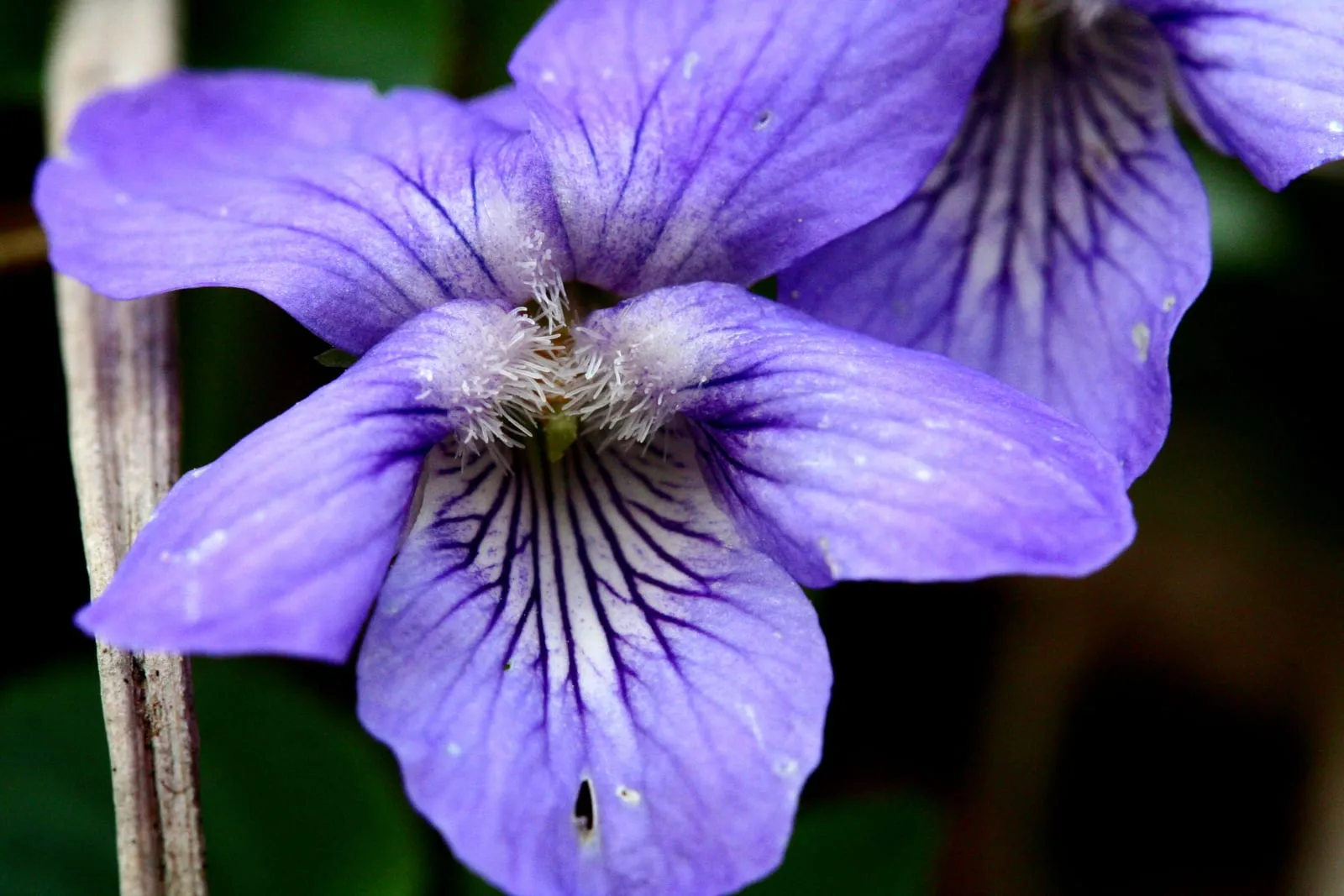
A low mat of heart-shaped, slightly glossy leaves on long stalks, with flowers held just above them on their own stems. The flowers are deep violet, or white in the form alba, about 1.5 cm across, with five petals and a short spur behind.
The scent is where it gets strange. Sniff a violet and it is intense, then a few seconds later it has gone, and then a minute afterwards it comes back. The compounds responsible are ionones, and they bind to the scent receptors in your nose and temporarily shut them down, so the flower has not stopped producing perfume; you have stopped being able to detect it. Almost nothing else in a garden does this.
Then there are the flowers you never see. The violet ones in February are showy, insect-pollinated, and often set no seed at all. Later in the year, down at ground level under the leaves, the plant produces a second kind of flower that stays closed, pollinates itself inside the bud and never opens. These are called cleistogamous flowers, and they are where most of a violet’s seed comes from.
Where it is from
Europe, western Asia and North Africa, and native to Britain, growing on shaded hedge banks, woodland edges and scrubby ground, usually on soils with some lime.
It is a plant of the woodland margin, and that is the position it wants in a garden. Give it shade for most of the day, soil with leaf litter worked into it, and shelter from wind.
How it grows
An evergreen perennial that spreads by stolons, runners that creep across the soil surface and root at intervals, so one plant becomes a colony within a few years. It also seeds itself, largely via those closed flowers, and ants carry the seeds away to new ground.
Flowering runs from February to April, with a scattering of autumn flowers in mild years. The plant grows through spring, then slows in summer heat, and several weeks of hot dry weather will send it into an early dormancy where it looks half-dead until the rain returns.
Propagation is easy and needs no skill. Lift a rooted runner in autumn or after flowering, cut it from the parent, and replant it.
Through the seasons
Winter brings the first flowers, from February onward, and a mild January sometimes starts them early.
Spring is the main flowering and the main growth. Water through any dry spell now, because drought in spring costs you next year’s flowers.
Summer is the difficult season. In heat the plant may go dormant and look scorched. Mulch it, keep it shaded, and leave it alone rather than digging it up.
Autumn is for dividing, replanting runners and mulching with leaf mould.
Care difficulty
Moderate, and the difficulty is placement rather than maintenance. Put a sweet violet in a shaded, humus-rich, sheltered spot and it will spread on its own for decades. Put it in sun and it scorches, struggles and eventually goes.
The other thing to be ready for is that it spreads. In a woodland border that is the point. In a small rockery it becomes a weeding job, so give it somewhere it can run.
Watering
In shade with decent soil, rain does the work.
Water through dry spells, and pay attention in spring while it is flowering and growing. Prolonged dryness scorches the leaf edges and sharply reduces the following year’s flowering, so a drought now is paid for next February.
Mulching with leaf mould does more than watering. It holds moisture, feeds the soil as it breaks down, and recreates the woodland floor the plant evolved on.
Standing water rots the crown, so the soil needs to drain even while holding moisture.
Warning signs, diseases and pests
Violet rust is the main disease, showing as bright orange pustules on the undersides of the leaves and yellow blotches on top. Pick off and destroy affected leaves rather than composting them, thin congested growth so air moves through, and water at the base.
Red spider mite attacks plants in hot dry positions, stippling the leaves and leaving fine webbing. It is a symptom of the plant being too dry and too warm, so the fix is shade and moisture rather than treatment.
Slugs and snails take the young leaves and flowers in damp spring weather.
Leaves going brown and crisp in July is usually heat and drought rather than disease, and the plant generally comes back in autumn.
A colony that has stopped flowering well is usually congested. Lift and divide.
Growing environment
Partial to full shade. The north side of a wall, under deciduous shrubs, along a hedge bottom, or the shaded front of a border all suit it. It will take morning sun, but hot afternoon sun scorches the leaves and shortens its life.
Fully hardy down to around -20 deg C, and it flowers early enough to shrug off late frosts.
Soil should be humus-rich and moisture-retentive with reasonable drainage. It does particularly well on soils with a bit of lime in them, reflecting the chalk and limestone banks it grows on in the wild, though it is not fussy.
Shelter matters more than most people expect. Wind dries the leaves and blows the scent away, and a violet in an exposed bed never seems as good as one tucked against a wall.
Feeding
A dressing of leaf mould or well-rotted garden compost each autumn is all it asks. Sweet violets evolved on decomposing leaf litter and respond to that far better than to fertiliser.
Avoid high-nitrogen feeds, which produce large soft leaves that hide the flowers and attract slugs.
Troubleshooting
Leaves scorched and brown in summer. Too much sun, too little water, or both. Mulch now and move it into shade in autumn.
Plenty of leaves, very few flowers. Congested clump, too much shade combined with too much nitrogen, or drought last spring. Divide it in autumn.
Orange spots on the undersides of leaves. Violet rust. Remove and destroy the affected foliage and improve air circulation.
It has taken over the border. Normal. Dig out the rooted runners in autumn and pass them on.
No scent at all. Two possible reasons. Some cultivars have had the scent bred out of them, so look for a named fragrant variety or the wild species. Or you have already saturated your scent receptors, in which case wait a minute and try again.
Fine webbing and speckled leaves. Red spider mite, brought on by heat and dry air. Move it somewhere cooler and shadier.