
Edible
Giant Granadilla
Passiflora quadrangularis
Also known as Badea, Barbadine
How to grow giant granadilla, Passiflora quadrangularis. Why the unripe fruit, leaves and root need cooking to break down cyanide compounds, the square winged stems that set it apart from other passionflowers, and the heavy support its fruit demands.
At a glance
- Difficulty
- Difficult
- Water
- Frequent and generous through the growing season
- Light
- Full sun
- Temperature
- Frost-tender; needs sustained warmth above 10 deg C
- Humidity
- High
- Hardiness
- USDA 10-11, RHS H1c, hardy to 5 C
- Type
- Evergreen tropical perennial vine
- Height
- 10-15 m of vine growth given support
- Native to
- tropical America
A lowland tropical vine that needs warmth and reliable moisture every month of the year, with no dormant strategy for surviving frost the way its temperate relative maypop has. A cold snap that only scorches maypop to the ground kills a giant granadilla outright, so it is a fully tropical plant rather than one merely tender at the margins.
Hardiness zones describe winter cold alone. Summer heat, humidity, rainfall and the length of the growing season decide as much, so treat the range as the outer limit rather than as a recommendation.
Toxic if eaten
- Safe to eat
- Ripe fruit pulp and aril, eaten fresh or juiced
- Do not eat
- Unripe fruit, foliage, and the root, which carry higher concentrations of cyanogenic compounds than the ripe fruit
- Harm from
- Eating it
- Affects
- People
Giant granadilla belongs to a genus that defends its unripe fruit and foliage with cyanogenic glycosides, compounds that release cyanide when the plant tissue is crushed or chewed, and this species carries them at a higher concentration than its smaller, temperate relative maypop, particularly in the root. The ripe fruit, large, yellow-green and fully mature, is the part grown for eating and is consumed widely across the tropics fresh, juiced or made into desserts. In some cuisines the unripe fruit is also eaten, but only after thorough cooking, which breaks the cyanogenic compounds down the same way cooking makes cassava root safe; it is not eaten raw. The foliage and the root are not treated as food at all and should be kept away from children and pets. The RHS harmful garden plants index covers the genus generally rather than this species by name, and it is not listed on the ASPCA toxic plant index, so this assessment follows the documented chemistry of the wider Passiflora genus.
Sources: RHS potentially harmful garden plants, ASPCA toxic and non-toxic plants
About
Giant granadilla is the largest-fruited member of the passionflower genus, a vigorous tropical vine grown across the tropics for a fruit that can reach the size and weight of a small melon. It is a genuine food crop rather than an ornamental curiosity, though its flowers are as striking as any passionflower’s and its unusually square, winged stems make it easy to tell apart from smaller relatives at a glance.
It needs consistently warm, humid conditions and a strong support to carry its considerable weight of vine and fruit, which sets it apart from hardier, smaller-fruited passionflowers grown much further from the tropics, and it is not a species that tolerates cold the way some of its relatives can.
Appearance and character
The stems are the best identifying feature, four-angled and noticeably winged along each edge, giving the plant its species name and distinguishing it immediately from the round or lightly ridged stems of most other passionflowers.
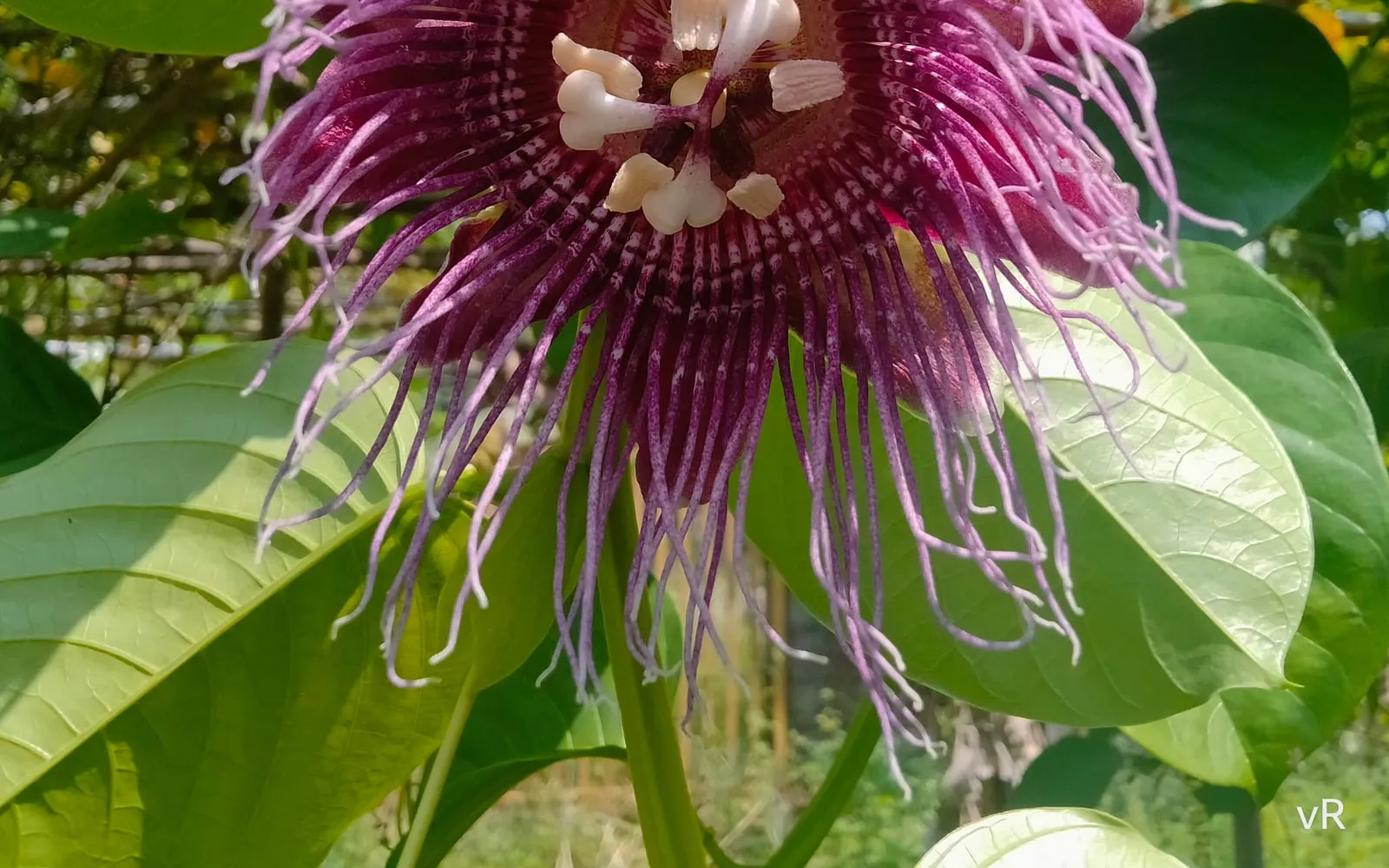
Leaves are broad, ovate and unlobed, larger and simpler in outline than the deeply cut, multi-lobed leaves typical of many other Passiflora species. Flowers open 10 to 12 cm across, fragrant, in shades of white through pink to purple, with a corona of thread-like filaments banded in purple, white and blue around a prominent central column.
Gardeners grow it for the fruit, an oblong to oval berry that can reach 20 to 30 cm long and several kilograms in weight, the largest fruit produced by any species in the genus, with a thick rind surrounding a mass of sweet, aromatic pulp and a jelly-like aril around each seed.
Where it is from
Passiflora quadrangularis is native to tropical South America, most likely originating in the Amazon basin, and has been cultivated across the wider tropics for so long that its precise wild range is now hard to pin down with confidence.
It grows in warm, humid lowland conditions with reliable rainfall throughout the year, and unlike some passionflowers native to more seasonal climates, it has no real dormant period built into its biology. That makes it considerably less cold-tolerant than a species such as maypop, whose roots survive freezing winters by retreating underground; a giant granadilla has no equivalent fallback and dies outright where frost reaches it.
How it grows
Plant in fertile, moisture-retentive but well-drained soil in full sun, with a strong, permanent support in place before planting, since a single season’s growth on a mature vine can run many metres and the weight of developing fruit is considerable.
Give the roots consistent warmth and moisture from the outset. Unlike its temperate relatives, this species has no capacity to survive a real cold snap or a prolonged dry spell by dying back and regrowing, so both protection from cold and steady watering matter throughout the plant’s life, not only while it is establishing.
Propagate from seed, which germinates readily in warm conditions, or from stem cuttings, which produce a flowering and fruiting vine faster than seed does. Hand pollination is sometimes worthwhile where the large bees or other pollinators the flower is adapted to are scarce, since poor natural pollination is a common reason a vigorous, well-flowered vine still sets little fruit.
Through the seasons
The main growing season, wherever a consistently warm, humid climate allows one all year, brings continuous vine growth, flowering and fruit development without a strict seasonal break.
Flowering happens over an extended period on a mature vine, with individual blooms opening for a day or so and a well-grown plant producing a long, overlapping succession of them.
Fruit development takes several months from flower to a fully ripe, harvestable fruit, given the size the fruit eventually reaches.
Any cool or dry period, wherever cultivation pushes the plant towards the cooler edge of its tolerance, slows growth noticeably and is the point at which the vine is most vulnerable to lasting damage or death.
Care difficulty
Difficult outside a reliably warm, humid, frost-free climate. The vine’s size and weight demand a serious support structure from the start, its complete lack of frost tolerance rules it out for most temperate gardens without a heated glasshouse, and it needs consistent warmth and moisture year round rather than tolerating the seasonal dieback a hardier relative like maypop manages.
Within a suitable climate it grows vigorously with little further trouble. Reaching that climate in the first place is the real obstacle for most growers.
Watering
Water frequently and generously through the growing season, keeping the soil consistently moist without allowing it to become waterlogged, since this species has no meaningful drought tolerance to fall back on.
Reduce watering only slightly during any cooler period, and never let the root zone dry out completely, since a vine grown in consistently tropical conditions rarely experiences the kind of sustained dry season some of its relatives are adapted to survive.
Warning signs, diseases and pests
Aphids cluster on new growth and flower buds, distorting soft tissue and leaving a sticky residue behind. A strong jet of water or an insecticidal soap deals with a light infestation quickly.
Spider mite builds up in hot, dry conditions, showing as fine speckling on the leaves with faint webbing in bad cases. Raising humidity around the plant helps prevent it, which suits a species that prefers humid air in any case.
Mealybug shows as small white, cottony tufts in leaf axils and sometimes on developing fruit. Wipe visible colonies away with a damp cloth or treat with horticultural soap.
Root rot follows soil that stays waterlogged rather than consistently moist, which the plant’s need for constant water can tip into if drainage is not equally reliable. Good drainage at planting time prevents most cases.
Growing environment
Full sun suits it best, supporting the strong growth and heavy fruit production this species is capable of; a vine grown in shade flowers and fruits considerably less freely.
High humidity matters as much as warmth, and a plant grown in dry air, whether in an arid outdoor climate or an under-ventilated glasshouse, generally performs worse than one in reliably humid conditions.
Fertile, moisture-retentive, well-drained soil supports both the vine’s vigorous growth and the size its fruit is capable of reaching. Poor or dry soil produces a smaller, less productive plant.
A strong, permanent support structure is not optional. The combined weight of a mature vine and a full crop of large fruit needs something sturdier than a typical garden trellis to carry safely.
Feeding
Feed with a balanced or fruit-tree fertiliser monthly through the growing season, supporting the substantial vegetative growth and large fruit this species is capable of producing.
Reduce or stop feeding during any period of noticeably slower growth, since a plant that is not actively growing makes poor use of applied fertiliser.
A generous mulch of well-rotted organic matter around the root zone supplies additional fertility over time and helps the soil retain the consistent moisture this vine needs.
Troubleshooting
Can I eat the unripe fruit like I have heard some cuisines do? Only after thorough cooking. The unripe fruit, along with the foliage and root, carries cyanogenic compounds that cooking breaks down, the same principle that makes raw cassava root dangerous and cooked cassava a staple food. Never eat any of these parts raw.
A cold night killed the whole vine to the ground. Unlike a hardier relative such as maypop, giant granadilla has no cold-adapted root system to regrow from. A vine killed by frost is very unlikely to recover, and growing this species where any frost is a real possibility means treating it as an annual or protecting it seriously through winter.
It produces plenty of flowers but very little fruit. Poor pollination is the most common cause. This species is adapted to large bees and other substantial pollinators, and a garden without enough of them present often needs hand pollination, transferring pollen between flowers with a small brush, to set a worthwhile crop.
The fruit is enormous but the trellis is starting to sag. The support was likely underbuilt for what this species can produce. A vine carrying multiple fruit that can each weigh over a kilogram needs a substantial structure, heavier than the trellis that would suit a smaller ornamental passionflower.
How is this different from the maypop grown further north? Size and hardiness are the two big differences. Giant granadilla produces a far larger fruit and needs constant tropical warmth with no tolerance for frost, while maypop produces a much smaller fruit but survives freezing winters by dying back to a hardy root system each year.