
Outdoor plant
Blue passion flower
Passiflora caerulea
Also known as Common passion flower, Blue crown passion flower
How to grow blue passion flower, Passiflora caerulea. The extraordinary flower explained, whether the orange fruit is safe, and cutting it back after a hard winter.
At a glance
- Difficulty
- Moderate
- Water
- In dry spells, and regularly in a container
- Light
- Full sun against a sheltered wall
- Temperature
- Hardy to around -10 deg C at the root, and the top growth is cut down by frost
- Hardiness
- USDA 7-10, RHS H4, hardy to -10 C
- Type
- Semi-evergreen woody climber, long lived and very vigorous
- Height
- 4-8 m
- Native to
- South America, from Brazil and Paraguay south to Argentina
- Best month
- August in the Northern Hemisphere, February in the Southern Hemisphere
The top growth dies back at about -10 C and the roots survive several degrees colder, so in a marginal climate it behaves as a herbaceous plant that regrows from the base each spring. Fruit needs a long warm autumn to ripen and rarely does so where summers are cool. It has naturalised in southern Europe, parts of Australia and New Zealand and the American south, and it suckers persistently once established.
Hardiness zones describe winter cold alone. Summer heat, humidity, rainfall and the length of the growing season decide as much, so treat the range as the outer limit rather than as a recommendation.
Every month named in this guide is for the temperate Northern Hemisphere. If you garden in the Southern Hemisphere, shift each one by six months, so August becomes February. Closer to the equator the wet and dry seasons matter more than the calendar, and the shift stops being a useful guide.
Edible, with limits
- Safe to eat
- The ripe orange fruit, in small quantities
- Do not eat
- The leaves, the stems and the unripe fruit
- Harm from
- Eating it
- Affects
- People, cats and dogs
Passiflora caerulea contains cyanogenic glycosides in its leaves, stems and unripe fruit, which release cyanide when the tissue is damaged. Eating the foliage causes vomiting, abdominal pain and in quantity more serious symptoms, and the ASPCA lists Passiflora caerulea as toxic to cats, dogs and horses on that basis. The ripe orange fruit is the exception. It is not poisonous and the pulp is edible, and it is also insipid, seedy and thoroughly disappointing next to the true passion fruit of Passiflora edulis. Eating a few ripe fruits causes nothing. Eating unripe green ones causes stomach upset. The reasonable position for a garden is to treat the fruit as harmless rather than as a crop, to remove it where small children might make a meal of green ones, and to keep the foliage away from a dog that chews plants. Passion flower extracts sold as herbal sedatives come from Passiflora incarnata, a different species, and that use does not transfer to the garden climber.
Sources: RHS potentially harmful garden plants, ASPCA toxic and non-toxic plants
About
The passion flower is the strangest thing most temperate gardeners can grow outdoors, and it is hardier than it looks.
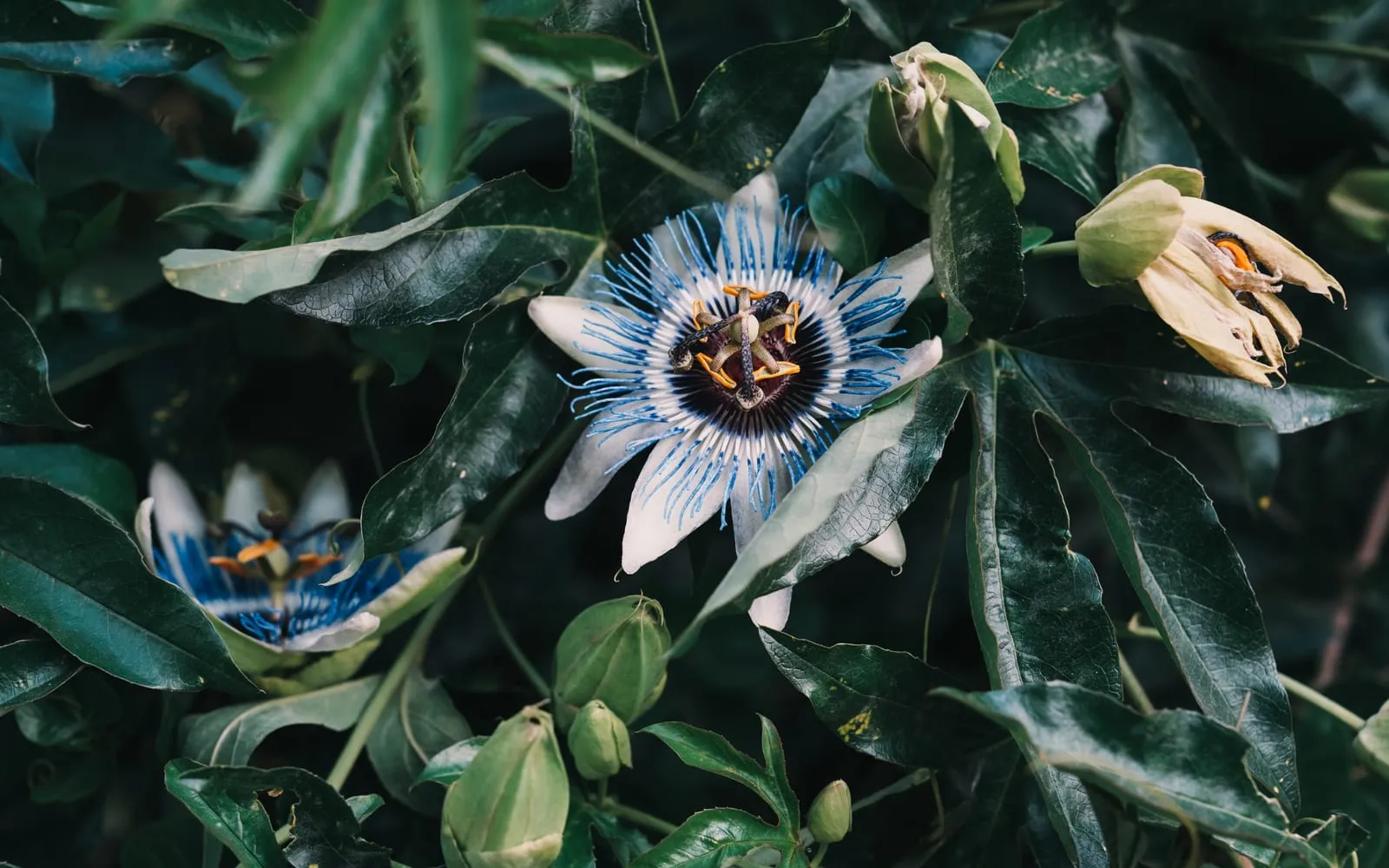
The flower is 8 to 10 cm across and built in layers. Ten white sepals and petals form the outer plate. Above them sits a dense fringe of filaments, blue at the tips, white in the middle and purple at the base. Rising from the centre is a green column carrying five stamens on a ring and three curved styles above them, arranged like nothing else in cultivation.
The name records a sixteenth-century reading of that structure by Spanish missionaries in South America, who saw the crucifixion in it. The three styles were the nails, the five stamens the wounds, the filament corona the crown of thorns, and the ten outer parts the apostles present.
It flowers from July to October and follows with egg-shaped orange fruits that look far better than they taste.
Grown against a sheltered sunny wall in a mild area it is close to permanent. In a cold winter the top growth is killed and the plant reshoots from the base in late spring, which alarms people who assume it has died. Wait until June before giving up on one.
Appearance and character
A semi-evergreen woody climber reaching 4 to 8 m in a season of good growth, clinging by coiled tendrils.
Leaves are palmate, divided almost to the base into five to seven narrow lobes, glossy mid-green, 10 to 15 cm across.
Tendrils spring from the leaf axils and coil tightly around wires, netting and neighbouring stems.
Flowers open from July to October, 8 to 10 cm across, with ten white or pink-tinged outer segments, a dense corona of filaments banded blue, white and purple, and a central column bearing five stamens and three styles.
Each flower lasts a single day, and a healthy plant opens several every day for months.
Fruits follow in late summer, egg-shaped, 4 to 6 cm long, ripening from green to bright orange, and full of red pulp and hard seeds.
Stems are woody at the base and green and soft at the tips, and they die back in cold weather.
‘Constance Elliot’ is the pure white cultivar and is generally reckoned slightly hardier than the type.
Where it is from
South America, from southern Brazil and Paraguay south into Uruguay and Argentina, growing in scrub and woodland edges.
Its native range reaches far enough south to give it the frost tolerance that distinguishes it from most of the genus, which is why this is the one passion flower that grows outdoors in a temperate climate.
It reached Britain around 1699 and has been grown here ever since, and it has naturalised in southern England, the Mediterranean and parts of the United States.
The genus contains over five hundred species, most of them tropical, and the edible passion fruit of the shops is Passiflora edulis, which needs a heated greenhouse here.
The flower structure evolved for pollination by large bees and, in some species, by hummingbirds and bats, and the corona guides the visitor into contact with the anthers.
Passiflora leaves are the food plant of heliconiid butterflies in the Americas, and the plants have evolved an unusual set of defences against them, including cyanogenic glycosides and structures on the leaves that mimic butterfly eggs.
How it grows
Plant in late spring, once the risk of hard frost has passed, which gives it a full season to establish before its first winter.
Choose a sheltered wall or fence in full sun, ideally facing south or west, which is what makes the difference between surviving a bad winter and not.
Poor to moderate free-draining soil suits it best. Rich ground produces enormous leafy growth with fewer flowers.
Provide wires or trellis for the tendrils to grip. It cannot climb a bare wall.
Water in the first summer and mulch the root area in autumn with bark or straw for winter protection, particularly in a cold garden.
Feed with high potash rather than a general fertiliser. Tomato feed through the summer gives flowers where a balanced feed gives foliage.
Prune in spring rather than autumn. Wait until the new growth shows, which may be late May, then cut back all the dead and damaged stems to live wood.
Cut the whole plant back hard each spring to keep it in bounds. It flowers on the current season’s growth, so hard pruning costs nothing.
Thin and tie in the new shoots through the summer, since an untrained plant becomes a dense mass that shades itself.
Remove suckers, which appear from the roots several metres from the plant in a warm garden.
Grow it in a large container in a cold garden and move it under cover in winter, or grow it in a conservatory.
Propagate from semi-ripe cuttings in summer or from seed, both of which work.
Do not assume a plant killed to the ground is dead. Wait until the end of June before digging it out.
Through the seasons
Winter may kill the top growth entirely in a cold spell. Leave it standing, since it protects the crown, and mulch the base.
Spring reshoots from the base or from live wood, sometimes not until late May, and this is pruning season.
Summer grows very fast and flowers from July, and the job is tying in and feeding with potash.
Autumn carries flowers into October and ripens the orange fruit.
Care difficulty
Moderate, and the difficulty is winter rather than the growing season.
In a mild sheltered garden in the south it is easy, vigorous and long-lived.
In a cold or exposed garden the top growth dies back most winters and the plant is a late-starting scrambler rather than a permanent framework, and in a hard winter the root dies too.
The other difficulty is vigour. It grows several metres in a season and will swamp a small space and sucker into a border.
Watering
Water in dry spells through the growing season, particularly against a wall where the soil is in rain shadow.
Established plants in the ground manage well and tolerate drought better than most climbers.
Container plants need regular watering all summer and should be kept just damp rather than wet through winter.
Avoid overwatering and rich wet soil, which produce leaf at the expense of flower.
Mulch the base in autumn with bark or straw for winter protection.
Warning signs, diseases and pests
The whole plant black and dead-looking after a cold winter is normal top-growth kill. Leave it, mulch the base, and wait until late June before deciding it has died. Cut back to live wood once the new shoots appear.
Vigorous leafy growth with few or no flowers is too much nitrogen or too much shade. Switch to a high-potash feed and check the position gets full sun.
Yellow mottling, distortion and puckering of the leaves is cucumber mosaic virus, which is common in passion flower. There is no cure. Remove and destroy a badly affected plant.
Suckers appearing several metres away in a border is normal behaviour in a warm garden. Dig them out.
Yellowing leaves in a container is usually a nutrient shortage or a pot that has run out of root room. Feed and repot.
Red spider mite under glass gives fine mottling and webbing in hot dry conditions. Increase humidity and use a biological control.
Fruit that stays green and never colours is a short or cool season, and it is common in the north.
Scale insect on the stems with sticky leaves and sooty mould is occasional. Treat in midsummer.
Growing environment
Full sun against a sheltered wall or fence, facing south or west.
Poor to moderate, free-draining soil. Avoid rich ground and avoid heavy wet clay.
Hardy to around -10 deg C at the root in a sheltered position, and the top growth is cut back by much less than that. It is reliable in mild coastal gardens and marginal in cold inland ones.
Allow 4 to 6 m of wall or fence and provide wires or trellis for the tendrils.
It suits a sunny sheltered wall, a fence, a pergola, a large container or a conservatory.
Do not plant it in a small space or against something you want it to share politely, since it grows over everything within reach.
Its wildlife value outside South America is modest, and bees do work the flowers for pollen.
Choose ‘Constance Elliot’ for pure white flowers and slightly better hardiness, and grow Passiflora edulis under glass if you want fruit worth eating.
Feeding
Feed with a high-potash liquid feed such as tomato food every two weeks from May to September. This is the single most useful adjustment for flowering.
Avoid general balanced fertilisers and anything high in nitrogen, which give large leaves and no flowers.
Mulch the base in autumn with bark or straw, which insulates the crown rather than feeding it.
Container plants need feeding throughout the growing season and repotting every two or three years.
A plant with rampant growth and no flowers is over-fed rather than under-fed.
Troubleshooting
Is the fruit edible? The ripe orange fruit is harmless and edible, and it is insipid and seedy. The unripe green fruit and the leaves contain cyanogenic glycosides and cause stomach upset. Remove green fruit where small children play.
It looks completely dead after the winter. Common. The top growth is killed by frost and the plant reshoots from the base, sometimes not until late May. Wait until the end of June before digging it out.
It grows enormously and never flowers. Too much nitrogen or not enough sun. Switch to a high-potash tomato feed and make sure it is in full sun against a warm wall.
When do I prune it? In spring, once the new growth shows. Cut all dead and damaged stems back to live wood, and cut the whole plant back hard to keep it in bounds. It flowers on the current year’s growth.
Can it climb a bare wall? No. It climbs by tendrils and needs wires, trellis or netting to grip.
Shoots are coming up all over the border. Root suckers, which is normal in a warm garden. Dig them out.
The leaves are mottled and puckered. Cucumber mosaic virus, which is common in this plant. There is no cure. Destroy a badly affected plant.
Will it survive in a cold garden? Marginally. Grow it against a south wall with a thick mulch over the roots, or keep it in a large container and move it under cover for the winter.
Is it poisonous to dogs? The ASPCA lists it as toxic. The foliage and unripe fruit contain cyanogenic glycosides. The ripe fruit does not.