
Edible
Barbados Gooseberry
Pereskia aculeata
Also known as Lemon Vine, Leaf Cactus
How to grow Barbados gooseberry, Pereskia aculeata. Why this cactus kept its leaves when almost every relative lost them, the hooked spines it climbs by, and cooking the young leaves as a vegetable alongside the tart fruit.
At a glance
- Difficulty
- Moderate
- Water
- Regular water through the growing season; less in cool weather
- Light
- Full sun to bright light for the heaviest flowering and fruiting
- Temperature
- Frost-tender; needs warmth year round
- Hardiness
- USDA 10-11, RHS H1b, hardy to 2 C
- Type
- Evergreen scrambling vine
- Height
- 3-9 m trained on a support; sprawls indefinitely without one
- Native to
- tropical America
A tropical American cactus with no adaptation to cold at all, and its leafy, broad-bladed growth is far more vulnerable to frost than the fleshy pads of a barrel or a prickly pear cactus, which store enough water to tolerate a light chill. A short dip toward freezing can defoliate it outright, and it needs consistent warmth through the year to keep growing and to flower.
Hardiness zones describe winter cold alone. Summer heat, humidity, rainfall and the length of the growing season decide as much, so treat the range as the outer limit rather than as a recommendation.
Not known to be toxic
- Safe to eat
- The ripe fruit, and the young leaves and shoots, cooked
Barbados gooseberry is a food plant on two counts, unusual for a cactus. The small, tart, orange-yellow fruit is eaten fresh or made into preserves, and the young leaves are cooked as a green vegetable in parts of its native range and where it has since been introduced. Neither the RHS harmful plants index nor the ASPCA toxic and non-toxic plants list carries an entry for Pereskia, and no toxic compound is documented in the fruit or the leaves. The hazard this plant carries is mechanical rather than chemical: the stems are studded with sharp, often hooked spines, in clusters of two or three at each leaf node on young growth and in dense woody clusters on older stems, capable of snagging clothing and skin badly enough to need careful, gloved handling at every stage of pruning or harvest.
Sources: RHS potentially harmful garden plants, ASPCA toxic and non-toxic plants
About
Barbados gooseberry looks nothing like the cactus most people picture, and that is why gardeners grow it. Pereskia is a genus of leafy cacti, retaining broad, ordinary-looking leaves that almost every other cactus lost tens of millions of years ago in favour of spines and swollen, water- storing stems. Botanists treat Pereskia as close to the ancestral form the whole cactus family evolved from, a scrambling, leafy vine armed with vicious thorns rather than a barrel or a paddle. It climbs by hooking those thorns over anything nearby, reaching several metres up a fence or a tree if given the chance, and produces a small, tart, edible fruit along the way.
Appearance and character
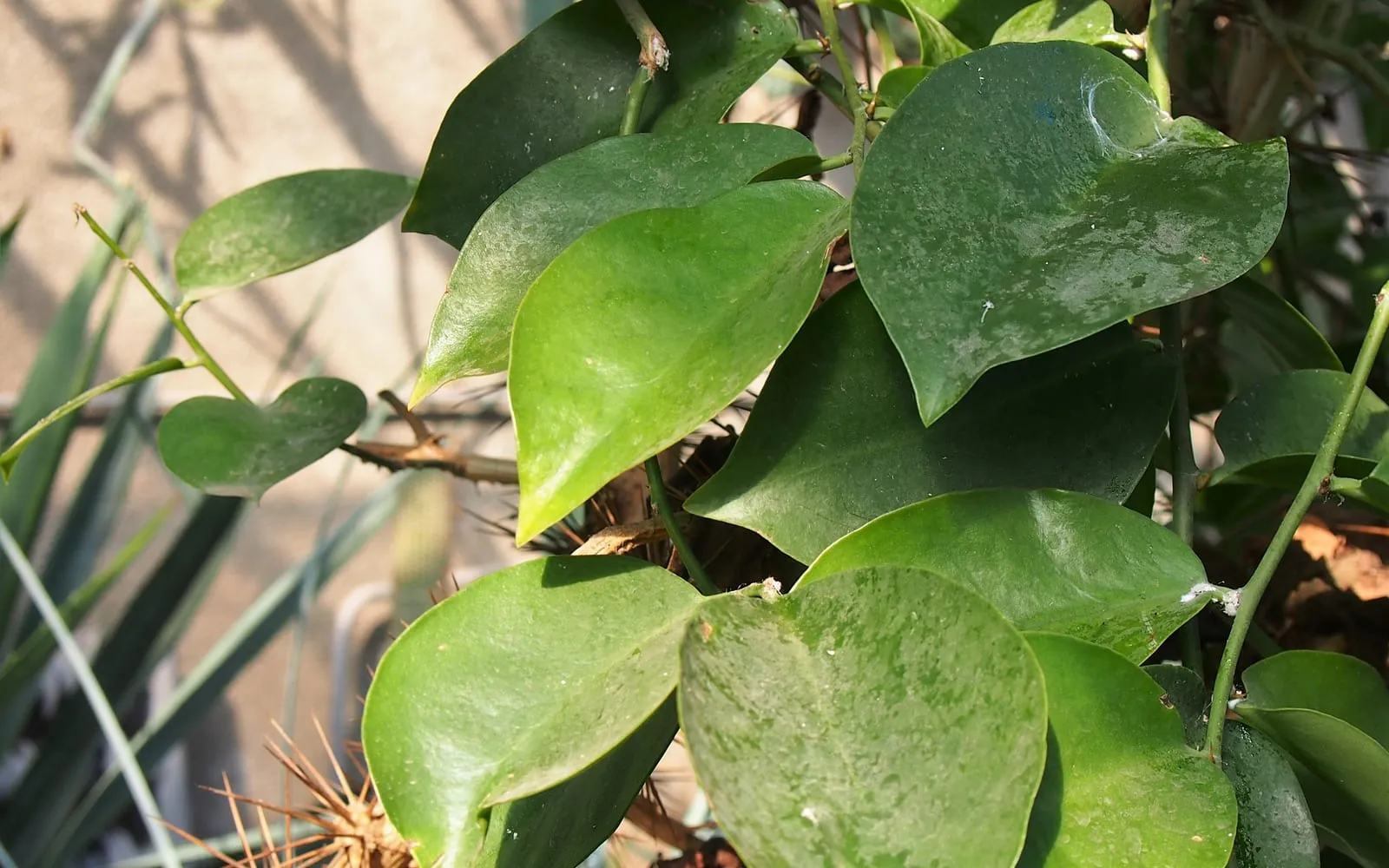
The leaves are the first surprise: fleshy but unmistakably leaf-shaped, glossy mid-green, three to eight centimetres long, arranged singly along woody stems that look far more like a bramble than a cactus. Look closely at each leaf axil, though, and the cactus family gives itself away. Clusters of two or three sharp spines emerge from that same point on young growth, and older stems develop dense woody spine clusters that make handling a mature plant a slow, deliberate business. Flowers are pale cream to pink, faintly fragrant and rose-like in form, opening in clusters along the stems in warm weather. The fruit that follows is round, one to two centimetres across, ripening from green to a yellow-orange skin, often still bearing small tufts of spines even at ripeness, over tart, juicy flesh surrounding several small seeds.
Where it is from
Pereskia aculeata is native to tropical America, from the Caribbean through parts of Central America and into northern South America, typically scrambling through forest margins and disturbed ground where it can reach sunlight by climbing over other vegetation. Its retained leaves and relatively unspecialised stem anatomy make it one of the closest living plants to what the ancestor of the entire cactus family probably looked like, before most lineages lost their leaves and evolved the swollen, photosynthetic stems that define a barrel or a paddle cactus. It has been carried well beyond its native range as both a food plant and an ornamental curiosity, and has become invasive in parts of South Africa and Australia, where its dense, thorny growth smothers native vegetation in the same way it scrambles over anything it meets at home.
How it grows
Give it a strong support from the start, a fence, trellis or a sturdy frame, since the plant climbs by hooking its thorns over whatever is nearby and becomes difficult to redirect once it has sprawled widely across the ground. Plant in free-draining, moderately fertile soil in full sun to bright light, and expect vigorous growth through a warm season. It tolerates fairly hard pruning to keep it within bounds, best done with thick gloves and long sleeves given the spines, and responds by producing fresh new growth from the cut points. Where the climate does not allow outdoor planting year round, it also grows well in a large container kept in bright light indoors or in a greenhouse over winter, trained onto a frame that can be moved.
Through the seasons
Spring brings the start of vigorous new growth as temperatures rise, and is the best time for any hard pruning.
Summer is the main growing and flowering season, with fruit developing on the current year’s growth.
Autumn brings the fruit to ripeness in a long, warm growing season, and growth begins to slow as temperatures drop.
Winter is a rest period. Reduce watering, and move a container-grown plant somewhere frost-free well before the first cold night.
Care difficulty
Moderate. The plant itself grows readily in a warm climate and forgives irregular watering better than many leafy vines, since its cactus ancestry gives it some tolerance for drying out between waterings. What raises the difficulty is entirely physical: every stage of handling, from training new growth onto a support to pruning and harvesting fruit, has to be done around spines capable of a painful, snagging injury. A gardener comfortable working carefully around a thorny climbing rose will find this plant familiar territory.
Watering
Water when the top few centimetres of soil or potting mix have dried out, then water thoroughly and let it drain fully. It tolerates missed waterings better than a typical leafy vine thanks to some water storage in its stems, though it grows and flowers best with reasonably consistent moisture through the warm growing season. Cut back sharply in winter, watering only enough to stop the mix drying out completely.
Warning signs, diseases and pests
Mealybug clusters in leaf joints and along soft new stems, visible as small white, cottony tufts; wipe them away with a damp cloth or treat with horticultural soap, taking care around the spines while doing so.
Scale insects form small, flat bumps along the woody stems, sapping the plant’s vigour gradually; treat the same way as mealybug, checking older, heavily spined growth carefully since scale can hide among the thorn clusters.
Spider mite thrives in hot, dry conditions, showing as fine pale speckling on the leaves; raising humidity slightly and rinsing the foliage when practical helps keep it in check.
Root rot follows a growing mix that stays wet for extended periods, showing as a plant that declines despite a damp pot. Unpot it, trim away any soft, blackened roots, and repot into fresh, free-draining mix, watering only once it has begun to dry out again.
Growing environment
Full sun to bright light gives the heaviest flowering and fruiting; a plant kept too shaded grows leggy and flowers sparsely. Free-draining soil or potting mix suits it better than anything that holds water for long, reflecting its cactus ancestry even with its unusually leafy growth. Warmth is non-negotiable outside a fully tropical or near-tropical climate; protect it from any temperature approaching freezing, since even a brief cold snap can defoliate the plant.
Feeding
Feed with a balanced liquid fertiliser monthly through spring and summer, when growth is most active. Reduce or stop feeding entirely through autumn and winter, when the plant is growing little and unused fertiliser only builds up as salts in a mix that is drying out between waterings at that time of year.
Troubleshooting
This does not look like a cactus at all. Is it one? Yes. It belongs to the cactus family and shares the family’s diagnostic feature, areoles that produce spines, but it kept the broad leaves that almost every other cactus lost over the course of its evolution, which is why it reads as an ordinary thorny vine at first glance.
The plant has sprawled across the ground and I cannot control it. Provide a strong support early, since this plant climbs by hooking its thorns onto anything within reach and becomes far harder to redirect once established along the ground. Cut back hard in spring and retrain the new growth onto a frame or fence from the base.
I keep getting scratched every time I work near it. The thorns are doing exactly what they evolved to do. Thick gloves, long sleeves and a pair of long-handled pruners for anything beyond the outer growth make the difference between routine maintenance and repeated injury.
Can I eat the leaves as well as the fruit? Yes, the young, tender leaves are cooked as a leaf vegetable in parts of the plant’s introduced range, though older leaves toughen and are better left on the plant.
Why has my container-grown plant stopped flowering? Insufficient light or a period of cold stress are the two most likely causes. Move it to the brightest position available and keep it well away from any draught or cold windowsill through winter, since flowering resumes with warmth and strong light the following season.