
Houseplant
Swiss cheese vine
Monstera adansonii
Also known as Monkey mask plant, Adanson's monstera, Five holes plant
How to care for Monstera adansonii. The small-leaved monstera with holes and no splits, how to tell it from the plant sold as obliqua, and why the holes only arrive with age.
At a glance
- Difficulty
- Easy
- Water
- When the top third of the compost has dried
- Light
- Bright indirect light, and it tolerates moderate shade
- Temperature
- 18-27 deg C, and never below 13 deg C
- Humidity
- Moderate to high. Fenestration develops faster above 60 per cent
- Hardiness
- USDA 10-12, RHS H1b, hardy to 13 C
- Type
- Evergreen perennial climber, long-lived
- Height
- 3-4 m indoors on a pole
- Native to
- Tropical America
Lowland rainforest from Mexico south through Central America and across tropical South America and the Caribbean, climbing trunks in warm, wet, shaded conditions with no dry season. It has no cold tolerance and is damaged below about 13 deg C, so outdoors it needs a warm humid frost-free climate. Indoors the constraint on leaf size and hole development is humidity and support rather than light.
Hardiness zones describe winter cold alone. Summer heat, humidity, rainfall and the length of the growing season decide as much, so treat the range as the outer limit rather than as a recommendation.
Toxic if eaten
- Do not eat
- Every part, and the sap most of all
- Harm from
- Eating it and handling it
- Affects
- People, cats and dogs
Monstera carries needle-shaped calcium oxalate crystals called raphides in all its tissues. Chewing a leaf or stem drives them into the lining of the mouth and throat, producing burning, drooling, swelling of the lips and tongue and difficulty swallowing. The ASPCA lists Monstera as toxic to cats and dogs on that basis and the same mechanism applies to people. Serious poisoning is rare because the pain begins immediately, though swelling that reaches the airway is an emergency in a small pet. The sap irritates skin, so wear gloves when pruning or taking cuttings. This plant is usually hung or trailed from a shelf, which puts the foliage within reach of a cat that climbs, and the fruit of the genus is only edible in one species and only when fully ripe, which is not this one.
Sources: ASPCA (Swiss Cheese Plant, Monstera adansonii), RHS potentially harmful garden plants
About
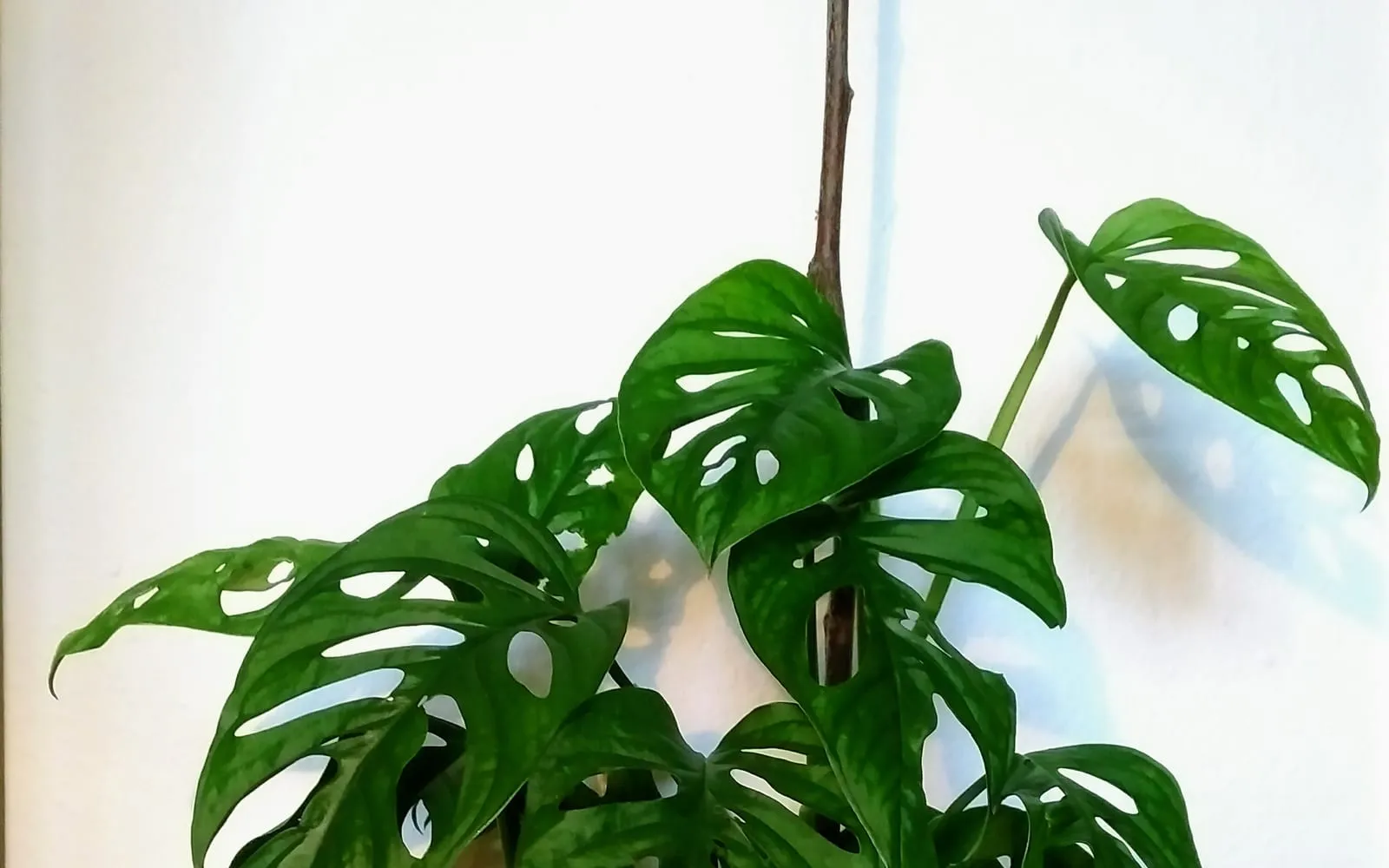
Monstera adansonii is the trailing cousin of the big Swiss cheese plant, and check the difference between them before you buy either. Where Monstera deliciosa eventually makes enormous leaves split from the edge to the midrib, this one makes smaller leaves perforated with closed oval holes and no splits at all.
The holes are the point and they are also the source of most disappointment. A young plant produces plain, entire, heart-shaped leaves with no holes whatever, and people buy a plant covered in perforations, propagate it, and find the cuttings coming up blank. Fenestration develops as the vine matures and climbs, and a plant kept trailing on a shelf stays juvenile for far longer than one given something to climb.
It is otherwise among the easier aroids, faster than a philodendron and more tolerant of a dim room than its reputation suggests.
Appearance and character
A climbing vine with slender green stems, prominent aerial roots at the nodes and leaves on long petioles.
Mature leaves are oval to lance-shaped, 15 to 30 cm long, mid to deep green and perforated with rows of oval holes on either side of the midrib. The holes are closed, meaning they sit within the leaf blade rather than cutting through to the edge, which is the quickest way to separate this species from deliciosa.
Juvenile leaves have no holes at all. The perforation count rises with each leaf as the plant climbs.
Growth is fast in warmth, with a vine reaching several metres given years and support.
The plant sold as Monstera obliqua is nearly always this species. True obliqua is rare in cultivation, with leaves that are more hole than tissue and paper-thin, and it is slow and difficult. If a plant is affordable and vigorous, it is adansonii.
Flowering indoors is very rare and produces the usual pale arum spathe.
Where it is from
Tropical forests from southern Mexico through Central America into much of tropical South America and the Caribbean.
Like the other climbing aroids it is a hemiepiphyte, germinating on the shaded forest floor, locating a trunk and climbing it with clinging aerial roots. The larger, more perforated leaves belong to the higher, older part of that journey.
Why the holes exist has been argued over for a long time. The leading explanation is that perforations let a leaf cover a larger area for the same amount of tissue, which improves the chance of intercepting the sunflecks that supply most of the light on a forest floor. Reduced wind damage and allowing rain through to the roots below have both been proposed as well.
The genus contains around fifty species, all from tropical America, and only a handful reach cultivation.
How it grows
Give it bright indirect light for the fastest development of holes, and accept slower, plainer growth in moderate shade.
Keep it out of direct sun, which bleaches and scorches the leaves.
Give it something to climb if you want mature foliage. A moss pole, a coir pole or a bark plank kept damp lets the aerial roots grip, and a climbing stem fenestrates far sooner than a trailing one.
Water when the top third of the compost has dried, thoroughly, and drain fully.
Keep it above 13 deg C and ideally between 18 and 27 deg C.
Raise the humidity where you can. Above 60 per cent the leaves are larger and the holes more numerous.
Feed monthly at half strength through the growing season.
Use a chunky mix. Compost with a third orchid bark and some perlite gives the roots the air they need.
Prune whenever the vine goes bare, cutting back to a node. The cuttings root readily in water or damp compost, and planting three or four back into the parent pot is the quickest way to a full plant.
Through the seasons
Spring restarts growth. Resume feeding, repot if the pot is full, and take cuttings now.
Summer is fast growth. Water when the top third dries, feed monthly, and train new growth onto the pole as it extends.
Autumn slows it. Reduce watering, stop feeding from October, and move the plant nearer the light.
Winter is the risk period. Keep it above 13 deg C, water sparingly and keep it away from cold glass. Expect no new leaves.
Care difficulty
Easy, and faster to establish than most aroids.
Missing holes is the commonest disappointment and is a matter of maturity and support rather than of feeding. A young plant, or a plant with nothing to climb, makes plain leaves.
Overwatering in dense compost is the way it dies. Aroid roots need air, and a peat-heavy mix that stays wet rots them.
Cold below 13 deg C causes dark patches and leaf drop.
Legginess follows low light and no pruning, and the bare stretches do not refill.
Watering
Water when the top third of the compost has dried, which in a warm room is roughly weekly in summer and every two weeks in winter.
Water thoroughly until it drains, then empty the saucer.
Water the moss pole too, since the aerial roots draw moisture from it.
Use rainwater or filtered water where the tap water is hard.
Underwatering shows as drooping leaves and curling at the edges, and recovery is quick.
Overwatering shows as yellowing leaves with brown centres, soft stems and a sour compost smell.
Warning signs, diseases and pests
New leaves without holes mean the plant is young, in low light, or has nothing to climb. Give it a damp pole and better light and wait.
Yellow leaves with brown patches in the middle are usually overwatering rather than dryness.
Brown crisp edges are dry air or fertiliser salts. Raise the humidity and flush the compost.
Long bare vine with leaves only at the tip is low light and no pruning. Cut back in spring and replant the cuttings into the same pot.
White cottony fluff around the leaf sheaths and aerial roots is mealybug, which hides well here.
Fine pale stippling with webbing is red spider mite in dry heated air.
Dark, water-soaked patches after a cold night are cold damage.
Black spots spreading from the leaf edge inward with a yellow halo are usually bacterial and follow water sitting on the foliage in a cool room. Remove affected leaves and improve airflow.
Growing environment
Bright indirect light for the best foliage, and it tolerates moderate shade at the cost of speed and hole development.
Never direct sun.
Warm, 18 to 27 deg C, with 13 deg C as the floor.
Moderate to high humidity, ideally above 60 per cent.
Chunky free-draining mix of compost, orchid bark and perlite in a pot with drainage holes.
A damp moss or coir pole for mature foliage.
Outdoors only in a warm humid frost-free climate in shade, USDA 10 and warmer.
Avoid dense peat compost, cold glass and dry heated air in winter.
Feeding
Feed monthly from spring to early autumn with a balanced liquid houseplant fertiliser at half strength.
Stop feeding from mid-autumn to early spring.
Feed less in a shaded position, where growth is slow and unused fertiliser accumulates as salts.
Repot every one or two years in spring into a chunky mix, one pot size up.
Flush the compost with plain water occasionally to clear salts.
Troubleshooting
My new leaves have no holes. The plant is juvenile or has nothing to climb. Fenestration develops with maturity and rises as the vine climbs, so give it a damp moss pole and brighter indirect light.
Is this Monstera obliqua? Almost certainly not. True obliqua is rare, very slow, paper-thin and mostly hole. A vigorous affordable plant is adansonii.
How is it different from a Swiss cheese plant? Monstera deliciosa is much larger and its leaves split from the edge to the midrib. This one stays smaller and its holes are closed within the leaf.
The vine is bare with leaves only at the end. Low light and no pruning. Cut back to a node in spring and root the cuttings into the same pot.
Is it safe with pets? No. It carries calcium oxalate raphides and the ASPCA lists Monstera as toxic to cats and dogs.
Black patches with yellow edges on the leaves. Usually bacterial, following wet foliage in a cool room. Remove the affected leaves, improve airflow and avoid watering over the top of the plant.
Can I root cuttings in water? Yes, readily. Cut below a node with an aerial root. Move them into compost once roots reach a few centimetres, since long-term water growth produces weaker roots.
Why does it have holes at all? The best-supported explanation is that perforations spread the same amount of leaf tissue over a wider area, improving the odds of catching the brief sunflecks that light a forest floor.
Swiss cheese vine problem guides
Not sure what is wrong? See the common houseplant pests guide.