
Disorder
Pot bound
Also called Root bound, Pot-bound roots
A houseplant drying out within a day, water running straight through, and roots out of the drainage holes. When to pot on, when to root prune instead, and the plants that prefer to stay tight.
At a glance
- Type
- Disorder
- Cause
- Growing conditions
- Severity
- Weakens the plant
- Affects
- Houseplants, Garden plants
- Active
- All year
What you are seeing
- Water running straight through and out of the bottom within seconds
- The plant drying out within a day of being watered
- Roots growing out of the drainage holes, or over the surface of the compost
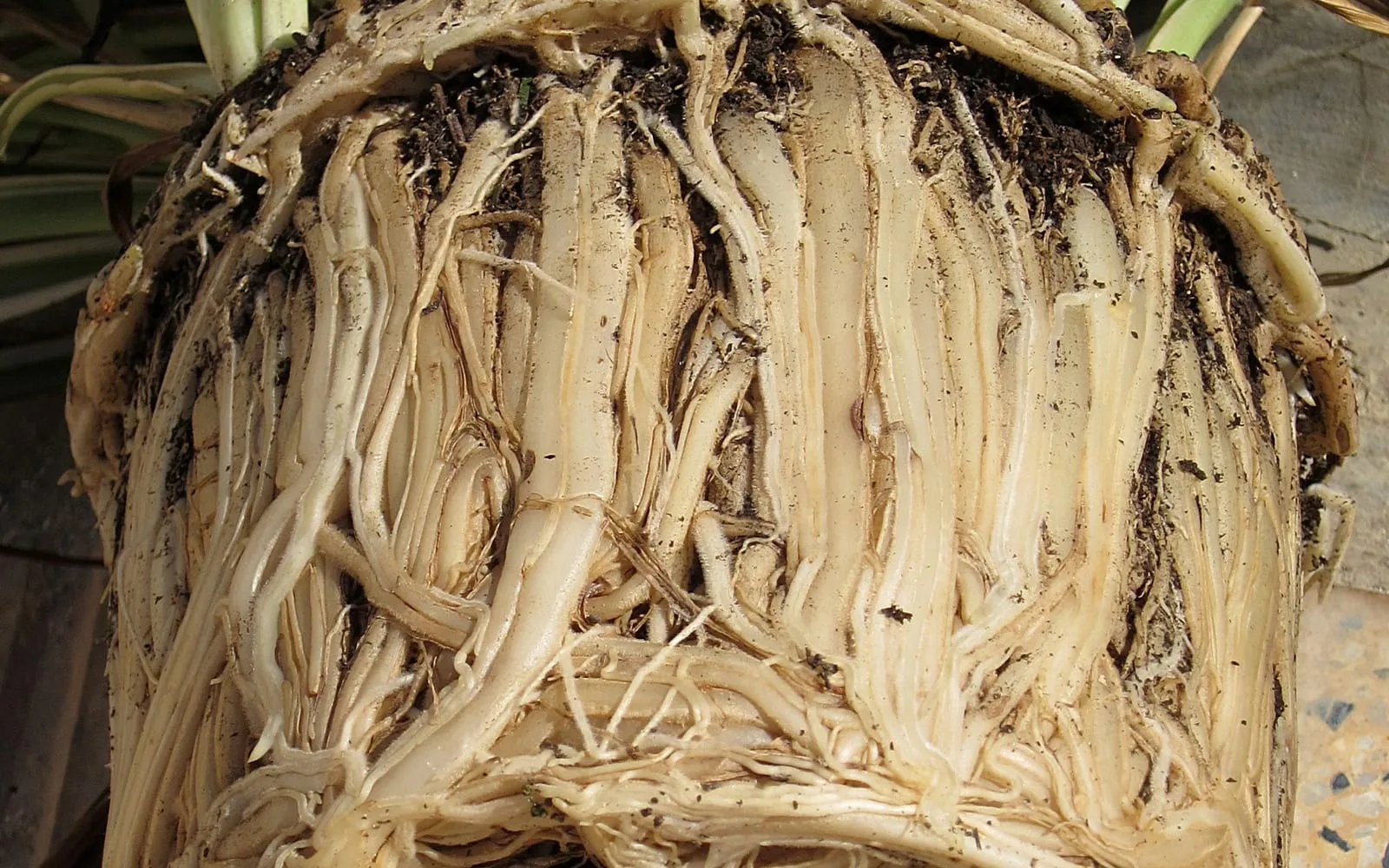
- A root ball that comes out of the pot in one solid mass with barely any compost visible
- Roots wound round and round the outside of that mass in a tight spiral
- New leaves smaller than the old ones, and growth stalled
- The plant top-heavy and falling over, or the pot bulging
Before you treat anything
Nothing here is harmful, beyond the usual care with a knife when cutting a root ball. Some houseplant saps irritate skin, so wear gloves with dumb cane, euphorbias and figs.
What you are looking at
You water the plant and the water is out of the bottom of the pot in a few seconds. A day later it is dry again, and the leaves are drooping by the afternoon.
Roots are coming out of the drainage holes, or running across the surface of the compost. The pot may be bulging, and the whole thing is top-heavy enough to fall over.
Slide it out. The root ball comes away as a solid mass in the exact shape of the pot, with hardly any compost visible, and the roots are wound round and round the outside in a tight spiral.
Why it dries out so fast
Compost holds water. Roots do not.
As a plant fills its pot, the proportion of the volume that is compost falls and the proportion that is root rises. Eventually there is so little compost left that the pot holds almost no reservoir at all, and water poured in runs down the gap between the root ball and the pot wall and straight out.
That is the whole mechanism, and it explains everything else. The plant dries within a day because there is nothing to hold the water. It is hungry because there is nothing holding nutrients either. Growth stalls because it cannot drink or feed reliably. And feeding harder fixes half of one problem while the other gets worse.
Not every plant minds
Being pot bound is a diagnosis rather than an insult, and several popular plants flower better for it.
Peace lilies, clivias, hoyas, agapanthus, spider plants and most orchids are all shy to flower in a generous pot and free-flowering in a tight one, because a plant with plenty of room puts its energy into leaves. Repotting a sulking clivia into something twice the size is a common way to lose a year of flowers.
So the test is what the plant is telling you. Dries out in a day, water running through, roots out of the holes and growth stalled means repot. Full pot, healthy leaves and plenty of flowers means leave it alone.
What to do about it
Water it thoroughly first, by standing the pot in a bucket until the bubbles stop, so the roots are not dry and brittle when you handle them.
Repot in spring, into a pot two to five centimetres wider and no more.
Tease the circling roots free with your fingers, and where they are matted, draw a knife down the sides of the root ball in three or four places and across the base.
Use fresh compost of the right type and firm it in without compacting it.
For a plant that cannot go into a bigger pot, root prune instead. Cut a few centimetres off the outside and base of the root ball, take a third off the top growth to match, and put it back in the same pot with fresh compost round the edge.
Top-dress anything too big to lift.
Leave the plants that flower better tight exactly as they are.
What it gets mistaken for
Drought produces the same wilting, and in a pot-bound plant the drought is permanent because the reservoir has gone.
Root rot leaves roots dark, soft and smelling, where pot-bound roots are pale and firm.
Nutrient shortage yellows the older leaves and responds to a feed. A pot-bound plant responds to a feed briefly and then stalls again.
Vine weevil grubs eat the roots of container plants and leave white C-shaped grubs and very little root at all, where a pot-bound plant has too much.
Compacted or exhausted compost holds water badly for a different reason, and the answer is the same one.
What to do, in order
Start here
Prevention, and the changes that stop the problem returning. Most of these pages should end at this tier.
- Pot on one size at a time
- Move to a pot two to five centimetres wider in diameter, no more. A plant put straight into a very large pot sits in a mass of wet compost its roots cannot reach, and that is how a pot-bound plant becomes a rotted one. Two moves over two years beat one big jump.
- Repot in spring
- Do it as growth starts, so the plant has a season of active growing to colonise the new compost. Repotting a houseplant in November leaves it sitting in cold wet compost for months.
- Know which plants prefer to be tight
- Peace lilies, clivias, hoyas, spider plants, agapanthus and most orchids flower better slightly pot bound, and repotting them generously produces leaves instead of flowers. Being pot bound is a problem only when the plant is telling you it is one.
- Do not use it as a reason to feed harder
- A plant that has run out of compost has run out of the thing that holds both water and nutrients. Feeding compensates for a while and the water problem gets worse regardless. Repot instead.
Then reach for a barrier
Netting, hand removal and water. Nothing here harms anything except the target.
- Tease or cut the circling roots before repotting
- Roots wound tightly round the outside of a root ball keep circling in the new pot and never colonise it. Pull the outer roots free with fingers, and where they are matted, draw a knife down the sides of the ball in three or four places and across the base. It looks brutal and it is what makes the repotting work.
- Root prune instead of potting on, where size matters
- For a large plant that cannot go into a bigger pot, take it out, cut away the outer few centimetres of root all round and across the base, remove up to a third of the top growth to match, and return it to the same pot with fresh compost round the edge. Bonsai has been done this way for centuries and any houseplant will take it in spring.
- Top-dress a plant too big to move
- Scrape off the top few centimetres of old compost, taking care not to tear roots, and replace with fresh. It buys a season or two on a specimen that would need two people to lift.
- Water a dried-out root ball by standing it in a bucket
- A shrunken root ball repels water from above and it runs down the gap at the side. Stand the whole pot in a bucket of water until the bubbles stop, then let it drain. Do that before repotting, since dry roots tear.
Plants affected
Guides that name it among the problems to watch for. The list is the plants it is characteristic of rather than everything it will feed on.