
Edible
Marsh Mallow
Althaea officinalis
Also known as Marshmallow, White mallow, Mortification root
How to grow marsh mallow, Althaea officinalis. The velvety grey perennial of salt marshes, the root behind the original sweet, and why it wants ground most herbs would rot in.
At a glance
- Difficulty
- Easy
- Water
- Regularly. It will not tolerate a dry root
- Light
- Full sun
- Temperature
- Fully hardy, to about -25 deg C
- Hardiness
- USDA 3-9, RHS H7, hardy to -25 C
- Type
- Hardy herbaceous perennial
- Height
- 100-150 cm, occasionally 2 m
- Native to
- Europe, western Asia
- Best month
- July and August in the Northern Hemisphere, January and February in the Southern Hemisphere
Damp ground is the requirement, and it takes salt, which is why it grows on the upper edges of salt marsh where few other herbs will. Cold is no obstacle. The mucilage that made the original sweet builds in the root over two seasons, so a first-year root is barely worth lifting.
Hardiness zones describe winter cold alone. Summer heat, humidity, rainfall and the length of the growing season decide as much, so treat the range as the outer limit rather than as a recommendation.
Every month named in this guide is for the temperate Northern Hemisphere. If you garden in the Southern Hemisphere, shift each one by six months, so July becomes January. Closer to the equator the wet and dry seasons matter more than the calendar, and the shift stops being a useful guide.
Not known to be toxic
- Safe to eat
- Root, leaves and flowers
Non-toxic. Marsh mallow is an edible and medicinal plant with a very long record of safe use, and it appears on neither the RHS list of potentially harmful garden plants nor the ASPCA list. The root, leaves and flowers are all eaten, and the root is the source of the mucilage that gave the modern sweet its name. The European Medicines Agency has assessed marsh mallow root as a traditional herbal medicine for dry cough and sore throat, and the caution it records is practical rather than toxicological: the mucilage can slow the absorption of other medicines taken at the same time, so the two should be separated by an hour or two. Nothing about the plant is a hazard in a garden.
Sources: European Medicines Agency, Althaea officinalis, RHS potentially harmful garden plants
About
Marsh mallow is the plant that gave the sweet its name and no longer has anything to do with it. The root is full of mucilage, and boiling it with sugar produced a soft white confection that was sold as a throat remedy through the nineteenth century. Manufacturers replaced the root with gelatine and the name stayed.
In the garden it is a handsome thing in its own right. A metre and a half of soft grey velvety foliage with pale pink flowers up the stem through July and August, and it does better in wet heavy ground than almost anything else in the herb collection.
Its natural home is salt marsh and brackish ditches near the coast, which tells you what it wants. Give it the wettest, heaviest corner you have.
Appearance and character
An upright clump, 1 to 1.5 m and occasionally 2 m, with several stout stems rising from a woody crown.
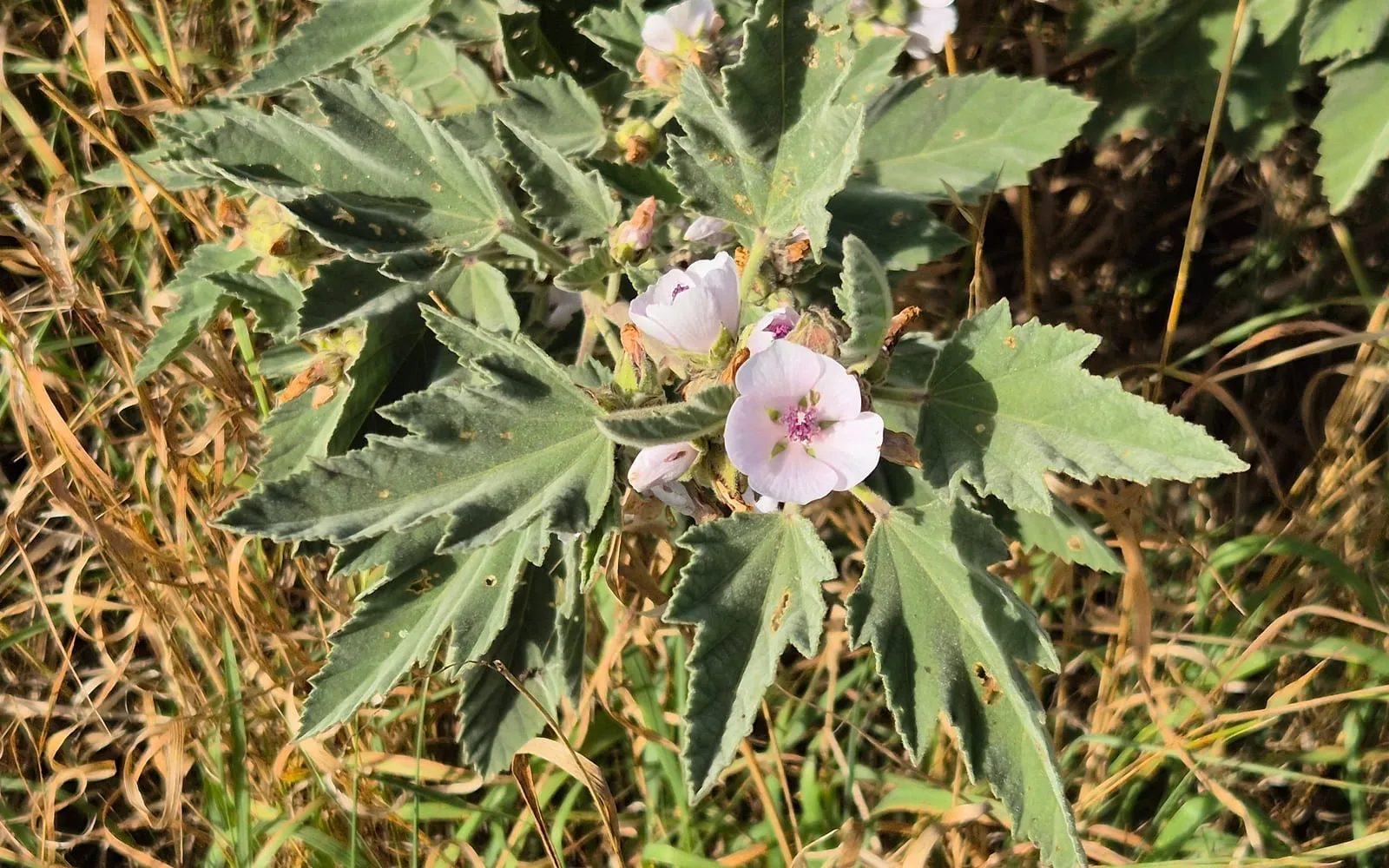
The whole plant is covered in fine soft down, which gives it a pale grey-green cast and a distinctly velvety feel. That texture is the fastest way to tell it from common mallow.
Leaves are broadly triangular to heart-shaped, shallowly three-lobed and toothed, held on short stalks.
Flowers are pale pink, 3 to 4 cm across, with five notched petals and a column of purple anthers at the centre. They open in the leaf axils up the stem from July to September, and they lack the dark veining common mallow has.
Seed cases are the same flat segmented rings the family produces.
The root is thick, white, fleshy and deeply mucilaginous, and cutting one open produces visible slime.
Where it is from
Marsh mallow is native to Europe, north Africa and western Asia, growing in salt marshes, brackish ditches and damp ground near the sea.
In Britain it is a genuine native, scattered along the coasts of southern and eastern England, most reliably in Essex, Kent, Sussex and around the Severn.
Its medicinal use goes back to Egyptian, Greek and Roman records, and the name Althaea comes from the Greek for to heal. Both root and leaf were used for coughs, sore throats and inflamed skin.
The confection is a French invention of the early nineteenth century. Pate de guimauve was made by whipping marsh mallow root extract with sugar and egg white, sold in pharmacies as a throat lozenge, and the recipe was industrialised in America with gelatine replacing the root entirely.
Nothing sold as a marshmallow today contains any part of the plant, which makes this one of the few cases where a plant is known worldwide by a product it is no longer in.
How it grows
Sow in autumn outdoors, or in spring after a period of cold in the fridge. The seed germinates better after chilling.
Sow at 1 cm and thin or plant out at 60 cm. It makes a substantial clump.
Alternatively divide an established plant in spring, or take root cuttings in autumn.
Choose a damp, heavy, sunny position. A pond margin, a bog garden, a ditch side or a low wet corner all suit it, and a dry border does not.
Water heavily until it is established, and never let it dry out.
Cut the plant down in autumn once the top growth dies, or leave the stems for winter structure.
Harvest leaves and flowers through the summer. Lift roots in autumn from a plant at least two years old, which sacrifices that crown unless you replant a piece.
Mulch each spring with compost.
Divide every four or five years to keep the clump vigorous.
Through the seasons
Winter is bare ground or dead stems. The plant disappears completely and returns in April.
Spring brings shoots from the crown, later than most perennials. Mulch now and watch for slugs.
Early summer is rapid growth. The stems reach full height by July.
Midsummer is flowering, from July to September, and bees work the flowers steadily.
Late summer ripens the seed. Collect some if you want more plants.
Autumn is the time to lift roots if you want them, and to cut the top growth down.
Care difficulty
Easy in wet ground and difficult in dry, which is the reverse of most herbs in this collection.
Drought is the practical problem. Marsh mallow grows in salt marsh, it has no tolerance for a dry border in July, and a plant that dries out repeatedly declines and dies. Site it where the ground stays damp rather than planning to water it.
Height surprises people. A mature clump is a metre and a half and occasionally two metres, which is a back-of-border plant rather than a herb bed one.
Mallow rust affects it as it does the whole family, disfiguring the leaves in late summer without killing the plant.
Beyond that it needs nothing. It is fully hardy, self-supporting, undemanding about soil chemistry and free of any serious pest.
Watering
Keep it wet. This is the single requirement and everything else follows from it.
Water new plants two or three times a week through their first two summers.
Water an established clump whenever the ground dries in summer, and give a thorough soak rather than a sprinkle.
Standing water in summer does no harm at all, which sets it apart from almost every other plant here.
Mulch thickly each spring to hold moisture, which does more than watering.
A container needs daily watering in July and is a poor home for a plant this size. Use the largest pot you can and stand it in a tray of water.
Warning signs, diseases and pests
Mallow rust spots the leaves orange-brown beneath in late summer and distorts the growth. Clear fallen leaves and cut affected growth away. Nothing cures it.
Aphids gather on flowering stems in June and rarely need action.
Slugs graze the spring shoots and can check a young plant.
Powdery mildew appears on plants that have gone dry at the root, which is a signal to water rather than to treat.
Wilting on a hot day means the root has dried out. Soak it thoroughly and mulch.
Short weak plants that never reach full height are usually short of water rather than of nutrients.
Yellowing lower leaves in late summer are normal.
Growing environment
Full sun. It flowers poorly in shade.
Damp, heavy, moisture-retentive soil. Clay is an advantage. This is one of the few plants in the collection that prefers ground that lies wet.
It tolerates brackish conditions and mild salinity, which makes it a genuine option for a coastal garden where salt spray defeats other perennials.
pH from 6 to 8. It grows on neutral and alkaline ground and is not fussy.
A pond margin, a bog garden, a ditch side or a damp low corner are all ideal.
It is fully hardy anywhere in its range and needs no shelter, though a 2 m stem in an exposed site may lean.
For pollinators it is good, flowering through July and August when many gardens run short.
Feeding
Mulch with compost each spring, spread over the root spread and kept off the crown. That is the whole feeding programme.
A balanced liquid feed once in early summer helps a young plant build a clump, and is unnecessary afterwards.
Avoid heavy nitrogen, which produces soft growth that flops and mildews.
Feed a container plant fortnightly through summer, since a pot cannot supply what a plant this size wants.
Rich damp ground is what it evolved for, so a fertile wet corner needs no improvement at all.
Troubleshooting
It died in a dry summer. Marsh mallow needs damp ground and will not survive a dry border. Move it to the wettest corner you have.
Is this the plant marshmallows are made from? It was. The root mucilage was whipped with sugar to make the original sweet, and manufacturers replaced it with gelatine. Nothing sold as a marshmallow now contains any of the plant.
It reached two metres. That is normal on good damp ground. Plant it at the back of a border.
Orange spots on the leaves. Mallow rust, which affects the whole family. Clear fallen leaves and cut affected growth away.
Can I use the root? Yes. Lift it in autumn from a plant at least two years old, wash and dry it, and use it for a mucilaginous infusion. Digging the root ends that crown, so replant a piece.
Can I grow it by the sea? It is a salt marsh plant and it tolerates brackish conditions better than almost any perennial, so a coastal garden suits it.
Is it the same as hollyhock? No, though they are close relatives and look similar in flower. Hollyhock is Alcea rosea, taller and coarser, with much larger flowers.