
Edible
Motherwort
Leonurus cardiaca
Also known as Lion's tail, Lion's ear, Throw-wort
How to grow motherwort, Leonurus cardiaca. The spiny-calyxed perennial for a wild corner, its long history in childbirth and heart complaints, and why it seeds itself everywhere.
At a glance
- Difficulty
- Easy
- Water
- Rarely once established
- Light
- Full sun to part shade
- Temperature
- Fully hardy, to about -25 deg C
- Hardiness
- USDA 3-8, RHS H7, hardy to -30 C
- Type
- Hardy herbaceous perennial
- Height
- 60-120 cm
- Native to
- Europe and central Asia
- Best month
- July and August in the Northern Hemisphere, January and February in the Southern Hemisphere
Cold suits it and it asks for almost nothing, which is how it has naturalised across Europe, North America and central Asia from gardens. Deadhead before the seed ripens if the ground around it matters. The square stems and whorled flowers stay standing through winter and self-sow from there.
Hardiness zones describe winter cold alone. Summer heat, humidity, rainfall and the length of the growing season decide as much, so treat the range as the outer limit rather than as a recommendation.
Every month named in this guide is for the temperate Northern Hemisphere. If you garden in the Southern Hemisphere, shift each one by six months, so July becomes January. Closer to the equator the wet and dry seasons matter more than the calendar, and the shift stops being a useful guide.
Toxic if eaten
- Do not eat
- The whole plant as a herbal preparation, and the sap on skin in sunlight
- Harm from
- Eating it and handling it
- Affects
- People
Motherwort is a medicinal plant rather than a culinary one and it deserves more caution than the other mint-family herbs here. It has a long record of use for heart palpitations and in childbirth, which is where both parts of its name come from, and the European Medicines Agency has assessed it as a traditional herbal medicine for nervous tension and palpitations. It is also a uterine stimulant, and standard herbal references advise against it in pregnancy for that reason. Handling the plant can cause contact dermatitis, and cases of photosensitisation have been reported after prolonged skin contact, so wear gloves when cutting it down. The dead stems carry stiff spiny calyces that will prick you regardless. It is not a plant to eat casually and not one to give to an animal.
Sources: RHS potentially harmful garden plants, European Medicines Agency, Leonurus cardiaca
About
Motherwort is a tall, rough, upright perennial from disturbed ground across Europe and central Asia, grown now for its long herbal history rather than for its looks. Mother refers to its use in childbirth. Cardiaca refers to the heart, for which it was given against palpitations from at least the medieval period.
The plant itself is easy to the point of being weedy. It grows in poor soil, tolerates drought and shade, needs nothing from you and seeds itself with real enthusiasm.
Two features decide where you put it. The dead flower stems are armed with sharp spiny calyces that catch bare hands when you clear them, and the sap causes dermatitis in some people. Wear gloves, and give it a corner where it can spread without causing trouble.
Appearance and character
An upright perennial, 60 cm to 1.2 m, branching in the upper half, forming a clump that widens each year.
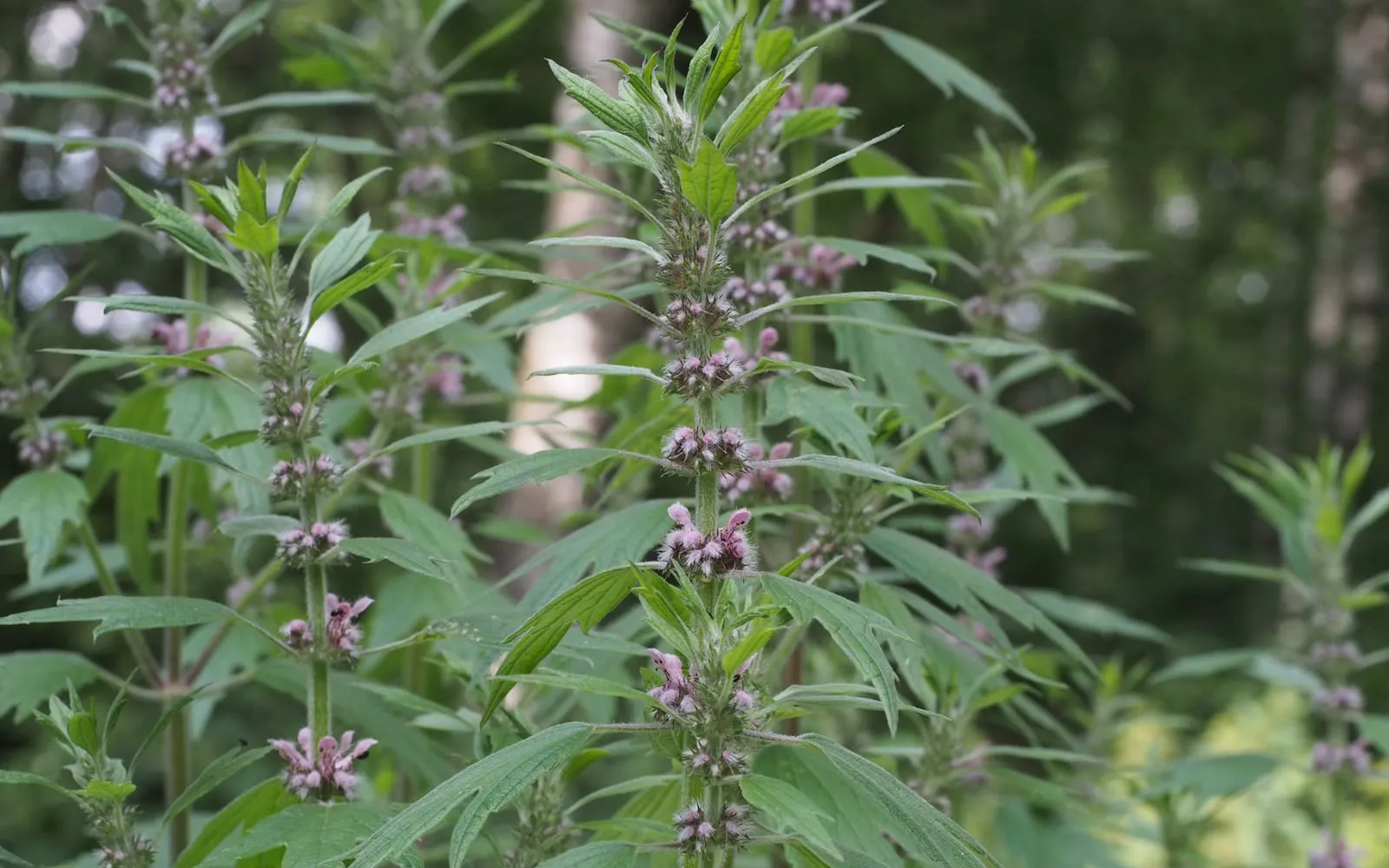
Leaves are the recognition character. Deeply cut into three to five pointed lobes, the lower ones broad and hand-shaped, dark green above and paler beneath, becoming narrower up the stem.
Flowers are small, pale pink to lilac, hooded and hairy on the upper lip, packed into whorls in the leaf axils up the upper stem from June to September.
The calyx behind each flower is stiff and ends in five sharp spines. Those harden as the seed ripens and they are what makes clearing the dead stems uncomfortable.
Stems are square, hollow, ridged and often purple-tinged.
The whole plant has a faint, sharp, unpleasant smell when crushed, which is one reason it was called throw-wort.
Where it is from
Motherwort is native to central Asia and south-eastern Europe and has spread across most of Europe and into North America as a naturalised plant of waste ground, hedgerows and old gardens.
In Britain it is an ancient introduction rather than a native, established here since at least the medieval period and now scattered on roadsides and rough ground, mostly near habitation.
Its medicinal history is long and consistent across cultures. Greek and Roman writers used it, Chinese medicine uses a different but related species, Leonurus japonicus, for the same purposes, and European herbals from the sixteenth century onwards recommend it for palpitations and for anxiety.
The childbirth association gave it its English name and it persisted into nineteenth century practice, both to ease labour and for the period after it.
Modern regulation treats it as a traditional herbal medicine, which means its use is recognised on the basis of long-standing practice rather than clinical trials.
How it grows
Sow in spring or autumn. The seed germinates readily and often benefits from a period of cold, so an autumn sowing outdoors in a pot left in the open works well.
Sow in modules at 18 deg C in spring for germination in two to three weeks.
Plant out at 45 to 60 cm. It makes a substantial clump and spreads sideways over time.
Site it where it can be left. Motherwort is a wild-corner plant rather than a border plant, and a rough bank, a hedge base or the back of a wild patch suits it.
It tolerates part shade and poor soil, which makes it useful in awkward places.
Cut it down in autumn wearing gloves, or leave the stems standing for winter structure and the birds, cutting in March instead.
Deadhead before the seed ripens if you do not want a colony. It seeds prolifically and the seedlings are tough.
Divide in spring every three or four years if the clump gets congested.
Through the seasons
Winter is bare stems or bare ground, depending on whether you cut it down. The dead stems stand well and hold seed for finches.
Spring brings shoots from the crown in March. Divide now if needed, and pull out unwanted seedlings while they are small.
Early summer is rapid growth. The stems reach full height by June.
Midsummer to early autumn is the flowering season, from June to September, in whorls that open in sequence up the stem. Bees work it steadily.
Autumn ripens the seed inside spiny calyces. Cut the plant down in gloves if you want to limit the spread, or leave it and accept the seedlings.
Care difficulty
Easy to the point of needing restraint rather than care.
It grows in poor soil, part shade and drought, needs no feeding, no staking and no watering once established, and it is hardy anywhere in its range.
Self-seeding is the practical problem. A single plant produces a great deal of viable seed and the seedlings appear across a wide area. Deadhead in August if you want to keep it in one place.
The spines are a genuine nuisance. Stiff sharp calyces on the dead stems catch bare hands and forearms, so cut it down in gloves and long sleeves.
Contact dermatitis affects some people who handle it repeatedly. Gloves cover both problems.
Beyond that there is very little to do. It is a plant to site correctly and then leave.
Watering
Water new plants weekly through their first summer.
After that, nothing. Motherwort is drought tolerant and grows on dry rubble in the wild.
Water in a prolonged drought only if the plant is visibly suffering, which it rarely does.
Water a container weekly in summer. The plant is large for a pot and it is not a natural container subject.
Water at the base. The lower leaves mildew in late summer and wetting them makes it worse.
Warning signs, diseases and pests
Powdery mildew coats the lower leaves in August, particularly in a dry season on a crowded plant. It is disfiguring rather than damaging. Thin the stems and remove the worst leaves.
Aphids gather on the flowering stems in early summer and rarely need action.
Slugs graze young plants and seedlings and do no lasting harm to an established clump.
Seedlings across the garden mean the seed ripened. Cut the stems down before August next year.
Flopping stems mean too rich a soil or too much shade. Neither is fatal, and neither needs treatment beyond moving the plant.
Yellowing lower leaves in late summer are normal for a tall herbaceous plant shedding its oldest growth.
A rash after cutting it down is contact dermatitis from the sap. Wear gloves.
Growing environment
Full sun to part shade. Motherwort is one of the few aromatic perennials in this collection that tolerates real shade, which makes it useful under a hedge.
Any soil that drains. It grows on rubble, chalk, clay and sand equally, and it has no soil preference worth recording.
pH from 5.5 to 8. It is entirely unfussy.
A wild corner, a hedge base, a rough bank or the back of a border are all right for it. A formal herb bed is not, because it is coarse and it spreads.
It is hardy anywhere in its range and needs no shelter.
For pollinators it is a strong plant, flowering steadily from June to September and attracting bumblebees in particular, which is what makes it worth a corner even in a garden with no interest in its herbal history.
Feeding
Nothing. Motherwort grows on waste ground and treats a fed border as an invitation to flop.
Do not add compost or manure. Poor ground gives you a stiffer, more compact plant.
A container plant takes a weak balanced feed once in spring and nothing afterwards.
Mulch, if you use one, should be for weed suppression rather than nutrition.
If a plant looks starved, the cause is almost always deep shade or root competition from a hedge rather than a shortage of nutrients.
Troubleshooting
It has seeded all over the garden. It does that. Cut the flowering stems down in August before the seed ripens, and hoe the seedlings while small.
Something scratched me clearing it up. The spiny calyces on the dead stems. Wear gloves and long sleeves, and cut it down before the stems dry hard.
I got a rash after handling it. Contact dermatitis from the sap, which affects some people and not others. Wear gloves in future.
The stems fell over. Rich soil or shade. Move it somewhere poorer and sunnier, or leave it, since it flowers regardless.
White powder on the lower leaves. Powdery mildew in late summer. Cosmetic. Thin the clump.
Is it the same as lion’s ear? The name is shared with Leonotis leonurus, a tender South African shrub with orange flowers, which is a different plant entirely. Motherwort is the hardy pink-flowered one.
Can I make tea from it? It is used that way traditionally and it is bitter. It is also a uterine stimulant and should not be taken in pregnancy, so treat it as a herbal preparation rather than a kitchen herb.