
Edible
German Chamomile
Matricaria chamomilla
Also known as Scented mayweed, Wild chamomile, Blue chamomile
How to grow German chamomile, Matricaria chamomilla. The annual behind chamomile tea, picking and drying the flowers, and the hollow flower centre that identifies it.
At a glance
- Difficulty
- Easy
- Water
- Rarely once established
- Light
- Full sun
- Temperature
- Hardy as a seedling. Autumn sowings overwinter outdoors
- Hardiness
- USDA 2-8, RHS H4, hardy to -10 C
- Type
- Hardy annual
- Height
- 20-60 cm
- Native to
- Europe, western Asia
- Best month
- May and June in the Northern Hemisphere, November and December in the Southern Hemisphere
An annual that seeds itself freely and comes up where it likes, which is how it holds a place in a garden without being replanted. Autumn sowings overwinter as small plants and flower a month earlier. Poor soil gives more flowers and richer soil gives more leaf.
Hardiness zones describe winter cold alone. Summer heat, humidity, rainfall and the length of the growing season decide as much, so treat the range as the outer limit rather than as a recommendation.
Every month named in this guide is for the temperate Northern Hemisphere. If you garden in the Southern Hemisphere, shift each one by six months, so May becomes November. Closer to the equator the wet and dry seasons matter more than the calendar, and the shift stops being a useful guide.
Skin irritant
- Safe to eat
- Flowers, for tea
- Do not eat
- None in ordinary use, though the daisy family allergy applies
- Harm from
- Eating it and handling it
- Affects
- People
German chamomile is the plant behind almost all commercial chamomile tea and it is safe in that use for most people. Two cautions apply. Anyone allergic to other Asteraceae, including ragweed, chrysanthemum and feverfew, can react to chamomile, and although severe reactions to chamomile tea are rare they have been documented. Handling the foliage causes contact dermatitis in some people. The ASPCA lists chamomile as toxic to dogs, cats and horses on the basis of vomiting, diarrhoea and dermatitis after prolonged exposure, which describes an animal eating a quantity of the plant rather than a garden risk. It is not on the RHS list of potentially harmful garden plants.
Sources: ASPCA (Chamomile, Anthemis nobilis), RHS potentially harmful garden plants
About
German chamomile is the chamomile in the tea bag. It is an annual, it grows easily from seed on poor ground, and one short row supplies a household with dried flowers for a year.
Picking is the part that takes commitment. The flowers open in succession over several weeks, they are small, and a jar of dried chamomile represents a great many mornings spent stripping heads off the plant. Doing it every few days keeps the plant producing.
Roman chamomile is the perennial one used for lawns. The two are told apart by the flower centre, which is hollow in this species and solid in the Roman one, and by the habit, since this one stands up and the other creeps.
Appearance and character
An upright branching annual, 20 to 60 cm, that flops outwards as the flowers come.
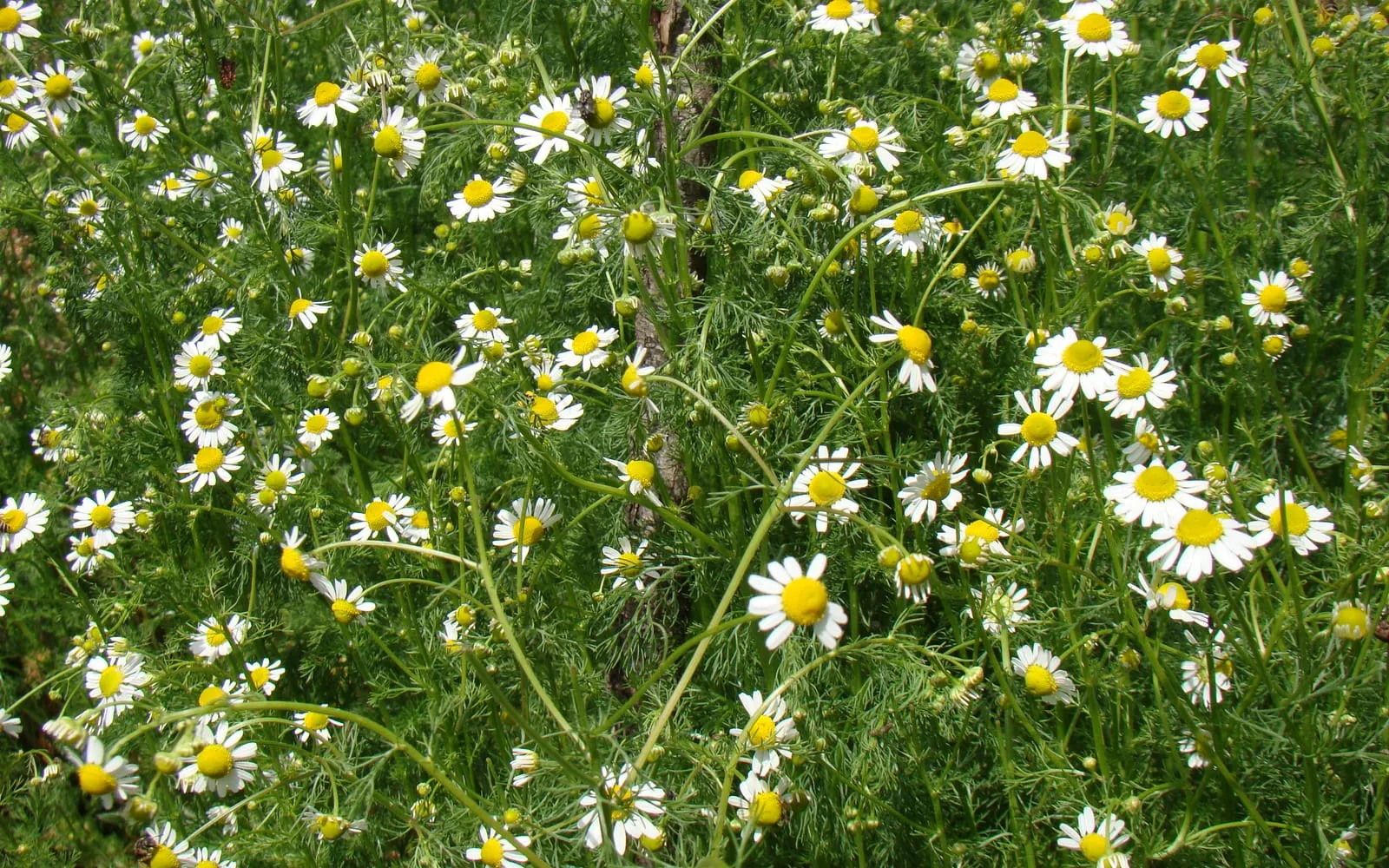
Leaves are finely divided into thread-like segments, bright green, hairless and feathery, sparse enough that the plant looks airy rather than leafy.
Flowers are daisies about 2 cm across, with white petals that reflex downwards around a domed yellow centre. They open from May and continue for weeks.
The flower centre is the identification character. Cut one in half: German chamomile is hollow inside and Roman chamomile is solid.
The scent is sweet and applelike, lighter than Roman chamomile’s, and it is strongest in the flowers rather than the leaves.
The blue in the name blue chamomile refers to the essential oil, which turns deep blue on distillation because of a compound called chamazulene formed during the process.
Where it is from
German chamomile is native to southern and eastern Europe and western Asia and has spread across most of the temperate world as a plant of arable land, waste ground and roadsides.
In Britain it is an archaeophyte, present since prehistory as an arable weed rather than a native, and it is now much less common in fields than it was because of herbicides.
Its medicinal use goes back to Egyptian and Greek records and it has run continuously since. The dried flower is one of the most widely used herbal preparations in the world.
The German in the name reflects where it was studied and grown commercially rather than where it originated. Germany, Hungary, Egypt and Argentina are all major producers.
Essential oil production is a serious industry. The oil is used in cosmetics and pharmacy, and the deep blue chamazulene it contains forms during distillation rather than existing in the flower.
How it grows
Sow direct where it is to grow. Chamomile has a fine root system and resents transplanting.
Sow in spring from March, or in autumn in September for stronger earlier plants. Autumn-sown chamomile overwinters as a small rosette and flowers weeks ahead of a spring sowing.
Scatter the seed on the surface and press it in without covering. It needs light to germinate and a covered sowing usually fails.
Thin to 15 to 20 cm. Crowded plants flop and mildew.
Choose an open sunny position on light poor soil. Rich ground gives you tall leafy plants with fewer flowers.
Water until the seedlings are established, then leave it.
Pick flowers from May, taking them fully open, on a dry morning after the dew has gone. Picking every two or three days keeps the plant flowering into August.
Let a few plants set seed and it will return every year without further sowing.
Through the seasons
Winter shows small rosettes from an autumn sowing and nothing from a spring one. The rosettes are hardy and need no protection.
Spring brings rapid growth from March and the first sowing. Thin the seedlings early.
Late spring is when the first flowers open, in May from an autumn sowing and June from a spring one.
Summer is the picking season and it runs for weeks. Pick every few days and the plant keeps producing.
Late summer is when the plants tire and flop. Pull them, or leave a few to scatter seed.
Autumn is the second sowing, in September, for next year’s early crop.
Care difficulty
Easy. German chamomile grows itself on poor ground and the only real work is the picking.
Rich soil is the usual mistake. A well-fed bed gives you a tall soft plant with plenty of leaf and few flowers, and the flowers are the crop.
Sowing too deep is the other. The seed needs light, so it goes on the surface and gets pressed in rather than raked over.
Flopping is normal and not worth fighting. The plant grows lax as it flowers, and sowing it thickly among other plants gives it something to lean on.
It has no pest or disease of consequence in a normal season, needs no watering once up, and no feeding at all.
Once it is in the garden it usually stays. Self-sown seedlings appear each spring and are welcome in a herb bed.
Watering
Water the seedbed before sowing and keep it just damp until germination.
Water seedlings in a dry spring until they are 10 cm tall.
After that, leave it. Chamomile grows on dry disturbed ground and copes with a cool summer without help.
Water in a genuine drought if the plants are wilting by mid-morning, and soak them thoroughly rather than sprinkling.
A container needs weekly watering in summer, letting the compost dry between times.
Avoid overhead watering on a crowded stand, which brings on mildew in August.
Warning signs, diseases and pests
Aphids collect on the flowering stems in warm weather. Rub them off or leave them for the ladybirds, since the plant is being picked for tea.
Slugs take seedlings in a wet spring. Protect a new sowing.
Powdery mildew whitens the foliage in late summer, particularly on crowded plants. It arrives as the plants are finishing anyway.
Plants that flop are behaving normally. Support them with neighbours rather than staking.
Tall leafy plants with few flowers mean the ground was too rich.
Poor germination usually means the seed was covered. It needs light.
Flowers that shatter when picked have been left too long. Pick them fully open but fresh.
Growing environment
Full sun. Chamomile in shade is thin, leggy and shy of flower.
Light, free-draining soil, poor rather than rich. Sandy ground, gravel and disturbed corners all suit it.
Neutral to slightly alkaline, around pH 6.5 to 7.5, though it grows over a wide range.
An open position is better than a sheltered one. It is a plant of arable fields and copes with wind by flopping.
A vegetable bed edge, a wildflower patch or a gravel corner are all good places for it. A rich herb border is not.
For pollinators it is useful, and it also draws hoverflies whose larvae eat aphids, which is a reason to have some near the vegetables.
Feeding
None. Feeding German chamomile gives you leaves instead of flowers, which defeats the point of growing it.
Do not add compost or manure before sowing. Poor ground produces short sturdy plants covered in flower.
A container plant takes a weak balanced feed once, if at all.
If plants look starved, the cause is almost always crowding rather than nutrition. Thin them.
Ground that grew chamomile needs nothing doing to it before the next crop, since the plant takes very little out.
Troubleshooting
Which chamomile makes tea? This one. German chamomile is the annual behind almost all commercial chamomile tea. Roman chamomile is the perennial used for lawns and can also be used for tea, though it yields far fewer flowers.
Nothing germinated. The seed was covered. Chamomile needs light, so surface sow and press it in.
Lots of leaf and few flowers. The ground is too rich. Grow it hard, on poor soil, in full sun.
The plants have flopped everywhere. Normal in flower. Sow it among other plants so it has support, or accept it.
How do I dry the flowers? Pick fully open heads on a dry morning, spread them in a single layer on a tray or mesh somewhere warm and airy out of sunlight, and store them airtight once they crumble at a touch.
How much do I need for a year’s tea? Rather more than most people expect. A row two metres long, picked every few days from May to August, fills a large jar.
Is it the same as scentless mayweed? No. Scentless mayweed, Tripleurospermum inodorum, is a common weed of the same family with no scent and a solid flower centre. Crush the flowers and smell them.