
Edible
Sweet Clover
Melilotus officinalis
Also known as Yellow melilot, Ribbed melilot, Yellow sweet clover
How to grow sweet clover, Melilotus officinalis. The hay-scented biennial legume, its value to bees, and the mouldy hay that led to the discovery of warfarin.
At a glance
- Difficulty
- Easy
- Water
- Rarely once established
- Light
- Full sun
- Temperature
- Fully hardy. The first-year plant overwinters
- Hardiness
- USDA 3-9, RHS H6, hardy to -30 C
- Type
- Hardy biennial, occasionally annual
- Height
- 60-150 cm, occasionally 2 m
- Native to
- Europe and Asia
- Best month
- June and July in the Northern Hemisphere, December and January in the Southern Hemisphere
A biennial that fixes nitrogen and roots deeply, which is why it is grown as a green manure on poor ground. The coumarin that gives the hay its scent turns to dicoumarol if the crop moulds, and cattle fed spoiled sweet clover hay bleed to death. Working out why is what produced warfarin.
Hardiness zones describe winter cold alone. Summer heat, humidity, rainfall and the length of the growing season decide as much, so treat the range as the outer limit rather than as a recommendation.
Every month named in this guide is for the temperate Northern Hemisphere. If you garden in the Southern Hemisphere, shift each one by six months, so June becomes December. Closer to the equator the wet and dry seasons matter more than the calendar, and the shift stops being a useful guide.
Toxic if eaten
- Do not eat
- The plant once it has spoiled or gone mouldy
- Harm from
- Eating it
- Affects
- People and horses
Fresh sweet clover is harmless and it has been used as forage and as a flavouring for centuries. The hazard appears only when the cut plant spoils. Sweet clover is rich in coumarin, the compound that gives new-mown hay its scent, and when the cut plant becomes mouldy certain fungi convert that coumarin into dicoumarol, a powerful anticoagulant. Cattle fed mouldy sweet clover hay bleed to death from minor injuries, a condition documented as sweet clover disease from the 1920s. The investigation of that disease led directly to the isolation of dicoumarol and then to warfarin, which is both a rat poison and one of the most widely used anticoagulant drugs. In a garden this is not a practical risk, since nobody eats it. It matters if you keep livestock, and it matters if you cut a large stand and leave it in a damp heap. High doses of the herb are also advised against for anyone taking anticoagulant medication.
Sources: RHS potentially harmful garden plants, ASPCA toxic and non-toxic plants
About
Sweet clover is the tall yellow legume that smells of new-mown hay when it dries. That scent is coumarin, and it is the same compound that gives woodruff and tonka beans their character.
For bees it is one of the best plants a garden can hold. A stand in flower from June to September is worked constantly, and the plant is grown as a bee forage crop in North America on a large scale.
Its most interesting history is medical. Cattle fed mouldy sweet clover hay in the American Midwest in the 1920s began bleeding to death from small wounds. The investigation of that disease isolated dicoumarol, and the compound developed from it became warfarin, which is both a rat poison and a drug taken daily by millions of people.
Appearance and character
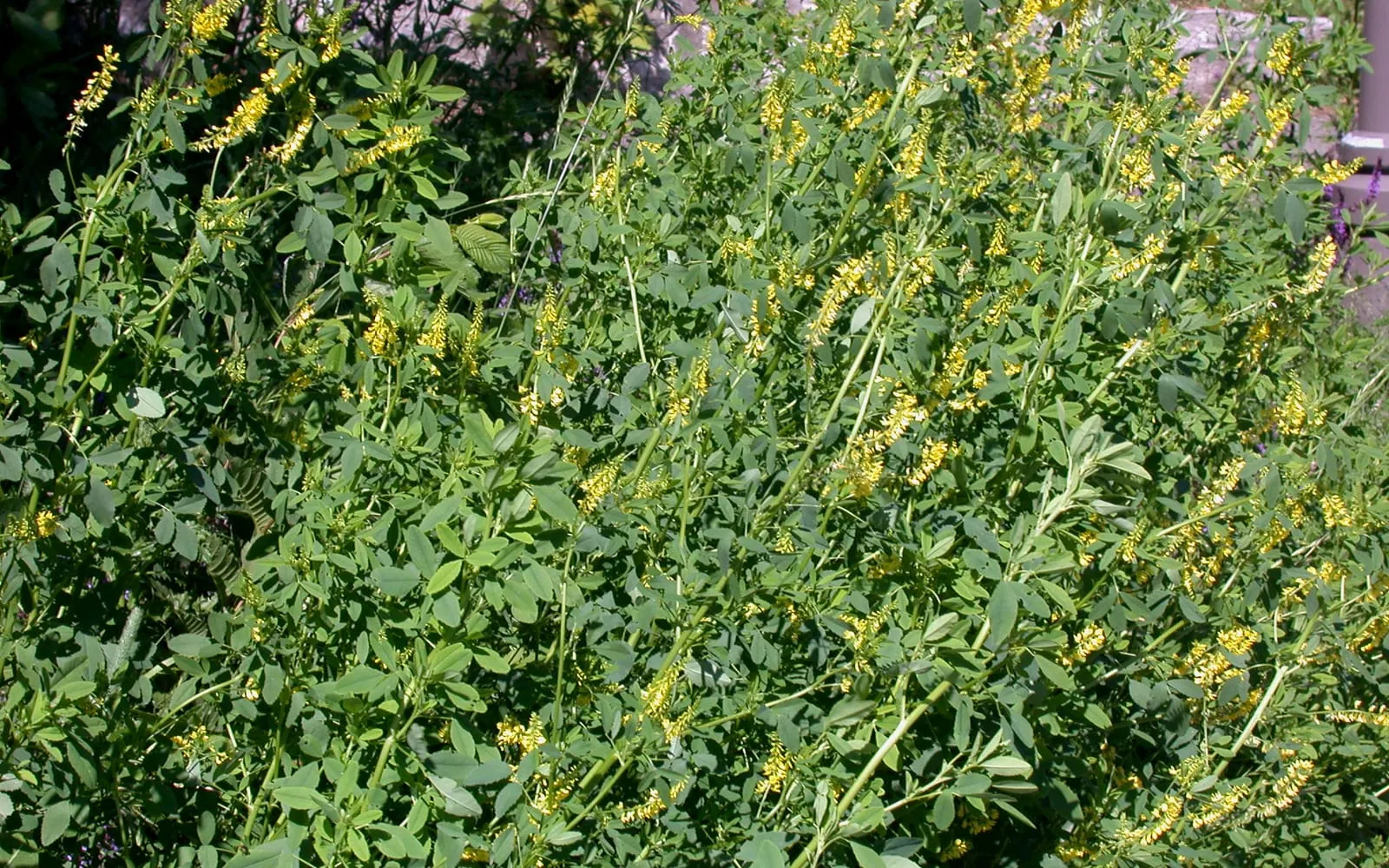
An upright branching plant, 60 cm to 1.5 m in its second year and occasionally 2 m, becoming rangy and open as it flowers.
Leaves are trifoliate like a clover, with three narrow toothed leaflets on a long stalk, and they are more elongated than a true clover’s.
Flowers are small yellow pea flowers, 5 to 7 mm, carried in long slender spikes up to 10 cm long from the leaf axils, opening from June to September.
Seed pods are small, ribbed, single-seeded and brown, and the ribbing gives the plant one of its English names.
The scent is the character. Fresh growth smells of little; cut and drying growth smells strongly of hay and vanilla.
The root system is deep and vigorous, with nitrogen-fixing nodules, which is why the plant grows on ground nothing else will occupy.
Where it is from
Sweet clover is native to Europe and temperate Asia and it grows through most of a cool climate on waste ground, roadsides, railway banks and old quarries, particularly on chalk and limestone.
Its agricultural career is mostly North American. Introduced there in the nineteenth century, it was taken up as a forage and green manure crop for poor dry ground and spread across the continent, where it is now both a valued crop and an invasive weed of prairie.
Beekeeping made it commercially important. Sweet clover honey is a major North American type, and the plant is sown specifically as bee forage.
Its role in medicine began with a disaster. Sweet clover disease killed cattle across the American and Canadian plains in the 1920s, and the veterinary investigation that followed led Karl Link’s laboratory in Wisconsin to isolate dicoumarol in 1940 and then to synthesise warfarin.
In Europe it has stayed a wild plant and a minor herb, used to scent snuff and tobacco and in a few traditional preparations.
How it grows
Sow direct where it is to grow, in spring or late summer. It has a deep taproot and transplants badly.
Sow at 1 cm and thin to 30 cm. Germination is fast, within a week or two in warm soil.
Scarify or soak hard seed overnight, since a proportion of the seed has a hard coat and germinates slowly otherwise.
Choose an open sunny position on poor free-draining ground. It grows on chalk, rubble and thin soil where nothing else will.
It is a biennial. In year one it makes a leafy plant, and in year two it flowers, seeds and dies.
Water until established, then leave it.
Cut the flowering stems before the seed ripens if you want to limit spread, since the seed persists in the soil for years.
Cut and dry the flowering tops in summer if you want the scent, and dry them properly rather than leaving them in a damp heap.
Do not feed it. It fixes its own nitrogen and rich ground makes it enormous.
Through the seasons
Winter is a low leafy first-year plant sitting through the cold. It is fully hardy.
Spring brings rapid growth in a second-year plant, which extends quickly from April.
Early summer is the start of flowering, from June, and the plant is full of bees from then on.
Midsummer is the peak, and it is the time to cut growth for drying if you want the hay scent.
Late summer ripens the seed. Cut the stems now if you want control, because the seed lasts a long time in soil.
Autumn ends the second-year plants, which die after seeding. New seedlings appear for next year.
Care difficulty
Easy to the point of being weedy, and the work is restraint rather than care.
It grows on poor dry ground, fixes its own nitrogen, needs no feeding and no watering, and it is fully hardy.
Self-seeding is the practical problem and it is a long-term one. Sweet clover seed has a hard coat and stays viable in soil for years, so a stand allowed to seed keeps producing plants long after you have removed the parents.
Size surprises people. A second-year plant can reach two metres on decent ground and it is rangy rather than handsome.
The biennial habit means a plant that flowers is finished. Plan for two generations if you want it every year.
Anyone keeping animals has one more thing to watch. Never let a cut stand go mouldy where stock can reach it.
Watering
Water the seedlings until they are established, then stop.
An established plant needs no watering in a temperate climate. The taproot goes deep and the plant is drought tolerant.
Water in an extended drought only if the plant is clearly suffering.
Water at the base rather than over the plant.
A container is a poor home for a plant this tall, and needs weekly watering if you use one.
Warning signs, diseases and pests
Aphids collect on the flowering spikes in warm weather and rarely need action.
Powdery mildew whitens the lower leaves in late summer, which is cosmetic on a plant this size.
Slugs graze young plants and do no lasting harm.
Plants that stay small in year one and never flower were sown too late.
Seedlings for years afterwards mean the seed ripened. The hard seed coat keeps it viable in soil for a long time, so cut the stems before seeding.
Flopping and sprawling in year two is normal on rich ground.
Cut growth heaped damp and going mouldy is the one condition to avoid, because that is what converts coumarin into an anticoagulant. Dry it properly or compost it thinly.
Growing environment
Full sun. Sweet clover in shade is thin and shy of flowering.
Poor, dry, free-draining soil. Chalk, limestone, rubble and thin sand all suit it, and it is one of the best plants for a difficult dry bank.
Alkaline is preferred, around pH 6.5 to 8.
An open position, a wild corner, a bank or a green manure plot are all sensible places. A tidy border is not, because the plant is tall, rangy and generous with its seed.
It is fully hardy anywhere in its range and needs no shelter.
For pollinators it is outstanding, flowering from June to September and drawing honeybees and bumblebees in great numbers, which is the main reason to grow it deliberately.
Feeding
None, and there is a specific reason. Sweet clover is a legume that fixes its own nitrogen through root nodules, so feeding it adds nothing it cannot supply itself.
Rich ground produces an enormous rangy plant that flops.
It is often grown as a green manure for exactly this reason, and digging in a first-year crop adds nitrogen to the soil for whatever follows.
A container plant needs no feed beyond fresh compost.
Poor thin ground is where the plant is most useful, and improving it defeats the purpose.
Troubleshooting
Why does it smell of hay? Coumarin, released as the cut plant dries. The same compound gives woodruff and tonka beans their scent.
It made leaves and no flowers. That is the first year. Sweet clover is a biennial and flowers in its second summer.
Is it dangerous? The fresh plant is not. Mouldy cut growth is, because fungi convert its coumarin into dicoumarol, an anticoagulant that has killed cattle fed spoiled hay. That is a livestock issue rather than a garden one. Do not leave a cut stand in a damp heap where animals can reach it.
Seedlings keep appearing years later. The seed has a hard coat and stays viable in soil for a long time. Cut the stems before the seed ripens.
It reached two metres. Normal on decent ground in its second year. Grow it on poor soil for a smaller plant.
Is this how warfarin was discovered? Yes. The investigation of cattle deaths from mouldy sweet clover hay in the 1920s led to the isolation of dicoumarol and then to warfarin.
Can I use it as green manure? Yes, and it is grown for that. Dig in a first-year crop before it flowers.