
Edible
Common Mallow
Malva sylvestris
Also known as Cheeses, High mallow, Country mallow
How to grow common mallow, Malva sylvestris. The veined purple flowers, the round seed cases children call cheeses, and the mallow rust that disfigures it every year.
At a glance
- Difficulty
- Easy
- Water
- Rarely once established
- Light
- Full sun to light shade
- Temperature
- Fully hardy, to about -20 deg C
- Hardiness
- USDA 4-8, RHS H6, hardy to -20 C
- Type
- Hardy perennial, often short-lived and grown as a biennial
- Height
- 40-120 cm
- Native to
- Europe, western Asia
- Best month
- June and July in the Northern Hemisphere, December and January in the Southern Hemisphere
It grows on almost any dry sunny waste ground and seeds itself hard, which is why it turns up along roadsides across the temperate world. Rust is the one real problem and it is worse in damp still air. Cold does not trouble it.
Hardiness zones describe winter cold alone. Summer heat, humidity, rainfall and the length of the growing season decide as much, so treat the range as the outer limit rather than as a recommendation.
Every month named in this guide is for the temperate Northern Hemisphere. If you garden in the Southern Hemisphere, shift each one by six months, so June becomes December. Closer to the equator the wet and dry seasons matter more than the calendar, and the shift stops being a useful guide.
Not known to be toxic
- Safe to eat
- Leaves, flowers and the young seed cases
Non-toxic. Common mallow is an edible wild plant and appears on neither the RHS list of potentially harmful garden plants nor the ASPCA list of plants toxic to cats, dogs and horses. Leaves, flowers and the round green seed cases are all eaten, and the leaves have been used as a pot herb across Europe and the Middle East for millennia. The texture is the thing to expect rather than any hazard, since the whole plant is mucilaginous and cooked mallow leaves thicken whatever they are cooked in. One qualification concerns nitrate: mallow accumulates it from rich ground, so plants growing on heavily manured soil or at the base of a farm wall are better left alone, which is the same advice that applies to spinach and beetroot leaf.
Sources: RHS potentially harmful garden plants, ASPCA toxic and non-toxic plants
About
Common mallow is the roadside plant with the purple flowers striped in darker veins, and the one whose seed cases children have called cheeses for centuries because a green one looks like a miniature truckle.
It is edible from top to bottom. The leaves cook down like a slippery spinach, the flowers go in salads, and the young seed cases are eaten raw and taste faintly of nuts. Egyptian and Levantine cooking uses mallow far more than British cooking does.
As a garden plant it is easy to the point of being a weed, flowering from June until the frosts and seeding itself into every gap. The one thing that spoils it is mallow rust, which arrives every summer, disfigures the leaves and cannot be prevented in any practical way.
Appearance and character
An upright to sprawling plant, 40 cm to 1.2 m, branching from a tough woody base, often leaning outwards rather than standing straight.
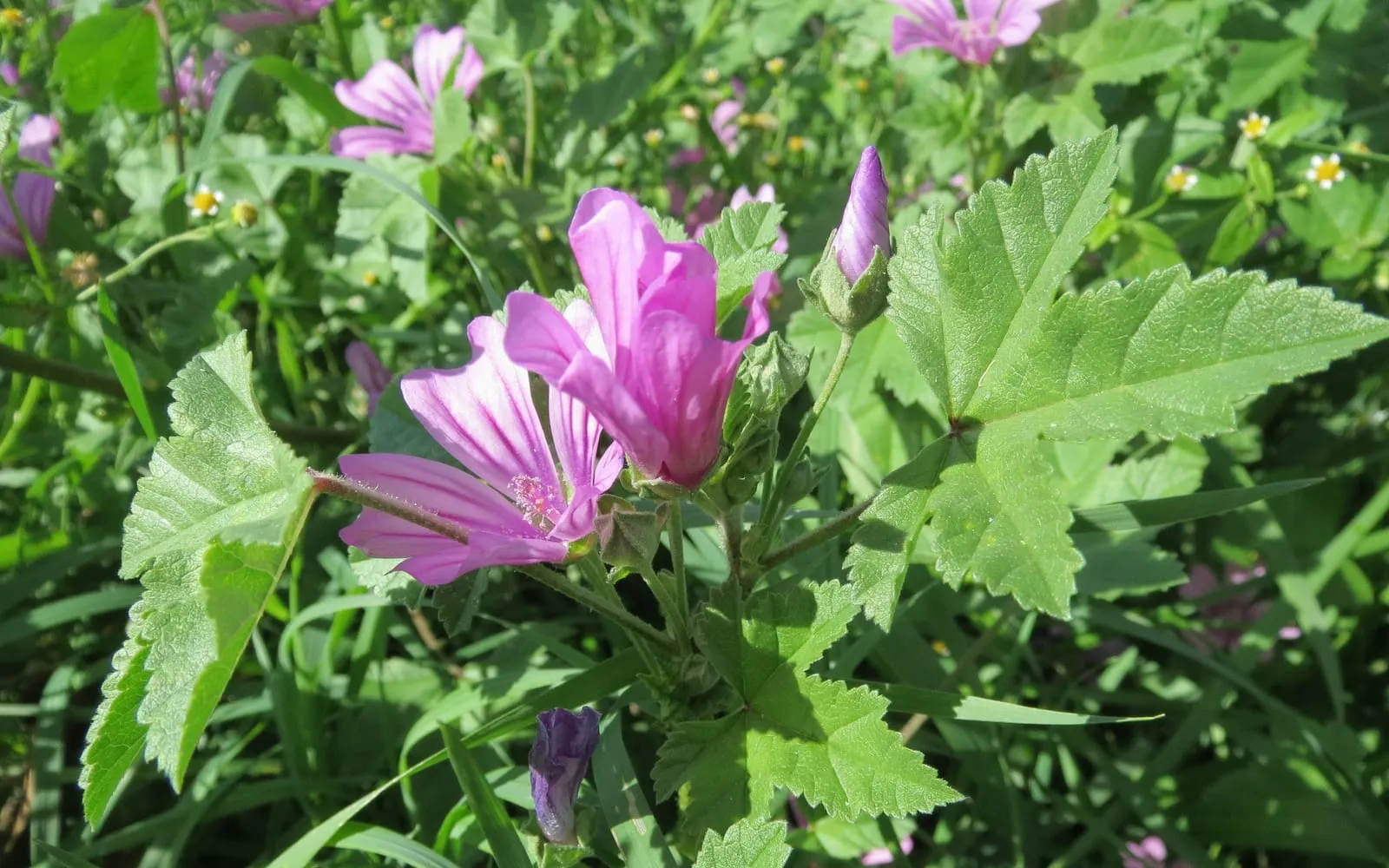
Leaves are rounded and shallowly lobed into five or seven, toothed at the edges, mid green and slightly hairy, and they are held on long stalks.
Flowers are the display. Pink-purple, 3 to 4 cm across, with five notched petals each marked by three or four darker veins running from the centre. They open in succession from June until October.
Seed cases follow, and they are the plant’s other identity. Flat, round, green and segmented into a ring of wedge-shaped nutlets that pull apart like a cheese.
The whole plant is mucilaginous. Chewing a leaf produces a slippery texture rather than a strong flavour.
The root is thick and taprooted, which is what makes an established plant persist in a path.
Where it is from
Common mallow is native to Europe, north Africa and western Asia, and it grows throughout Britain on roadsides, waste ground, hedge banks and rough grass, particularly on drier ground in the south.
It has been eaten for as long as there are records. Greek and Roman writers describe it as food, and Roman authors treat it as a vegetable of the poor while also crediting it with medicinal properties.
Egypt and the Levant kept the habit. Mallow leaves are cooked as khubeza across the region, and the plant remains a common wild vegetable there rather than a historical curiosity.
Its medicinal use was for the mucilage. Mallow was given for coughs and sore throats, in the same way its relative marsh mallow was, on the basis that the slippery texture soothed the surface it touched.
The name mallow, the family name Malvaceae, and the colour word mauve all descend from the same root, and mauve was named from the flower colour when the first synthetic dye of that shade was made in 1856.
How it grows
Sow direct in spring or autumn where it is to grow. It has a taproot and transplants poorly once past the seedling stage.
Sow at 1 cm deep and thin to 45 cm. Germination takes two to three weeks.
Alternatively let it seed itself, which it will do enthusiastically, and move seedlings while they are small.
Choose an open sunny position on ordinary or poor soil. Rich ground gives a large soft plant that flops.
Water until established, then leave it.
Cut it back by half in July if it has gone lax or rusty. It regrows and flowers again into autumn.
Harvest young leaves through the summer, flowers as they open and seed cases while still green and soft.
Deadhead if you want to limit seeding, though the plant produces so much that control means pulling plants rather than deadheading them.
Treat it as a short-lived perennial. Plants often decline after three or four years and the self-sown replacements are stronger.
Through the seasons
Winter is a low woody base and little else. It is fully hardy.
Spring brings new shoots from the crown in April and seedlings across the bed.
Early summer is the start of flowering, from June, and it continues for months.
Midsummer is when mallow rust shows on the leaves. Cut the plant back if it looks bad, and take the clean regrowth.
Late summer brings the seed cases, which are worth picking green.
Autumn ends the display at the first hard frost. Cut the stems down, or leave them and expect seedlings.
Care difficulty
Easy. Common mallow grows itself, and everything about caring for it is optional.
Mallow rust is the one persistent problem. It appears every summer, spotting the leaves orange-brown beneath and distorting the growth, and no treatment available to a gardener controls it. Cutting the plant back and clearing the fallen leaves reduces the following year’s infection, which is as good as it gets.
Rich soil produces a floppy plant. Poor dry ground produces a better one.
Self-seeding is generous. That is convenient in a wild corner and tiresome in a tidy border.
Nothing else needs doing. No feeding, no watering, no staking, no protection.
The plant is short-lived and replaces itself, so a declining specimen is normally best pulled out rather than nursed.
Watering
Water new plants weekly through their first summer.
After that, nothing. Common mallow is drought tolerant and grows on dry roadside banks without help.
Water in an extended drought if the plant wilts by mid-morning, and soak it properly.
Water at the base rather than over the leaves, which reduces rust and mildew slightly, though neither can be prevented.
A container works if it is deep enough for the taproot, and needs weekly watering in summer.
Warning signs, diseases and pests
Mallow rust is the main problem and it is close to universal. Orange-brown pustules break out on the leaf undersides, matching yellow spots above, and bad infections distort the growth and drop the leaves. Cut the plant back, clear every fallen leaf and expect it again next year.
Aphids gather on flowering stems and rarely need action.
Slugs take seedlings. Established plants shrug them off.
Powdery mildew whitens the leaves in late summer, usually on top of the rust.
Flopping means rich soil or shade. Cut the plant back by half.
Yellowing lower leaves through summer are normal ageing on a plant that keeps extending.
Seedlings across the bed mean the seed cases ripened. Pull the plant earlier next year.
Growing environment
Full sun to light shade. It flowers best in sun and tolerates part shade.
Almost any free-draining soil. Roadside verges, rubble, gravel and dry banks all suit it better than a prepared bed.
pH from 6 to 8. It is unfussy and grows on chalk.
Poor ground is an advantage. Rich beds produce lax plants that need cutting back.
It is fully hardy anywhere in its range and needs no shelter, though a tall plant on rich soil leans in wind.
For pollinators it is useful, flowering from June to October and drawing bees throughout. It is also the food plant of the painted lady butterfly’s caterpillars, along with thistles and nettles.
Feeding
None. Fed mallow grows large, soft and floppy, and it flowers no better for it.
Do not add compost or manure. Poor ground gives you a plant that stands up.
A container plant takes a weak balanced feed once in spring.
Avoid growing it on heavily manured ground if you plan to eat the leaves, since mallow takes up nitrate from rich soil.
If a plant looks starved, the cause is usually deep shade or root competition rather than nutrition.
Troubleshooting
Orange spots all over the leaves. Mallow rust. It arrives every year and nothing available to a gardener cures it. Cut the plant back, clear the fallen leaves and take the regrowth.
It flopped over. Rich soil or too much shade. Cut it back by half and grow the next one harder.
Can I eat it? Yes. Young leaves cook like a slippery spinach, the flowers go in salads and the green seed cases are eaten raw. Avoid plants growing on heavily manured ground, because mallow takes up nitrate.
What are the cheeses? The round green seed cases, segmented like a wheel of cheese, which is where the country name comes from. They are edible while soft.
Is it the same as marsh mallow? No. Marsh mallow, Althaea officinalis, is taller, velvety grey and grows in damp brackish ground, and its root was the original marshmallow. Common mallow is the roadside one with veined purple flowers.
It seeded everywhere. Expected. Pull the plants before the seed cases dry, or accept a colony.
The plant died after three years. Common mallow is short-lived. Let a seedling take its place.