
Edible
Cashew
Anacardium occidentale
Also known as Cashew apple, Caju, Kaju, Maranon
How to grow cashew, Anacardium occidentale. Warmth, the cashew apple, shell oil hazards and why raw cashews need processing.
At a glance
- Difficulty
- Difficult
- Water
- Once a week in growth, sparingly in winter
- Light
- Full sun, as much as a heated greenhouse can give
- Temperature
- 24-30 deg C, and it is damaged below 10
- Humidity
- Moderate. It wants a dry season to flower and fruit
- Hardiness
- USDA 10-12, RHS H1b, hardy to 10 C
- Type
- Tender evergreen tree
- Height
- 8-14 m in the tropics, 2-3 m in a large pot
- Native to
- north-eastern Brazil
- Best month
- May in the Northern Hemisphere, November in the Southern Hemisphere
Seasonally dry tropical Brazil. It needs a distinct dry period to flower and set, so it crops poorly in the wet tropics despite growing well there. The shell oil is caustic and related to poison ivy, which is why the nuts are always sold shelled and roasted.
Hardiness zones describe winter cold alone. Summer heat, humidity, rainfall and the length of the growing season decide as much, so treat the range as the outer limit rather than as a recommendation.
Every month named in this guide is for the temperate Northern Hemisphere. If you garden in the Southern Hemisphere, shift each one by six months, so May becomes November. Closer to the equator the wet and dry seasons matter more than the calendar, and the shift stops being a useful guide.
Poisonous if eaten
- Safe to eat
- The kernel after processing, and the cashew apple
- Do not eat
- The shell around the nut, and the sap, both of which contain anacardic acid and cardol
- Harm from
- Handling it, sap in the eyes and eating it
- Affects
- People, cats and dogs
The processed kernel is a food and everything around it is not. Cashew sits in the Anacardiaceae with mango, pistachio, poison ivy and poison oak, and it carries the family chemistry in concentrated form. The shell surrounding the kernel holds cashew nut shell liquid, a mixture of anacardic acid and cardol closely related to the urushiol of poison ivy, and contact produces a severe blistering dermatitis. In the eye it causes serious injury. This is why no shop anywhere sells a cashew in its shell and why every cashew on sale, including those labelled raw, has been steamed or roasted to destroy the liquid before shelling. Shelling one at home without equipment carries a real risk of chemical burns to the hands. The smoke from burning shells carries the same compounds and causes airway irritation. Cashew is one of the standard tree nut allergens and reactions can be severe, and anyone already sensitised to poison ivy may react to cashew or mango. Cashew apples are safe and are eaten fresh across Brazil and India. The ASPCA advises against feeding nuts to cats and dogs generally, for the fat content and the choking risk rather than for a specific toxin.
Sources: RHS potentially harmful garden plants, ASPCA people foods to avoid feeding your pets, NHS guidance on food allergy
About
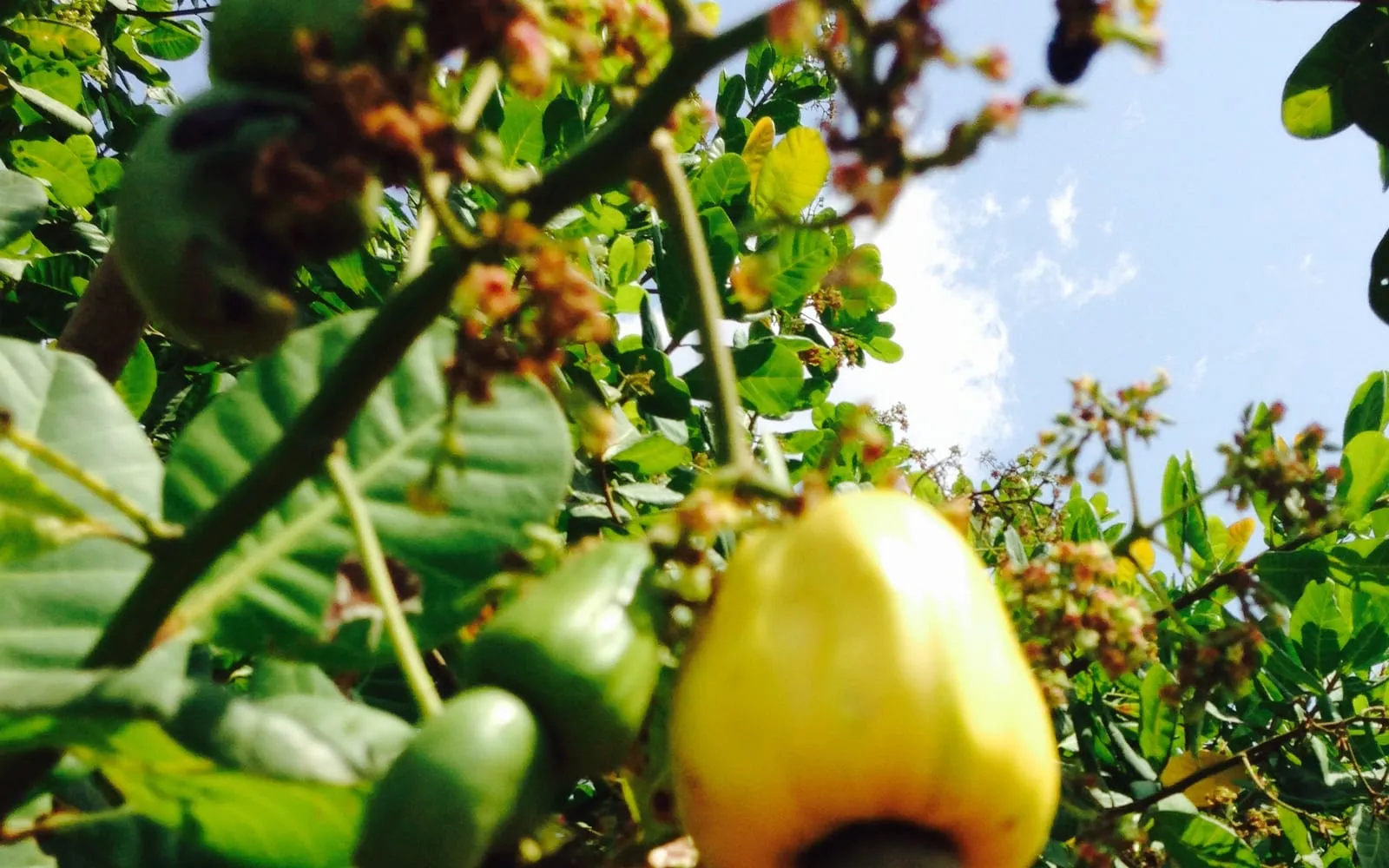
The cashew grows its nut on the outside of its fruit. What hangs from the branch is a swollen red or yellow pear the size of a small apple, and dangling from the bottom of it is a grey kidney-shaped shell with the kernel inside. The pear is the swollen flower stalk and the shell is the true fruit, which puts the whole arrangement inside out compared with everything else in the orchard.
That shell is why cashews cost what they do. It holds a caustic liquid closely related to the urushiol in poison ivy, and getting the kernel out means steaming or roasting the shell first, then cracking and peeling each one, work still done largely by hand across India, Vietnam and West Africa. No shop sells cashews in the shell anywhere in the world.
The pear itself, the cashew apple, is juicy, astringent and highly perishable, so it rarely leaves the country it grew in. Brazil drinks it as juice, Goa distils it into feni, and the rest of the world has never tasted one.
Appearance and character
An evergreen tree with a low spreading crown, often broader than it is tall, reaching 8 to 14 m in the tropics and easily kept to 2 or 3 m in a pot.
The trunk is short and often crooked, branching low, with grey-brown bark.
Leaves are leathery, oval to obovate with a rounded or notched tip, 10 to 20 cm long, clustered towards the ends of the shoots, with prominent parallel side veins.
New growth flushes bronze or red before hardening to dark green.
Flowers come in large branched panicles at the shoot tips, small, pale yellow-pink and fragrant, with both male and hermaphrodite flowers on the same panicle. Most set nothing.
The cashew apple is the swollen receptacle. Pear-shaped, 5 to 11 cm, ripening yellow, orange or scarlet, glossy, soft, and full of astringent juice.
The nut hangs beneath it, a grey-green kidney-shaped shell 2.5 to 3.5 cm, hard and smooth, with the kernel curled inside a double wall filled with caustic oil.
Where it is from
Anacardium occidentale is native to north-eastern Brazil, where it grows on coastal sand and in the caatinga scrub inland, and the Tupi people who used it gave the world the name through acaju.
Portuguese ships carried it to Goa in the 1560s and to Mozambique at about the same time, planted first to stabilise coastal sand rather than for the nut.
India took it up as a crop. Kerala, Goa and Tamil Nadu built the processing industry, and Indian and later Vietnamese factories still shell most of the world’s cashews.
West and East Africa grow enormous quantities of raw nuts, with Cote d’Ivoire, Nigeria and Tanzania among the leading producers, much of it shipped to Asia for processing.
Brazil, the plant’s homeland, is now a modest producer by comparison, though it retains the cashew apple culture that the rest of the world does not have.
How it grows
Sow a fresh unroasted nut in its shell, which needs handling with gloves. Nuts sold for eating have been heat-treated and will not germinate.
Sow point down at 25 to 30 deg C in gritty free-draining compost, and expect germination in two to four weeks.
Use a deep pot from the start. The seedling puts down a strong taproot and hates disturbance.
Grow in a heated greenhouse or conservatory outside the tropics. Frost kills it and anything below 10 deg C damages it.
Give full sun and as much heat as possible, with 24 to 30 deg C in summer.
Water sparingly. This is a dry-country tree that stands on sand, and root rot from a wet pot is the commonest killer.
Prune to shape in spring and keep it to a manageable size.
Feed lightly in the growing season and not at all in winter.
Expect a fruiting plant in three to five years in the tropics and no fruit at all outside the tropics in most cases. Grafted plants fruit sooner.
Handle any nut that does form with gloves, and do not attempt to shell one at home.
Through the seasons
March and April are for repotting, pruning and starting to feed as growth resumes.
May and June are the main growth flush, with bronze new foliage.
July and August are the months to keep the greenhouse hot and the compost on the dry side.
September is when to start reducing water and feed.
Winter is a dry rest above 10 deg C, and the tree keeps its leaves through it.
Late winter is when a mature tree flowers in the tropics, after a dry period, which is difficult to reproduce under glass.
Care difficulty
Difficult, and difficult in an unusual direction. The plant is drought-hardy and undemanding, and a cool temperate climate is wrong at every point.
Heat is the requirement, with 24 to 30 deg C in summer and 10 deg C as an absolute winter floor.
Overwatering kills more potted cashews than anything else.
Flowering needs a dry season followed by warmth, which a heated greenhouse cannot easily provide.
The realistic outcome is a handsome evergreen foliage tree, and that is worth having.
The shell chemistry means the fruit, if it ever comes, is not a casual harvest.
Watering
Water once a week through the growing season.
Let the compost dry well between waterings.
Reduce sharply from October.
Water perhaps once a month through winter, keeping the compost nearly dry.
Never leave the pot standing in water.
Use tepid water in a cool greenhouse, since cold water on warm roots checks the plant.
Warning signs, diseases and pests
Wilting in damp compost is root rot, and it is the usual cause of death.
Leaf drop after a cold night is chill damage below 10 deg C.
White powder on a flower panicle is powdery mildew, which is what costs commercial crops most of their yield.
Black sunken spots on young fruit and flower stalks are anthracnose.
Fine speckling with webbing is red spider mite in dry glasshouse air.
White waxy fluff in the leaf axils is mealybug.
Brown limpets along the stems are scale.
A rash on the forearms after pruning means the sap got on the skin, and gloves prevent it.
Growing environment
A heated greenhouse or a bright conservatory.
Full sun.
Minimum 10 deg C in winter, with 24 to 30 deg C in summer.
Moderate humidity with good ventilation.
Light gritty sharply drained compost.
A deep pot for the taproot.
Room for a spreading crown, since the tree grows sideways more than upwards.
Feeding
Feed a balanced liquid feed monthly from April to August.
Switch to high potash if a mature plant sets flower.
Skip manure and heavy nitrogen, which produce soft growth on a plant adapted to poor sand.
Add grit to the compost rather than organic matter.
Feed nothing from October to March.
Top dress with fresh gritty compost each spring.
Troubleshooting
Why can I never buy cashews in the shell? Because the shell contains a caustic oil related to poison ivy. Every cashew sold anywhere has been steamed or roasted and shelled first, including the ones labelled raw.
Are raw cashews raw? No. They have been heat-treated to destroy the shell oil. A cashew that had never been heated would not be safe to shell by hand.
What is the cashew apple? The swollen flower stalk above the nut, a juicy red or yellow pear eaten fresh in Brazil and India. It is too perishable to export, which is why almost nobody outside the growing countries has tried one.
Is cashew related to poison ivy? Yes. Both are in the Anacardiaceae, along with mango and pistachio, and they share the same class of skin-irritant compounds. Someone sensitised to poison ivy may react to cashew or mango skin.
Can I grow one from a shop-bought nut? No. Shop nuts have been heat-treated and are dead. You need a fresh unroasted nut in its shell, handled with gloves.
Will it fruit outside the tropics? Very unlikely. It needs a dry season followed by heat to flower, which a heated greenhouse cannot easily supply. Grow it as a foliage tree.
Why did mine die? Most likely a wet root. Cashew grows on coastal sand and rots in compost that never dries.
Is cashew a common allergen? Yes, it is one of the standard tree nut allergens, and reactions can be severe. Anyone with a known nut allergy should treat cashew, pistachio and mango skin with the same care.
Can I give cashews to my dog? Better not. The ASPCA advises against feeding nuts to pets generally, for the fat content and the choking risk.
Cashew problem guides
Not sure what is wrong? See the common vegetable pests guide.