
Edible
Longan
Dimocarpus longan
Also known as Dragon's eye, Lungan, Mata kucing
How to grow longan, Dimocarpus longan. The dragon's eye fruit that needs less winter chill than a lychee, how it differs from its famous cousin, and why it keeps better.
At a glance
- Difficulty
- Difficult
- Water
- Twice a week in growth, sparingly in the winter rest
- Light
- Full sun
- Temperature
- Needs a cool spell at 12-18 deg C to flower. Frost damages young wood
- Humidity
- Moderate to high in summer
- Hardiness
- USDA 10-11, RHS H1c, hardy to 0 C
- Type
- Tender evergreen tree
- Height
- 10-20 m in the open, 2 m in a pot
- Native to
- southern China, Myanmar
- Best month
- July and August in the Northern Hemisphere, January and February in the Southern Hemisphere
Subtropical southern China, and it needs a cool dry spell of a few weeks to initiate flowers. Trees in the even warmth of the equatorial tropics grow well and flower erratically, which is the same trap that catches lychee.
Hardiness zones describe winter cold alone. Summer heat, humidity, rainfall and the length of the growing season decide as much, so treat the range as the outer limit rather than as a recommendation.
Every month named in this guide is for the temperate Northern Hemisphere. If you garden in the Southern Hemisphere, shift each one by six months, so July becomes January. Closer to the equator the wet and dry seasons matter more than the calendar, and the shift stops being a useful guide.
Not known to be toxic
- Safe to eat
- The ripe translucent aril
- Do not eat
- The seed, which is not eaten
Longan is not toxic and no reputable source lists it as harmful to people or pets. It belongs to the same family as lychee and ackee, both of which carry hypoglycin compounds in unripe fruit, and the sensible reading is to treat unripe longan the same way rather than to assume it is exempt: eat the fruit ripe, and do not let children graze on green windfalls on an empty stomach. The seed is large, hard and inedible, and is a choking hazard for small children and a gut obstruction risk for a dog. Dried longan, sold widely in Chinese groceries, is the same fruit dehydrated and carries no additional concern.
Sources: RHS potentially harmful garden plants, ASPCA toxic and non-toxic plants
About
Longan is the lychee’s more forgiving cousin. The Chinese name translates as dragon’s eye, from the look of the peeled fruit, where a translucent white aril wrapped round a shiny black seed does resemble an eyeball.
It asks less of the grower than lychee in two useful ways. The winter chill it needs to flower is milder, around 12 to 18 deg C rather than 10 to 15, and the fruit keeps for a week or more after picking rather than browning in two days.
Longan is sweeter, muskier and less floral than lychee, with a faint smokiness that comes through strongly in the dried fruit sold in every Chinese grocer.
Appearance and character
An evergreen tree to 20 m in the open, with an upright habit and a rounded crown rather more open than a lychee’s.
Bark is corky and rough, and the branches are brittle and break in wind.
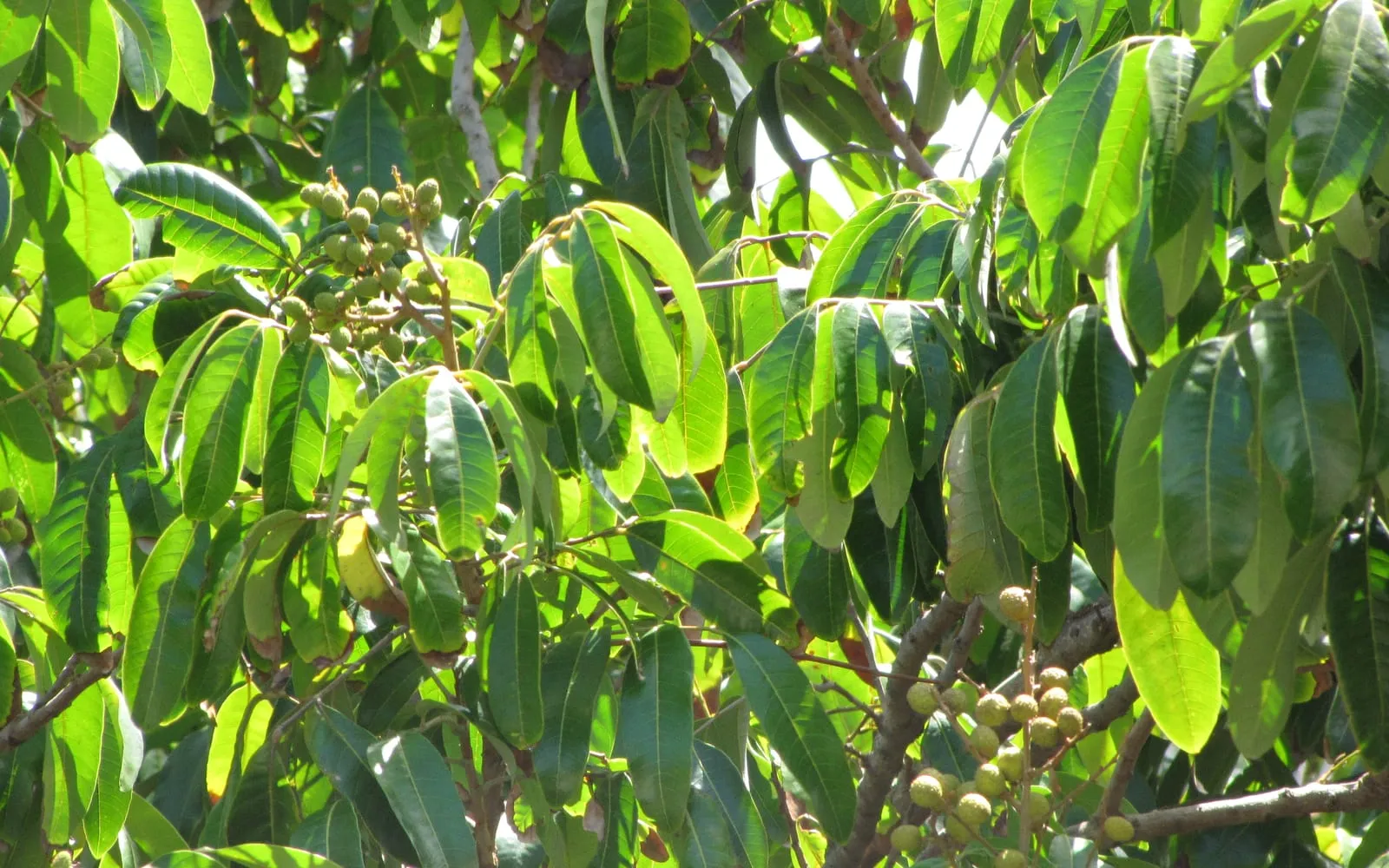
Leaves are pinnate with three to six pairs of leaflets, each oblong and 6 to 15 cm, glossy dark green above and dull below. New flushes are pale green rather than the coppery red of lychee, which separates the two at a glance.
Flowers come in large branched terminal sprays, small and pale yellow-brown, covered in fine hairs, and heavily scented.
Fruit hangs in drooping clusters, round, 2 to 3 cm, with a thin leathery skin that is tan to yellow-brown and nearly smooth. Lychee skin is bumpy and pink-red and the difference is unmistakable.
Peeled, the fruit is a translucent white aril round a single large glossy black seed with a white scar at one end, which is the dragon’s eye.
Dried longan shrinks to a dark sticky mass and is used in soups and teas.
Where it is from
Longan is native to southern China and the hill country of Myanmar, and it has been cultivated in Guangdong and Fujian for at least two thousand years, alongside lychee and often in the same orchards.
Chinese medicine has used dried longan for as long as there are records of it, and the dried fruit remains a standard ingredient in tonic soups.
Cultivation spread into Vietnam, Thailand and Taiwan, and Thailand became the largest exporter, sending both fresh and dried fruit across Asia.
The plant reached Florida, Hawaii and Australia in the nineteenth and twentieth centuries and is grown there commercially on a small scale.
Temperate markets see fresh longan intermittently in Chinese and South East Asian groceries in late summer, and dried longan year round.
How it grows
Buy a grafted or air-layered plant. Seedlings take a decade and vary wildly.
Sow seed fresh if you want a plant rather than a crop. Longan seed, like lychee, dies within days of leaving the fruit.
Use a free-draining sandy compost on the acid side of neutral.
Grow in full sun at 25 to 32 deg C in summer.
Water regularly through growth and keep the compost damp without being wet.
Give a cool winter spell at 12 to 18 deg C with reduced water for six to eight weeks. This is milder than lychee’s requirement and easier to arrange in an unheated greenhouse.
Feed fortnightly from April to August with a balanced feed containing iron.
Stake it and shelter it, because the branches are brittle.
Prune after fruiting to keep the plant to a manageable size.
Expect fruit on a grafted plant in three to five years, arriving a few weeks later in the season than lychee.
Through the seasons
Winter is the cool rest that sets the flowers. Hold at 12 to 18 deg C, water sparingly, and feed nothing.
Late winter to early spring brings the flower sprays.
Spring is flowering and setting. Raise the temperature and resume feeding and watering.
Early summer is fruit swell, which runs about four months from flowering to harvest.
Late summer is harvest, a few weeks after lychee.
Early autumn is the post-fruiting growth flush. Prune lightly.
Autumn is the taper towards the winter rest. Stop feeding and reduce water.
Care difficulty
Difficult, though a step easier than lychee.
The winter chill is still the deciding factor, and at 12 to 18 deg C it is within reach of a frost-free greenhouse that is not heated to living-room temperature.
Iron shortage on hard water is the commonest complaint on hard water, as it is with lychee. Use rainwater and slightly acid compost.
Brittle branches need shelter and staking.
Seedlings are slow and unreliable, so buy a grafted plant.
Frost damages young wood, though established trees take a light one.
Longan tolerates a drier atmosphere than lychee, which makes it the better choice for a conservatory where humidity is hard to keep up.
Watering
Water twice a week in growth, keeping the compost evenly damp.
Drain fully. Longan dislikes heavy wet compost as much as lychee does.
Reduce sharply for the winter rest, giving only enough to keep the leaves from flagging.
Use rainwater where the supply is hard.
Keep summer humidity moderate to high, though longan is less demanding here than lychee.
Water steadily during fruit swell, since irregular watering splits the fruit.
Mulch the pot surface to steady the moisture around the shallow roots.
Warning signs, diseases and pests
Yellowing between green veins is iron shortage from hard water or alkaline compost.
Brown crisp leaf margins are salt burn or dry air.
A plant that grows and never flowers has not had its cool winter spell.
Brown limpets on stems and leaf undersides are scale insects.
White fluff in the leaf axils is mealybug.
Wilting in damp compost means root rot.
Branches snapping in a draught or when handled is the species being brittle rather than a disease. Stake and shelter it.
Fruit splitting is irregular watering during swell.
Small fruit with little flesh usually means the plant carried too heavy a set. Thin the clusters.
Macadamia nut borer tunnels into longan fruit outdoors, running toward the seed and often causing early drop. A native parasitic wasp gives useful control in Australia later in the season. It occurs throughout Australia and much of Asia and the Pacific, and has not reached Europe or New Zealand.
Growing environment
A greenhouse that runs hot in summer and cool but frost free in winter.
Summer at 25 to 32 deg C.
Winter at 12 to 18 deg C for six to eight weeks, with reduced water.
Full sun.
Sandy free-draining compost, slightly acid.
pH from 5.5 to 6.5.
Rainwater in a hard water area.
Shelter from wind and a stake, because of the brittle branches.
Feeding
Feed fortnightly from April to August with a balanced liquid feed containing iron.
Add sequestered iron at the first sign of yellowing between the veins.
Stop feeding at the end of August.
Give nothing through the winter rest.
Top-dress with composted bark or leaf mould each spring.
Repot every second or third year into fresh compost.
Avoid lime and hard water, both of which lock up iron.
Troubleshooting
How is longan different from lychee? The skin is smooth and tan rather than bumpy and pink-red, the flesh is sweeter and muskier with a faint smokiness, the fruit keeps for a week rather than two days, and the tree needs a milder winter chill.
Why is it called dragon’s eye? The peeled fruit is a translucent white ball around a shiny black seed with a white scar, which looks convincingly like an eye.
It grows well and will not flower. It needs six to eight weeks at 12 to 18 deg C in winter to initiate flower buds. A warm conservatory prevents it.
Can I sow the seed from a fruit? Yes, if you sow it the same day. It dies within a few days of leaving the fruit. The seedling will take ten years or more to fruit.
The leaves are yellow with green veins. Iron shortage from hard water or alkaline compost. Use rainwater, slightly acid compost and sequestered iron.
A branch snapped when I moved it. Longan wood is brittle. Stake the plant and keep it out of draughts and wind.
What is the dried longan in Chinese shops? The same fruit dehydrated. It is used in tonic soups and sweet teas, and it is where most people first meet the flavour.
Are unripe longans dangerous? No case has been documented as it has with lychee, but the two are close relatives with related chemistry. Eat them ripe and keep green windfalls away from children.
Longan problem guides
Not sure what is wrong? See the common vegetable pests guide.
- Iron shortage on alkaline compost or hard water
- Root rot in heavy wet compost
- Scale insects on stems and leaf undersides
- Failure to flower without a cool winter spell
- Mealybug in the leaf axils
- Wind damage to the brittle branches
- Macadamia nut borer, present throughout Australia and much of Asia and the Pacific