
Edible
Macadamia Nut
Macadamia integrifolia
Also known as Queensland nut, Bush nut, Bauple nut, Smooth-shelled macadamia
How to grow macadamia, Macadamia integrifolia. The hardest shell in the nut trade, the only Australian native grown as a world food crop, and why it must never reach a dog.
At a glance
- Difficulty
- Difficult
- Water
- Once or twice a week in growth, less in winter
- Light
- Full sun, with light shade when young
- Temperature
- 18-30 deg C, and it is damaged below 3
- Humidity
- Moderate to high
- Hardiness
- USDA 9-11, RHS H1c, hardy to -2 C
- Type
- Tender evergreen tree
- Height
- 12-15 m in Australia, 2-3 m in a pot
- Native to
- south-eastern Queensland, northern New South Wales
- Best month
- May in the Northern Hemisphere, November in the Southern Hemisphere
Subtropical rainforest margins in south-east Queensland and northern New South Wales, and the only Australian native plant grown as a major world food crop. It takes a light frost once established and wants a mild winter with some cooling to flower well.
Hardiness zones describe winter cold alone. Summer heat, humidity, rainfall and the length of the growing season decide as much, so treat the range as the outer limit rather than as a recommendation.
Every month named in this guide is for the temperate Northern Hemisphere. If you garden in the Southern Hemisphere, shift each one by six months, so May becomes November. Closer to the equator the wet and dry seasons matter more than the calendar, and the shift stops being a useful guide.
Toxic if eaten
- Safe to eat
- The kernel
- Do not eat
- The whole nut where a dog is concerned, and the husk
- Harm from
- Eating it
- Affects
- Dogs and people
Macadamia kernels are food for people and are among the small number of foods that are specifically dangerous to dogs. Macadamia toxicosis produces weakness, vomiting, tremors, hyperthermia and a characteristic hind limb weakness that leaves a dog unable to stand, typically within twelve hours of eating them. Very small quantities are enough, the mechanism is still not understood, and dogs almost always recover within a day or two with veterinary support, though the episode is alarming. The ASPCA lists macadamia nuts among the people foods to avoid feeding pets for this reason. If a dog eats macadamias, ring a vet. Macadamia is also a standard tree nut allergen for people, though it causes fewer severe reactions than cashew or Brazil nut. The green husk around the shell is not eaten. The shell itself is the hardest in commercial use and needs real force to crack, which is a hand injury risk rather than a chemical one.
Sources: ASPCA people foods to avoid feeding your pets, NHS guidance on food allergy, RHS potentially harmful garden plants
About
Macadamia is the only Australian native plant that has become a major world food crop. Everything else on the supermarket shelf was domesticated somewhere else, and this one came out of the subtropical rainforest of south-east Queensland within the last hundred and fifty years.
The Gubbi Gubbi and neighbouring peoples ate it long before that, calling it bauple and other names, and it is one of the few bush foods that entered commercial cultivation with its origins reasonably well recorded.
Hawaii made it famous. Australian seed reached Hawaii in the 1880s, and Hawaiian growers built the industry and the marketing that put macadamias in every airport shop. Australia only overtook Hawaii as the largest producer in the 1990s.
The shell is what people remember. It takes around 300 newtons to crack, several times what a hazelnut needs, and commercial processing uses steel rollers. The nutcracker in your kitchen drawer will not do it.
Appearance and character
A dense evergreen tree, 12 to 15 m in Australia, kept to 2 or 3 m in a large pot by pruning.
Bark is grey-brown and the crown is rounded and heavy with foliage.
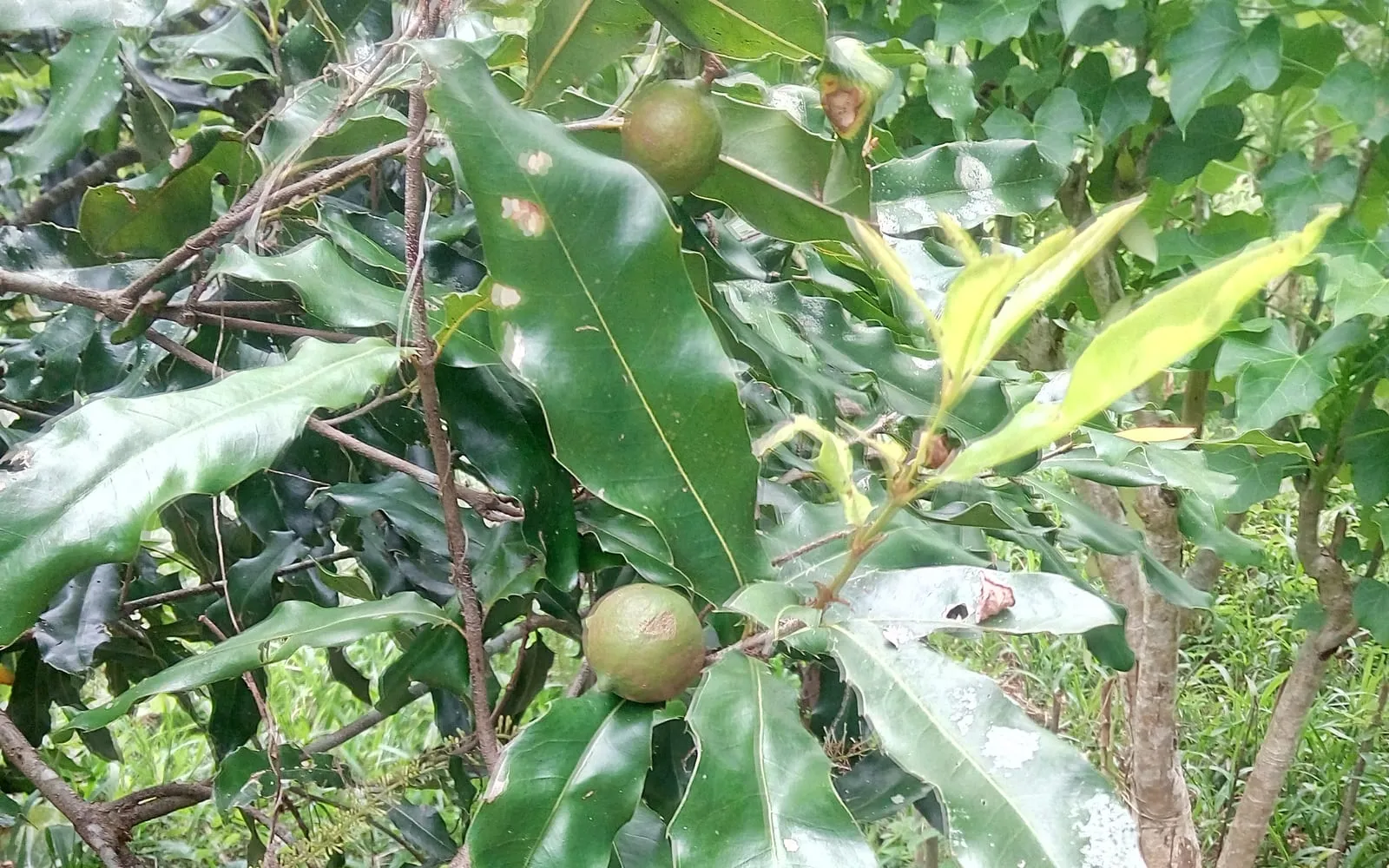
Leaves are the identification. They are stiff, leathery, oblong, 10 to 30 cm long, and arranged in whorls of three or four at each node rather than singly or in pairs.
Leaf margins on Macadamia integrifolia are smooth or nearly so, and its close relative Macadamia tetraphylla has sharply toothed margins and whorls of four, which is how growers tell the two apart.
New growth flushes bronze or reddish before hardening.
Flowers hang in long slender racemes 15 to 30 cm long, with hundreds of small creamy white flowers on each. They are a Proteaceae flower, with the style pushing out through the split perianth.
Fruit is a green leathery husk 2 to 3 cm across that splits and drops, revealing a smooth hard brown shell inside.
The kernel is round, cream, and unusually high in oil, which is what gives it the texture people pay for.
Where it is from
Macadamia integrifolia is native to a small area of subtropical rainforest in south-eastern Queensland and just over the border into northern New South Wales.
Aboriginal communities in that country ate the nuts and traded them, and the species has one of the shortest journeys from wild food to global crop of any plant in the shops.
European botanists described it in 1857 and named the genus after John Macadam, a Scottish-Australian chemist. The first commercial planting was in Queensland in the 1880s.
Hawaii took seed in 1882 and built the industry, selecting the cultivars that still dominate and creating the market.
Australia, South Africa, Kenya, Hawaii, China and Guatemala are the main producers now, with Australia and South Africa trading places at the top.
Wild populations back in Queensland are threatened by clearing, and the species is listed as vulnerable in its native range.
How it grows
Grow from a fresh nut in its shell or, far better, from a grafted plant. A seedling takes 8 to 12 years to fruit and may not come true.
Sow fresh seed at 25 deg C in free-draining acid compost. Germination takes one to three months.
Grow in a cool greenhouse or conservatory outside the tropics. Macadamia is hardier than most tropical nut trees and tolerates a light touch of frost, though it is damaged below about 3 deg C.
Give full sun once established and light shade when young.
Use an acid ericaceous compost with grit. This is a Proteaceae, and it evolved on phosphorus-poor soil.
Feed with a low-phosphorus fertiliser. Ordinary plant food will burn the roots and scorch the leaf tips, which is the standard way people kill Proteaceae.
Water evenly and let the surface dry between waterings.
Prune in spring to keep it to size and to open the crown.
Expect flowers on a grafted plant after four or five years under good conditions, and expect nuts only if two cultivars are grown for cross pollination.
Harvest by picking up what falls, which is how it is done commercially, then dry the nuts in the shell for several weeks before cracking.
Through the seasons
Spring is for repotting, pruning and resuming the feed.
Late spring is when a mature plant hangs its long flower racemes.
Summer is the main growth period, and the months for steady water.
Autumn is nut fall in Australia, and the point in the Northern Hemisphere to reduce feeding.
Winter is a cool bright rest above 3 deg C, with the tree in full leaf.
Late winter is the time to check the compost is not staying wet, which is what kills Proteaceae in a cold greenhouse.
Care difficulty
Difficult, and the difficulty is chemistry rather than cold.
Phosphorus is the trap. Proteaceae have specialised roots adapted to phosphorus-poor soil, and ordinary fertiliser poisons them.
Acid free-draining compost is required, and it must never stay wet.
It is hardier than the other tropical nuts here and survives a cool greenhouse.
Nuts need two cultivars for cross pollination and several years of growth.
As an evergreen foliage tree with whorled leaves it is handsome and slow, which is the likely outcome in a cool summer.
Watering
Water once or twice a week through the growing season.
Let the surface dry between waterings, since constant wet rots the roots.
Reduce in winter without letting the compost go bone dry.
Use rainwater in a hard water area, as the plant dislikes lime.
Keep humidity moderate to high.
Drain fully and never leave the pot standing in water.
Warning signs, diseases and pests
Burnt brown leaf tips and margins usually mean phosphorus toxicity from ordinary fertiliser rather than drought.
Yellowing between the veins on new growth is lime-induced chlorosis from hard water or an alkaline compost.
Wilting in damp compost is root rot, which Proteaceae suffer more than most.
Fine speckling with webbing is red spider mite in dry air.
Brown limpets along the stems are scale.
White waxy fluff in the leaf axils is mealybug.
Flowers appearing but no nuts setting usually means there is only one cultivar and no cross pollination.
Leaf drop after a hard frost is cold damage, and the plant needs protection below 3 deg C.
Macadamia nut borer tunnels through the husk to the shell outdoors, leaving a frass-packed hole and often causing premature nut drop. It occurs throughout Australia’s growing regions and much of Asia and the Pacific, and is established in Hawaii, but has not reached the mainland United States, Europe or New Zealand.
Growing environment
A cool or frost-free greenhouse or conservatory.
Full sun when mature, light shade when young.
Minimum 3 deg C, with 18 to 30 deg C for growth.
Moderate to high humidity.
Acid free-draining ericaceous compost with added grit.
Rainwater rather than hard tap water.
A second cultivar nearby if nuts are the goal.
Feeding
Feed a low-phosphorus fertiliser, or one formulated for Australian natives and Proteaceae.
Avoid ordinary general-purpose plant food, bonemeal and superphosphate absolutely, since phosphorus poisons the roots.
Feed monthly from April to September and nothing in winter.
Top dress with ericaceous compost each spring.
Add grit rather than manure to improve the medium.
Keep the feed weak rather than strong.
Troubleshooting
Why are the leaf tips burning? Almost always phosphorus. Macadamia is a Proteaceae and ordinary fertiliser contains far more phosphorus than it can tolerate. Use a low-phosphorus feed made for Australian natives.
How hard is the shell? The hardest in commercial use, needing around 300 newtons to crack. Domestic nutcrackers will not manage it. A vice or a purpose made macadamia cracker will.
Are macadamias dangerous to dogs? Yes. They cause weakness, vomiting, tremors and a distinctive hind limb weakness within about twelve hours. Dogs usually recover in a day or two with veterinary support, but ring a vet if one eats any.
Will it fruit outside the tropics? Possibly, with a grafted plant, several years, a frost-free greenhouse and two cultivars for cross pollination. It is a long project.
Is it hardy? Hardier than any of the other tropical nuts. It tolerates a light frost and is damaged below about 3 deg C, so a frost-free greenhouse is enough.
How do I tell the two macadamia species apart? Leaf margins and whorls. Macadamia integrifolia has smooth margins and whorls of three; Macadamia tetraphylla has sharply toothed margins and whorls of four.
When do I harvest? Pick the nuts up off the ground after they fall, which is what commercial growers do. Dry them in the shell for several weeks before cracking.
Why does my plant have yellow leaves with green veins? Lime-induced chlorosis, from hard water or an alkaline compost. Switch to rainwater and ericaceous compost.
Is it Australian or Hawaiian? Australian. Hawaii built the industry from Australian seed in the 1880s and did the marketing, which is why so many people assume otherwise.
Macadamia Nut problem guides
Not sure what is wrong? See the common vegetable pests guide.