
Edible
Guava
Psidium guajava
Also known as Common guava, Apple guava, Amrood
How to grow guava, Psidium guajava. The smell that fills a room, pink flesh against white, the seeds you can and cannot chew, and why it is a weed across half the tropics.
At a glance
- Difficulty
- Moderate
- Water
- Weekly in growth, less in winter
- Light
- Full sun
- Temperature
- Minimum 5 deg C to survive, 15 deg C to grow. Light frost damages young wood
- Humidity
- Moderate. It is unfussy
- Hardiness
- USDA 9-11, RHS H1c, hardy to -2 C
- Type
- Tender evergreen shrub or small tree
- Height
- 3-10 m in the open, 1.5-2 m in a pot
- Native to
- Mexico, Central America, northern South America
- Best month
- May, June and September in the Northern Hemisphere, November, December and March in the Southern Hemisphere
Tropical America, and now one of the most widely naturalised fruit trees on earth. Birds spread the seed and it forms thickets that displace native vegetation across Hawaii, Fiji, the Galapagos, and parts of Africa and Australia. It is a declared weed in several of them, so check before planting.
Hardiness zones describe winter cold alone. Summer heat, humidity, rainfall and the length of the growing season decide as much, so treat the range as the outer limit rather than as a recommendation.
Every month named in this guide is for the temperate Northern Hemisphere. If you garden in the Southern Hemisphere, shift each one by six months, so May becomes November. Closer to the equator the wet and dry seasons matter more than the calendar, and the shift stops being a useful guide.
Not known to be toxic
- Safe to eat
- The whole fruit including skin and seeds, and the young leaves as a tea
Guava is not toxic. The ASPCA does not list it as harmful to cats or dogs, the whole fruit including the skin and seeds is eaten, and guava leaf tea is a common domestic remedy for diarrhoea across the tropics with a long record of ordinary use. Two practical notes rather than toxicological ones. The seeds are hard enough to crack a filling and are best swallowed whole or avoided by anyone with fragile teeth, and unripe guava is astringent and constipating in quantity. The plant is a serious environmental problem in Hawaii, Fiji, the Galapagos and much of the Pacific, where birds spread the seed and dense thickets replace native forest, so it should not be planted out anywhere it could escape.
Sources: ASPCA toxic and non-toxic plants, RHS potentially harmful garden plants
About
A ripe guava announces itself from another room. The scent is musky, sweet and slightly cheesy, and it carries further than any other fruit in this collection.
The flesh comes in two main colours. White-fleshed cultivars are crisper and more acid, pink-fleshed ones are softer and sweeter, and the pink ones are what most juice and paste are made from.
It is also among the easiest tropical fruit to grow, which is a rare thing on this list. Guava takes a light frost, tolerates poor soil, fruits within three years from seed, and crops in a pot. The same qualities have made it a destructive invasive plant across the Pacific.
Appearance and character
A multi-stemmed evergreen shrub or small tree, 3 to 10 m in the open and easily held at 1.5 m in a pot.
Bark is the giveaway. Smooth, thin and copper-brown, flaking off in patches to leave a mottled green and grey surface, much like a eucalyptus.
Young stems are square in cross-section, which is unusual outside the mint family and useful for identification.
Leaves are opposite, oval, 5 to 15 cm, dull light green, with the veins strongly impressed above and prominent below, giving a quilted look. Crushed, they smell resinous.
Flowers are white, 2 to 3 cm, with four or five petals and a large boss of white stamens, borne singly or in threes in the leaf axils.
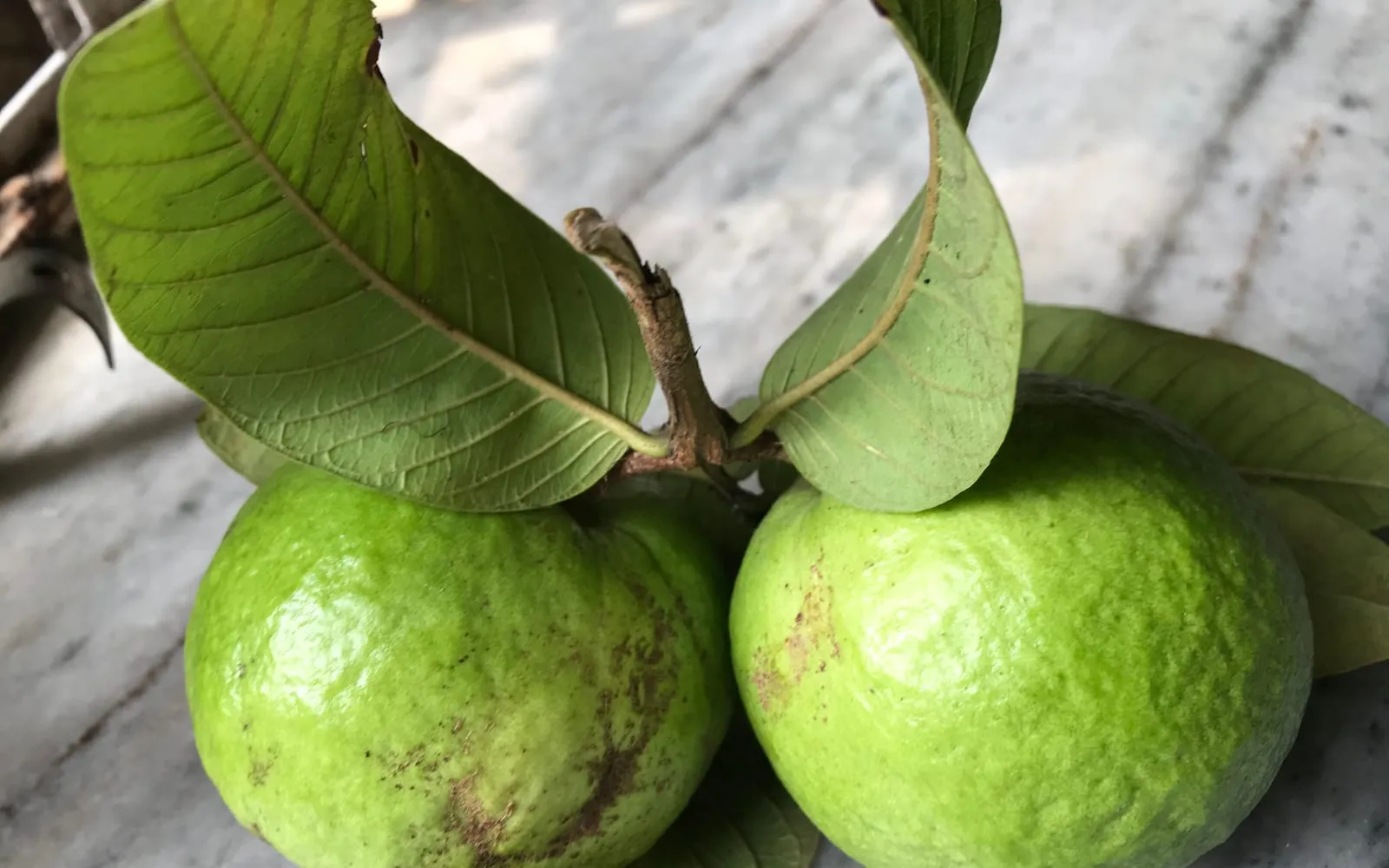
Fruit is round to pear-shaped, 4 to 12 cm, with a thin yellow-green skin, and it carries the dried calyx at the far end as a small crown.
Flesh is white, pink or salmon depending on cultivar, granular near the skin and soft in the centre, with a mass of small hard seeds in the middle.
Where it is from
Guava is native to a broad band from southern Mexico through Central America into northern South America, and it was domesticated there long before European contact.
Archaeological remains in Peru date guava to several thousand years ago, and it was in cultivation across Mesoamerica and the Caribbean when the Spanish arrived.
The Spanish and Portuguese carried it across the Pacific to the Philippines and Guam and across the Atlantic to Africa and India within a century, and it naturalised everywhere it went.
India is now the largest producer by a wide margin, and guava is a staple fruit of Indian and Pakistani markets under the name amrood.
The ease with which it spreads has made it a weed. Guava forms dense thickets in Hawaii, Fiji, New Caledonia and the Galapagos, shading out native vegetation, and it is one of the more damaging plant invaders in the Pacific.
Temperate markets see fresh guava in South Asian and Caribbean groceries, and guava nectar and paste in supermarkets.
How it grows
Sow seed from a ripe fruit. Guava germinates freely, and unlike most tropical fruit here the seed keeps for months.
Sow on the surface of free-draining compost at 20 to 25 deg C and cover lightly. Germination takes two to eight weeks and is often uneven.
Pot on into ordinary free-draining compost. Guava is not fussy about soil and will grow in almost anything that drains.
Grow in full sun at a minimum of 10 to 15 deg C for growth, and keep it above 5 deg C in winter.
Water weekly in growth and less in winter.
Feed fortnightly from April to September.
Prune hard. Guava fruits on new wood, so cutting back in late winter improves the crop and keeps a pot plant compact.
Expect fruit from seed in three to four years, which is fast for a fruit tree, and sooner from a cutting or a grafted plant.
Do not plant it out anywhere in the tropics or subtropics where it could escape.
Through the seasons
Winter is a cool rest above 5 deg C, watered sparingly and not fed. The plant may drop some leaves.
Late winter is the time to prune, since guava fruits on new wood.
Spring brings the growth flush and the first flowers. Repot and start feeding.
Early summer is flowering and setting on a plant pruned in late winter.
Midsummer is fruit swell. Move to a high-potash feed.
Late summer to autumn is harvest, which runs over several weeks because the fruit does not all ripen together.
Autumn is when to reduce feeding and watering as growth slows.
Care difficulty
Moderate, and among the easiest tropical fruits a temperate grower can attempt.
Cold tolerance is better than most here. Guava survives to about 5 deg C comfortably and mature plants take a light frost with damage to the young wood only.
Soil is not a problem. It grows in sand, clay and everything between, provided water drains away.
Fruiting comes quickly. Three to four years from seed and sooner from a cutting.
Pruning is the main skill, and it is straightforward. Cut back in late winter, because fruit comes on the current season’s growth.
Fruit fly is the great enemy in the tropics and is not a problem under glass.
The plant’s invasiveness is a reason for care rather than a difficulty. Never plant it out where it could escape into a warm climate.
Watering
Water weekly in growth, giving a good soak and letting the surface dry between times.
Reduce in winter to a fraction of that, keeping the compost barely damp.
Water steadily during fruit swell. Irregular watering splits guava fruit and causes drop.
Drain fully. Guava tolerates most soils and does not tolerate standing water.
Tap water is fine, since guava is not sensitive to hardness the way lychee is.
Mulch a pot in summer to steady the moisture.
Expect some leaf drop after a dry spell, and expect recovery.
Warning signs, diseases and pests
Small dimpled holes in fruit with a soft brown patch beneath are fruit fly. Cut one open and look for larvae. It is the main pest of guava worldwide and is rare under glass. Which species is responsible depends on where you are: Queensland fruit fly across eastern Australia, and various Bactrocera, Anastrepha and Ceratitis species across the rest of the tropics and subtropics. Net the fruit, pick and destroy fallen fruit promptly, and follow local quarantine rules on moving home-grown fruit between regions.
Sunken dark spots on fruit and leaves in humid conditions are anthracnose.
Brown limpets along stems and leaf undersides are scale.
White waxy fluff in leaf axils and on roots is mealybug.
Yellowing older leaves in winter is normal. Guava sheds some leaf in a cool rest.
Leaf drop and blackened shoot tips after frost are cold damage. Cut back to live wood in spring.
Wilting in damp compost is root rot.
Fruit splitting is irregular watering during swell.
Seedlings coming up in every neighbouring pot means fruit fell and the seed germinated. Guava seed is persistent.
Growing environment
A greenhouse, conservatory or a bright indoor spot. Outdoors in summer in a sheltered south-facing corner, brought in before frost.
Minimum 5 deg C to survive, 15 to 30 deg C to grow and fruit.
Full sun.
Moderate humidity. Guava is not demanding here.
Any free-draining compost. A standard multipurpose mix with added grit is ample.
pH from 5.0 to 7.0, which is a wide tolerance.
A pot large enough to support a fruiting plant, since a crop on a small root system exhausts it.
Feeding
Feed fortnightly from April to September with a balanced liquid feed.
Switch to high potash, such as tomato feed, as the fruit swells.
Stop feeding at the end of September.
Give nothing through the winter rest.
Top-dress or repot each spring, since guava grows fast and exhausts a pot.
Add magnesium if older leaves yellow between the veins.
Avoid heavy nitrogen late in the season, which delays fruiting and leaves soft growth to be frosted.
Troubleshooting
Can I eat the skin and the seeds? Yes to the skin, and the seeds are eaten too, though they are hard enough to crack a filling. Swallow them whole or eat around the centre.
What is the difference between pink and white guava? Cultivar. White-fleshed guavas are crisper and more acid, pink ones are softer and sweeter, and pink is what most juice and paste is made from.
Why does the whole house smell of it? Ripe guava is one of the most strongly scented fruits there is. Keep it in a sealed container in the fridge if the smell is too much.
When do I prune? Late winter. Guava fruits on the current season’s growth, so cutting back before the spring flush increases the crop and keeps a pot plant to size.
Will it survive a cool winter outside? No. It takes a light frost with damage to the young wood but a cool winter will kill it. Bring it under cover.
How fast will it fruit from seed? Three to four years, which is unusually quick for a fruit tree.
The fruit has small holes and is rotten inside. Fruit fly. It is the major pest of guava in the tropics and is very unlikely in a heated greenhouse.
Should I plant it out on holiday somewhere warm? No. Guava is a serious invasive weed across the Pacific and in the Galapagos, spread by birds, and it forms thickets that replace native forest.
Guava problem guides
Not sure what is wrong? See the common vegetable pests guide.