
Edible
Hops
Humulus lupulus
Also known as Hop, Common hop, Golden hop
How to grow hops, Humulus lupulus. Training the bines clockwise up strings, why you need female plants, picking at the right moment, and drying the cones.
At a glance
- Difficulty
- Moderate
- Water
- Weekly through summer, generously
- Light
- Full sun, with a little afternoon shade acceptable
- Temperature
- Fully hardy to about -20 deg C
- Hardiness
- USDA 3-8, RHS H6, hardy to -25 C
- Type
- Hardy herbaceous perennial climber, long-lived
- Height
- 5-8 m in a season
- Native to
- Europe, including Britain, and western Asia
- Best month
- September in the Northern Hemisphere, March in the Southern Hemisphere
Cone production needs long summer days, which confines commercial growing to roughly 35 to 55 degrees of latitude in both hemispheres and explains why the hop map is a pair of narrow bands. Nearer the equator the plant climbs and flowers poorly. It needs 120 frost-free days and a support system built for 6 m of growth in a season.
Hardiness zones describe winter cold alone. Summer heat, humidity, rainfall and the length of the growing season decide as much, so treat the range as the outer limit rather than as a recommendation.
Every month named in this guide is for the temperate Northern Hemisphere. If you garden in the Southern Hemisphere, shift each one by six months, so September becomes March. Closer to the equator the wet and dry seasons matter more than the calendar, and the shift stops being a useful guide.
Skin irritant
- Safe to eat
- The young spring shoots as a vegetable, and the cones for brewing
- Harm from
- Eating it and handling it
- Affects
- People, cats, dogs and horses
Hops are used in brewing worldwide and the young shoots are eaten as a spring vegetable in Belgium and northern Italy. Two cautions apply. The bines and leaves are covered in tiny hooked hairs that abrade skin and cause a rash after prolonged handling, which is well documented among hop pickers as hop dermatitis, so wear long sleeves when training or picking. More seriously, hops are dangerous to dogs. Malignant hyperthermia has been reported in dogs that ate hop cones or spent grain from home brewing, causing a rapid and sometimes fatal rise in body temperature, with greyhounds and other breeds prone to the condition most at risk. The ASPCA lists Humulus lupulus as toxic to dogs on those grounds. Never let a dog reach cones, dried hops or brewing waste, and treat any ingestion as a veterinary emergency rather than something to watch. Hops also have a sedative effect in people and interact with alcohol and sedative medications, which is relevant to hop pillows and teas rather than to growing the plant.
Sources: ASPCA (Hops, Humulus lupulus), RHS potentially harmful garden plants
About
A hop plant is a perennial rootstock that throws up five to eight metres of climbing growth every summer and dies back to the ground every winter. The climbing stems are called bines rather than vines, because they twine with stiff hooked hairs instead of gripping with tendrils.
They twine clockwise, always, and a bine trained the wrong way round a string will unwind itself. That is the first practical thing to know.
The second is that only female plants produce cones. Hops are dioecious, and a male plant gives nothing worth having. Every named brewing variety is a female clone propagated from cuttings, which is why hops are bought as rhizomes or plants rather than grown from seed.
Appearance and character
Vigorous twining bines, 5 to 8 m in a single season, rough with tiny hooked hairs that catch on anything they touch.
Leaves are large, three or five-lobed, coarsely toothed and rough on both surfaces, in a deep green. The golden-leaved ‘Aureus’ is grown as an ornamental and produces usable cones.
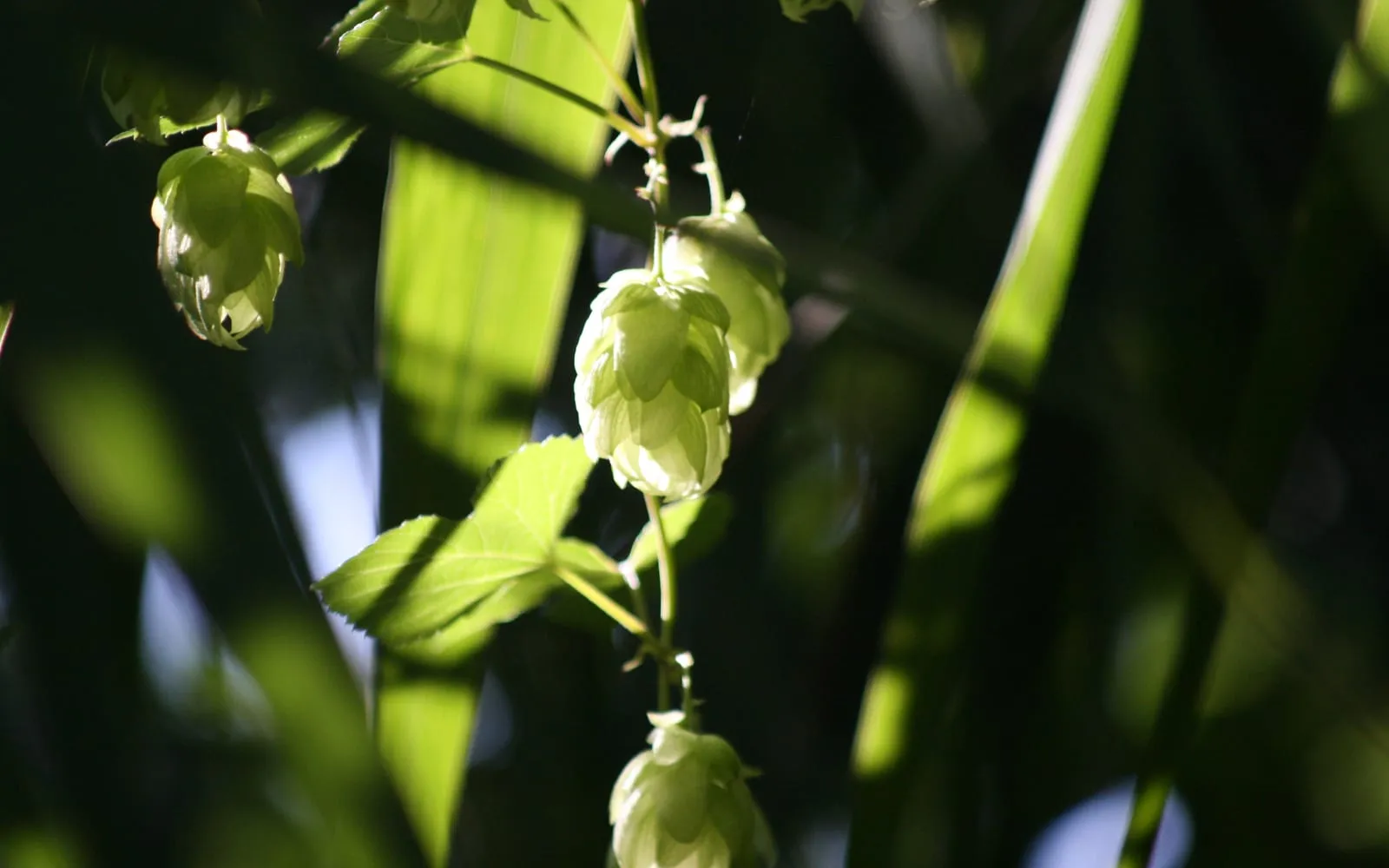
Female flowers develop into cones from August, pale green, papery and overlapping, 2 to 5 cm long, hanging in clusters.
Lupulin is the crop within the crop. Rub a cone open and yellow resinous powder falls out from the base of each bract, and that powder carries the bitter acids and aromatic oils brewing wants.
Scent is strongly resinous, citrusy or spicy depending on variety, and it fills a garden in September.
Where it is from
Humulus lupulus is native across Europe, including Britain, western Asia and North America, growing in hedgerows and damp woodland margins.
Brewing with hops began in central Europe, and Hildegard of Bingen described their preservative effect in the twelfth century.
England resisted them for two hundred years. English ale was unhopped and hopped beer was a Flemish import treated with suspicion, and Henry VI was petitioned to ban the hop as a wicked weed. Kent and Sussex took up commercial growing in the sixteenth century and the oast houses followed.
British hop acreage collapsed through the twentieth century, and the craft brewing revival has partly reversed it.
Wild hops in British hedgerows are a mix of natives and escapes from old hop gardens.
How it grows
Plant rhizomes or pot-grown plants in early spring, and buy a named female variety rather than growing from seed.
Plant 1 m apart with the rhizome horizontal, 5 cm deep, into deep ground dug with well-rotted manure.
Provide serious support before planting. Five metres of vertical string, wire or netting, anchored top and bottom. Traditional hop gardens run coir string from a ground peg to an overhead wire.
Let the shoots come up in April, then choose the three or four strongest and cut the rest away. Train them clockwise around the strings and they take hold within days.
Strip the leaves and side shoots from the bottom metre of each bine in June, which improves airflow and reduces downy mildew.
Expect little in the first year. A hop crops properly from its third season.
Pick in September when the cones feel papery and springy, smell strongly, and leave yellow lupulin on your fingers.
Cut the bines to the ground after picking and mulch the crown.
Through the seasons
Early spring is for planting rhizomes and for mulching established crowns with manure. Put the strings up before growth starts.
Mid spring brings the shoots. Select three or four per plant and cut the rest out, which is what concentrates the crop. The thinnings are the edible shoots, cooked like asparagus.
Summer is growth, and it is astonishing. A bine can add 20 cm in a day. Train clockwise, water generously, strip the lower metre in June, and watch for aphids.
Late summer and early autumn ripen the cones, from late August into September. Pick when they are papery, springy and aromatic.
Autumn and winter are for cutting the bines to the ground, composting them, and mulching the crown.
Care difficulty
Moderate, and mostly a matter of infrastructure.
The support is the real commitment. Five metres of vertical string every year, anchored well enough to carry a heavy bine in an August gale. Growers who put up a two-metre trellis are disappointed.
Damson-hop aphid is the defining pest, arriving in June from overwintering plums and building fast.
Downy mildew blackens and kills the growing tips in a wet spring, and stripping the lower metre of each bine is the main cultural control.
Water is the other demand. A hop transpires heavily and a dry July gives small cones with little lupulin.
Patience is needed for the first two years, and yields are heavy from the third.
Watering
Water generously through summer, around 20 litres per plant a week in dry weather. This is one of the thirstiest plants in the garden.
A dry July and August gives small cones with poor lupulin, which is the main way a hop crop disappoints.
Water at the base rather than over the foliage, which reduces both mildews.
Mulch heavily in spring with compost or well-rotted manure.
Reduce watering after picking, since the plant is heading into dormancy.
Container growing is possible in a very large pot of 50 litres or more with daily watering, and yields are much lower than in the ground.
Warning signs, diseases and pests
Damson-hop aphid colonises the undersides of leaves and the developing cones from June, and it can build to numbers that ruin a crop. It overwinters on plum and damson, so a hop grown near either is at greater risk. Wash colonies off with a jet of water, encourage ladybirds and hoverflies, and check the leaf undersides weekly from May.
Red spider mite bronzes the leaves in a hot dry summer, particularly on a sheltered wall. Damp the foliage in hot weather.
Downy mildew blackens and stunts the shoot tips in a wet spring, producing distorted spike-like growths. Strip the lower metre of each bine, space the plants, and remove affected shoots.
Powdery mildew coats leaves and cones with white bloom in a dry summer.
Verticillium wilt yellows and wilts one side of a plant and is a serious disease of commercial hop gardens. There is no cure. Remove affected plants and do not replant hops on that ground.
Small cones with little lupulin usually mean drought or too many bines left on the plant.
Spotted lanternfly mobs the bines in large numbers, feeding on the sap and coating everything below in sticky honeydew, and a sustained heavy attack weakens the plant. It has spread across nineteen US states since 2014 and has not established outside North America and its native Asia; destroy any egg mass found, a grey-brown smear resembling dried mud on hard surfaces.
Growing environment
Full sun, and a little afternoon shade is tolerated.
Deep, rich, free-draining soil. Hops root deeply and repay proper ground preparation with manure.
Neutral to slightly alkaline, pH 6 to 7.5.
Vertical support of at least 5 m, anchored top and bottom. A wall, a barn end, a tall pergola, or the traditional string-and-wire arrangement.
Shelter from the worst wind, since a fully grown bine carries an enormous sail area.
A permanent position, since the rootstock stays for twenty years or more.
Away from plums and damsons where practical, since they host the overwintering aphid.
Out of reach of dogs, given the risk from cones.
Feeding
Mulch with well-rotted manure in March, generously. Hops are hungry.
Feed with a balanced fertiliser at the same time, around 70 g per square metre.
Give a potash-rich feed in June as the cones start to form.
Avoid heavy nitrogen after midsummer, which gives soft growth that mildews and delays the cones.
Mulch again in autumn after cutting the bines down.
Troubleshooting
No cones at all. Either a male plant or a plant in its first or second year. Buy a named female variety, and expect a real crop from the third season.
The bine unwound itself from the string. It was trained anticlockwise. Hops twine clockwise without exception. Rewind it the other way.
Colonies of aphids all over the leaves and cones. Damson-hop aphid. Wash them off with a jet of water, check weekly from May, and encourage predators. Growing away from plums and damsons reduces the pressure.
Black distorted shoot tips in a wet spring. Downy mildew. Remove affected shoots, strip the lower metre of each bine, and improve airflow.
Small cones with almost no yellow powder. Drought, or too many bines left on the plant. Water generously through July and August, and train only three or four bines per plant.
One side of the plant wilted and yellowed. Verticillium wilt. There is no cure. Remove the plant and do not replant hops there.
When exactly do I pick? When a cone feels papery and springy rather than soft, springs back when squeezed, smells strongly, and leaves yellow lupulin on your fingers when rubbed. A cone picked green has little bittering value.
Can I eat the shoots? Yes. The thinnings removed in spring are a delicacy in Belgium and northern Italy, cooked briefly like asparagus. They are among the most expensive vegetables in Europe.