
Edible
Australian Round Lime
Microcitrus australis
Also known as Dooja, Gympie lime, Australian lime
How to grow Australian round lime, Microcitrus australis. The Queensland rainforest citrus that was a bushfood before it was a crop, its place beside the finger lime, and the thorns it comes with.
At a glance
- Difficulty
- Moderate
- Water
- Weekly in growth, sparingly in winter
- Light
- Full sun, with light shade when young
- Temperature
- Minimum around minus 3 deg C once established
- Humidity
- Moderate
- Hardiness
- USDA 9-11, RHS H1c, hardy to -2 C
- Type
- Tender to half-hardy evergreen shrub or small tree
- Height
- 3-18 m in the open, 1.5 m in a pot
- Native to
- Queensland, New South Wales
- Best month
- May, June and September in the Northern Hemisphere, November, December and March in the Southern Hemisphere
Subtropical rainforest of south-east Queensland, growing as an understorey tree. It takes more shade than any other citrus and a light frost once established.
Hardiness zones describe winter cold alone. Summer heat, humidity, rainfall and the length of the growing season decide as much, so treat the range as the outer limit rather than as a recommendation.
Every month named in this guide is for the temperate Northern Hemisphere. If you garden in the Southern Hemisphere, shift each one by six months, so May becomes November. Closer to the equator the wet and dry seasons matter more than the calendar, and the shift stops being a useful guide.
Skin irritant
- Safe to eat
- The whole fruit, juice and rind
- Do not eat
- The peel oils, which can raise a rash in sunlight
- Harm from
- Handling it
- Affects
- People
Australian round lime is not toxic and nothing in it is listed as harmful to cats or dogs. It carries the standard citrus caution. Peel oils in the Rutaceae contain furanocoumarins, and skin contact with the oil followed by sun exposure can raise phytophotodermatitis, a burn-like rash that blisters and leaves brown marks for months. Handling a lot of fruit on a bright day is the usual way this happens, and gloves prevent it. The spines are the other practical hazard, sitting in the leaf axils and sharp enough to draw blood. The fruit itself is eaten whole, juice and rind, and is a standard Australian bushfood.
Sources: RHS potentially harmful garden plants, ASPCA toxic and non-toxic plants
About
Australian round lime is one of six citrus species native to Australia, and it was eaten by Aboriginal people in south east Queensland long before Europeans gave it a botanical name.
The fruit is round, 3 to 5 cm, thin-skinned and green to yellow-green, with a sharp lime flavour and a distinct resinous note that separates it from a Tahitian lime.
It sits alongside the finger lime in the modern Australian bushfood trade, overshadowed by it commercially and better suited to a pot, since it is slower, denser and more compact. Both are now placed in Citrus by most botanists, though the older Microcitrus name is still widely used and is what the app carries.
Appearance and character
A dense twiggy evergreen shrub or small tree, 3 to 18 m in the open and slow enough to hold at a metre and a half in a pot.
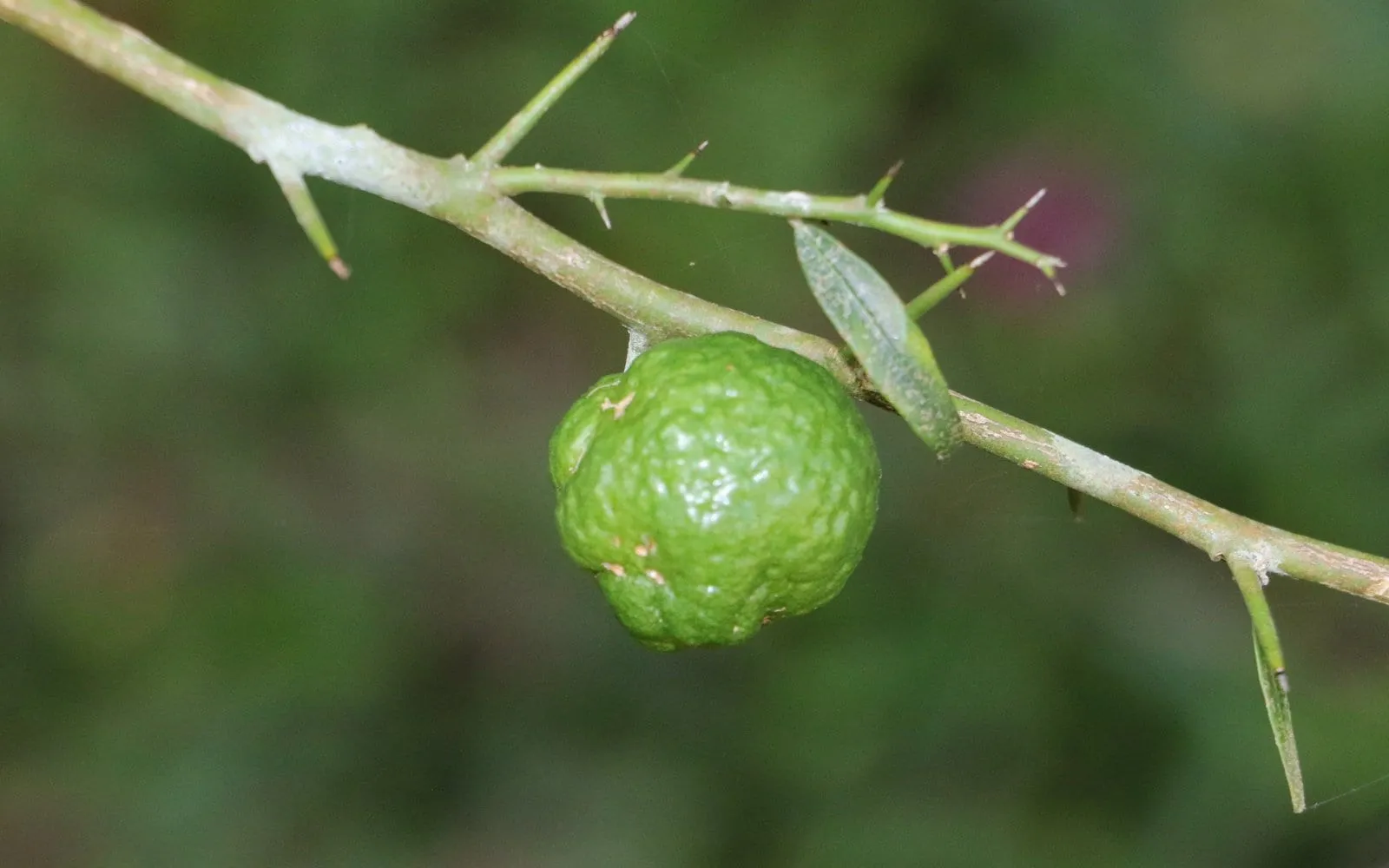
Sharp spines sit in the leaf axils along the branches, and they are the first thing anyone handling it notices.
Bark is grey-brown and rather smooth.
Leaves are alternate, small, 2 to 5 cm, oval to diamond-shaped, glossy dark green and aromatic when crushed, with the citrus oil glands visible against the light. Juvenile plants often carry much smaller leaves than mature ones.
Flowers are small, white, five-petalled and fragrant, borne singly or in small clusters in the leaf axils.
Fruit is round, 3 to 5 cm, with a thin green to yellow-green rind covered in prominent oil glands.
Flesh is pale green to yellowish, in segments, with juice vesicles that are firmer and more separate than an ordinary lime’s.
Flavour is sharply acid with a resinous, faintly turpentine note that Australian cooks use deliberately.
Where it is from
Australian round lime is native to the rainforest and rainforest margins of south east Queensland and north east New South Wales.
Aboriginal people of the region ate it and used it, and it is one of a small group of native Australian citrus that includes the finger lime, the desert lime, the round lime and three others.
European settlers in Queensland used it as a lime substitute from the nineteenth century and it was known as the Gympie lime after the town.
It was largely forgotten until the Australian bushfood movement of the 1990s brought native ingredients back into restaurant cooking, and the finger lime in particular became a commercial crop.
The round lime remains a minor crop, grown by specialist Australian nurseries and by collectors abroad.
Temperate markets see the plant occasionally from citrus specialists and the fruit not at all.
How it grows
Buy a grafted plant if you can. Australian citrus are usually grafted onto standard citrus rootstocks, which speeds them up considerably.
Sow seed from a ripe fruit if that is what you have. It germinates at 20 to 25 deg C in three to six weeks and is often polyembryonic, giving several seedlings of which most are clones.
Grow in free-draining slightly acid compost, ideally a proprietary citrus mix.
Give full sun, with light shade for a young plant.
Keep it above about minus 3 deg C once established, which makes it hardier than most citrus.
Water weekly in growth and sparingly in winter, letting the surface dry between times.
Feed fortnightly from April to September with a summer citrus feed, then switch to a winter citrus feed from October.
Prune lightly to shape, wearing gloves.
Expect fruit in three to five years from a grafted plant and six to eight from seed.
Through the seasons
Winter is a cool rest a little above freezing, watered sparingly, with a winter citrus feed given occasionally.
Early spring is the time to repot and prune, and to switch to the summer feed.
Late spring brings flowering, which is fragrant.
Early summer is fruit set.
Midsummer is fruit swell.
Autumn is harvest, and fruit may hang on the plant for some weeks.
Late autumn is when to switch back to the winter feed and reduce watering.
Care difficulty
Moderate, and much the same as growing any citrus in a pot.
Cold tolerance is good for a citrus. An established plant takes a few degrees of frost, which is better than a lemon manages.
Citrus feeding is the main discipline. Summer and winter formulations differ and using the wrong one is the commonest fault.
Cold wet compost in winter causes root rot and leaf drop, so the pot has to drain freely.
Growth is slow, which suits a pot and delays fruiting.
The spines need gloves and make pruning slower.
Fruit comes in three to five years on a grafted plant.
Watering
Water weekly in growth, giving a thorough soak and letting the surface dry.
Reduce in winter, watering only when the compost has dried down.
Drain fully. Cold wet compost is the main cause of loss in any potted citrus.
Use rainwater where the supply is hard, since citrus dislike alkaline water.
Keep humidity moderate.
Water steadily during fruit swell.
Never leave a pot standing in a saucer of water.
Warning signs, diseases and pests
Yellowing between green veins is iron or manganese shortage, which potted citrus show readily on hard water.
Leaf drop in winter usually means cold wet compost.
Winding pale trails inside young leaves are citrus leaf miner.
Brown limpets on the stems and leaf undersides are scale, often with sooty mould below them.
White fluff in the leaf axils is mealybug.
Fine webbing on the leaves is spider mite in dry heated air.
Wilting in damp compost is root rot.
Fruit dropping small is irregular watering or a heavy set.
A rash after handling fruit on a bright day is phytophotodermatitis from the peel oils.
Growing environment
A cool greenhouse or conservatory, standing outdoors for the summer.
Minimum around minus 3 deg C for an established plant, frost free for safety in a pot.
Full sun, with light shade for a young plant.
Moderate humidity.
A proprietary citrus compost, free-draining and slightly acid.
pH from 5.5 to 6.5.
Rainwater in a hard water area.
A pot of 30 to 40 cm, and gloves for the spines.
Feeding
Feed fortnightly from April to September with a summer citrus feed.
Switch to a winter citrus feed from October, given occasionally through the cold months.
The two formulations differ in nitrogen and trace elements, and using summer feed in winter is the commonest citrus mistake.
Add sequestered iron if the young leaves yellow between the veins.
Repot every second or third spring into fresh citrus compost.
Avoid ordinary multipurpose feed, which does not carry the trace elements citrus need.
Keep feeding steady rather than heavy.
Troubleshooting
Is this the same as a finger lime? No. The finger lime is Citrus australasica, with elongated fruit full of caviar-like vesicles. This is the round lime, whose fruit is round with more conventional citrus flesh. Both are Australian natives now usually placed in Citrus.
Why does the app call it Microcitrus? The older name. Most botanists have moved Microcitrus into Citrus, and the app carries the earlier classification, which is still in wide use.
How hardy is it? Better than most citrus. An established plant takes a few degrees of frost, though a pot has cold roots and is safer kept frost free.
What does it taste like? Sharply acid like a lime, with a resinous, faintly turpentine note that Australian cooks use deliberately.
The leaves are yellow between the veins. Iron or manganese shortage, which potted citrus show readily on hard water. Use rainwater, citrus compost and sequestered iron.
Why did it drop its leaves in winter? Cold wet compost. Water far less through the cold months and make sure the pot drains.
Do I need special citrus feed? Yes, and both formulations. Summer and winter citrus feeds differ in nitrogen and trace elements, and using the wrong one is the commonest fault in potted citrus.
I got a rash after handling the fruit. Phytophotodermatitis from the peel oils, raised by sun exposure after contact. Wear gloves on a bright day.
Australian Round Lime problem guides
Not sure what is wrong? See the common vegetable pests guide.