
Edible
Macadamia Nut
Macadamia tetraphylla
Also known as Rough-Shell Macadamia, Bush Nut
Practical guidance for growing macadamia nut, Macadamia tetraphylla, including its rough shell and whorled leaves that separate it from the smooth-shell species, frost sensitivity, Phytophthora risk, and its toxicity to dogs.
At a glance
- Difficulty
- Moderate
- Water
- Regularly while establishing, then consistent moisture through flowering and nut fill
- Light
- Full sun
- Temperature
- Subtropical; young trees are frost-tender, mature trees tolerate a light frost
- Hardiness
- USDA 9b-11, RHS H3, hardy to -3 C
- Type
- Evergreen tree, slow to reach cropping age, long-lived once established
- Height
- 8-12 m in cultivation
- Native to
- eastern Australia
A subtropical rainforest-margin tree rather than a true tropical one, and that distinction matters more than the zone number alone. Established trees of this species tolerate an occasional light frost better than the more widely planted smooth-shell macadamia, Macadamia integrifolia, does, which is why tetraphylla is the more common choice at the cooler edge of macadamia-growing country. Young trees have none of that tolerance and need real frost protection until several years old. A mild winter chill period appears to help flowering, so the ideal is cool but not cold rather than warm year-round.
Hardiness zones describe winter cold alone. Summer heat, humidity, rainfall and the length of the growing season decide as much, so treat the range as the outer limit rather than as a recommendation.
Toxic to dogs if eaten
- Safe to eat
- The roasted or raw kernel, for people
- Do not eat
- The raw nut kernel, for dogs specifically
- Harm from
- Eating it
- Affects
- Dogs
Macadamia nuts are a genuine, well-tolerated food for people, eaten raw or roasted, but the ASPCA lists macadamia among plants and foods toxic to dogs, and this is one of the better-documented food toxicities in veterinary medicine. Ingestion causes macadamia nut toxicosis, typically weakness, especially in the hind legs, vomiting, tremors and a raised body temperature, usually starting within twelve hours of eating a nut and resolving within one to two days with supportive veterinary care; the exact toxic compound is not fully identified, and no reliably fatal case in a dog has been documented, but it is a genuine veterinary emergency rather than a minor upset, and any dog that has eaten macadamia nuts should see a vet promptly. Toxicity to cats and horses is not well documented either way. Not every wild species in the genus Macadamia is safe for people to eat. Some close relatives carry bitter, cyanogenic compounds that made them unpalatable and unsafe, and it is only Macadamia integrifolia and Macadamia tetraphylla, both selected and bred for the table, that supply the commercial and garden nut crop eaten today.
Sources: ASPCA toxic and non-toxic plants, RHS potentially harmful garden plants
About
Macadamia tetraphylla is the rough-shelled macadamia, a close relative of the smooth-shelled Macadamia integrifolia that supplies most of the commercial world crop, and the more cold-tolerant of the two species where a garden or orchard sits at the cooler margin of what a macadamia can grow in.
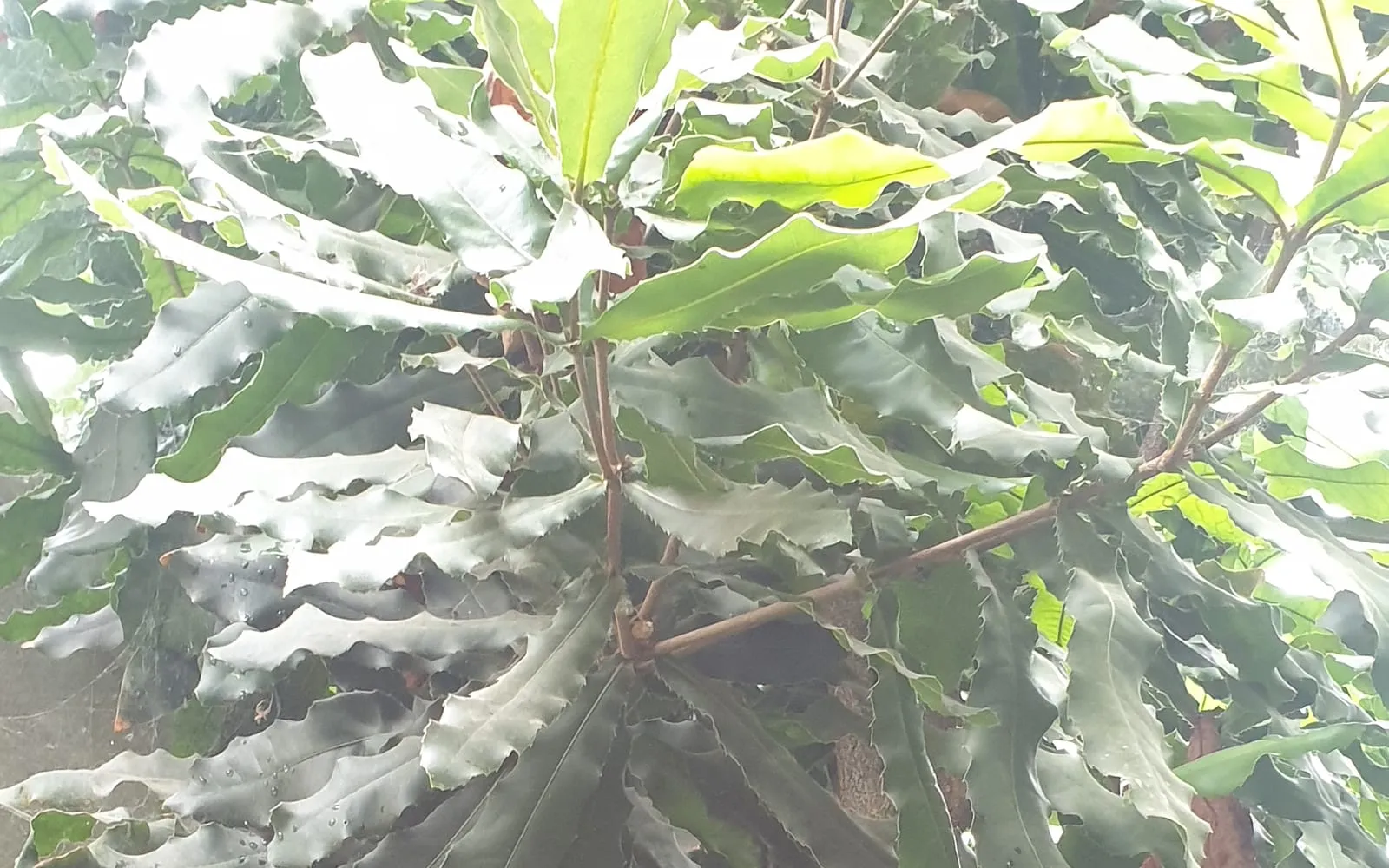
Its name gives away the easiest way to tell it apart from its smoother relative: tetraphylla means four leaves, referring to the whorls of four leaves arranged around the stem, against integrifolia’s whorls of three, along with more sharply toothed, spinier leaf margins that are usually visible on sight.
Appearance and character
A dense, rounded, evergreen tree with glossy, leathery leaves arranged in whorls of four around each stem, each leaf edged with small, sharp spines, noticeably more so than the smoother-margined leaves of Macadamia integrifolia. New growth often emerges with a pink or bronze flush before hardening to dark green.
Long, drooping flower spikes carry dozens of small flowers, typically pink-tinged in this species, a shade deeper than the cream to white flowers of the smooth-shelled macadamia. Flowers are followed by round, hard-shelled nuts encased in a green husk that splits and drops the nut as it ripens, and the shell itself is distinctly rougher and more textured than the smooth shell of its better-known relative, the feature both its common and scientific names point to.
Where it is from
Macadamia tetraphylla is native to a comparatively narrow strip of eastern Australia, along the border country of northern New South Wales and southern Queensland, growing as an understorey or margin tree in subtropical rainforest rather than in open ground.
That native habitat, at the cooler, more southerly edge of the genus’s range compared with the more tropical distribution of Macadamia integrifolia further north in Queensland, gives this species more cold tolerance than its relative. Australian Aboriginal peoples harvested macadamia nuts from wild trees for a long time before European settlement, and commercial breeding and cultivation, which began in earnest in the twentieth century, drew on both species and produced most of the varieties grown around the world today, many of them hybrids between the two rather than pure tetraphylla or pure integrifolia.
How it grows
Plant in full sun on well-drained, slightly acidic soil. Waterlogging is one of the fastest ways to lose a macadamia, since the roots are particularly vulnerable to Phytophthora root rot in wet ground.
Choose a site with some shelter from strong wind, since the canopy and the developing nut crop are both vulnerable to wind damage, and a young tree in particular benefits from a windbreak while establishing.
Protect young trees from frost for at least the first three to five years. This species tolerates an occasional light frost once mature far better than it does as a seedling or young graft, so real protection, whether that is a frost cloth, a temporary structure or a naturally sheltered microclimate, matters most in those early years.
Expect a long wait before the first useful crop. A grafted tree typically begins bearing within four to seven years, considerably faster than a seedling-grown tree, but a full commercial-scale crop still takes the better part of a decade to arrive.
Harvest as nuts drop naturally rather than picking them from the tree, since ripening is uneven across a crop and dropped nuts are reliably ready, though they need collecting promptly and regularly to stay ahead of rodents and other wildlife.
Through the seasons
Winter brings the mild chill period that appears to encourage flowering, and is also the season young trees most need frost protection.
Spring is flowering, with the long, drooping flower spikes opening over several weeks and drawing bees and other pollinators.
Summer is nut development, through which the tree benefits from consistent moisture rather than either drought or waterlogging.
Autumn is harvest in most growing regions, as ripe nuts begin dropping and need regular, prompt collection from the ground.
Care difficulty
Moderate. A mature, well-sited tree needs comparatively little routine care, but reaching that maturity takes real attention. Frost protection while young, strict avoidance of waterlogged ground at any age, shelter from strong wind, and patience through several years of growth before any meaningful crop appears are each straightforward on their own. Together they add up to a tree that rewards planning far more than most nut trees do.
Watering
Water regularly while a young tree establishes its root system, and maintain consistent soil moisture through flowering and while the nuts are filling, since drought stress at either stage reduces the crop.
Never let the root zone sit waterlogged at any stage of the tree’s life. Good drainage matters more to this species than to almost any other common garden nut tree, given how readily wet ground invites Phytophthora root rot.
Warning signs, diseases and pests
Macadamia nut borer tunnels into the developing husk, leaving a small entry hole and a frass-packed passage running to the shell, and often causes affected nuts to drop early. Collecting and destroying fallen nuts and husks through the season reduces the population reaching the following year.
Phytophthora root rot is the disease to take most seriously. It attacks the roots in poorly drained soil, and a tree already declining from wet ground is far more vulnerable to it than one on a well-drained site. There is no reliable cure once it takes hold in the roots, which makes prevention through site choice and drainage the real defence.
Scale insects settle on stems and leaf undersides, sapping the tree and excreting the sticky honeydew that sooty mould then grows on, coating foliage in a black film that blocks light from the leaf beneath it. Treating the underlying scale resolves both problems together.
Growing environment
Full sun suits it best, matching its origin as a canopy or margin tree of subtropical rainforest rather than deep forest shade.
Well-drained, slightly acidic soil is close to essential, and any site prone to standing water after rain should be avoided or substantially improved before planting.
Shelter from strong wind protects both the canopy and the developing crop, and a site with some elevation or air movement to reduce frost pooling helps young trees through their most vulnerable early years.
Feeding
Feed with a balanced fertiliser formulated for macadamia or citrus, applied in several light doses through the growing season rather than one heavy application, which suits the tree’s steady, ongoing nutrient needs better than a single seasonal feed.
Avoid excess nitrogen, particularly on a young tree, since it can push soft vegetative growth at the expense of the root development the tree needs to establish well.
Troubleshooting
My dog ate a macadamia nut. What should I do? Contact a vet promptly. Macadamia nut toxicosis in dogs typically causes weakness, especially in the back legs, vomiting and tremors within about twelve hours, and while it usually resolves within a day or two with supportive care, it needs veterinary assessment rather than waiting it out at home.
How do I tell this species apart from the more common macadamia? Look at the leaves. This species carries them in whorls of four with noticeably spiny margins, against the smooth-shell macadamia’s whorls of three and smoother leaf edges, and the nut shell itself is visibly rougher and more textured than the smooth-shell species.
My young tree was damaged by a light frost. This species tolerates frost better than most macadamias once mature, but a young tree has little of that resistance. Protect it through at least its first three to five winters, and expect a mature tree in a suitable climate to cope with an occasional light frost that would have damaged it badly when young.
Why has my tree not produced any nuts after several years? Macadamias are slow to reach bearing age, typically four to seven years even for a grafted tree, and longer for one grown from seed. Poor pollination, cold damage to flowers, or a site with too much shade can all delay a first crop further.
Can I eat the nuts raw, or do they need roasting? Both are fine for people. Raw and roasted macadamia kernels are both a genuine, safe food, and roasting is a matter of flavour and shelf life rather than removing any toxin, unlike some other nuts.