
Edible
Soursop
Annona muricata
Also known as Graviola, Guanabana, Prickly custard apple
How to grow soursop, Annona muricata. The spiny green fruit behind guanabana juice, and the reason French health authorities warned against the leaf tea sold as a cancer cure.
At a glance
- Difficulty
- Difficult
- Water
- Twice a week in growth, reduced in winter
- Light
- Full sun with light shade when young
- Temperature
- Minimum 15 deg C. The least cold tolerant of the Annonas
- Humidity
- High
- Hardiness
- USDA 10-12, RHS H1b, hardy to 12 C
- Type
- Tender evergreen tree
- Height
- 4-9 m in the open, 1.5-2 m in a pot
- Native to
- the Caribbean, northern South America
- Best month
- June and July in the Northern Hemisphere, December and January in the Southern Hemisphere
Wet lowland tropical America. It is the most cold-sensitive of the annonas and is damaged below about 10 deg C. Flowers are poorly visited by insects, so hand pollination raises the crop sharply.
Hardiness zones describe winter cold alone. Summer heat, humidity, rainfall and the length of the growing season decide as much, so treat the range as the outer limit rather than as a recommendation.
Every month named in this guide is for the temperate Northern Hemisphere. If you garden in the Southern Hemisphere, shift each one by six months, so June becomes December. Closer to the equator the wet and dry seasons matter more than the calendar, and the shift stops being a useful guide.
Toxic if eaten
- Safe to eat
- The white flesh in normal amounts
- Do not eat
- The seeds, leaves, bark and root, which are rich in annonacin
- Harm from
- Eating it and sap in the eyes
- Affects
- People
Soursop flesh eaten as a fruit is treated as safe, and it is a staple of Caribbean and Latin American drinks. The concern attaches to concentrated and repeated exposure. Soursop is the richest known dietary source of annonacin, an annonaceous acetogenin that damages dopamine-producing neurons in laboratory studies, and epidemiological work in Guadeloupe linked heavy long-term consumption of soursop fruit, juice and leaf tea to an unusually high local rate of atypical parkinsonism that does not respond to the usual treatment. The French food safety agency ANSES reviewed the evidence and advised against regular consumption of Annona products, and against leaf and seed preparations in particular. Soursop leaf capsules and teas are widely sold on unproven claims about cancer, and those are the preparations carrying the highest acetogenin load. The seeds are strongly irritant and toxic like other Annona seeds and must never be blended into juice or allowed near an eye. Eating the fruit occasionally is a different proposition from drinking leaf tea daily, and the second is what the warnings are about.
Sources: EFSA Journal risk assessment of Annona muricata in food supplements, RHS potentially harmful garden plants
About
Soursop is the fruit behind guanabana juice, sold across the Caribbean and Latin America and increasingly in supermarkets as a carton. The fruit is large, dark green and covered in soft curved spines, and the flesh is white, fibrous and sharply sweet, tasting of pineapple and strawberry with a sour edge.
Selling it fresh is difficult. A ripe soursop bruises if looked at and lasts two or three days, which is why nearly all of it is pulped, frozen or turned into juice at source.
The tree comes with a public health story that a guide has to tell plainly. Soursop leaf tea and capsules are marketed worldwide as a cancer treatment, there is no clinical evidence supporting that, and there is evidence linking heavy long-term consumption to a form of parkinsonism that does not respond to treatment.
Appearance and character
An upright evergreen tree, 4 to 9 m, branching low and rather open in habit.
Leaves are alternate, oblong, 8 to 20 cm, glossy dark green above and paler below, leathery, and strongly aromatic when crushed.
Flowers are yellow-green, fleshy and triangular, about 4 cm, with three thick outer petals, and they grow directly from the trunk and older branches as well as from young wood.
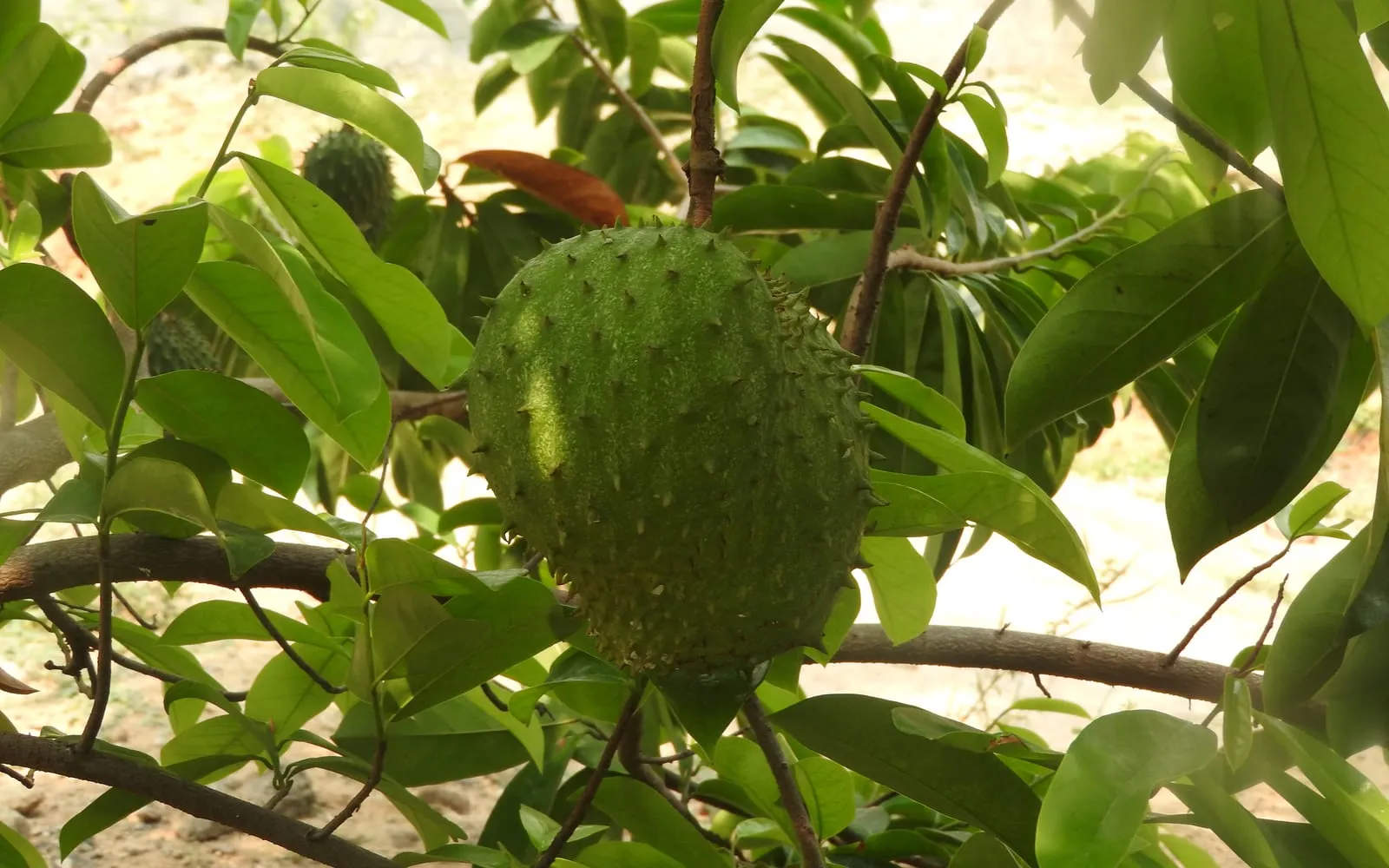
Fruit is the largest of the Annonas. Heart-shaped to oblong, 15 to 35 cm, up to several kilograms, dark green with soft curved spines that are the remains of the ovary wall rather than true prickles.
Skin is thin, and the spines bend under a finger without hurting.
Flesh is white, fibrous and juicy, in segments, with large glossy black seeds scattered through it.
Ripeness is judged by a slight softening and a lightening of the green. Fruit is picked firm and ripened indoors over a few days.
Aroma of a ripe one is strong and unmistakable, sweet and slightly fermented.
Where it is from
Soursop is native to the Caribbean islands and northern South America, and was carried early through Central America and into the wider tropics.
The Spanish moved it across the Pacific to the Philippines within decades of contact, and it naturalised across South East Asia and Africa.
It is grown throughout the humid tropics now, on a small scale almost everywhere, and it is a market fruit rather than a plantation crop because it travels so badly.
Mexico, Brazil, Colombia, Venezuela and the Philippines produce most of what enters trade, largely as frozen pulp.
Guadeloupe is where the medical story emerged. Neurologists there recorded an unusually high rate of atypical parkinsonism and traced an association with lifelong heavy consumption of soursop fruit, juice and leaf infusions, which led to work on annonacin and eventually to a French national advisory against regular consumption.
Temperate markets see soursop as frozen pulp and cartoned juice in Caribbean, African and Latin American food shops.
How it grows
Sow seed from a ripe fruit. Soursop seed keeps for several months and germinates at 25 to 30 deg C in two to four weeks.
Grow at a minimum of 15 deg C. Soursop is the least cold tolerant of the Annonas and is damaged below about 10 deg C.
Keep humidity high. This is a wet-tropics tree and it dislikes dry air.
Give light shade when young and full sun once established.
Water twice a week in growth and reduce in winter without drying out.
Use free-draining slightly acid compost.
Feed monthly from April to September.
Hand-pollinate. Like all Annonas the flowers are protogynous and set poorly without help. Collect pollen from male-phase flowers in the afternoon and brush it into female-phase flowers the following morning.
Expect fruit in three to five years from seed under good conditions, and expect that only in a well-heated humid house.
Through the seasons
Winter is the difficult season. Hold above 15 deg C with humidity up, water lightly, and feed nothing.
Spring brings the growth flush and the start of flowering. Repot and begin feeding.
Early summer is the main flowering period and the hand pollination window.
Midsummer is fruit swell, which takes four to six months from flower to ripe fruit.
Late summer is a second flush of growth.
Autumn is when to stop feeding and reduce watering while holding the temperature up.
Care difficulty
Difficult, and the hardest of the four Annonas in this collection.
Minimum 15 deg C year round with no cool rest, which is the opposite of cherimoya’s requirement and catches people out.
High humidity is needed, and a heated greenhouse in winter is too dry without help.
Hand pollination is needed for any crop at all.
Fruit takes four to six months to develop, which means the plant must be held in good conditions right through a temperate autumn.
The fruit bruises and keeps for two or three days, so there is no margin for error at harvest.
As a foliage plant it is handsome and grows steadily in a warm humid house, which is the realistic outcome for most.
Watering
Water twice a week through the growing season, keeping the compost evenly damp.
Reduce in winter without letting the compost dry out.
Drain fully every time.
Keep humidity high with misting, damp gravel and grouping.
Use rainwater in a hard water area.
Water steadily through the long fruit development period.
Never let a pot stand in cold water.
Warning signs, diseases and pests
Flowers dropping without setting is normal without hand pollination.
Fruit growing lopsided means partial pollination.
Black sunken patches on the fruit in humid still air are anthracnose.
White waxy fluff around the fruit stalk and in the leaf axils is mealybug, which soursop attracts strongly.
Brown limpets on the stems are scale.
Leaf drop after a cold night is chill damage below 10 deg C.
Brown leaf tips mean dry air.
Wilting in damp compost is root rot.
Fruit dropping half-grown usually means the plant could not support the load or the watering was irregular.
Growing environment
A heated humid greenhouse or conservatory. There is no cool-house option, unlike cherimoya.
Minimum 15 deg C, ideally 25 to 30 deg C.
High humidity year round.
Full sun when mature, light shade when young.
Free-draining rich slightly acid compost.
pH from 5.5 to 6.5.
Rainwater in a hard water area.
A large pot, since the fruit is heavy and the plant needs a root system to carry it.
Feeding
Feed monthly from April to September with a balanced liquid feed.
Switch to high potash as fruit swells.
Stop feeding at the end of September.
Give nothing through winter.
Top-dress or repot each spring.
Add magnesium if older leaves yellow between the veins.
Keep feeding moderate, since heavy nitrogen produces soft growth and few flowers.
Troubleshooting
Does soursop cure cancer? No. Leaf teas and capsules are sold worldwide on that claim and no clinical evidence supports it. What the evidence does show is harm: heavy long-term consumption of soursop fruit, juice and leaf tea is associated with an atypical parkinsonism in Guadeloupe that does not respond to the usual treatment, and the French food safety agency has advised against regular consumption.
Is it safe to eat the fruit? Eating the fruit occasionally is treated as safe and it is a staple drink across the Caribbean. The warnings concern regular heavy consumption and, above all, leaf and seed preparations.
Can I blend the whole fruit? Never with the seeds in. Annona seeds are strongly irritant and toxic, and seed material in an eye causes severe inflammation. Remove them first.
Why do the flowers fall off? No pollination. All Annonas open female first and male later, so they set poorly without hand pollination.
Why does it need such a warm winter when cherimoya does not? Different origins. Cherimoya comes from Andean highlands and wants a cool dormancy. Soursop is a wet lowland tropical tree and is damaged below 10 deg C.
The fruit went black in patches. Anthracnose, encouraged by still humid air. Improve the airflow.
How do I know when to pick it? When the dark green lightens slightly and the fruit gives a little. Ripen it indoors over a few days. A ripe one keeps two or three days at most.
What is guanabana? The Spanish name for this fruit. The juice and frozen pulp sold under that name is soursop.
Soursop problem guides
Not sure what is wrong? See the common vegetable pests guide.