
Edible
Mamey Sapote
Pouteria sapota
Also known as Mamey colorado, Zapote, Sapote
How to grow mamey sapote, Pouteria sapota. The salmon-pink flesh behind a Cuban batido, the single huge glossy seed, and the scratch test that tells you whether one is ready.
At a glance
- Difficulty
- Difficult
- Water
- Weekly in growth, sparingly in winter
- Light
- Full sun
- Temperature
- Minimum 10 deg C. Young trees are killed by frost
- Humidity
- Moderate to high
- Hardiness
- USDA 10-11, RHS H1b, hardy to 5 C
- Type
- Tender evergreen tree
- Height
- 15-40 m in the open, 2 m in a pot
- Native to
- southern Mexico, Central America
- Best month
- May and June in the Northern Hemisphere, November and December in the Southern Hemisphere
Seasonally dry Central American forest. Fruit takes twelve to twenty-four months on the tree from flower to ripe, so a tree carries two crops at once and any frost in that window costs both.
Hardiness zones describe winter cold alone. Summer heat, humidity, rainfall and the length of the growing season decide as much, so treat the range as the outer limit rather than as a recommendation.
Every month named in this guide is for the temperate Northern Hemisphere. If you garden in the Southern Hemisphere, shift each one by six months, so May becomes November. Closer to the equator the wet and dry seasons matter more than the calendar, and the shift stops being a useful guide.
Edible, with limits
- Safe to eat
- The ripe salmon-coloured flesh
- Do not eat
- The seed kernel, which is bitter and contains cyanogenic compounds
- Harm from
- Eating it
- Affects
- People
The flesh is food and is eaten in quantity across Mexico, Cuba and Central America. The seed is not eaten. Its kernel is bitter, contains cyanogenic glycosides and has been used as a rodenticide, and the oil pressed from it is a cosmetic ingredient rather than a food. The seed is far too large and hard to swallow by accident, so the practical risk is low, but it should never be blended into a drink and should be kept away from children and dogs. Unripe flesh is astringent and unpleasant rather than harmful. Nothing in the plant is listed by the ASPCA as toxic to cats or dogs.
Sources: RHS potentially harmful garden plants, ASPCA toxic and non-toxic plants
About
Mamey sapote looks unremarkable and cuts open to something startling. Under a rough brown skin the flesh is a deep salmon pink to orange-red, soft, sweet and dense, tasting of sweet potato, pumpkin and almond.
Cuba and Mexico turn it into batidos and ice cream, and a mamey milkshake is one of the fixtures of a Miami or Mexico City summer.
The tree is a long project. Fruit takes twelve to twenty-four months to ripen on the branch, which means a mature tree carries two crops at once at different stages, and a grafted plant takes three to five years to start.
Appearance and character
An upright open evergreen tree, 15 to 40 m in the open, with branches in loose tiers and a straight trunk.
All parts exude a white latex when cut.
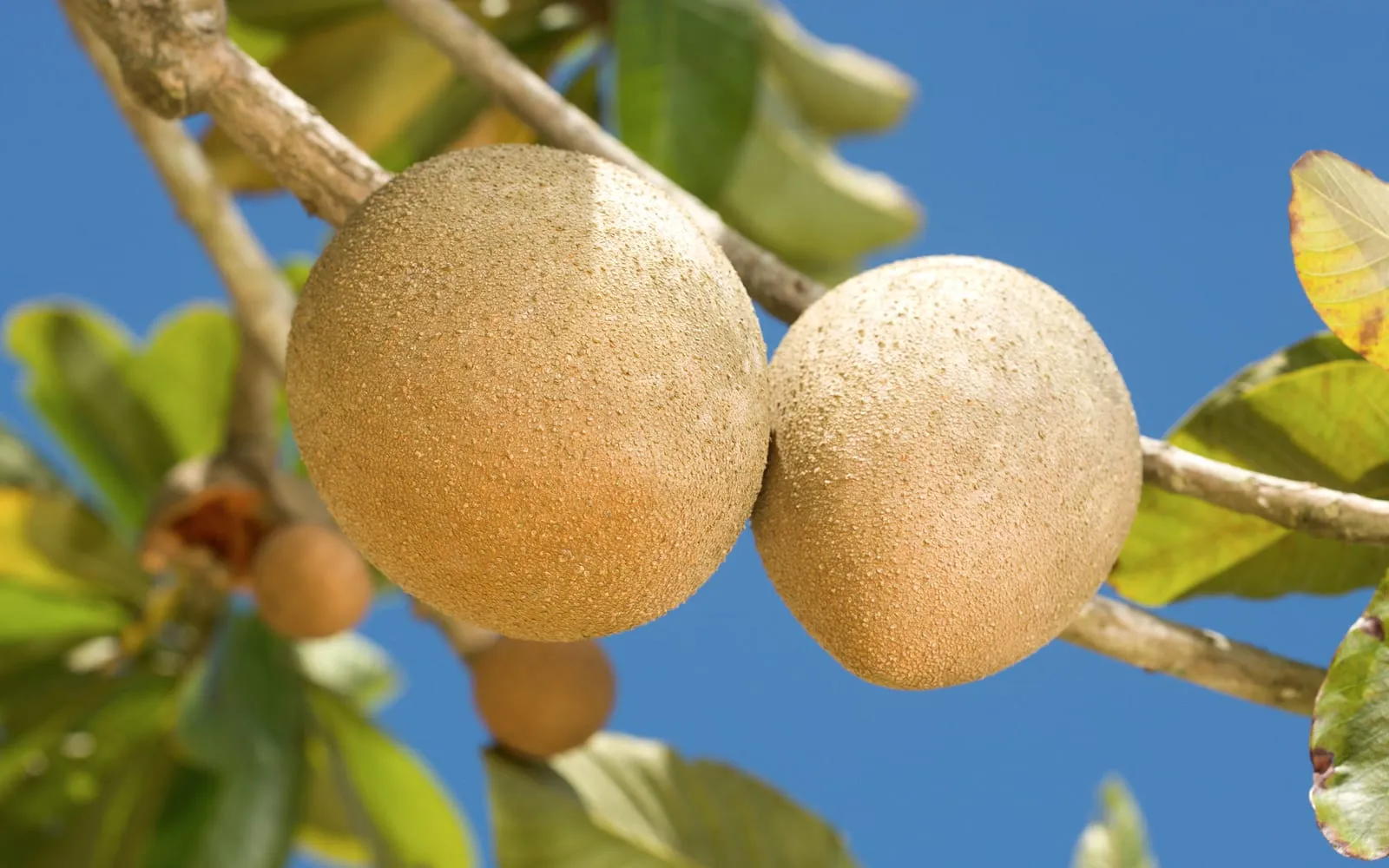
Leaves cluster at the ends of the shoots in rosettes, obovate, 10 to 30 cm, tapering to the base, dull mid-green, and rather large and coarse.
Flowers are small, cream to pale yellow, and grow directly on the older wood and the trunk in tight clusters, which is easy to miss.
Fruit is oval to football-shaped, 8 to 25 cm, weighing up to two kilograms, with a thick rough brown skin that has the texture of fine sandpaper.
Flesh is salmon pink to orange-red, smooth and dense, without fibre.
The seed is a single large glossy chestnut-brown ellipse with a pale rough scar running down one side, and it fills much of the fruit.
Ripeness is tested by scratching the skin near the stem. Salmon-coloured flesh under the scratch means ready to pick, green means wait.
Where it is from
Mamey sapote is native to the lowland forests of southern Mexico, Belize, Guatemala and Honduras.
It was cultivated across Mesoamerica before European contact, and Nahuatl and Maya names for it survive in the Spanish ones used today.
Cuba adopted it thoroughly, and Cuban cultivars such as Magana and Pantin are the ones grown commercially in Florida.
Names cause confusion. Mamey sapote is Pouteria sapota; black sapote is a persimmon, Diospyros nigra; white sapote is Casimiroa edulis in the citrus family; and mamey apple is Mammea americana. Four unrelated fruits share variants of one name.
Mexico, Cuba, Guatemala and Florida grow it commercially. Temperate markets see it as frozen pulp in Latin American food shops and almost never fresh.
How it grows
Sow seed from a ripe fruit. The seed is large, keeps only a few weeks, and germinates at 25 to 30 deg C in four to eight weeks.
Crack the seed coat carefully along the pale scar to speed germination.
Buy a grafted plant if fruit is the aim. Seedlings take seven to ten years and give variable fruit.
Grow in deep free-draining compost. This species tolerates limestone soils well.
Give full sun and a minimum of 10 deg C.
Water weekly in growth and sparingly in winter.
Feed monthly from April to September with a feed containing iron.
Expect a slow start. Seedlings put down a strong taproot before making much top growth, so use a deep pot.
Expect fruit on a grafted plant in three to five years, taking twelve to twenty-four months from flower to ripe fruit.
Pick by the scratch test rather than by appearance, and ripen indoors over a week or two.
Through the seasons
Winter is a cool rest above 10 deg C, watered sparingly and unfed.
Spring brings a growth flush and flowering on the older wood. Repot and start feeding.
Early summer is fruit set, alongside fruit set the previous year still swelling.
Midsummer is the main growing period.
Autumn is when the previous year’s fruit approaches maturity.
Late autumn is when to stop feeding and reduce watering.
A mature tree carries two crops at different stages for most of the year.
Care difficulty
Difficult, chiefly because of the time involved.
Fruit takes twelve to twenty-four months on the tree, so the plant has to be held in good condition through two cool winters for a single crop.
Minimum 10 deg C is needed, and frost kills a young tree outright.
Size is a problem. The tree is naturally large and the leaves are coarse, so a pot plant needs regular pruning and still takes up room.
Iron shortage in a pot is common and shows as yellowing between the veins.
Grafted plants are hard to find outside the tropics and seedlings take seven to ten years.
The scratch test has to be learnt, because there is no other way to judge picking time and a fruit picked green never ripens.
Watering
Water weekly in growth, giving a deep soak.
Reduce in winter, keeping the compost barely damp.
Drain fully.
Water steadily through the long fruit development, since irregular watering causes drop across a crop that has already taken a year.
Use rainwater where the supply is very hard.
Keep humidity moderate to high.
Use a deep pot, because the taproot goes down rather than out.
Warning signs, diseases and pests
Yellowing between green veins is iron shortage, which pot-grown plants show readily.
A fruit that never ripens after picking was taken green. Use the scratch test next time.
Brown limpets on the stems are scale.
White fluff in the leaf axils is mealybug.
Wilting in damp compost is root rot.
Leaf drop after a cold night is chill damage below 10 deg C.
Fruit dropping part-grown is usually irregular watering.
Slow top growth on a young seedling is normal while the taproot establishes.
Growing environment
A heated greenhouse or large conservatory. There is no outdoor option outside the tropics.
Minimum 10 deg C, with 25 to 32 deg C for growth.
Full sun.
Moderate to high humidity.
Deep free-draining compost, tolerant of lime.
pH from 6.0 to 8.0.
A deep pot for the taproot, and room for a coarse-leaved plant.
Shelter from wind, which tears the large leaves.
Feeding
Feed monthly from April to September with a balanced liquid feed containing iron.
Switch to high potash while fruit is swelling.
Add sequestered iron at the first yellowing between the veins.
Stop feeding at the end of September.
Give nothing through winter.
Top-dress or repot every second spring into a deeper pot.
Keep feeding steady across the long fruiting cycle.
Troubleshooting
How do I tell when one is ripe enough to pick? Scratch the skin near the stem with a fingernail. Salmon or orange flesh under the scratch means ready to pick. Green means leave it, and a fruit picked green never ripens.
How long does the fruit take? Twelve to twenty-four months on the tree, which is why a mature tree carries two crops at once at different stages.
Is this the same as black sapote or white sapote? No. Four unrelated fruits share versions of the name. Mamey sapote is Pouteria sapota, black sapote is a persimmon, white sapote is in the citrus family, and mamey apple is Mammea americana.
Can I eat the seed? No. The kernel is bitter, contains cyanogenic compounds and has been used as a rodenticide. The oil pressed from it is a cosmetic ingredient rather than a food.
The leaves are yellow between green veins. Iron shortage, which is common in a pot. Give sequestered iron and check the compost is not too alkaline.
Why is my seedling growing so slowly on top? It is building a taproot first. Use a deep pot and be patient.
Will it fruit outside the tropics? In a heated greenhouse with a grafted plant, in three to five years, and it needs holding through two winters per crop.
What is a mamey batido? A Cuban milkshake of mamey flesh, milk, ice and sugar. It is the commonest way the fruit is eaten outside its growing region.
Mamey Sapote problem guides
Not sure what is wrong? See the common vegetable pests guide.