
Outdoor plant
Guelder rose
Viburnum opulus
Also known as Water elder, Cramp bark, Snowball tree
How to grow guelder rose, Viburnum opulus. Lacecap flowers in May, translucent red berries in autumn, and why it thrives in the wet ground that kills other shrubs.
At a glance
- Difficulty
- Easy
- Water
- Rarely once established, and it wants damp soil rather than watering
- Light
- Full sun to partial shade, and it flowers and fruits best in sun
- Temperature
- Fully hardy, to about -35 deg C
- Hardiness
- USDA 3-8, RHS H7, hardy to -35 C
- Type
- Deciduous shrub, moderately long lived and suckering slightly
- Height
- 3-5 m
- Native to
- Europe, north Africa and central Asia, and native throughout Britain
- Best month
- September in the Northern Hemisphere, March in the Southern Hemisphere
Damp ground suits it and it takes heavy clay and seasonal flooding, which few shrubs will. Viburnum leaf beetle, found in Ontario in 1947 and in New York State in 1996, strips this species faster than any other and has killed established plants across north-eastern North America. Where the beetle is present, resistant viburnums are the sensible choice.
Hardiness zones describe winter cold alone. Summer heat, humidity, rainfall and the length of the growing season decide as much, so treat the range as the outer limit rather than as a recommendation.
Every month named in this guide is for the temperate Northern Hemisphere. If you garden in the Southern Hemisphere, shift each one by six months, so September becomes March. Closer to the equator the wet and dry seasons matter more than the calendar, and the shift stops being a useful guide.
Edible, with limits
- Safe to eat
- The berries after thorough cooking, in jelly
- Do not eat
- The raw berries and the bark
- Harm from
- Eating it
- Affects
- People, cats and dogs
Guelder rose berries contain viburnin and related compounds and cause vomiting and diarrhoea when eaten raw in quantity. They are also extremely bitter and smell unpleasant when crushed, which limits how many anybody eats by accident. Across northern and eastern Europe the fruit is a traditional food, cooked into jelly and syrup and known as kalyna in Ukraine, where it is a national emblem, and the cooking is what makes it acceptable. Do not eat the berries raw, and treat a child eating a handful as a stomach upset to watch rather than an emergency, ringing a doctor if symptoms persist. The bark contains active compounds and was used medicinally as cramp bark, which is where one of the common names comes from, and it is not something to experiment with. The ASPCA does not list Viburnum opulus, so no hazard is recorded for cats and dogs rather than one being ruled out, and the usual outcome of a dog eating berries is vomiting.
Sources: RHS potentially harmful garden plants, ASPCA toxic and non-toxic plants
About
Guelder rose is the native shrub for ground that stays wet.
Most garden shrubs sulk or die in heavy soil that lies damp through the winter. Guelder rose grows in wet woodland, beside ditches and along stream banks in the wild, and a boggy corner that has killed two other things is exactly where it belongs.
It gives three good seasons. The flowers open in May and June in flat lacecaps, with a ring of large showy sterile florets around a centre of small fertile ones, which is the same arrangement a lacecap hydrangea uses and for the same purpose. Berries follow from August in translucent scarlet bunches that catch the light. The leaves turn crimson and purple in October.
It is a viburnum rather than a rose, and the name has nothing to do with roses. Guelder is Gelderland, a Dutch province, where the sterile snowball form was raised.
That snowball form is worth avoiding unless you specifically want it. ‘Roseum’, sold as the snowball tree, has every floret sterile, so it makes handsome white globes and never sets a single berry.
Appearance and character
A deciduous shrub reaching 3 to 5 m, open and arching, with the branches held in loose layers.
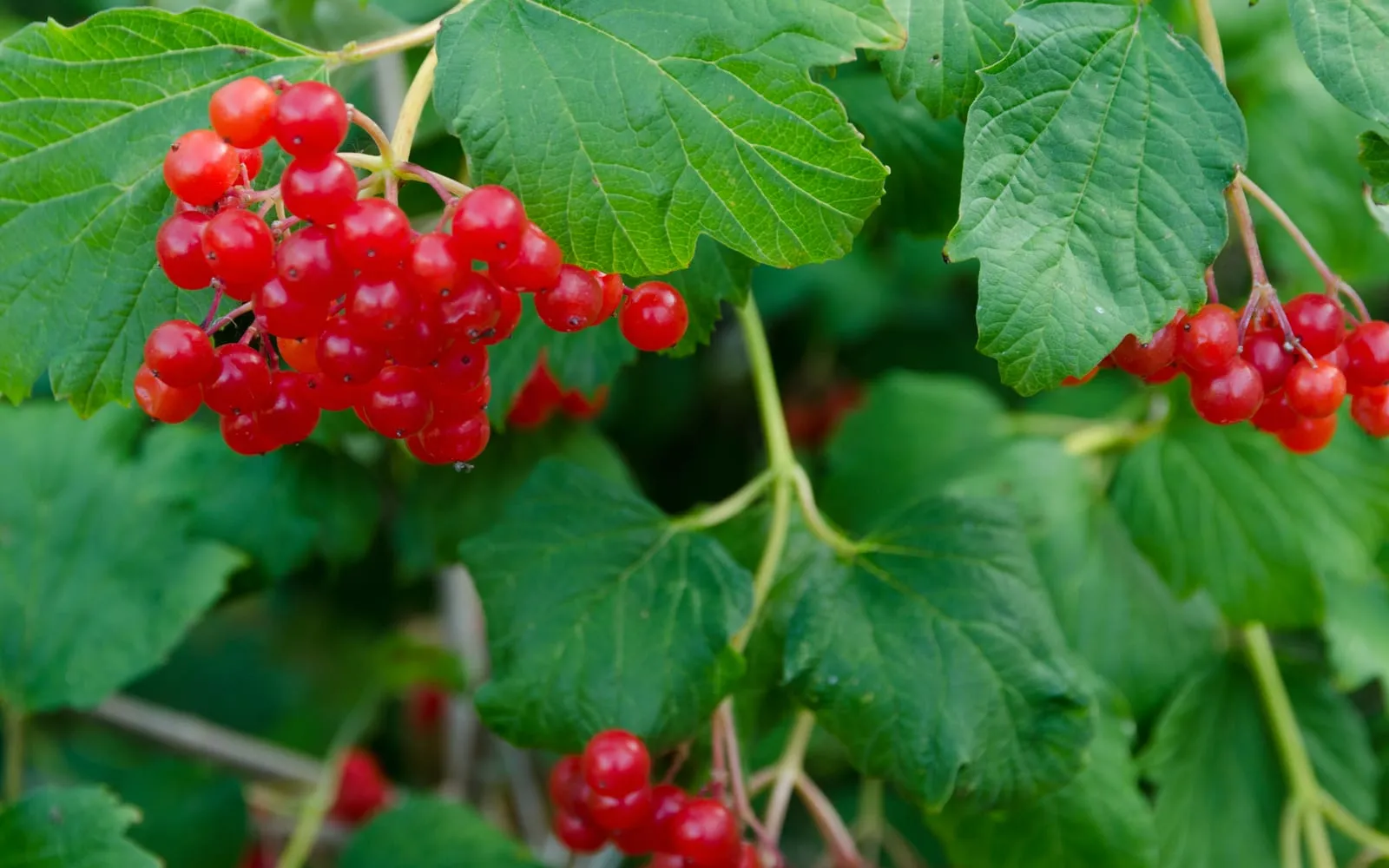
Leaves are three-lobed and maple-like, 5 to 10 cm long, coarsely toothed, mid-green and slightly downy beneath. They are the reason it gets mistaken for a field maple, and the leaves are alternate on maple and in opposite pairs on guelder rose.
Flowers open in May and June in flat corymbs 5 to 10 cm across. The outer ring is made of large white sterile florets up to 2 cm wide, and the centre is a mass of small creamy fertile flowers that carry the scent and the nectar.
Berries ripen from August, 8 mm across, glossy translucent scarlet, in drooping bunches that hang well into winter. Crushed fruit smells strongly and unpleasantly.
Autumn colour is good, running through crimson to purple, and it is one of the better native shrubs for October.
Stems are grey-brown, angular, and the plant suckers gently at the base.
‘Compactum’ reaches 1.5 m and fruits well, which suits a smaller garden.
Where it is from
Europe, north Africa and central Asia, and native throughout Britain and Ireland.
It grows in wet woodland, alder carr, hedgerows on damp ground, fen margins, ditch banks and beside streams, on any soil that stays moist and particularly on heavy clay.
Its cultural weight in eastern Europe is considerable. Kalyna is a national symbol of Ukraine, appearing in folk song, embroidery and poetry, and the berries are cooked into syrup and jelly across the region.
The bark was used in western herbal medicine as cramp bark, prescribed for muscle spasm, which is where the alternative name comes from.
The snowball cultivar ‘Roseum’ was raised in Gelderland in the Netherlands and reached England in the sixteenth century, and the shrub took its English name from the cultivar rather than the other way around.
Its wildlife value is high. The flowers feed hoverflies and beetles, the berries feed bullfinches, mistle thrushes and waxwings, and it hosts the caterpillars of several moths.
How it grows
Plant bare-root between November and March or container-grown at any frost-free time.
Choose damp ground. It grows well in heavy clay, beside a pond, in a low-lying corner and anywhere that stays moist through summer.
Avoid dry sandy soil and the rain shadow of a wall, where it struggles and mildews.
Full sun gives the best flowering and the heaviest crop of berries. It tolerates partial shade at some cost to both.
Water through the first summer and mulch well.
Prune after flowering in midsummer if you want berries, or in late winter if you do not mind losing a season of fruit.
Cut one third of the oldest stems to the base every year or two, which keeps the plant open and producing new growth. Guelder rose flowers on wood made the previous year.
Avoid shearing it. It is a naturally arching shrub and clipping it into a ball ruins both the shape and the flowering.
Renovate an overgrown plant by cutting everything to 30 cm in late winter. It regrows readily and takes two years to flower again.
Remove suckers at the base if you want a tidy single clump.
Plant it in a mixed native hedge at around five plants per metre alongside hawthorn, hazel, blackthorn and dog rose, and cut the hedge on a two or three year rotation so it flowers and fruits.
Propagate from hardwood cuttings in autumn, from softwood cuttings in early summer, or by layering an arching stem.
Through the seasons
Winter holds the last berries for the birds and is the planting and renovation season.
Spring breaks into leaf early and the flower buds develop through April.
Summer flowers in May and June, and this is when viburnum beetle larvae shred the foliage.
Autumn is the best season. Scarlet berries from August, crimson and purple leaf colour in October, and the two together for a few weeks.
Care difficulty
Easy on the right soil.
It tolerates heavy clay, waterlogging, cold, wind and shade, needs no feeding and regrows from hard cutting.
The two things it will not accept are dry soil and hard clipping.
Viburnum beetle is the one pest that reliably causes complaints, and it disfigures the plant in June without killing it.
Watering
Water through the first summer after planting.
Established guelder rose on damp ground needs no watering.
Water it in a drought if it is on lighter soil, since drought stress is what brings on mildew and a poor berry crop.
Mulch heavily every spring to hold moisture, which suits it better than watering.
Warning signs, diseases and pests
Leaves reduced to a lace of veins in May and June is viburnum beetle. The creamy-yellow larvae feed in groups on the undersides, then the adult beetles do a second round of damage in late summer. The plant survives and looks wretched. Check the tips of last year’s shoots in winter for the egg-laying scars and prune them out, which is the most effective control.
Curled and distorted shoot tips is viburnum aphid. It is cosmetic and feeds a great many predators.
White powder on the leaves in a dry summer is powdery mildew, which follows drought at the roots. Mulch and water.
No berries at all on a plant that flowers well means you have the sterile snowball cultivar ‘Roseum’ rather than the species.
Few berries on a species plant is usually shade, or pruning in late winter and removing the flowering wood.
Brown scorched leaf edges is drought or wind.
Honey fungus attacks viburnum and is fatal.
Growing environment
Full sun to partial shade, with better flowering and fruiting in sun.
Moist to wet soil, including heavy clay and ground that lies damp in winter. It is one of the best native shrubs for a wet corner.
Fully hardy to about -35 deg C, and tolerant of exposure and cold.
Allow 3 to 4 m of spread, or plant ‘Compactum’ at 1.5 m for a smaller garden.
It suits a pond edge, a damp border, a wet corner, a native hedge, a woodland edge or a wildlife garden.
Its wildlife value is high. Hoverflies and beetles work the flat flowers, bullfinches and mistle thrushes take the berries, waxwings strip them in an invasion year, and the leaves host moth caterpillars.
Grow it with the plants that share wet ground. Alder, willow, dogwood, alder buckthorn and meadowsweet all suit the same conditions.
Choose the species rather than ‘Roseum’ if you want berries and wildlife value. Choose ‘Roseum’ only if you want the white globes and accept no fruit.
Feeding
None needed on ordinary soil.
Mulch every spring with compost or leaf mould, kept off the stems.
Avoid high-nitrogen feeds, which produce soft growth that aphids and mildew both prefer.
A weak plant is nearly always too dry rather than short of nutrients.
Troubleshooting
Something has stripped the leaves to a lace. Viburnum beetle larvae in late spring, followed by the adults in late summer. Prune out the egg-laying scars on the tips of last year’s shoots in winter, which is the best control. The plant survives.
It flowers well and never sets berries. You have ‘Roseum’, the sterile snowball cultivar, where every floret is sterile. Plant the species if you want fruit.
Can I eat the berries? Cooked, yes, and they make a sharp jelly that is a traditional food across eastern Europe. Raw they cause vomiting and taste foul.
When should I prune it? After flowering in midsummer if you want berries. Take one third of the oldest stems to the base every year or two and leave the arching shape alone.
Can I clip it into a hedge shape? Not as a specimen. Shearing ruins the shape and the flowering. It works in a mixed native hedge cut on a two or three year rotation.
Is this guelder rose or a maple? The leaves look similar. Guelder rose holds them in opposite pairs, maple holds them alternately, and guelder rose has lacecap flowers and red berries.
Will it grow in a wet corner? Yes, and that is where it does best. It grows in wet woodland and beside streams in the wild.
The leaves went white and powdery. Powdery mildew following dry roots. Mulch heavily and water in drought.
Can I cut an old overgrown one back? Yes. Take everything to 30 cm in late winter. It regrows and flowers again within two years.