
Pest
Viburnum beetle
Pyrrhalta viburni
Also called Viburnum leaf beetle
Viburnum beetle skeletonises leaves in May and again in August. Check shoot tips for eggs in winter, remove affected growth and choose less susceptible viburnums when replanting.
At a glance
- Type
- Pest
- Cause
- Insect
- Severity
- Destroys the crop or display
- Affects
- Garden plants
- Active
- April to September
- Established in
- Europe and North America
What you are seeing
- Leaves grazed down to a lace of veins, so the shrub looks skeletonised
- Creamy yellow grubs with black spots and markings, feeding in groups from April to June
- A second wave of damage from July as the adults feed
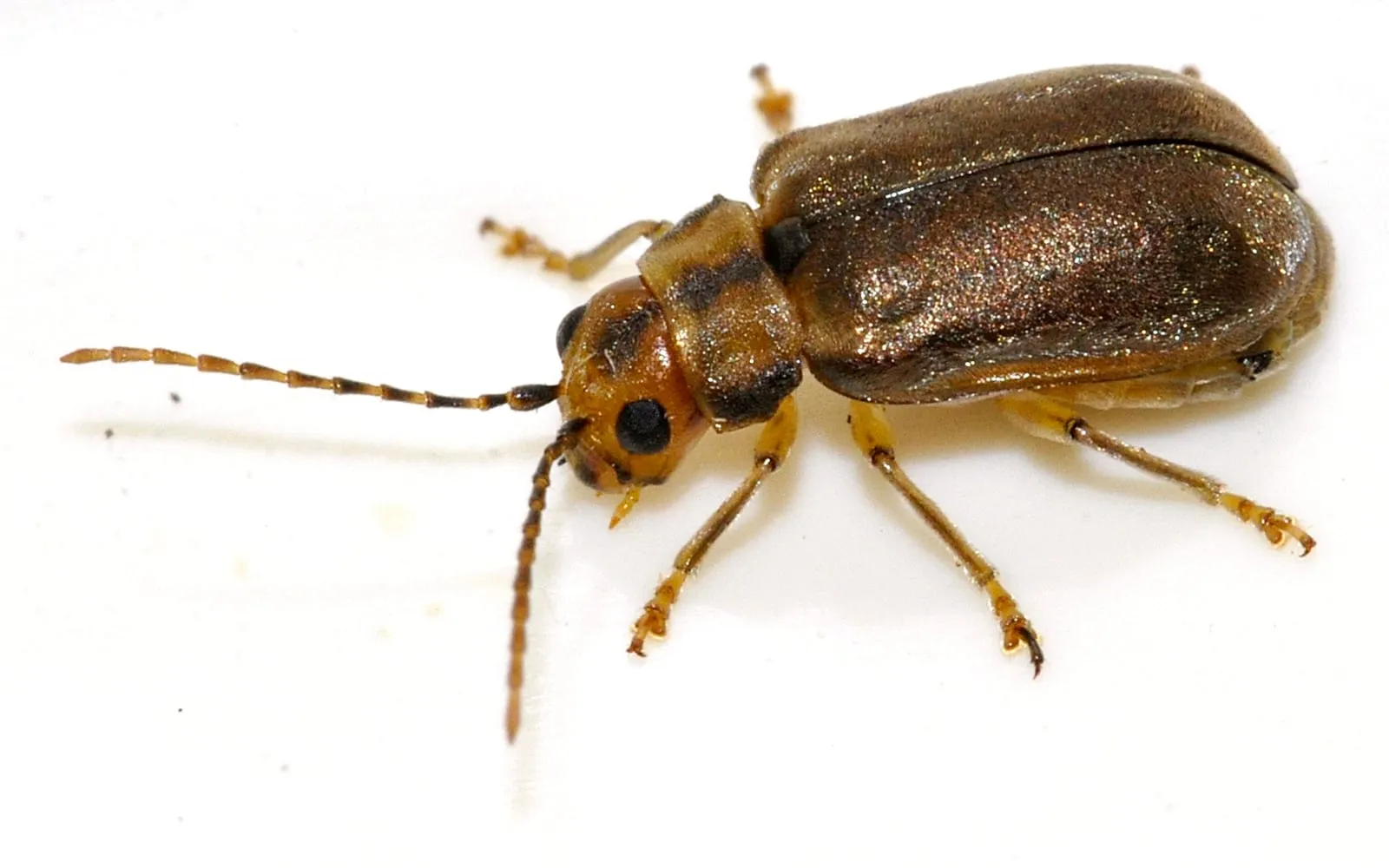
- Greyish-brown beetles about 5 mm long on the foliage in late summer
- Rows of small pits in the underside of young shoot tips, each capped with a dark crust
- The same shrub defoliated year after year, thinning and dying back
Before you treat anything
Harmless to handle. Note that viburnum berries are mildly toxic to people regardless of the beetle, so the usual care applies with children.
What you are looking at
A viburnum with its leaves eaten down to a network of veins, so the whole shrub looks like green lace held up to the light. On a laurustinus hedge it can be every leaf on the outer face.
In spring, turn a damaged leaf over. Creamy yellow grubs marked with black spots and dashes feed in groups on the underside, from April into June, and they are what does the first round of damage.
They then drop into the soil to pupate, and from July the adults emerge, small greyish-brown beetles about 5 mm long, and start on what is left. So the shrub gets stripped twice in one season by the same insect wearing two different shapes.
The eggs are on the shrub all winter
The part that turns this from an annoyance into something you can deal with sits on the shrub all winter, in plain sight.
In late summer, the females chew rows of small pits into the underside of the current year’s shoot tips, lay their eggs inside them, and cap each pit with a crust of chewed wood and excrement. Those caps sit there, dark and slightly raised, in neat lines along the young wood, from September right through to March.
They are visible. Turn a shoot tip over in January and you can see them.
Cut those tips out over the winter, burn or bin them, and the larvae that would have hatched in April never appear. One session with the secateurs on a still afternoon, on a shrub that has nothing else going on, does more than a summer of picking grubs off leaves.
What it does and does not kill
A single defoliation is survivable. Viburnum breaks again, and a shrub in good heart replaces the leaves within weeks.
What kills is the repetition. Two strippings a year, several years running, on a shrub that is not watered or fed, thins the plant out, kills back the outer growth, and eventually finishes it. A great many laurustinus hedges have gone this way in southern England.
Keeping the plant well fed and mulched is therefore a control measure rather than an afterthought, because it buys the shrub the reserves to keep replacing what it loses.
What to do about it
Turn the shoot tips over between October and March, find the rows of capped pits, and prune those tips out.
Check the leaf undersides weekly from April and pick the larvae off, or take off the leaves they are grouped on.
Look again from July, when the adults start.
Mulch, water and feed the shrub so it can afford to refoliate.
Where a hedge has been stripped several years running, replant with a viburnum the beetle largely ignores, such as V. x bodnantense, V. plicatum or V. x burkwoodii.
Leave the birds and the predatory bugs to help, and keep sprays off the shrub.
What it gets mistaken for
Caterpillars and sawfly larvae both have fleshy prolegs along the abdomen behind the three pairs of true legs. Viburnum beetle larvae have none, which settles it in a couple of seconds.
Box tree caterpillar leaves silk, frass and stripped box, and touches nothing else.
Vine weevil adults cut small clean notches out of the leaf margins at night and leave the rest of the leaf whole.
Viburnum whitefly leaves small black scale-like young on the leaf undersides and sticky honeydew, without eating any tissue.
Powdery mildew and leaf spots discolour a viburnum leaf without removing any of it.
Not established in Australia and New Zealand
Do not prune, spray or otherwise treat a suspected case. Doing so risks spreading an organism the country has kept out, and it disturbs the evidence needed to identify it. Photograph what you can see, leave the plant alone, and contact your national or state plant health authority. The control advice further down this page is written for regions where this problem is already established.
Pyrrhalta viburni is European and Asian and has moved in one direction. It turned up in Ontario in 1947, was breeding around Ottawa by 1978, reached Maine in 1994 and New York in 1996, and has since appeared on the other side of the continent in British Columbia and Washington State. It does more damage to North American viburnums than to the European species it evolved alongside, because the native ones have no shared history with it. Its spread southwards looks limited by winter rather than by distance, since the eggs need a long cold period before they hatch and a mild winter leaves them stranded. Australia and New Zealand hold no records of it at all.
What to do, in order
The steps below apply where this problem is already established.
Start here
Prevention, and the changes that stop the problem returning. Most of these pages should end at this tier.
- Know which viburnums it prefers
- Viburnum tinus and V. opulus take the worst of it, along with V. lantana and V. davidii. V. x bodnantense, V. plicatum, V. carlesii and the evergreen V. x burkwoodii are much less affected. Where a laurustinus hedge has been stripped three years running, replanting with one of those is a real option.
- Feed and water a defoliated shrub
- Viburnum refoliates after a stripping, and what it cannot do is refoliate twice a year on dry hungry soil. Mulch, water through the summer and feed in spring, and a shrub takes years of this. Neglect it and it thins out and dies back.
- Expect two waves and check between them
- The larvae feed from April into June and the adults from July into September, so a shrub cleared in May is chewed again in August by anyone who stopped looking. Two rounds of inspection beat one.
Then reach for a barrier
Netting, hand removal and water. Nothing here harms anything except the target.
- Prune out the egg-laying sites over winter
- This is the control that works, and almost nobody knows about it. In late summer the females chew rows of small pits into the underside of the current year's shoot tips and cap each one with a dark crust of chewed wood and excrement. Those caps are visible through the winter. Cut the tips carrying them off between October and March and burn or bin them, and the following spring's larvae never hatch.
- Pick the larvae off in spring
- They feed in groups on the undersides of the leaves from April, so a single leaf often carries a dozen. Taking those leaves off, or knocking the larvae into soapy water, handles a small shrub. Go back weekly through May.
- Take the worst-affected growth out altogether
- Where one part of a hedge is being defoliated hardest, cutting it back removes the larvae and the eggs at the same time and the shrub breaks again from lower down.
Then bring in the predators
Encourage what already lives in the garden, and buy predators in where the problem is under glass and nothing will arrive on its own.
- Encourage the birds and stop spraying over them
- Tits and other small birds take both larvae and adults, and predatory bugs and ladybird larvae work over the colonies. An unsprayed shrub supports all of them, and nothing available in a garden centre would outperform them anyway.
Biological controls are live organisms and their sale and release are regulated country by country. An agent sold freely in one place may be unapproved in another, so buy from a licensed supplier where you live and never import or move one yourself.
Plants affected
Guides that name it among the problems to watch for. The list is the plants it is characteristic of rather than everything it will feed on.