
Outdoor plant
Mock Orange
Philadelphus coronarius
Also known as Sweet mock orange, Philadelphus, English dogwood
How to grow mock orange, Philadelphus coronarius. The scent, the one-in-three pruning cut that keeps it flowering, and why cutting it in winter removes every bloom.
At a glance
- Difficulty
- Easy
- Water
- Rarely once established
- Light
- Full sun to light shade, and it flowers poorly in deep shade
- Temperature
- Fully hardy, to about -30 deg C
- Hardiness
- USDA 4-8, RHS H6, hardy to -30 C
- Type
- Deciduous shrub, long lived and suckering from the base
- Height
- 2-3.5 m
- Native to
- Southern Europe and Asia Minor, in scrub and on rocky woodland edges
- Best month
- June in the Northern Hemisphere, December in the Southern Hemisphere
Cold, drought and poor soil are all taken. It flowers on last summer growth, so prune within a few weeks of the flowers fading and never in winter, which is the only way most people go wrong with it. Full sun gives the heaviest scent and deep shade gives leaves and little else. Philadelphus lewisii is the native western North American species and carries the same scent.
Hardiness zones describe winter cold alone. Summer heat, humidity, rainfall and the length of the growing season decide as much, so treat the range as the outer limit rather than as a recommendation.
Every month named in this guide is for the temperate Northern Hemisphere. If you garden in the Southern Hemisphere, shift each one by six months, so June becomes December. Closer to the equator the wet and dry seasons matter more than the calendar, and the shift stops being a useful guide.
Not known to be toxic
Philadelphus is not listed by the RHS as a potentially harmful garden plant and is not recorded by the ASPCA as toxic to cats, dogs or horses. No part of it is a recognised hazard to people or animals, and it is a reasonable choice for a garden used by children and pets. The name causes an occasional worry that is worth answering directly, since mock orange is unrelated to true orange and produces no fruit that anybody would try to eat. Its small dry seed capsules are not edible and are not toxic either. The plant is sometimes sold in North America as English dogwood, which is a further piece of misleading naming, since it is not a dogwood and shares nothing with that genus. Where a plant is unlisted by both sources rather than positively assessed as safe, the sensible reading is that no hazard has been recorded rather than that one has been ruled out, so there is no reason to encourage anybody to eat it.
Sources: RHS potentially harmful garden plants, ASPCA toxic and non-toxic plants
About
Mock orange is grown for two weeks in June. For those two weeks it is smothered in white flowers and the scent carries across a garden, and for the rest of the year it is a plain green shrub that asks nothing of anybody.
Gardeners accept that trade because the scent is exceptional. It is sweet, heavy and close to orange blossom, strongest in the evening and on still warm days.
The plant is old in temperate gardens, grown since the sixteenth century, and it turns up in cottage gardens and Victorian shrubberies where it has often been ignored for decades and still flowers.
Almost every disappointment with this shrub traces back to one mistake. It flowers on wood made the previous year, so a plant tidied up in winter has had its flowers cut off before they formed.
Appearance and character
A deciduous shrub with upright arching stems rising from a clump at the base, reaching 2 to 3.5 m and spreading slowly outwards by suckering.
Stems are pale brown, and the bark on older wood peels in thin papery strips, which is a useful winter identification.
Leaves are oval, pointed, up to 9 cm long, mid-green, held in opposite pairs, with a few shallow teeth along the edge. Autumn colour is a soft yellow and is not the reason to grow it.
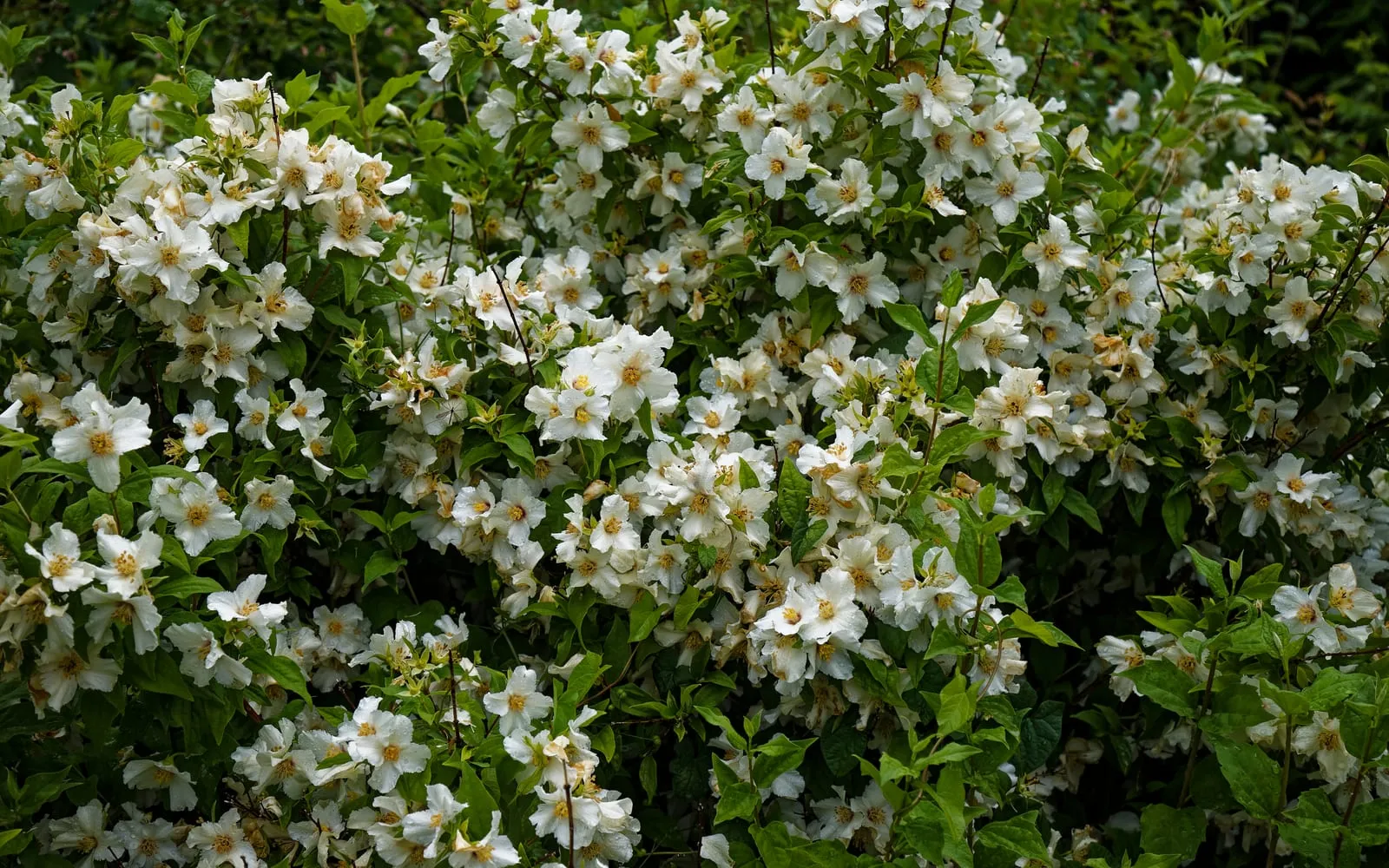
Flowers open in June in short clusters along the previous year’s stems. Each is about 3 to 4 cm across, pure white, with four broad petals and a central boss of yellow stamens.
The scent is the character of the plant. It is intensely sweet and orange-like, and in P. coronarius it is stronger than in most of the large-flowered hybrids that have replaced it in garden centres.
A golden-leaved form, ‘Aureus’, is widely sold. It is brighter in spring, scorches in strong sun, and flowers less freely than the plain green species.
Where it is from
Southern Europe and Asia Minor, growing in scrub, on rocky woodland edges and in open stony ground.
It has been cultivated in Britain since at least the 1560s, which is long enough that it is often assumed to be native.
The genus name honours Ptolemy Philadelphus, and the species name coronarius means suitable for garlands, which tells you what the flowers were used for.
Its dry stony origins explain its tolerance of chalk, poor soil and drought, and its dislike of waterlogged ground.
How it grows
Plant between autumn and early spring in sun or light shade.
Any reasonable soil will do, including chalk and clay, provided it is not waterlogged. This is an undemanding shrub.
Prune immediately after flowering, in late June or July, and not at any other time.
The method is one in three. Cut about a third of the oldest stems right down to ground level, and shorten the stems that have just flowered back to a strong new side shoot lower down.
That removes old unproductive wood, keeps the shrub from becoming a thicket of dead centres, and leaves the current season’s new growth to flower next June.
Renovate a badly neglected plant by cutting the whole thing to about 30 cm in late winter, accepting that you lose one year of flowers and get a much better shrub afterwards. Repeating the one-in-three cut thereafter keeps it in order.
Propagate from softwood cuttings in early summer or hardwood cuttings in autumn, both of which root easily. Suckers can be detached with roots in winter.
Through the seasons
Winter is bare stems with peeling bark. Leave the shrub alone unless you are carrying out a full renovation.
Spring brings leaves in April and flower buds forming along last year’s wood.
Summer is the flowering, in June, followed straight afterwards by the pruning that sets up next year.
Autumn gives modest yellow leaf colour and dry brown seed capsules. Nothing needs doing.
Care difficulty
Easy. It is hardy, tolerant of most soils, untroubled by drought once established and almost never killed by anything except honey fungus.
The one thing that requires getting right is the timing of the prune, and the penalty for getting it wrong is a year without flowers rather than a dead plant.
Left entirely alone it survives indefinitely and gradually declines into a congested mass with flowers only at the tips, which is why the annual one-in-three cut matters.
It is not a plant for a small garden unless you are prepared to prune it, since a mature specimen occupies a good deal of space for eleven months of modest interest.
Watering
Water through the first summer after planting.
An established mock orange needs no watering in a temperate climate.
Prolonged drought in a young plant’s first two years is worth guarding against, and after that the shrub looks after itself.
Waterlogged ground is the condition it will not tolerate. It prefers dry and poor to wet and rich.
Warning signs, diseases and pests
No flowers is the complaint that brings most people to this plant, and pruning at the wrong time is nearly always the reason. Mock orange flowers on the previous summer’s growth, so anything cut in autumn, winter or spring takes the flower buds with it. Prune in the fortnight after flowering finishes.
Blackfly cluster on soft shoot tips in early summer, distorting the growth. They attract ladybirds and hoverflies and the plant grows through them, so a jet of water is usually all that is warranted.
Powdery mildew coats the leaves in white in dry summers, particularly on crowded plants in poor air movement. Thinning the shrub with the annual prune is the useful response.
Leaf spot produces brown or purple blotches in wet seasons and needs no treatment.
Honey fungus attacks Philadelphus and kills it. White fungal sheets under the bark at the base and the sudden death of whole stems are the signs, and there is no cure.
A congested shrub with a dead centre and flowers only at the top is telling you it has not been thinned for years. Start the one-in-three cut, or renovate it hard.
Sparse flowering on a correctly pruned plant usually means too much shade.
Growing environment
Full sun to light shade. It will grow in moderate shade and it flowers substantially better with sun on it.
Any reasonable, free-draining soil. It is excellent on chalk, unbothered by clay, and tolerant of poor stony ground.
It is fully hardy to about -30 deg C, and needs no shelter, though a sheltered spot holds the scent rather than letting the wind take it.
Allow 2.5 m of width for the species. Smaller hybrids such as ‘Belle Etoile’ or ‘Manteau d’Hermine’ are better choices for a confined space.
Site it where the scent will be used. Near a seat, a path or an open window in June is worth more than a position at the back of a border.
Underplant it with something that carries the space through the rest of the year, since the shrub itself offers little after July.
Feeding
A mulch of compost or well-rotted manure in early spring is enough.
It flowers perfectly well in poor soil and generally does not need fertiliser.
Avoid high-nitrogen feeds, which produce lush leafy growth at the expense of flowers.
A plant that is not flowering is almost certainly a pruning or a light problem rather than a feeding one, so check both before adding anything.
Troubleshooting
It has not flowered for years. Almost certainly pruned at the wrong time. Mock orange flowers on last year’s wood, so cut it only in the fortnight after flowering ends in June.
When exactly do I prune it? Straight after the flowers fade, in late June or July. Take a third of the oldest stems to the ground and shorten the flowered stems to a strong new shoot.
Can I cut a huge overgrown one right back? Yes. Cut it to about 30 cm in late winter. You lose the next summer’s flowers and get a far better shrub the year after.
The middle is dead wood and the flowers are all on top. Congestion from years without thinning. Begin the one-in-three cut, or renovate it hard in one go.
The shoot tips are covered in blackfly. Common in early summer and rarely serious. A jet of water knocks them off and predators deal with the rest.
White powdery coating on the leaves. Powdery mildew, worse in dry summers on crowded plants. Thinning the shrub improves airflow and helps more than spraying.
Is it related to orange trees? No. The name comes from the scent of the flowers. It produces no edible fruit and is not a citrus.
Is it safe for children and pets? It is not listed as harmful by the RHS and not recorded as toxic by the ASPCA. Nothing about it invites eating, and no hazard has been recorded.