
Outdoor plant
Strawberry Tree
Arbutus unedo
Also known as Cane Apple
Practical guidance for growing strawberry tree, Arbutus unedo, including its flowers and fruit together in autumn, lime tolerance unusual for its family, peeling red bark, and edible but unremarkable berries.
At a glance
- Difficulty
- Moderate
- Water
- Regularly while establishing, then rarely once settled
- Light
- Full sun to light shade
- Temperature
- Hardy in most temperate climates once established; young growth dislikes hard frost
- Hardiness
- USDA 7-10, RHS H4, hardy to -10 C
- Type
- Evergreen tree or large shrub, slow-growing and long-lived
- Height
- 5-8 m, occasionally taller with age
- Native to
- the Mediterranean, western Europe
A Mediterranean and Atlantic-coast tree, and the two halves of that origin pull in different directions. It expects a dry, sun-baked summer and resents one that stays humid and wet, but the population native to south-west Ireland shows it tolerates a cool, damp, windswept Atlantic winter better than its Mediterranean reputation suggests. Established trees take short periods below the minimum here; what damages it is prolonged hard frost on young growth, not an occasional cold night.
Hardiness zones describe winter cold alone. Summer heat, humidity, rainfall and the length of the growing season decide as much, so treat the range as the outer limit rather than as a recommendation.
Not known to be toxic
- Safe to eat
- The ripe autumn fruit, eaten fresh, as jam or distilled into liqueur
Strawberry tree is not listed by the ASPCA among plants toxic to cats, dogs or horses, and the RHS does not include it in its potentially harmful garden plants index. The fruit is edible, though mild and mealy rather than sweet, which is where the species name unedo is said to come from: the Roman writer Pliny claimed it meant "I eat one," on the grounds that one is usually enough. Overripe fruit left to fall and ferment on the ground has a minor reputation for mildly intoxicating birds that gorge on a large quantity of it, in the same way fermenting windfall apples occasionally do, but this is not a poisoning risk to a person, a dog or a cat eating fruit off the tree or the ground in ordinary amounts.
Sources: ASPCA toxic and non-toxic plants, RHS potentially harmful garden plants
About
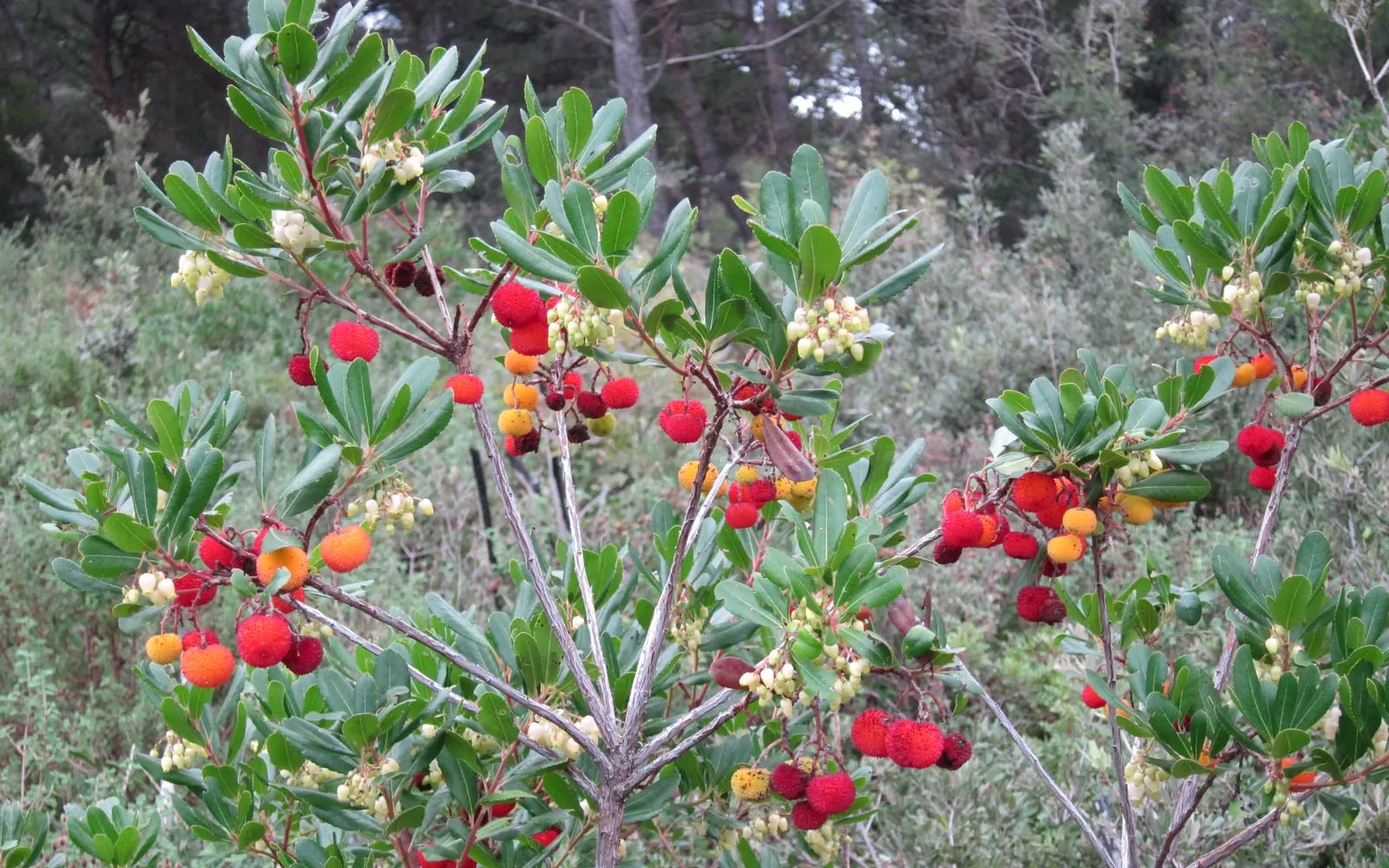
Strawberry tree does something few trees manage: it carries flowers and ripe fruit at the same time. The current year’s white, urn-shaped flowers open in autumn just as the previous year’s fruit finishes ripening into warty red-orange spheres that closely resemble strawberries from a short distance, so a mature tree in October can be in bloom and in fruit simultaneously.
It belongs to the heather family, Ericaceae, which makes its second distinguishing trait more surprising still. Most of that family, azalea and rhododendron among them, demands acidic soil and struggles or dies on lime. Strawberry tree tolerates alkaline ground comfortably, an exception within its own family rather than the rule.
Appearance and character
An evergreen tree or large shrub, usually rounded and often multi-stemmed from the base, with glossy, dark green, finely toothed leaves that give it year-round substance in the garden.
The bark is a major ornamental feature in its own right: reddish-brown, rough and shredding in vertical strips on older wood, giving mature specimens a warm, textured trunk that stands out clearly in winter light.
Flowers are small, white to pale pink and urn-shaped, hanging in drooping clusters that closely resemble the flowers of lily of the valley, though the likeness is a coincidence of shape rather than kinship. The urn-shaped bloom is a heath-family trait it shares with blueberry and pieris. Fruit takes a full year to ripen from flower to fruit, starting green, turning yellow, then a warty orange-red, and by the time it colours fully the following season’s flowers are already opening beside it.
Where it is from
Arbutus unedo is native across the Mediterranean basin and along the Atlantic coast of western Europe, growing as part of the maquis and garrigue scrub vegetation typical of that region, alongside other drought-tolerant, fire-adapted shrubs.
Its most notable outlying population sits far from the Mediterranean proper, in the lake district of Killarney in south-west Ireland, an Atlantic, distinctly non-Mediterranean climate. That disjunct population, part of what botanists call the Lusitanian flora, a scatter of species shared between Ireland, north-west Spain and Portugal but largely absent from the country in between, shows that this species handles a wetter, cooler climate better than its Mediterranean image implies.
The tree carries deep cultural weight in Spain, where a bear reaching up into a strawberry tree, El Oso y El Madrono, appears on the official coat of arms of the city of Madrid. Its readiness to resprout strongly from the base after fire or hard cutting, an adaptation to the Mediterranean scrub it evolved in, is also part of why it has survived so well in a landscape shaped by recurring wildfire.
How it grows
Plant in full sun to light shade on well-drained soil. It tolerates both acidic and alkaline ground without difficulty, which is unusual latitude for a member of the heather family and worth taking advantage of on a chalky or limy site where azaleas and rhododendrons would fail outright.
Growth is slow, particularly in the first few years, so a container-grown specimen from a nursery is a far more practical starting point than seed for anyone wanting a tree of visible size within a reasonable time.
Water regularly through the first two summers to establish a deep root system, then reduce watering markedly. Once settled, the tree is adapted to a Mediterranean-type dry summer and generally performs better without supplemental watering through the warmest months than with it.
Prune only to remove dead, damaged or crossing growth, or to shape a young tree, ideally in spring after the coldest weather has passed. It tolerates hard cutting well if renovation is needed, resprouting readily from old wood, a trait shaped by its native fire ecology.
Through the seasons
Spring is the safest window for any structural pruning, once the risk of hard frost on young growth has passed for the season.
Summer is quiet growth in the heat, and established trees need little or no watering through this period.
Autumn brings the tree’s signature overlap: white flowers opening at the same time as the previous year’s fruit ripens to red-orange.
Winter holds the evergreen foliage and the peeling, textured bark as the main interest, with the tree otherwise dormant.
Care difficulty
Moderate. Once established, strawberry tree needs no routine feeding, minimal summer watering and only occasional pruning. The establishment years need more care, because growth is slow and young shoots are more sensitive to hard, prolonged frost than a mature tree’s hardiness suggests. Choose a sheltered site for that vulnerable early period.
Watering
Water regularly through the first two summers after planting, giving a deep soak that reaches the developing root system rather than frequent light watering at the surface.
Once established, cut back watering significantly. A mature tree adapted to a dry Mediterranean summer generally fares better left to its own devices through the hottest months than watered on a routine schedule, and overwatering established trees is a more realistic risk than underwatering them.
Warning signs, diseases and pests
Leaf spot appears as dark blotches on the foliage in a wet, humid season, more of a cosmetic issue than a serious threat on an otherwise healthy tree.
Scale insects settle on stems and the undersides of leaves, sapping the plant and excreting sticky honeydew as they feed.
Sooty mould grows on that honeydew rather than on the tree itself, coating leaves in a black film that blocks light and looks worse than the underlying scale infestation alone; treating the scale insects resolves both together.
Root rot follows waterlogged ground, and this is the condition most likely to kill an otherwise resilient tree. A site with reliable drainage matters more to its long-term health than almost any other single factor.
Growing environment
Full sun produces the densest flowering and fruiting; light shade is tolerated but growth is slower and less floriferous.
Well-drained soil is essential regardless of pH, since the tree tolerates both acidic and alkaline ground provided water does not sit around the roots.
Coastal, exposed and windswept sites suit it well, reflecting both its Mediterranean scrub origin and the Atlantic-facing Irish population that tolerates salt-laden wind.
Feeding
Little is needed on most soils. This is a tree adapted to lean Mediterranean scrub and generally performs best without routine fertilising.
A light application of a balanced feed in spring can help a young tree establish on very poor soil, but avoid feeding a settled, mature specimen, which rarely benefits from it.
Troubleshooting
Is it normal to see flowers and fruit on the tree at the same time? Yes, and it is one of the species’ defining features. The current season’s flowers open in autumn just as the previous year’s fruit finishes ripening, so both appear together for several weeks.
The fruit does not taste like much. That matches its reputation. The species name unedo is traditionally explained as Latin for “I eat one,” reflecting a mild, mealy flavour that rewards one bite rather than a handful, though it is widely used to make jam and, in Portugal, a distilled brandy called medronho.
My tree is struggling on chalky soil. It should not be, since strawberry tree is one of the few members of the heather family that tolerates alkaline ground well. Check drainage instead; waterlogging is a far more likely cause of poor growth than the pH of the soil.
Young growth was damaged by a late frost. This is the tree’s real vulnerability. Mature wood tolerates real cold, but soft young shoots can be scorched or killed by a hard, prolonged frost, particularly in the first couple of years after planting. A sheltered position while young reduces the risk considerably.
Can I grow it near the coast? Yes, and it is a good choice there. Both its Mediterranean and its Atlantic Irish native populations grow in exposed, salt-affected coastal conditions without difficulty.