
Edible
Kiwi fruit
Actinidia deliciosa
Also known as Chinese gooseberry, Kiwifruit, Yang tao
How to grow kiwi fruit, Actinidia deliciosa. A vine that needs a male and a female, serious support, and the warmest wall you can offer it.
At a glance
- Difficulty
- Difficult
- Water
- Twice weekly through summer, and it is a thirsty plant
- Light
- Full sun, on a sheltered south or west wall
- Temperature
- Dormant wood hardy to -15 deg C, new growth killed at -1 deg C
- Hardiness
- USDA 7-9, RHS H5, hardy to -15 C
- Type
- Deciduous woody climber, long-lived
- Height
- 8-10 m if unrestricted, kept to 4-5 m on wires
- Native to
- China
- Best month
- October and November in the Northern Hemisphere, April and May in the Southern Hemisphere
Season length matters more than winter cold, since the fruit needs 220 to 240 frost-free days to ripen and the dormant wood takes -15 deg C without trouble. New growth is killed at -1. Plants are male or female, so one male serves six or eight females, and a lone vine will flower every year and fruit never.
Hardiness zones describe winter cold alone. Summer heat, humidity, rainfall and the length of the growing season decide as much, so treat the range as the outer limit rather than as a recommendation.
Every month named in this guide is for the temperate Northern Hemisphere. If you garden in the Southern Hemisphere, shift each one by six months, so October becomes April. Closer to the equator the wet and dry seasons matter more than the calendar, and the shift stops being a useful guide.
Edible, with limits
- Safe to eat
- The fruit
- Harm from
- Eating it
- Affects
- People
The fruit is food, sold in every supermarket. The two cautions are both about people rather than about poison. Kiwi is one of the more common fruit allergies, and reactions range from a tingling mouth to something more serious, with a recognised cross-reaction in people allergic to latex, banana or avocado. Separately, the fruit contains needle-like calcium oxalate crystals and the enzyme actinidain, which together produce the mild mouth irritation many people notice after eating several, and which is why kiwi will not set a gelatine dessert. Neither the RHS nor the ASPCA lists Actinidia as harmful to people or pets. Cats are strongly attracted to the stems and roots in the way they respond to catmint, and a young plant needs protecting from being shredded rather than from being poisoned.
Sources: RHS potentially harmful garden plants, ASPCA toxic and non-toxic plants
About
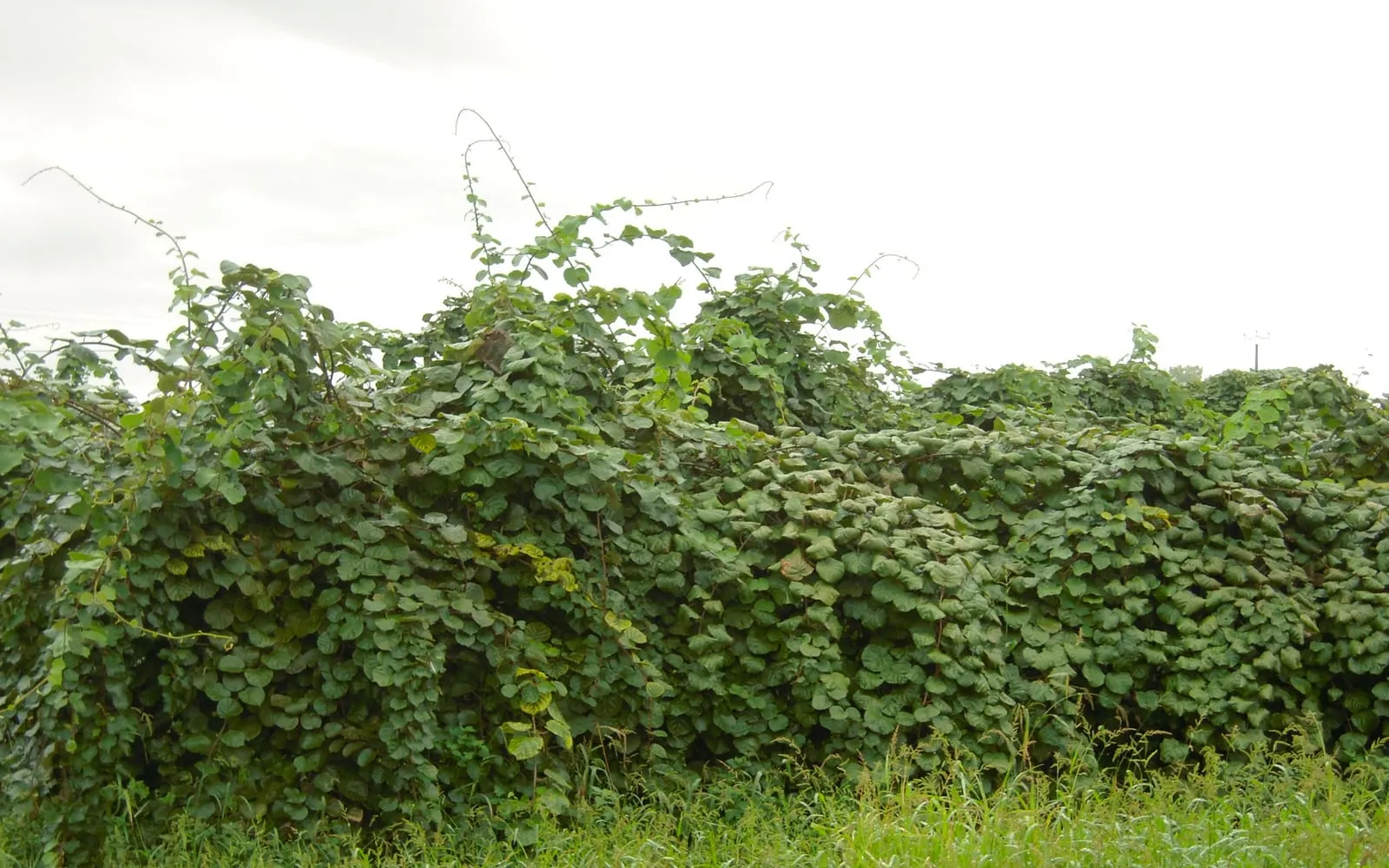
A kiwi vine will cover the side of a house. It grows three or four metres in a season, twines around anything within reach, and carries leaves the size of a hand. Anyone planting one against a flimsy trellis discovers the scale of the mistake in year three.
Fruiting in a cool climate is possible and takes commitment. The plant needs a long warm season, a sheltered sunny wall, a male and a female plant, and a support system built for the weight.
The limiting factor is a late frost. Dormant wood shrugs off -15 deg C, but the soft new growth in April is killed at around -1 deg C, and a vine defoliated in spring will not crop that year.
Where it works, it works well. An established vine on a warm wall in a mild district can produce a hundred fruit, picked hard in late autumn and ripened indoors.
Appearance and character
A vigorous deciduous climber that twines rather than clinging, so it needs something to wrap around.
Stems are thick and woody with age, and the young shoots are covered in reddish bristly hairs.
Leaves are large, 12 to 20 cm, rounded to heart-shaped, dark green above and paler and hairy beneath, on long stalks.
Flowers open in May and June, 3 to 5 cm across, creamy white ageing to buff, with a faint scent. Male flowers carry a mass of yellow stamens and female flowers a central white cluster of styles surrounded by sterile stamens.
Fruit is the familiar brown oval, 5 to 8 cm long, densely covered in short stiff hairs, with green flesh and small black seeds around a pale core.
Where it is from
Actinidia deliciosa is native to central and southern China, growing in mountain forest at moderate altitude where it scrambles into trees.
Chinese growers had used the wild fruit for centuries under the name yang tao, and seed reached New Zealand in 1904 through a schoolteacher returning from a visit.
New Zealand did the breeding that made it a commercial crop, selecting ‘Hayward’ in the 1920s, which remains the dominant variety worldwide.
The name changed for marketing. Chinese gooseberry sounded wrong for Cold War American buyers, and the fruit was renamed after the kiwi bird in 1959.
The wild plant’s forest habitat explains what it wants in a garden. It climbs to reach light, roots in deep leaf litter, and will not tolerate drying out.
How it grows
Buy named plants and buy both sexes. ‘Hayward’ is the standard female and ‘Tomuri’ the matching male. One male pollinates up to eight females.
Alternatively grow ‘Jenny’, a self-fertile female, which crops lightly but needs only one plant and suits a small garden.
Build the support first. Galvanised wires at 50 cm intervals on a south or west wall, or a pergola with substantial timbers. A mature vine is heavy.
Plant in spring into deep soil improved with plenty of compost, at pH 6 to 6.5.
Protect young plants from cats with a mesh cage. Cats respond to Actinidia in the way they respond to catmint and will destroy a young vine.
Train a single main stem up to the top wire, then two permanent arms along it, and fruit on side shoots from those arms.
Through the seasons
Growth begins in April and is fast and soft, which is exactly when frost is still possible. Fleece the vine on cold nights until mid-May.
Flowering is in May and June. Bees do the work, and a still cold spell during flowering reduces the set.
Summer growth is extraordinary and needs controlling. Shorten the current season’s side shoots to five or six leaves beyond the last fruit in July.
Water heavily through summer. This is one of the thirstiest plants in the fruit garden.
Fruit is picked in late October and November, hard, before the first hard frost. Store it cool and bring a few at a time into a warm room with a banana to ripen.
Winter pruning in January removes a proportion of the old fruited wood and ties in replacements.
Care difficulty
Difficult, and the rating reflects the number of things that must all go right.
The vine needs a male and a female, a warm sheltered site, a long season, heavy watering, strong support and annual pruning in two seasons.
Spring frost is the recurring problem and the hardest to control, since the plant breaks dormancy early and the new growth is very tender.
Vigour is a challenge in itself. An unpruned vine becomes an unmanageable tangle within three years.
Northern gardens and exposed sites will struggle. Anywhere south of the Midlands with a good wall has a reasonable chance.
Watering
Water generously and often. An established vine needs 25 to 30 litres twice weekly through summer, and more in hot weather.
The large soft leaves lose water fast, and the plant wilts visibly when short.
A vine against a wall sits in rain shadow and cannot rely on rainfall at all.
Mulch thickly in spring with compost or bark over a wide area, keeping it clear of the stem.
Drainage must still be good. Waterlogged roots rot, so the target is a soil that holds moisture without staying saturated.
Warning signs, diseases and pests
New growth blackened and collapsed in April. Frost. Fleece on cold nights until the middle of May, and expect little or no fruit in a year where this happens.
Young stems shredded and chewed near the base. Cats. Cage young plants until the bark hardens.
Large leaves torn and browning at the edges. Wind. Shelter matters as much as sun for this plant.
Leaves yellowing, growth stalling, roots dark. Root rot from waterlogging. Improve drainage.
Brown limpet-like bumps on older stems with sooty mould beneath. Scale insects. Scrub them off where reachable.
Leaf margins brown and crisp in July. Leaf scorch from drought or reflected heat off a wall. Water far more heavily and mulch.
Growing environment
Full sun on a sheltered south or west wall. This is not a plant for an open windy garden.
Deep fertile soil that holds moisture, at pH 6 to 6.5, with good drainage.
Shelter from wind protects the large leaves and helps pollinating insects during flowering.
A frost-free spring matters more than a warm summer, since the vine breaks dormancy early.
Allow 4 to 5 m of wall per vine, with wires able to carry real weight, and remember you need room for a male as well as a female.
Feeding
Feed a balanced general fertiliser in early spring as growth begins.
Follow with a high-potash liquid feed monthly from May to July, which supports flowering and fruit development.
Mulch generously with compost or well-rotted manure each spring, which feeds and conserves water together.
Stop feeding by the end of July so growth hardens before autumn.
A hungry vine shows pale leaves and short growth, though the more common fault in this species is underwatering rather than underfeeding.
Troubleshooting
Vigorous growth, no flowers. Either the plant is male, too young, or pruned too hard. Vines take three to five years to flower.
Flowers but no fruit. No male plant nearby, or cold weather during flowering stopped the bees.
All growth killed in spring. Late frost on soft new shoots. Fleece until mid-May.
Vine swamping its support. Normal vigour. Prune in summer and again in winter, and build supports that can carry the weight.
Fruit small and hard, never ripening on the vine. Correct. Kiwis are picked hard in late autumn and ripened indoors alongside a banana.
Leaves wilting on hot afternoons. Water shortage. This plant needs far more water than most gardeners expect.
Kiwi fruit problem guides
Not sure what is wrong? See the common vegetable pests guide.